

If you are asking whether Washington is finally prepared to recognize the 1971 Bangladesh genocide, the first distinction matters most: an introduced House resolution is not yet recognition, and even passage would not be a criminal judgment. It could still establish an official position in one chamber of Congress on a genocide whose Hindu victims have too often been blurred into generic wartime suffering.
That distinction lets you support recognition without overselling it. You can ask for results that a congressional declaration can realistically advance: truthful naming, access to archives, serious education, survivor-centered remembrance and stronger protection for vulnerable minorities.
H. Res. 1130 is a recognition effort, not a court judgment

On March 20, 2026, a bipartisan group in the US House of Representatives introduced H. Res. 1130, with Representative Greg Landsman leading the effort. Members are being asked to recognize the 1971 Bangladesh genocide, condemn atrocities committed by elements of the Pakistan Army and aligned auxiliary forces, and acknowledge the disproportionate targeting of Bengali Hindus.
The critical word is introduced. Unless you have separately verified later congressional action, do not describe H. Res. 1130 as passed, enacted or settled US policy. When you encounter a new claim about its status, ask three separate questions: Was it introduced? Did the House adopt it? Did the executive branch take its own action? The available March 20 account establishes the first of those steps.
Even if the House adopts it, this kind of sense-of-the-House action remains non-binding. It cannot convict an accused person, order compensation or compel Pakistan or Bangladesh to follow a particular policy. Recognition and judicial accountability are related, but they are not interchangeable.
Non-binding does not mean meaningless. Congressional recognition can influence the language used in American diplomacy, strengthen demands for archival openness, encourage inclusion in genocide education and give survivors and their descendants an official point of reference. Judge the effort by those attainable effects, not by powers a House resolution does not possess.
The genocide case does not turn on one casualty number

The Pakistan Army launched Operation Searchlight on March 25, 1971. What followed was not merely an exchange between armed forces. Civilians were killed, communities were terrorized, women endured mass sexual violence, intellectuals were abducted and murdered, and millions were driven from their homes.
The numerical record requires honesty. Estimates of the dead range from several hundred thousand to the three million cited by the Government of Bangladesh. Credible scholarly estimates for survivors of sexual violence have often fallen between 200,000 and 400,000. Approximately 10 million refugees fled to India, with Hindus forming the majority. These figures describe the enormous scale of the catastrophe, but the differences among estimates should not be concealed.
A disputed total does not settle whether genocide occurred. Genocide is distinguished by prohibited acts committed with the relevant intent against a protected group, in whole or in part. The core categories in the UN Genocide Convention include killing members of such a group, inflicting serious bodily or mental harm, and deliberately imposing conditions of life calculated to bring about its physical destruction. Religious groups are expressly protected, making the evidence concerning Bengali Hindus legally significant.
The strongest case therefore rests on pattern, selection and purpose rather than on one preferred number. In April 1971, US Consul General Archer K. Blood used the word “genocide” in diplomatic communication that recorded selective attacks on Hindus. Survivor testimony, refugee demographics, reports from particular killing sites, evidence of discriminatory identification and records concerning military and militia conduct reinforce one another.
Pakistan’s Hamoodur Rahman Commission examined command failures and militia mobilization. Since 2010, Bangladesh’s International Crimes Tribunal has assembled judgments, testimony and documentary exhibits concerning individual responsibility. Its proceedings have also attracted international criticism over due process. You do not have to suppress that criticism to take the underlying atrocity record seriously. Historical recognition can rest on a substantial body of evidence while individual criminal guilt continues to require proof and fair procedure.
The same conduct may also qualify as crimes against humanity or war crimes. Those categories are not rival explanations that force you to choose only one. Each addresses a different legal dimension of organized violence.
Hindu targeting must be named without erasing other victims
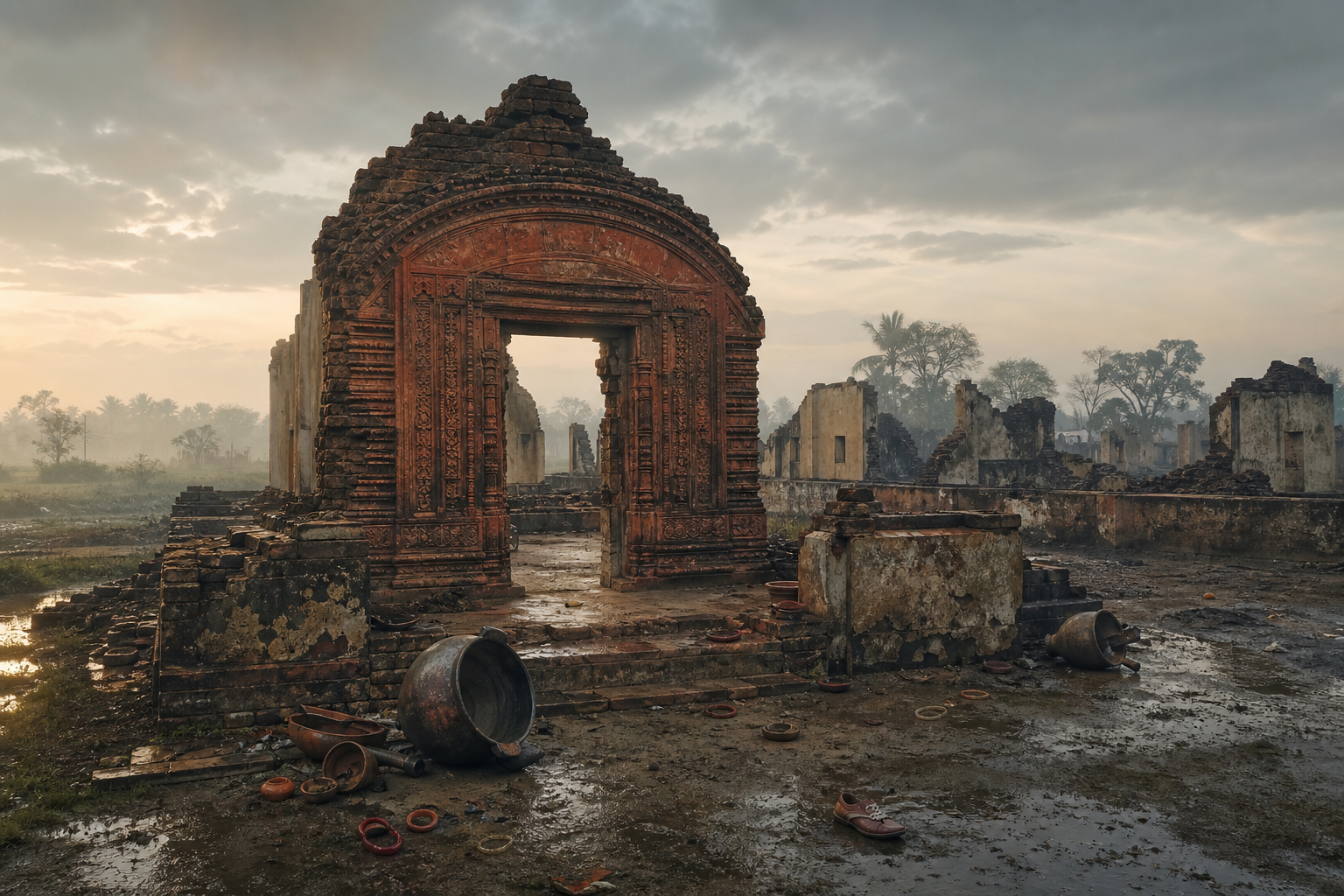
The most accurate formulation holds two truths at once: Pakistan’s campaign victimized Bengali civilians from several communities, and Bengali Hindus faced disproportionate, group-directed violence. Saying only “Bengalis were killed” hides the religious selection visible in many operations. Saying only “Hindus were killed” can obscure the Bengali Muslims, Buddhists and others attacked as disloyal to the Pakistani state.
Specific places show why the Hindu dimension cannot be treated as an incidental footnote. Killings struck Dhaka’s Hindu locality of Shankhari Bazar within days of Operation Searchlight. The Jathibhanga massacre followed in Dinajpur in April. At Chuknagar in May, forces attacked civilians who were trying to flee. Across Hindu-majority neighborhoods and refugee routes, targeted raids, discriminatory identification and intimidation created a path from terror to dispossession and flight.
The violence did not end with those early and mid-war massacres. Near the war’s conclusion, Al-Badr units abducted and murdered intellectuals in Dhaka. The participation of auxiliaries such as Razakar, Al-Badr and Al-Shams, including forces aligned with Jamaat-e-Islami, matters because it helps identify organizations, chains of responsibility and ideological motives.
That precision also prevents collective blame. The responsible language names elements of the Pakistan Army, particular militias, commanders, collaborators and extremist ideologies. It does not assign inherited guilt to every Pakistani or every Muslim. A recognition campaign loses both moral and historical discipline when it turns evidence about identifiable perpetrators into hostility toward an entire living community.
For a Dharmic audience, remembrance should be neither timid nor vengeful. Truth requires us to name anti-Hindu persecution plainly. Ahimsa and pluralism require us to distinguish perpetrators from populations and justice from retaliation. That combination protects Hindu memory while leaving room for solidarity with every community harmed in 1971.
Recognition matters only if institutions use it

A congressional declaration is best understood as an opening, not the end of the work. Its first practical value is vocabulary: officials, educators and cultural institutions gain a clear basis for teaching 1971 as genocide rather than reducing it to the collateral tragedy of a civil war.
Its second value is access. Declassification, digitization and open archival programs would allow independent researchers to test claims, reconstruct local events and preserve evidence before witnesses and fragile records are lost. This is especially important when public debate becomes trapped in competing headline numbers. Open records let the structure of the violence remain visible even where estimates differ.
Its third value is prevention. Remembrance becomes relevant to the present when it strengthens rapid accountability for communal attacks, rule-of-law protection for Hindus, Buddhists, Christians and indigenous communities, and preservation of endangered religious and historical sites in Bangladesh. Using 1971 only as a slogan while ignoring current minority vulnerability would empty recognition of its preventive purpose.
If you are writing to a representative, preparing educational material or evaluating an advocacy campaign, make the request concrete:
- Ask for House recognition of the 1971 Bangladesh genocide while describing H. Res. 1130 by its verified legislative status.
- Insist that the public record explicitly acknowledge the disproportionate targeting of Bengali Hindus without omitting other victim communities.
- Pair recognition with declassification, archive access, digitization, testimony preservation and inclusion of 1971 in genocide-studies curricula.
- Connect commemoration to present-day minority protection, prompt accountability for communal violence and preservation of Dharmic heritage.
- Encourage Pakistan to acknowledge documented atrocities and open relevant archives while rejecting collective blame against present-day people.
These requests keep recognition survivor-centered. They also provide standards by which you can later judge whether public officials converted commemorative language into institutional work.
Key takeaways for advocacy and teaching
- Status: H. Res. 1130 was introduced in the US House on March 20, 2026. Introduction is not the same as adoption, and a House resolution would remain non-binding.
- Evidence: The genocide case rests on patterns of selection, killing, serious harm, forced displacement and destructive conditions, not on agreement about one casualty figure.
- Hindu victims: Bengali Hindus were disproportionately targeted, while Bengali Muslims, Buddhists and other civilians also suffered grave crimes.
- Responsibility: Name military elements, auxiliary organizations and implicated ideologies precisely. Do not replace accountability with collective guilt.
- Follow-through: Recognition should lead to open archives, education, memorialization, preservation of survivor testimony and practical minority protections.
If you act on this issue now, ask for more than ceremonial language but no more than a congressional resolution can honestly deliver. Support recognition, insist on explicit acknowledgment of Hindu targeting, and attach that recognition to archives, education, survivor dignity and minority security. That is how overdue memory begins to serve both justice and prevention.