
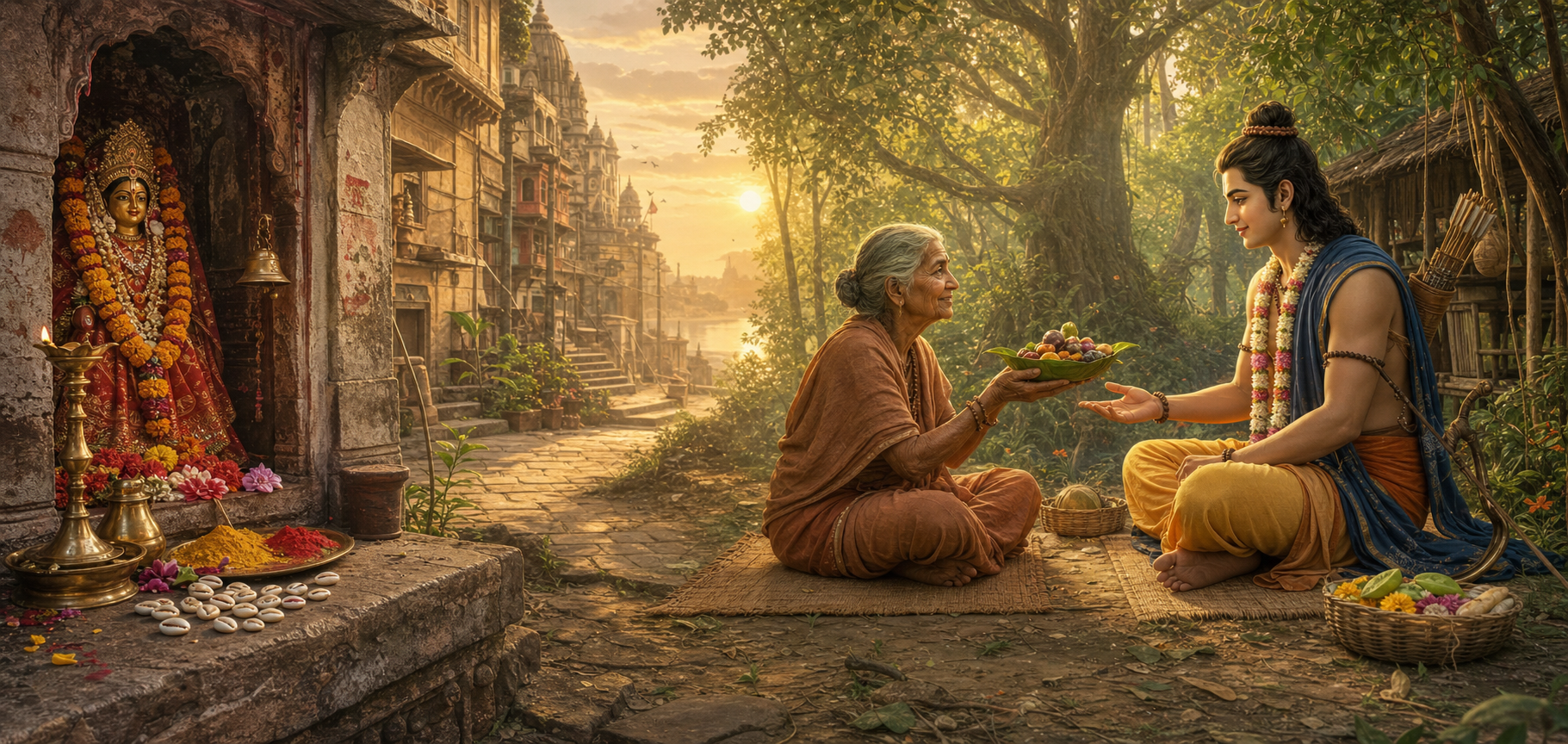
If you are deciding whether Kaudi Mata belongs in your Kashi pilgrimage, do not ask only how large or famous the shrine is. Ask what it trains you to notice. A modest sanctum can reveal dimensions of Kashi that its monumental temples cannot disclose on their own: household devotion, regional memory, ordinary prosperity, and the sacred dignity of what the world overlooks.
Shabari presents the same test in narrative form. Her meeting with Sri Rama asks whether bhakti remains an admired religious idea or changes how you offer, receive, serve, and judge another person. Kaudi Mata and Shabari belong to different devotional settings, but together they show what spiritual equality requires in practice.
Why a small shrine changes the way you see Kashi
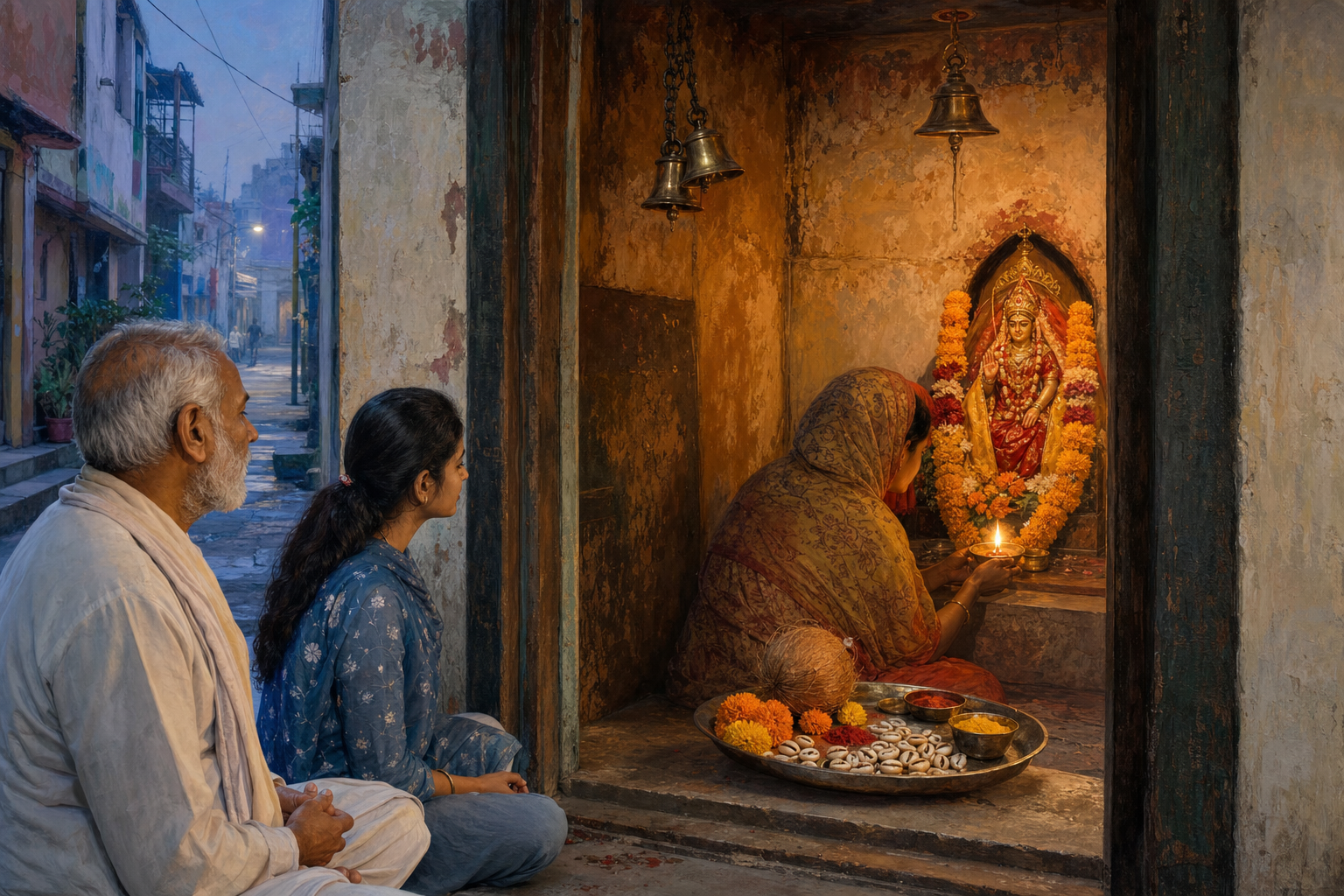
Kaudi Mata is revered as a form of Goddess Lakshmi and, in local Kashi tradition, as the sister of Lord Kashi Vishwanath. Those two identities explain much of the shrine’s appeal. Lakshmi brings the divine into the well-being of the household, while the language of sisterhood places Kaudi Mata within Kashi’s intimate family of deities.
The word kaudi refers to the cowrie shell. Cowries once circulated as a means of exchange and remain associated with fortune, auspiciousness, and Lakshmi worship. Beside lotus motifs, lamps, turmeric, kumkum, and grains, the cowrie makes prosperity visible through a small, familiar object. It does not represent grandeur for its own sake. It points toward the resources by which a household is sustained.
That distinction matters. Worship of Lakshmi can be reduced to a request for acquisition: place an object before the deity and expect more money in return. Kaudi Mata’s symbolism supports a more demanding understanding. Prosperity includes resourcefulness, stability, care for dependants, and the responsible circulation of what has been received. A cowrie kept on an altar should therefore prompt a question: are the resources of this home being used dharmically?
The description of Kaudi Mata as Vishwanath’s sister should also be heard in the register in which Kashi speaks. It is local sacred kinship, not a proposition that every Hindu community must express in identical theological language. Kashi makes the divine approachable through relationships familiar to human life: mother, brother, sister, guardian, host, and sovereign. Such language does not make the deity less transcendent. It permits the devotee to approach transcendence without treating it as remote.
This helps explain why Kaudi Mata holds particular meaning for pilgrims from South India. Devotees formed by Friday Lakshmi worship, Varalakshmi Vrata, Karthika Masam lamp-lighting, or household use of turmeric and kumkum can encounter a familiar devotional grammar in an unfamiliar city. Pilgrims from Tamil Nadu, Karnataka, Andhra Pradesh, Telangana, and Kerala do not have to abandon their regional inheritance in order to belong in Kashi.
That is Ishta in lived form. One pilgrim may approach the sacred through Sri Rama, another through Vishwanath, another through Annapurna or Vishalakshi, and another through Lakshmi as Kaudi Mata. The chosen form creates intimacy without requiring hostility toward other forms. Kashi’s unity is strengthened by these overlapping loyalties because each gives a real community a way to enter the city’s sacred life.
If you include Kaudi Mata in a pilgrimage, do so as a complement to Kashi’s larger sacred ecology. Do not turn one community’s cherished route into a compulsory rule for every Hindu. Pilgrimages commonly bring devotees to Kashi Vishwanath, Annapurna Devi, Vishalakshi, Kalabhairava, and numerous smaller shrines, but the sequence and emphasis can differ. A living tirtha can hold several faithful itineraries at once.
Read Shabari without reducing her to a plate of berries

Shabari is often remembered through one tender image: she offers forest berries to Sri Rama after tasting them so that only the sweetest reach him. That image has become a powerful emblem of bhakti in popular retelling. Yet the ethical weight of her encounter does not rest on a berry alone.
Shabari is an ascetic disciple associated with the hermitage of Matanga Rishi near Pampa Sarovar. She spends years in service and waits faithfully for Rama’s arrival. Rama and Lakshmana eventually reach her during the search for Sita. The hospitality offered at that moment is therefore not an impulsive display of emotion. It is the flowering of a life already disciplined by service, patience, and expectation.
This is the first correction you should make when explaining the episode. Sincere feeling is not a shortcut around preparation. Shabari’s bhava has credibility because it has been trained. She has served before being seen, waited without demanding a timetable, and prepared to give the best within her reach. Her apparently simple offering carries the moral weight of that unseen practice.
Textual care matters as well. The Ramayana lives through Valmiki’s telling and through later regional and vernacular traditions, including the Kamba Ramayanam and Ramcharitmanas. Popular devotional memory does not reproduce every version in exactly the same way. You need not flatten those versions or make the entire teaching depend on whether a particular telling describes each berry in the familiar manner. The durable center is Shabari’s service, her welcome, and Rama’s acceptance.
That acceptance reveals spiritual equality without making bhakti careless. The lesson is not that anything offered in any manner becomes appropriate if the giver claims good intentions. Shabari does not give Rama what she considers worthless. She gives attentive hospitality from the resources actually available to her. Bhava raises the quality of the act; it does not excuse indifference.
- Her waiting shows that devotion can mature without public recognition.
- Her service shows that spiritual worth is not created by social prestige.
- Her offering shows that care can make an ordinary object worthy.
- Rama’s reception shows that the receiver must not let status prejudice obstruct grace.
- The encounter shows that equality in bhakti means equal sacred eligibility, not the erasure of every vow, role, or ritual distinction.
The last distinction is essential. Egalitarian bhakti does not require every Hindu practice to become identical. It denies that social standing, regional origin, wealth, or outward polish gives one person ownership of Bhagavan. A disciplined ritual life and a rejection of spiritual arrogance can coexist. Shabari’s story challenges pride, not seriousness.
Nor should the encounter be treated as a charming interruption in Rama’s urgent journey. It occurs during the search for Sita and helps establish the ethical direction of that journey. Rama’s response demonstrates that the defense of dharma cannot be separated from the recognition of devotion in a person whom a status-conscious society might fail to honor.
Equality becomes real when abundance is shared with dignity
A cowrie and a forest berry are both ordinary things. Neither commands attention through size or cost. In devotion, however, each acquires rasa: the felt quality through which an external act communicates an inner disposition. The cowrie evokes an order that sustains life; the berry embodies the devotee’s wish to offer sweetness. Material and meaning meet through care.
This is where Kaudi Mata and Shabari correct two opposite mistakes. Prosperity without service becomes possession and display. Service that ignores the material needs of another person becomes sentiment. Lakshmi’s abundance must sustain life, while Shabari’s love must take the form of actual hospitality. Bhakti joins the two.
You can test whether that joining has happened by looking beyond the altar. Does Lakshmi worship make a household more generous or merely more anxious to acquire? Does admiration for Shabari change who receives the best food, the comfortable seat, or patient attention? Do pilgrims welcome people from another linguistic region, or treat unfamiliar customs as inferior? Does a grand temple itinerary leave room for a small shrine whose community memory is no less sincere?
These are not secondary social questions added to religion from outside. They measure whether the religious disposition has reached conduct. Lighting a lamp before Lakshmi while humiliating a dependant separates ritual from its ethical fruit. Praising Rama’s acceptance of Shabari while ranking guests by status does the same.
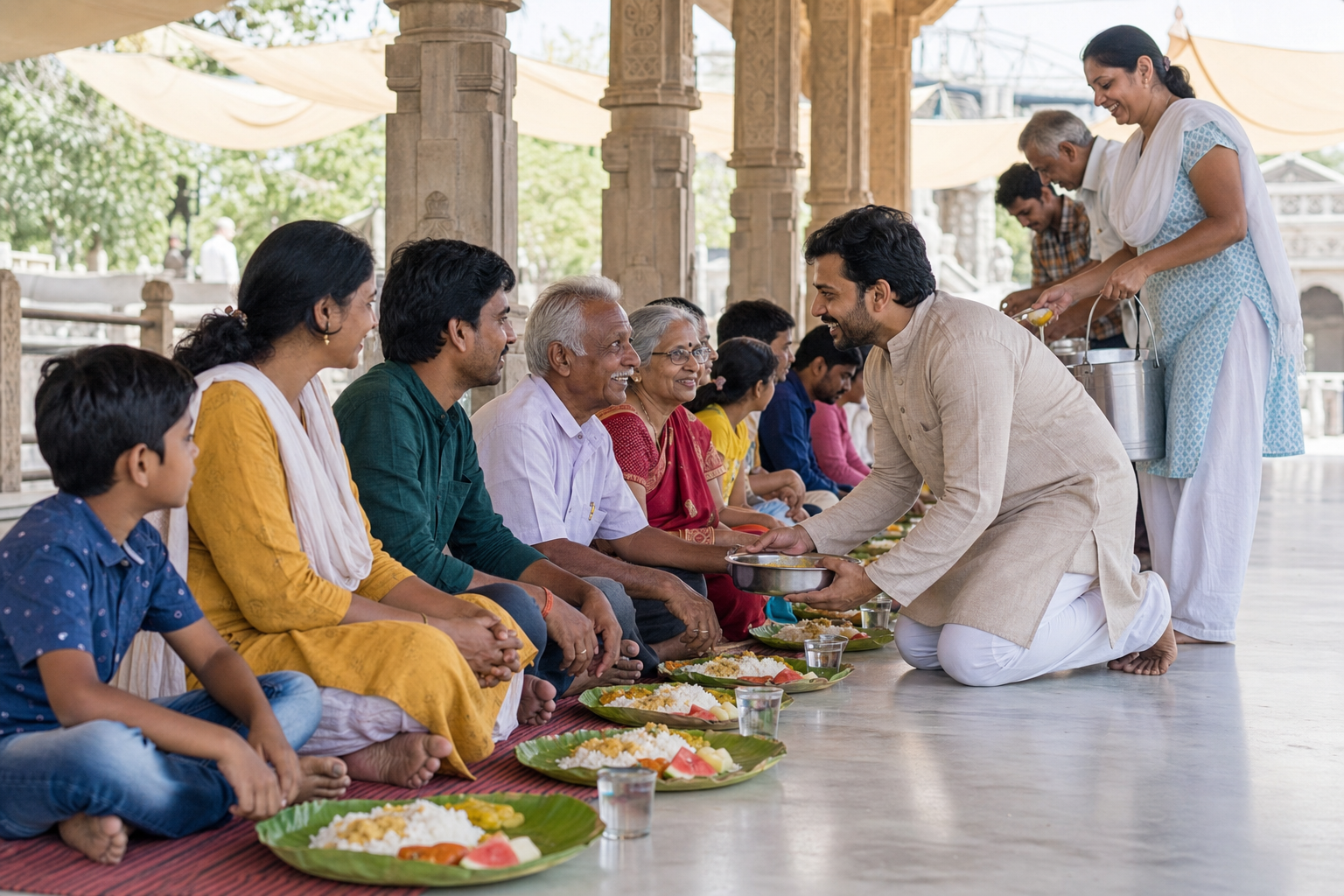
Kashi offers a practical setting in which to resist that separation. Pilgrims from the South and the Hindi heartland cross paths in shrines, mathas, dharmashalas, queues, and places where prasada is shared. Regional practices remain recognizable, yet participation creates a broader devotional language. When you encounter a form of worship that is unfamiliar but recognizably dharmic, curiosity is usually a better first response than correction.
The same ethical family resemblance appears across Dharmic traditions without making those traditions interchangeable. Buddhist dana emphasizes generosity and the intention that animates it. Jain ahimsa and aparigraha discipline both harm and possessiveness. Sikh langar gives equality an institutional form through a shared meal. Kaudi Mata worship and Shabari’s hospitality have their own Hindu theological settings, but they participate in a wider Dharmic insistence that inner cultivation must become responsible action.
Notice the mechanism in each case. Equality is not secured merely by declaring that everyone is equal. It is enacted through food, seating, speech, service, restraint, and access. If you want bhakti to become egalitarian, work on those points of contact. That is where hidden hierarchy usually reappears.
Turn the insight into a pilgrimage and household discipline
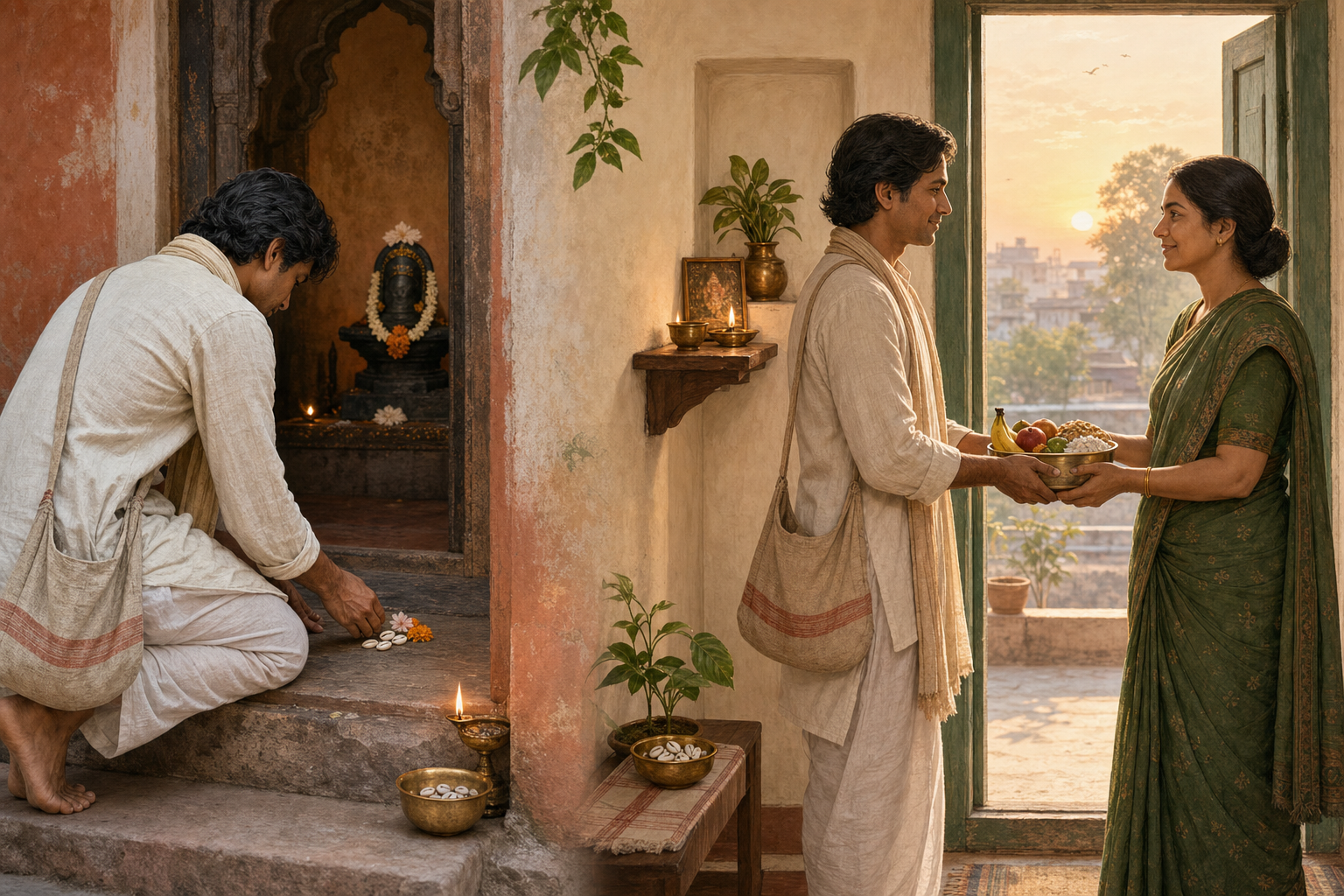
Before entering Kashi
Begin with an intention specific enough to govern your behavior. Instead of asking only for a successful journey, resolve that the pilgrimage will make your household more responsible and your hospitality less hierarchical. This is not a prescribed mantra. It is a practical sankalpa that connects darshan with conduct.
- Leave time for intimate shrines as well as major temples. A schedule that values only scale will miss much of Kashi’s devotional texture.
- Learn that Kaudi Mata is approached locally as a Lakshmi svarupa and as Vishwanath’s sister. That small amount of context prevents the visit from becoming a hurried collection of darshans.
- If you wish to take an offering, keep it simple. Cowries, a modest naivedyam, or a lamp are associated with the tradition, but follow the practice permitted at the shrine rather than improvising.
- Confirm current access and offering etiquette locally. A small shrine may not operate like a large temple, and reverence includes asking before assuming.
Do not approach the shrine as a mechanism for guaranteed material gain. Pray for well-being if that is your need, but include the wisdom and restraint required to use prosperity well. Lakshmi worship becomes deeper when the devotee asks to become trustworthy with abundance.
While receiving darshan
A small shrine creates an opportunity to slow down. Observe how local devotees approach. If an offering is not possible, folded hands and attentive presence are sufficient. The value of darshan does not rise with the price or visibility of what you carry.
Apply the Shabari principle before leaving the threshold. Wait your turn without using status to advance yourself. Speak respectfully to the people who maintain the shrine. Make room for a pilgrim whose language or ritual habits differ from yours. Receive prasada without turning its quantity or presentation into a judgment about the sanctity of the place.
These actions may look smaller than formal worship, but they disclose its quality. Shabari’s devotion is remembered precisely because care transformed a small offering. Your pilgrimage should produce the same movement from intention to attentive action.
After returning home
Choose a rhythm you can sustain. You might light a lamp on Fridays, recite Sri Lakshmi Ashtottara, or read a short portion of the Ramayana. During Deepavali or Dhanteras, even a simple offering of grains can direct attention toward the sources of household sustenance. Devotees familiar with Karthika Masam may naturally connect the practice with their established lamp-lighting observances.
Then pair the observance with one visible act. Share food without ranking the recipients. Set aside a portion of household resources for dana. Welcome a guest without first evaluating social usefulness. Give a worker or helper the same courtesy you would extend to an honored visitor. Listen patiently when an older relative or a pilgrim from another region uses unfamiliar devotional language.
Keep the pairing exact: one act of worship, one act that tests attachment or pride. Otherwise the practice can remain safely symbolic. If a Friday lamp never changes how the home treats people, add a specific act of hospitality before adding more ritual complexity.
You can also use the cowrie as a household reminder. When you see it near the altar, identify one resource that needs more dharmic handling: food that should not be wasted, time that should be given, money that should be used responsibly, or attention owed to someone routinely ignored. This converts a symbol of prosperity into a discipline of stewardship.
Key takeaways
- Kaudi Mata is locally revered in Kashi as a form of Lakshmi and as the sister of Kashi Vishwanath; the kinship language makes the sacred intimate and accessible.
- The cowrie represents more than the wish for money. It points toward household well-being, resourcefulness, and responsible use of abundance.
- Shabari’s devotion is grounded in years of service, waiting, and preparation. The berries should not be separated from that disciplined life.
- Popular retellings preserve the image of tasted berries, while Ramayana traditions do not need to be flattened into one identical narration for the ethical teaching to hold.
- Egalitarian bhakti means that social prestige does not monopolize divine grace. It does not require every ritual role or form to become identical.
- The practical test is hospitality: who receives good food, patient attention, respectful speech, and a genuine place in the devotional community?
On your next Friday observance or visit to Kashi, pair one small offering with one act that costs a little social pride: wait without claiming privilege, serve without ranking, share food, or welcome an unfamiliar pilgrim. That pairing turns Kaudi Mata’s auspiciousness and Shabari’s bhava from admired memory into sadhana.