You may have found two different dates for the same Alwar ThiruNakshatram. Before you arrange temple travel, invite relatives, or print a household calendar, check what each date is actually measuring. A ThiruNakshatram is not a fixed Gregorian anniversary.
The dependable identifier is the saint’s Tamil solar month together with the janma-nakshatra. The Gregorian date must then be fixed from the nakshatra interval, your local sunrise, and the rule followed by your temple or lineage. That distinction is especially important for devotees outside Bharat, because an India date can shift when calculated for another time zone.
Key takeaways
- Start with the canonical pair: the Tamil month and nakshatra. A star name without its month is not enough because stars such as Thiruvonam recur every lunar cycle.
- The usual Sri Vaishnava rule assigns the observance to the civil day on which the relevant nakshatra prevails at local sunrise.
- Use nakshatra start and end times calculated for your city. Do not copy an Indian civil date into a calendar for Toronto, London, Singapore, Sydney, or another location.
- Drik and Vakya Panchangams can place a boundary on different sides of sunrise. Follow the Panchang family used by your temple rather than combining dates from several systems.
- For one firm 2026–2027 anchor, Panguni or Meena Revati falls on 7 April 2027 in IST, when many temples, including Srirangam, mark Periya Perumal Thirunakshatram. Confirm the local programme before travelling.
The month-and-star calendar to keep beside your Panchang
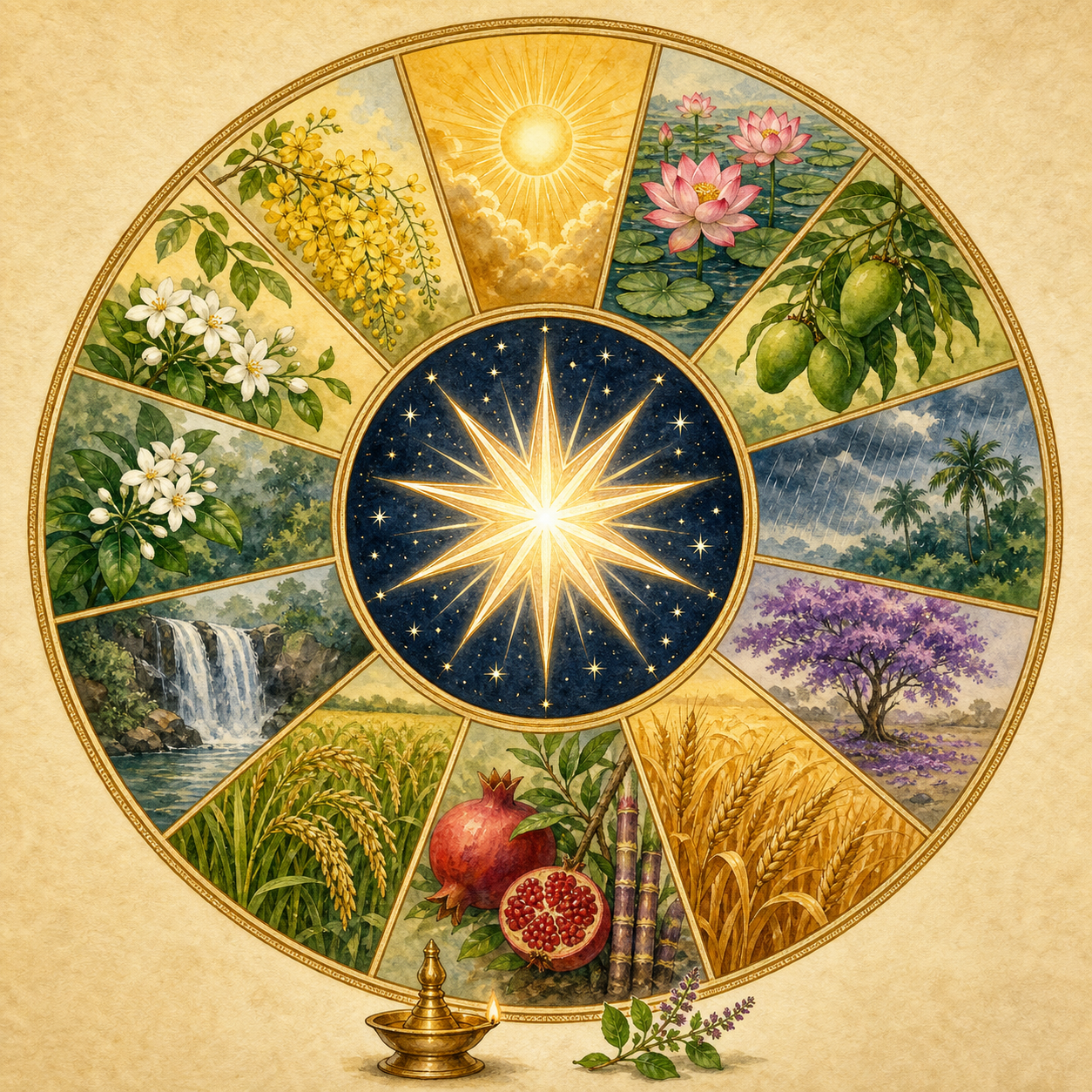
The Tamil solar year runs from Chithirai through Panguni, approximately from mid-April to mid-April. Each annual observance is recovered by finding the named nakshatra within its prescribed Tamil month. This month-and-star pair is the stable part of the calendar; the corresponding Gregorian date is the location-dependent part.
The following working calendar brings together the widely observed Alwar and Acharya month-star identities needed for 2026–2027. It also makes clear why the month must never be omitted. Three separate observances, for example, use Thiruvonam but fall in three different Tamil months.
| Tamil month | Nakshatra | ThiruNakshatram | Place in the tradition |
|---|---|---|---|
| Chithirai | Chitra | Madhurakavi Alvar | Alwar |
| Chithirai | Thiruvadirai | Sri Ramanuja | Acharya |
| Vaikasi | Visakam | Nammalvar | Alwar |
| Aani | Swathi | Periyalvar | Alwar |
| Aani | Anusham | Nathamuni | Acharya |
| Aadi | Pooram | Andal, or Kodhai | Alwar |
| Aadi | Thiruvonam | Alavandar, or Yamunacharya | Acharya |
| Purattasi | Thiruvonam | Vedanta Desika | Acharya |
| Aippasi | Thiruvonam | Poigai Alvar | Alwar |
| Aippasi | Avittam | Bhoothath Alvar | Alwar |
| Aippasi | Sadayam | Pey Alvar | Alwar |
| Aippasi | Moolam | Manavala Mamunigal | Acharya |
| Karthigai | Krittika | Thirumangai Alvar | Alwar |
| Karthigai | Rohini | Thiruppaan Alvar | Alwar |
| Thai | Magam | Thirumazhisai Alvar | Alwar |
| Masi | Punarvasu | Kulasekhara Alvar | Alwar |
| Panguni | Revati | Periya Perumal | Temple and deity observance; 7 April 2027 in IST |
This is a practical core calendar, not an exhaustive register of every observance in every matham. A lineage may preserve additional Acharya ThiruNakshatrams, and a Divya Desam may give special prominence to a date rooted in its own history. Add those entries from your matham’s or temple’s annual calendar without replacing the month-star identities above.
Turn each month-star pair into the correct local date
A nakshatra is an interval of time, not an all-day label attached permanently to a Gregorian square. Astronomically, the nakshatras are 27 equal sidereal divisions of 13°20′. A Panchang calculates when the Moon enters and leaves each division. Your task is to compare that interval with sunrise on the two possible civil dates.
- Find the Alwar, Acharya, or deity in the table and copy both the Tamil month and the nakshatra. Do not search by the star alone.
- Open a reliable Panchang configured for the city where you will observe the day. Record the nakshatra’s local start and end times rather than copying only the displayed date.
- Check local sunrise on both candidate dates. Under the common sunrise rule, select the day on which the required nakshatra is in force at sunrise.
- Check whether the Panchang is Drik or Vakya and, where shown, which ayanamsha it uses. Keep the same system for the entire annual calendar.
- Compare your result with the current utsava-patrika, sannadhi notice, or announcement from the temple whose programme you plan to attend.
The fourth step explains many apparent contradictions. Drik Panchangams use contemporary astronomical calculations, while Vakya Panchangams retain traditional rule-based values. Both have established places in South Indian practice. A small difference in the calculated boundary becomes liturgically visible when the nakshatra begins or ends close to sunrise. The useful question is therefore not which app has the most confident-looking date, but which calendrical system your sampradaya institution consistently follows.
Choose a Panchang that displays the whole nakshatra interval. A date-only screen hides the information needed to resolve a boundary case. If the star changes near sunrise, save the start time, end time, sunrise time, location, and calendar family in your notes. You will then be able to explain the decision to your family instead of passing along an unexplained date.
For devotees abroad, calculate from local sunrise. Do not take a Chennai or Srirangam date and merely subtract a time-zone offset. The nakshatra may cover sunrise in India but not sunrise where you live, producing a different civil date. Use the actual city setting, and make sure the calendar handles daylight-saving time where it applies.
The clearest fixed point in this cycle is Panguni Revati on 7 April 2027 in IST, associated with Periya Perumal Thirunakshatram in many temples, including Srirangam. Treat 7 April as the India-time anchor. If you are elsewhere, run the same Revati interval against your own sunrise and then check your local temple’s notice.
Let the temple calendar settle genuine boundary cases
The sunrise rule is common, but it is not the only rule found in practice. Some temples observe the day whenever the nakshatra touches part of the civil day. Others apply inherited nazhigai-based thresholds or a local convention preserved through the temple’s Acharya succession. In a close case, the temple’s established method takes precedence for participation in that temple’s utsavam.
A two-day programme does not automatically mean that the organisers are uncertain. When a nakshatra crosses an awkward boundary, a temple may hold thirumanjanam, parayanam, or an internal observance on the nakshatra-touch day and schedule the public purappadu separately. Read the programme by event, not merely by the festival heading.
If you are planning a visit, ask the temple office three precise questions:
- Which Panchang family is being followed for this year’s observance?
- On which date will vishesha thirumanjanam and satrumurai take place?
- Is the evening purappadu on the same day, or has it been scheduled separately?
Place matters because each kshetra carries its own devotional memory. Srirangam naturally gives particular weight to Periya Perumal-related observances. Srivilliputhur gives Aadi Pooram its characteristic fullness as Andal’s kshetra. Kanchipuram prominently observes Vedanta Desika under Purattasi Thiruvonam, while Melukote preserves distinctive Ramanuja and Nammalvar traditions. These emphases enrich the common Sri Vaishnava calendar; they do not create rival calendars.
Build a home observance that the whole family can sustain
You do not need to reproduce a temple-scale utsavam at home. Keep the observance recognisable, sattvic, and centred on remembrance through the Divya Prabandham. Prepare the evening before so that uncertainty about food or texts does not consume the nakshatra morning.
- Confirm the selected date, local sunrise, and the nakshatra end time. Write them down where everyone participating can see them.
- Begin with snanam, light a deepam at or around sunrise while the nakshatra is in force, and offer tulasi.
- Recite a manageable portion of the relevant Divya Prabandham. Thiruppavai is especially fitting for Andal’s Aadi Pooram, while Tiruvaymoli pasurams belong naturally to Nammalvar’s Vaikasi Visakam.
- Offer a modest naivedyam such as pongal, akkara adisil, fruit, or the preparation customary in your household.
- Conclude with prayer and a concrete act of seva. Support for temple annadanam or gosamrakshana is one suitable extension of the observance when it is within your means.
With children or elderly relatives, shorten the recitation rather than abandoning it. A small passage repeated attentively can hold the family together better than a long session that leaves participants exhausted. If your temple conducts an online or local parayanam, you can align the household recitation with it while still using the correct local date.
Make one 2026–2027 worksheet now with five fields for every observance: name, Tamil month, nakshatra, provisional local date, and temple confirmation. Fill the first three fields from the table, but enter a civil date only after checking the local nakshatra span. That small discipline will give you a calendar you can trust, share, and use for seva throughout the year.