
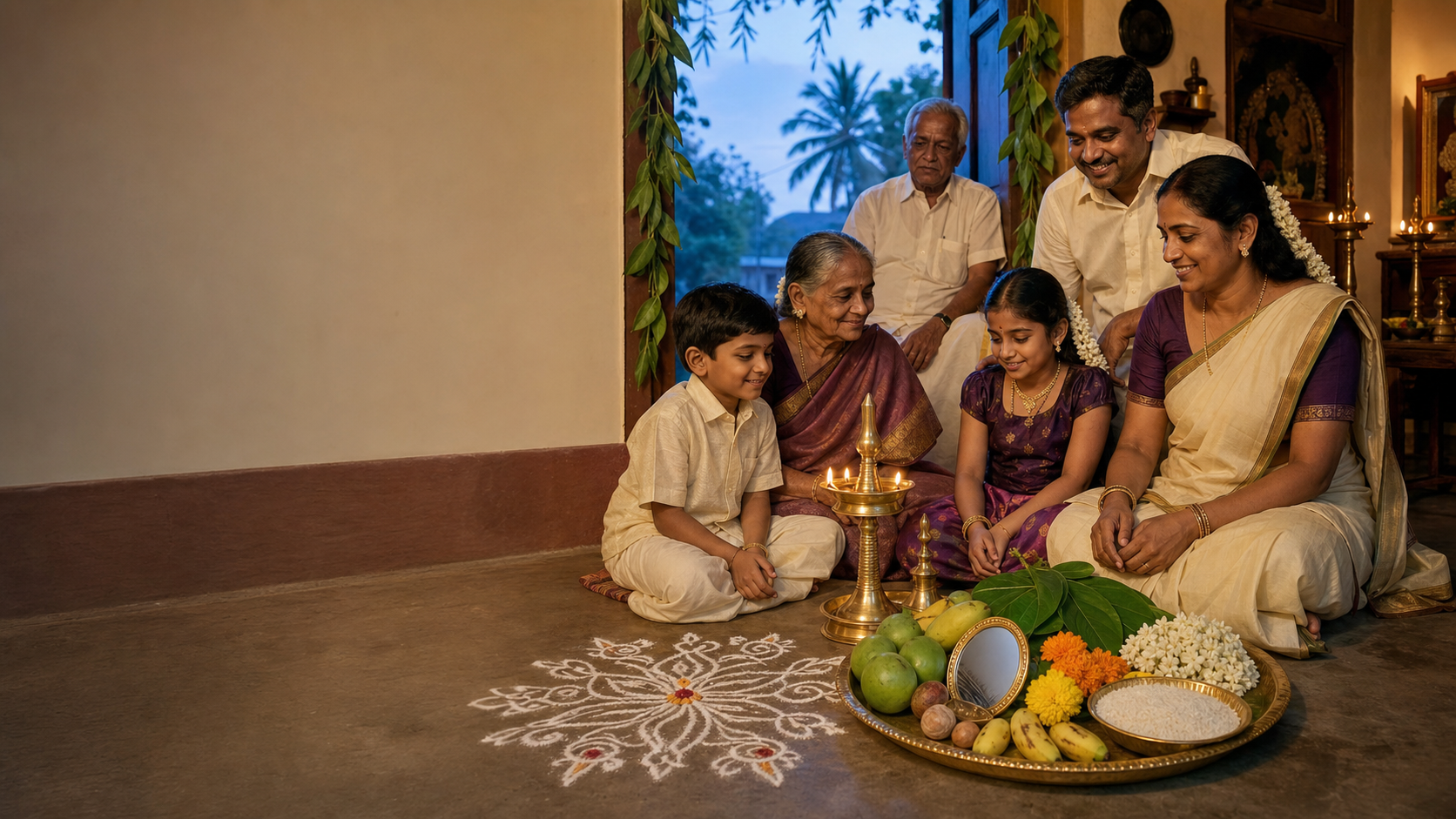
If you are arranging leave, temple worship, cooking, and family calls for Puthandu, you need more than a date on the calendar. The central question is what belongs at dawn, what should be kept for Mesha Sankranti, and which customs depend on your family’s parampara.
For most families in Tamil Nadu, the answer begins with Tuesday, 14 April 2026. This guide gives you a workable order for the day, explains the 9:25 AM ingress, and helps you observe the Tamil solar New Year without turning every regional custom into a compulsory ritual.
Key takeaways for Chithirai Vishu 2026
- Date: Puthandu, Varusha Pirappu, or Chithirai Vishu falls on Tuesday, 14 April 2026, for most of Tamil Nadu and Sri Lanka.
- Exact solar ingress: The Sun enters sidereal Mesha at 9:25 AM IST.
- Punya-kalam: The stated 2026 interval for snana, sankalpam, japa, dana, Surya-arghya, and lineage-authorized tarpanam is 9:25 AM to 12:17 PM IST.
- New year: The day opens Chithirai Masam and Parabhava Varusha, the 2026–2027 year in the traditional 60-year Samvatsara cycle.
- Simple home observance: Snana, kolam, a lit lamp, prayer, panchanga shravanam, fresh naivedyam, blessings from elders, and one definite act of dana are enough to give the day a coherent dharmic form.
- Outside India: Do not assume that the Indian civil date and ritual window apply unchanged. Use a location-adjusted Tamil panchangam or the timing followed by your local temple.
Build the morning around the Mesha ingress
Puthandu is a solar new year. Its astronomical marker is the nirayana Sun reaching the beginning of Mesha Rashi, or sidereal Aries. That is why the Tamil year begins in mid-April rather than at the tropical March equinox. The two systems use different reference frames: the tropical zodiac remains tied to the equinox, while the sidereal calculation applies an ayanamsa to retain a stellar reference.
Many contemporary panchangams use the Lahiri ayanamsa, but computational conventions are not identical everywhere. Drik and vakya almanacs, local longitude, sunrise reckoning, and temple protocol can produce differences of several minutes or affect the civil day assigned to an observance. For a family already committed to a particular panchangam, consistency with that calendar matters more than combining times gathered from several systems.
For a household following the stated Tamil Nadu timing, the exact ingress at 9:25 AM IST and the punya-kalam ending at 12:17 PM provide a practical framework. You do not have to compress the entire festival into that interval. Reserve it for the rites specifically connected with Sankranti, while placing cleaning, cooking, greetings, and other preparations around it.
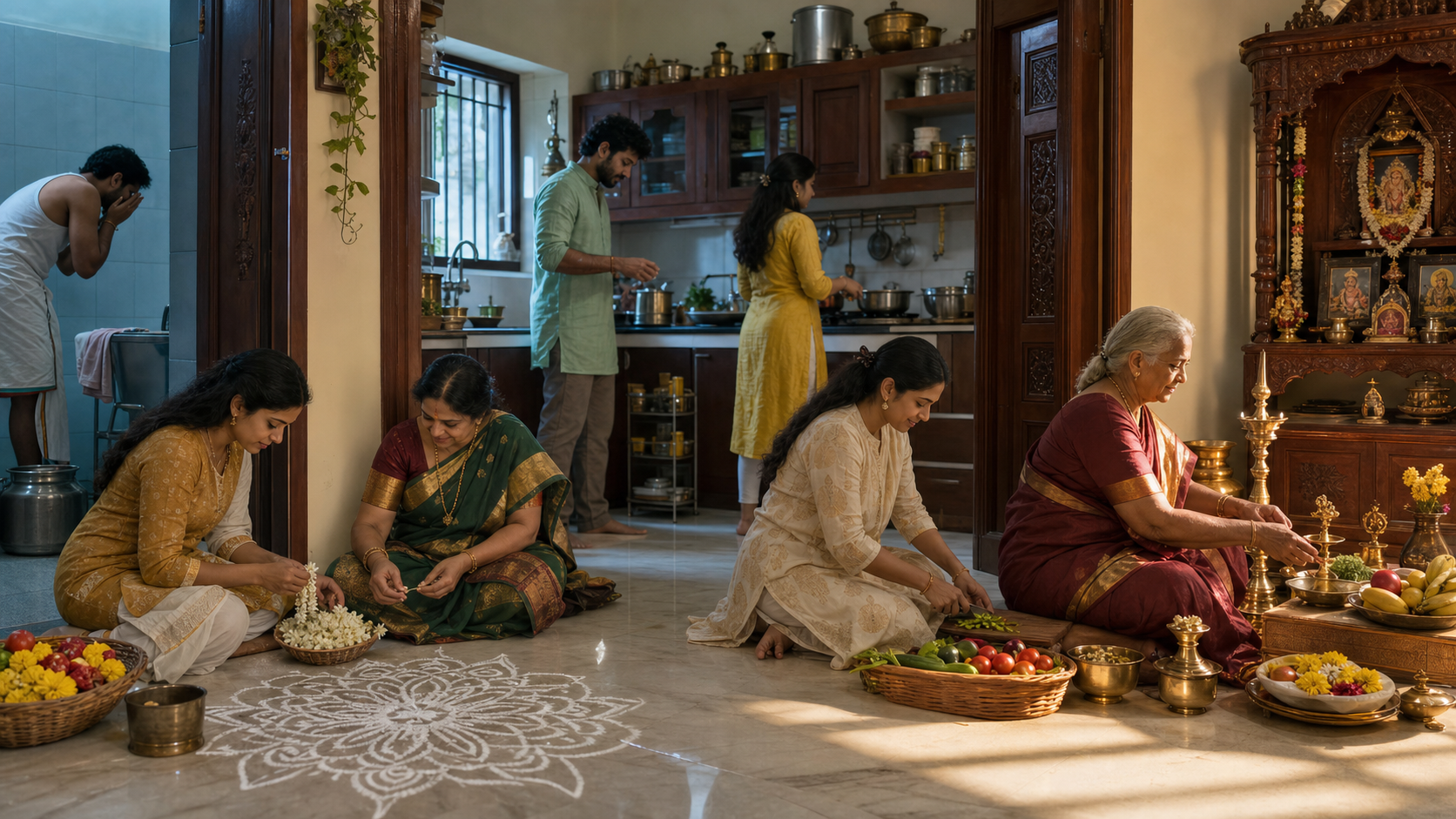
- Prepare on the previous evening. Clean the puja area, set aside clean clothes, obtain flowers and naivedyam ingredients, and decide what you will give as dana. If your family observes a kani tradition, arrange it before sleeping so that it can be the first auspicious sight at dawn.
- Begin the day with physical and visual order. Bathe, clean the entrance, draw a kolam, and light the home altar lamp. Offer a short prayer to Ganesha, Surya, and your ishta devata or kula devata according to family practice.
- Finish ritual preparation before 9:25 AM. Place the required water, flowers, lamp, mantra book, panchangam, and charity items where you can reach them. The punya-kalam is better spent in attentive worship than in searching for sesame, darbha, or a misplaced matchbox.
- Use 9:25 AM–12:17 PM for Sankranti observances. Make your sankalpam, offer Surya-arghya, perform japa or archana, and complete any tarpanam prescribed by your lineage. A temple visit, dana, or simple silent prayer can also be placed within this period.
- Complete the household celebration without rushing it. Read or hear the new panchangam, offer the prepared food, share prasada, receive the blessings of elders, and exchange Puthandu greetings. If the family meal or temple visit must happen later, that does not erase the Sankranti observance already completed.
If work or caregiving prevents an elaborate morning, protect one small period within the punya-kalam. Bathe beforehand, light a lamp, state your intention, offer water to Surya, repeat your chosen mantra, and complete a planned act of generosity. Scale is optional; attention and follow-through are not.
Let your parampara decide the technical rites
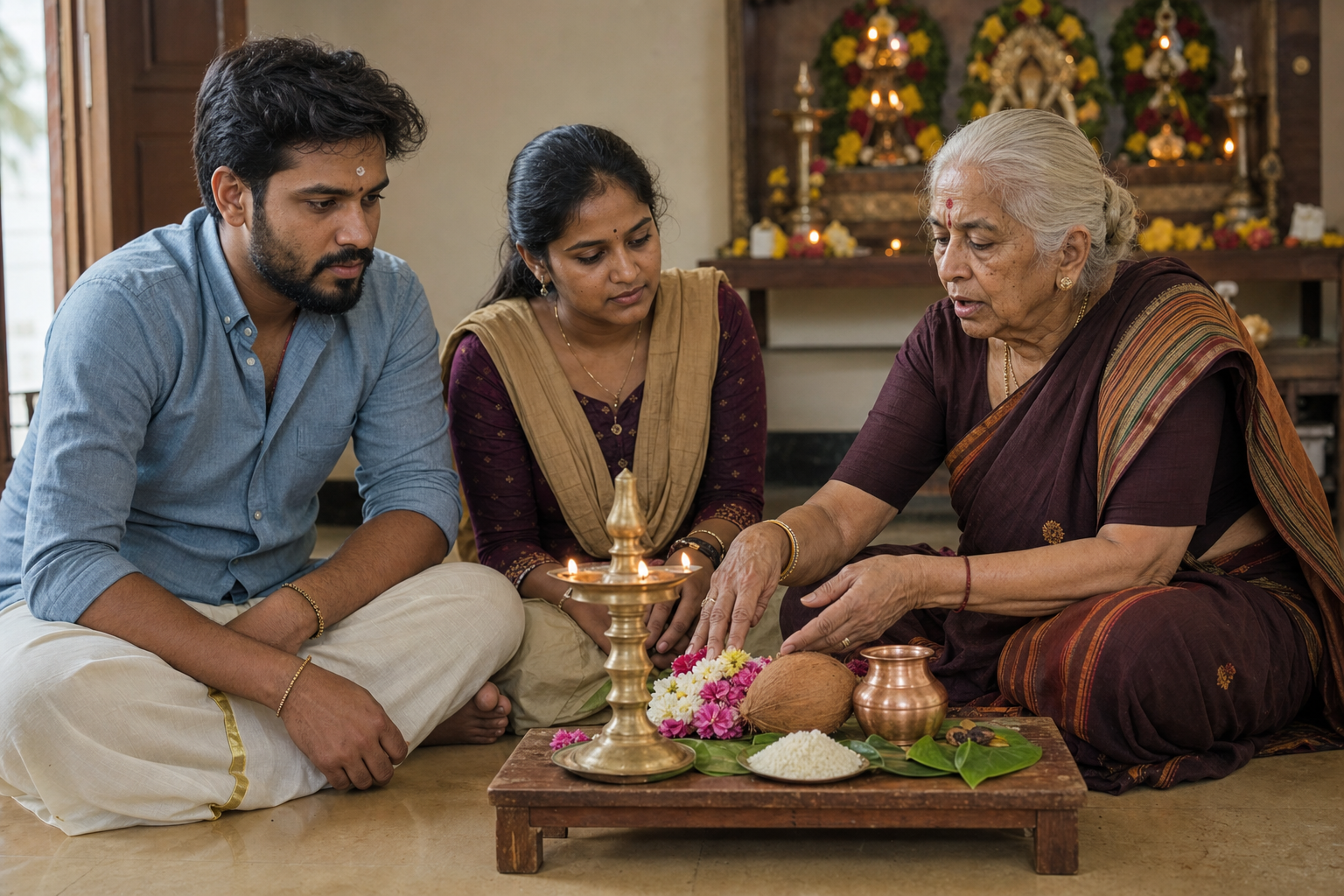
A useful Puthandu plan separates broadly accessible household worship from lineage-specific ritual. Anyone can maintain a clean altar, light a lamp, offer flowers and food, pray, hear the panchangam, serve a meal, or give dana. Tarpanam is different. Its mantras, hand positions, eligibility rules, and sequence can vary by Vedic shakha and family tradition.
A concise Puthandu sankalpam for the Mesha transition is:
mama upātta samasta-durita-kṣaya-dvāra śrī-parameśvara-prītyarthaṁ, Parabhava nāma saṁvatsare, Uttarāyaṇe, Vasanta-ṛtau, Mesha saṅkramaṇa puṇya-kāle, Chithirai Vishu Punyakaala Tharpanam kariṣye.
The statement identifies the spiritual purpose, Parabhava Samvatsara, the season, the Mesha Sankranti punya-kalam, and the rite being undertaken. If you are not performing tarpanam, do not mechanically retain the final declaration. State the practice you are actually about to perform, or use the sankalpam taught by your priest or family elder.
For an established Sankranti-tarpanam practice, customary materials include a clean vessel, water mixed with black sesame, darbha when available, and a spoon. Pitṛ offerings are generally made facing south, with the water released according to the hand position taught in the lineage. Concise invocations sometimes used for the paternal line, maternal line, and all ancestors include:
- Om Pitrubhyah Svadha Namah.
- Om Matamahabhyo Svadha Namah.
- Om Sarvebhyo Pitrubhyah Svadha Namah.
These brief invocations are not a universal replacement for a full Taittirīya, Mādhyandina, Shukla Yajurveda, or other inherited sequence. If your family has a prescribed method, keep it intact. If you have never been taught tarpanam, Puthandu morning is not the time to assemble a new procedure from disconnected instructions.
Many traditions also advise a person whose father is living to omit Pitṛ-tarpaṇa. In that situation, or whenever eligibility is uncertain, choose practices that do not create a lineage conflict: Surya-arghya with “Om Ghrini Suryaya Namah,” Gayatri japa, prayer for the well-being of the family, annadana, vastra-dana, or another sattvic act of service. Ask a knowledgeable family priest before the next Sankranti if you want to establish a fuller practice.
Understand the customs instead of treating them as a checklist
The familiar elements of Puthandu are memorable because each gives you a way to practise the new year’s intention. A kolam makes order and hospitality visible at the threshold. A lamp places clarity at the centre of the home. Fresh naivedyam turns preparation and appetite into gratitude before the family eats.
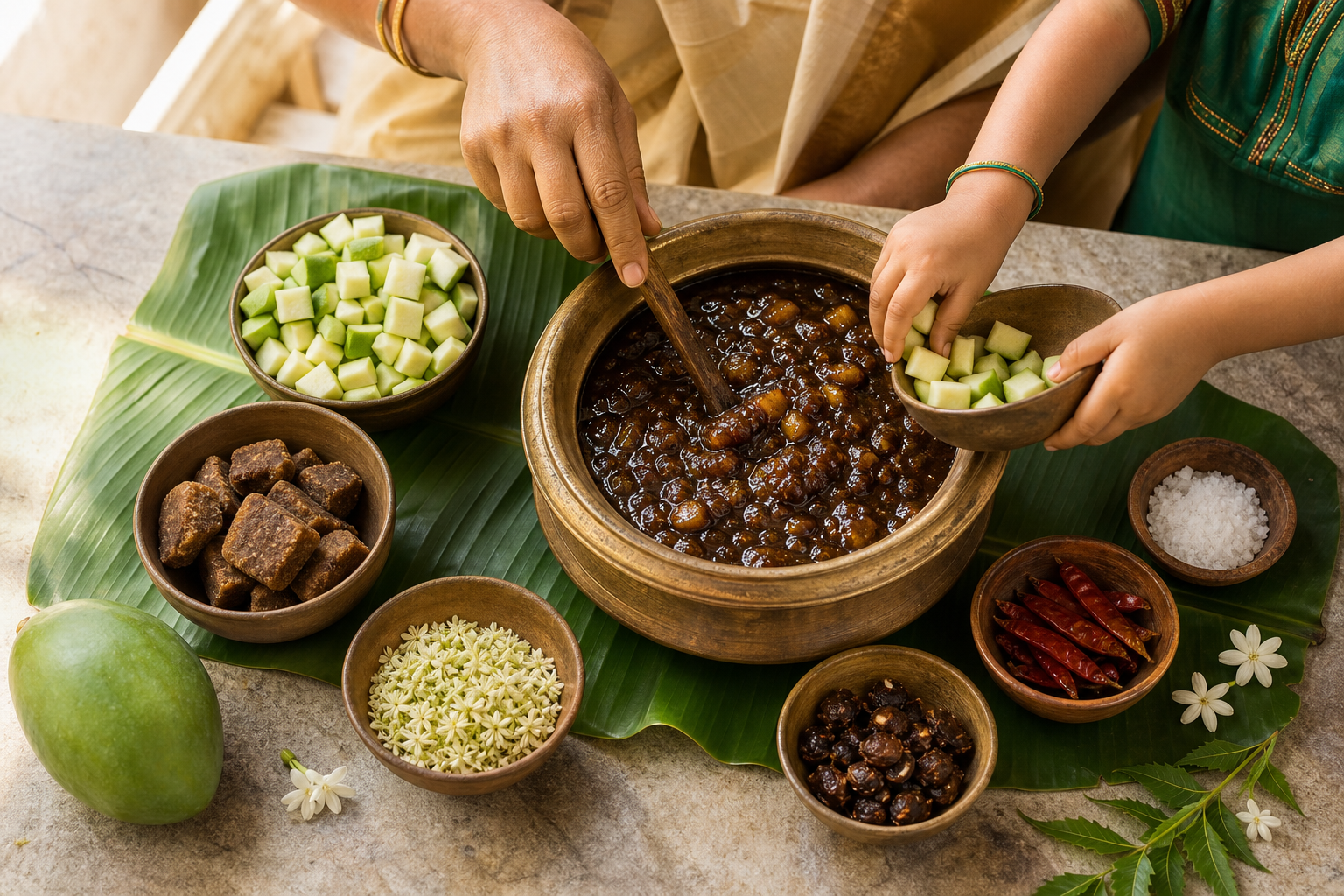
Maanga pachadi carries one of the day’s clearest teachings. Its contrasting tastes recall that a year will not arrive in a single flavour. Sweetness, bitterness, sourness, and heat belong to the same serving, just as gain, disappointment, surprise, and effort belong to the same life. The point is not to predict hardship or demand passive acceptance. It is to meet changing conditions without allowing one pleasant or painful moment to define the whole year.
Panchanga shravanam performs a different task. The new almanac introduces Parabhava Varusha through its calendar, seasonal indications, planetary movements, festival dates, and traditional assessments such as aaya-vyaya. Hear these forecasts with respect, but also with proportion. They are a framework for attentiveness and prudent planning, not a release from ethical judgment or personal responsibility.
The kani requires similar clarity. In Kerala’s Vishu tradition, a carefully arranged first sight may include a sacred image, a lamp, mirror, grains, fruit, and kani konna flowers; elders may later give Vishu kaineettam to younger family members. Some Tamil households also maintain an auspicious first-sight custom, but it is not necessary to retrofit every Kerala practice into Puthandu. If kani belongs to your family, prepare it carefully. If it does not, your kolam, lamp, puja, naivedyam, and panchanga reading form a complete Tamil observance.
This distinction matters especially when teaching children. Tell them which practices come from their own grandparents, which are common across Tamil homes, and which belong principally to neighbouring regional traditions. That gives them both rootedness and respect; a vague mixture gives them neither.
Honour the shared solar turn without erasing differences
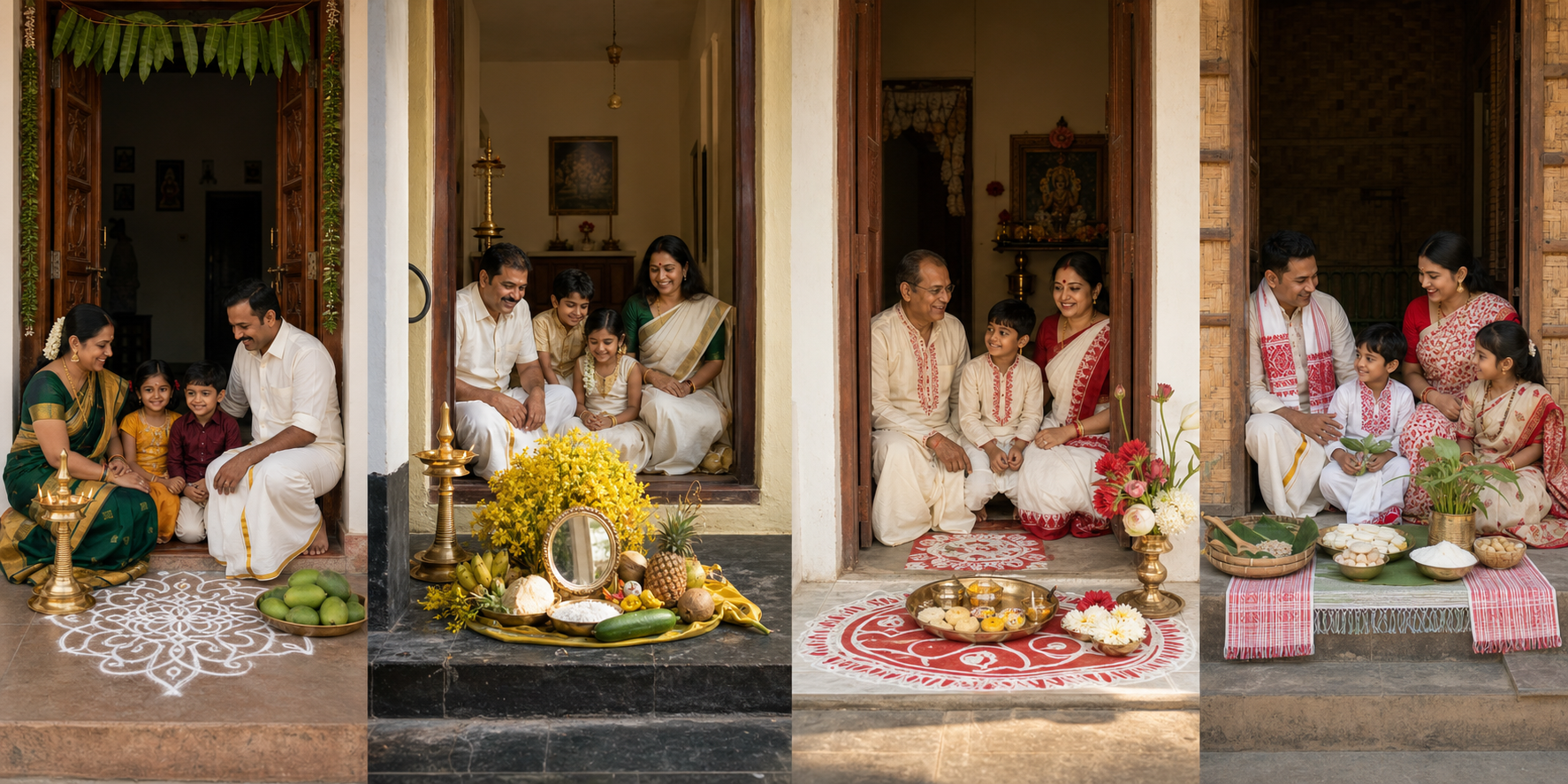
Mesha Sankranti carries a wide civilizational resonance. Tamil communities welcome Puthandu or Varusha Pirappu, while Kerala observes Vishu. Odisha marks Maha Vishuba Sankranti or Pana Sankranti, Assam welcomes Bohag or Rongali Bihu, and Bengali communities observe Naba Barsha or Pohela Boishakh around the same seasonal threshold. Sri Lanka’s Sinhala and Tamil New Year also belongs to this mid-April arc.
Vaisakhi has its own powerful Sikh meaning. Alongside the agricultural season, it commemorates the formal initiation of the Khalsa in 1699. That history should not be reduced to a generic “Indian new year” label. The better account is more generous and more accurate: related calendars and seasonal rhythms can coexist with distinct memories, theologies, foods, and forms of worship.
You can make that unity tangible at home. Use each festival’s proper name when greeting friends. Ask relatives from another region how they observe the day rather than assuming their rite matches yours. With children, place Puthandu, Vishu, Vaisakhi, Pana Sankranti, Bohag Bihu, and Pohela Boishakh on a map of Bharat and its civilizational neighbourhood. The lesson is not that every tradition is interchangeable. It is that plurality can grow from a recognisable respect for time, nature, lineage, generosity, and renewal.
Carry the new-year intention through Chithirai Masam
Puthandu opens a month, not merely a morning. Chithirai Masam 2026 is anticipated to run from about 14 April to 14 May in the Tamil calendar, subject to the almanac used locally. Treat 14 April as the beginning of a short cycle of worship, accountability, and service rather than the end of the celebration.
Madurai’s Chithirai Thiruvizha brings the sacred geography of Meenakshi Amman, Sundareswarar, Kallazhagar, and the Vaigai River into public life. The 2026 processions are expected during late April and early May, but exact arrangements should come from the temples closer to the festival. Do not build travel around an estimated procession date when the authoritative schedule has not yet been announced.
Chitra Pournami adds an ethical checkpoint later in the month through worship associated with Chitragupta, reflection on karma, lamps, fasting according to capacity, and charity. Obtain its civil date from your location-adjusted panchangam. The same rule applies to Chithirai’s Ekadashi, Pradosham, Amavasya tarpanam, and Sankashti Chaturthi observances; their dates depend on lunar tithi and local reckoning rather than on a simple fixed-date list.
The growing heat also gives Chithirai seva a practical direction. Water stewardship, a thanneer pandal, and the distribution of cooling drinks such as neer mor or panakam turn seasonal awareness into care for people outside the household. Choose one act that your family can actually complete and assign responsibility for it before the festival.
Before 14 April, write a three-line family plan: the panchangam and timing you will follow, the central rite you will protect from distraction, and the dana or seva you will complete. That small commitment will do more for Parabhava Varusha than an ambitious festival checklist abandoned by noon.
References
- HinduPad — Chithirai Vishu (Puthandu) 2026: Auspicious Mesha Sankranti Time, Rituals, Meaning, and Unity
- HinduPad — Chithirai Vishu 2026: Powerful Tharpana Mantras, Puthandu Sankalpam & Punya Kaalam
- HinduPad — Chithirai Masam 2026: Tamil New Year, Astronomical Basis, and Festival Guide