
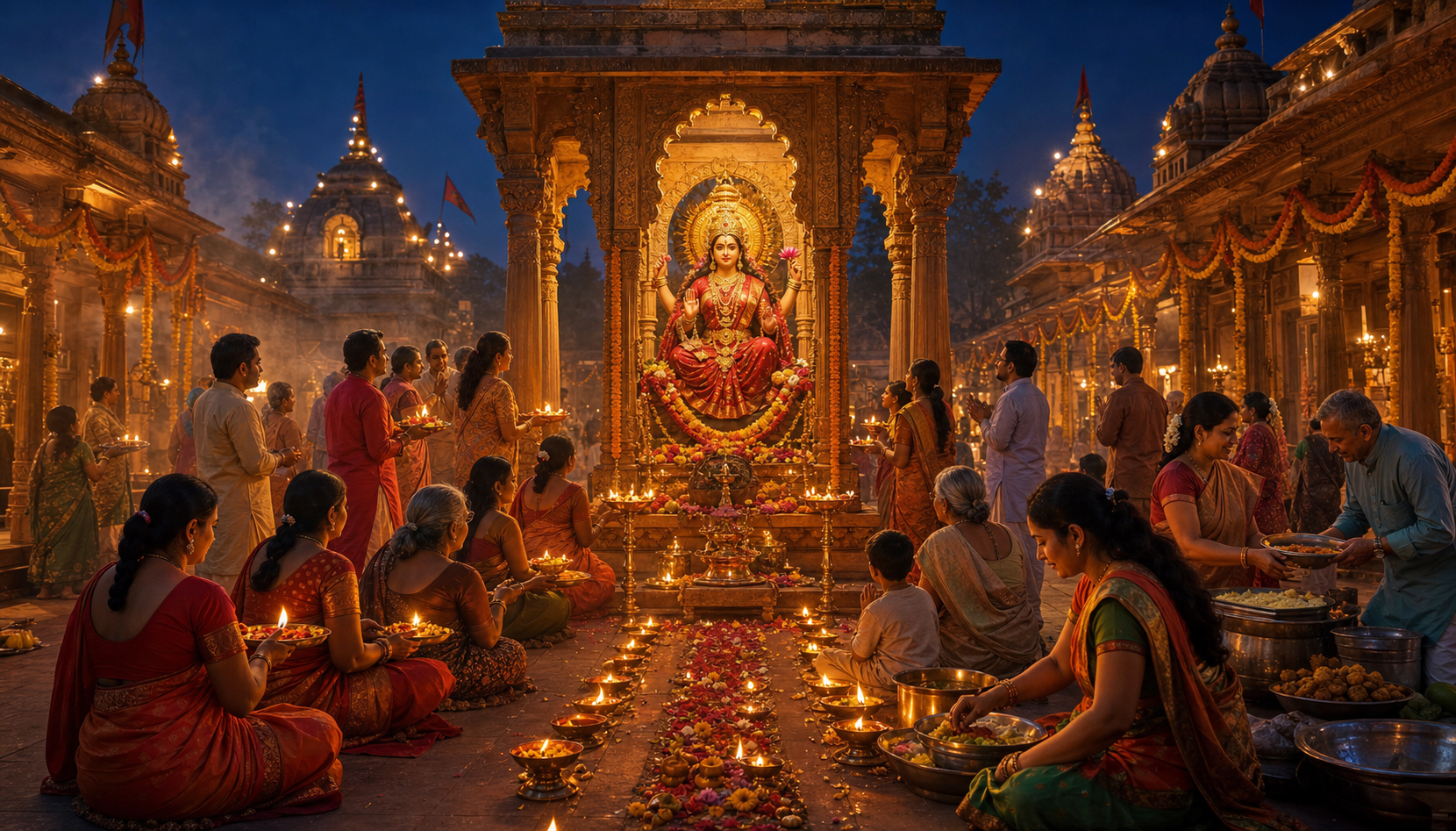
You may know the familiar outline: Devi appears, an asura falls, lamps are lit, and the community celebrates. The harder question is what any of this asks of you once the bells quiet and ordinary life resumes.
A useful answer emerges when you treat legend as a diagnosis of disorder and festival as training in how to overcome it. Shakti worship then becomes more than admiration for divine power. It teaches you to identify adharma accurately, summon the right kind of strength, restore what has been damaged, and keep power answerable to compassion.
The victory is not the whole legend
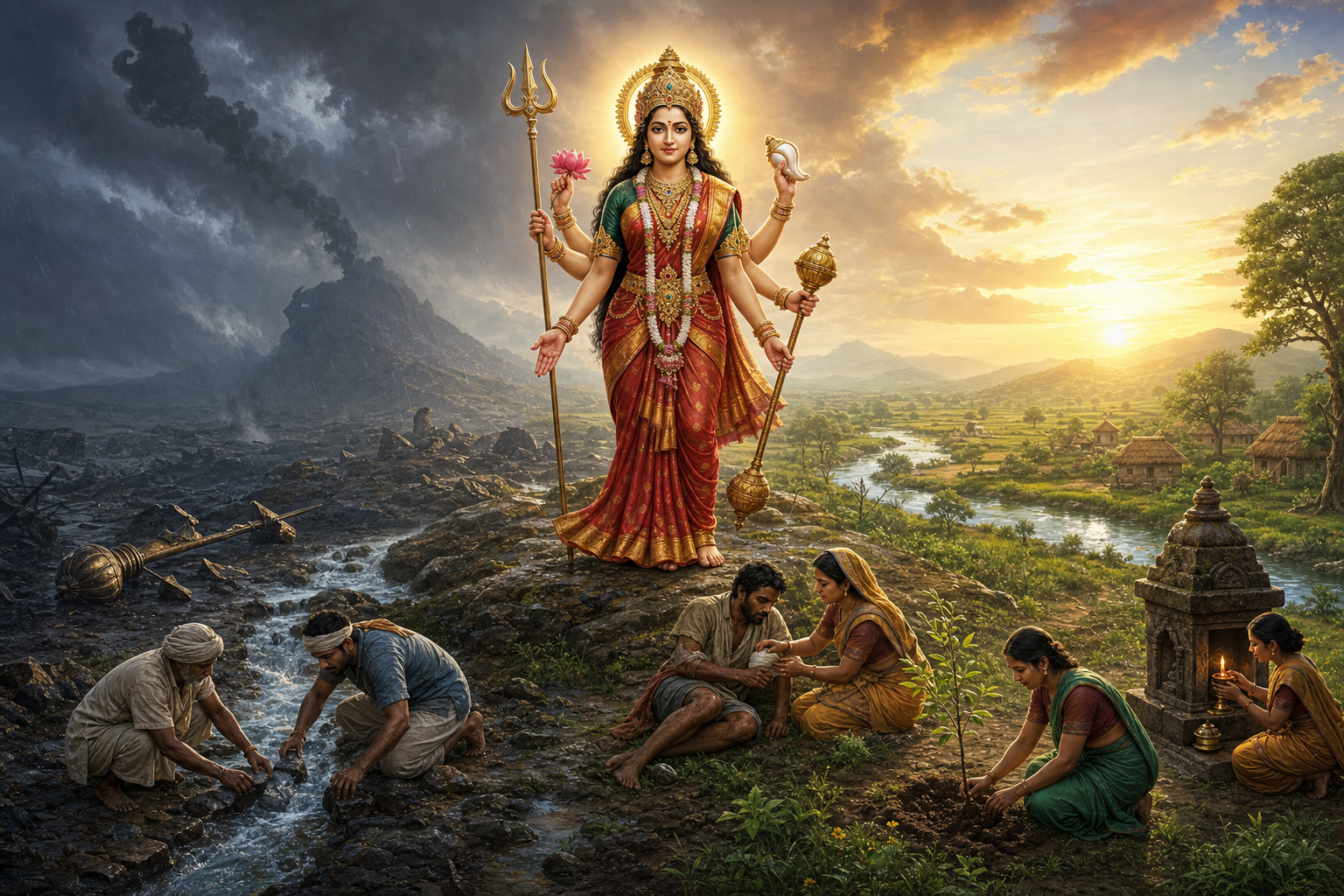
Shakti is dynamic power expressed through the many forms of Devi. That power can nurture, create, protect, confront, and clarify. The maternal and martial forms of the Goddess are therefore not opposites. A mother who sustains life may also have to defend it; courage without care becomes brutality, while care without the capacity to resist adharma becomes helpless sentiment.
Durga’s victory over Mahishasura gives Navratri its best-known dramatic image. It affirms that entrenched disorder cannot always be reasoned away or politely accommodated. Courage must align with wisdom, restraint, and compassion if it is to restore dharma rather than reproduce the violence it opposes.
The legend of Kolhasur introduces an equally important final movement. In Karavira, the asura Kolha seizes power and subjugates the land. Mahalakshmi, revered locally as Ambabai and Karavira Nivasini, answers the appeals of sages and devas, defeats him, and liberates the region. At the point of defeat, Kolhasur asks that the city carry his name and that the Goddess remain there for the welfare of all. Mahalakshmi grants both requests, and the memory of conflict is transformed into the sacred identity of Kolhapur.
This ending matters. Mahalakshmi does not pretend that the tyranny never happened, and the city does not lose the memory of Kolhasur. Yet memory is no longer allowed to serve disorder. It is absorbed into a place where the Goddess remains present for public welfare. Shakti achieves more than removal: she turns a history of domination into a continuing obligation to protect dharma.
Read a Shakti legend through four movements
- Name the disorder. Ask what has actually been corrupted: judgment, responsibility, truth, social trust, self-command, or the protection owed to others. Avoid using the label of adharma merely for whatever frustrates you.
- Identify the required form of power. Some situations need Durga’s refusal to yield. Others need Lakshmi’s constructive ordering of resources, Saraswati’s clarity, or the patience that prevents force from becoming vengeance.
- Notice how order is restored. The decisive moment is not only the asura’s fall. Look for the return of right relationship, protected space, moral responsibility, knowledge, or communal well-being.
- Study what happens to memory. Kolhasur’s name remains, but its meaning changes. Your aim is likewise not to deny a failure, fear, or conflict. It is to prevent that memory from continuing to rule you.
This approach also corrects a dangerous misreading. A Shakti legend is not permission to classify disliked people or present-day communities as demons. Its first demand is self-scrutiny. The inner Kolha can be pride, greed, or delusion, including the pride that makes a person certain that adharma exists only outside the self.
Questions to carry into puja
- What disorder am I asking Devi to help me confront?
- Which quality of Shakti does this situation require: protection, disciplined action, generosity, clarity, endurance, or compassion?
- What would restored order look like in conduct, not merely in feeling?
- What action must follow the prayer if the prayer is sincere?
Answer these before you become preoccupied with festival clothing, decoration, or the correct photograph. Beauty belongs in worship, but it should frame attention rather than replace it.
Let the nine nights become a disciplined sequence
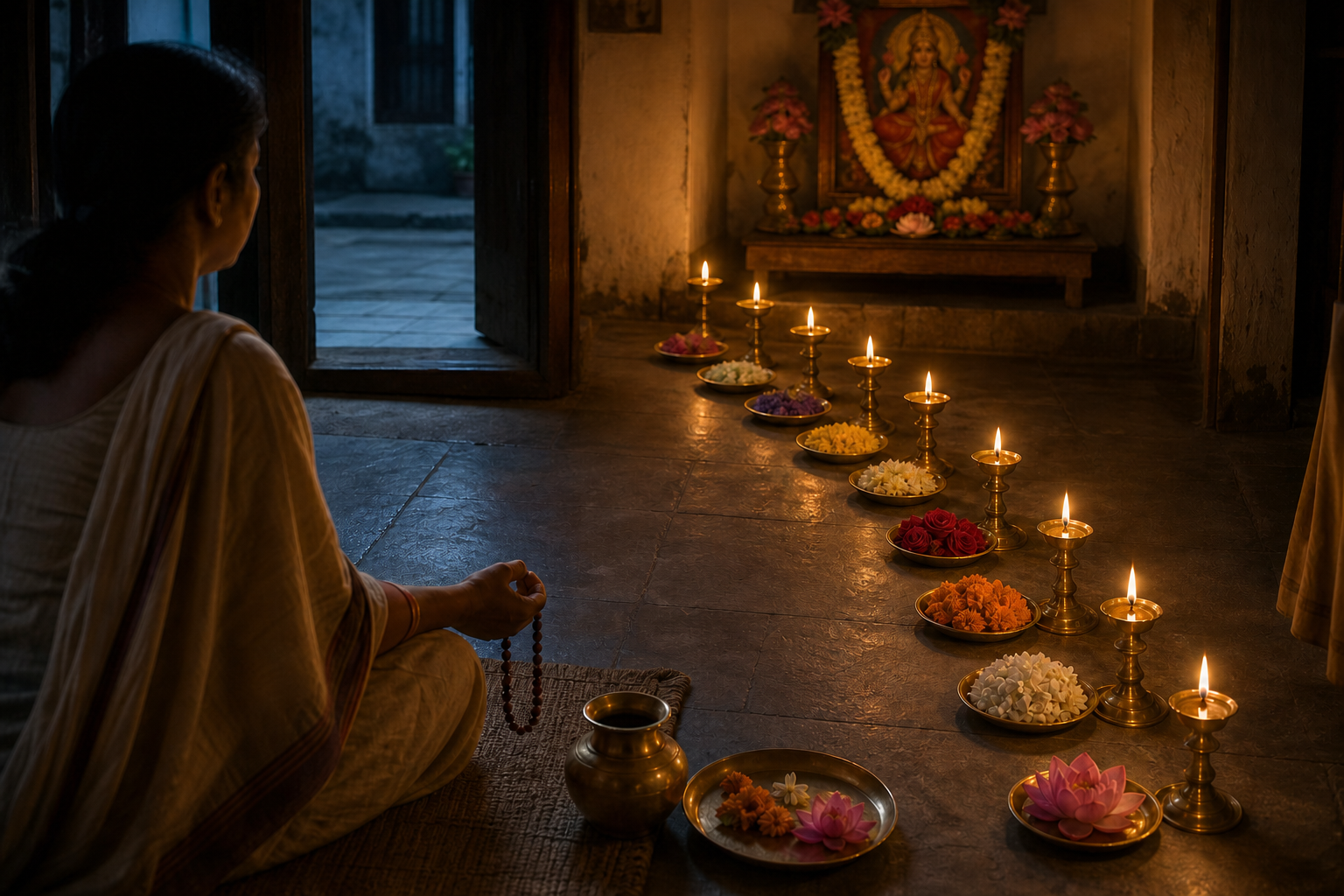
Navratri gives this inner work a deliberate rhythm. A widely used interpretation organizes the festival into three movements associated with the gunas: Durga for overcoming inertia, Lakshmi for constructive energy and prosperity, and Saraswati for knowledge and clarity. Traditions vary, but this sequence offers a practical way to prevent nine nights of worship from becoming nine repetitions of the same intention.
- During the Durga movement, remove. Choose an entrenched pattern that weakens dharmic action: a duty repeatedly postponed, an indulgence defended as entitlement, a fear left unnamed, or speech that spreads disorder. Make the prayer concrete by interrupting that pattern.
- During the Lakshmi movement, build. Direct energy and resources toward what should flourish. Put neglected responsibilities in order, practice dana or seva, care for the household and community that sustain you, and distinguish genuine prosperity from accumulation without purpose.
- During the Saraswati movement, clarify. Study a sacred teaching, improve the truthfulness of your speech, return to a neglected discipline of learning, or seek the knowledge needed to act wisely. Victory without clarity is unstable because the old confusion can simply take a new form.
The progression is important. Removing a harmful tendency creates space, but empty space does not remain empty. Constructive habits must occupy it. Knowledge then helps those habits endure without becoming mechanical. In practical terms, do not vow only to stop something during Navratri. Decide what dharmic practice will replace it and what understanding will keep that practice alive.
Use the Navadurga as nine questions for conduct
The nine forms of Durga can guide a daily examination. The following questions draw on their traditional associations with resolve, discipline, courage, creativity, responsibility, righteous action, fearlessness, renewal, and grace. They are prompts for practice, not replacements for the rituals of your family, temple, or sampradaya.
- Shailaputri: What needs a grounded beginning rather than another elaborate plan?
- Brahmacharini: Which discipline will I keep when enthusiasm fades?
- Chandraghanta: Where must courage remain calm enough to hear clearly?
- Kushmanda: What can I create that gives light or vitality to others?
- Skandamata: Who or what has been entrusted to my care?
- Katyayani: Which necessary action have I delayed in the name of keeping peace?
- Kalaratri: Which fear, shadow, or destructive tendency must be faced without disguise?
- Mahagauri: What requires cleansing, restitution, or a sincere new beginning?
- Siddhidatri: Can I receive accomplishment as grace and responsibility rather than personal possession?
Keep the ritual core stable and manageable
Traditional observance may include Ghatasthapana, daily puja, lamps, stotras, mantras, vrata, and kanya puja. The kalash, filled with water and adorned with mango leaves and a coconut, represents continuity, fertility, and auspicious presence. If your household already has an established method, follow it faithfully instead of assembling unrelated practices from social media.
If you are beginning, choose a modest practice you can maintain: prepare a clean place, light the lamp safely, use a prayer known in your family or community, reflect on the day’s form of Devi, and complete an act consistent with that reflection. A short observance followed by disciplined conduct is more meaningful than an elaborate setup abandoned after the first burst of enthusiasm.
Fasting is a vrata, not a competition or a measure of personal worth. Traditional guidance explicitly allows observance according to capacity. If food restriction conflicts with your health needs, do not force it; seek appropriate professional advice and ask a knowledgeable guide in your tradition about a safe form of observance. Restraint in angry speech, wasteful consumption, or compulsive entertainment can also give the period a serious ethical boundary, even when it is not treated as a substitute for a prescribed ritual fast.
Kanya puja likewise carries a demand beyond ceremony. Honoring girls as embodiments of sacred potential rings hollow if respect disappears outside the ritual setting. Let the worship affect how you listen, protect dignity, share opportunity, and challenge contempt in ordinary life.
If you are planning Navratri in 2026
Shardiya Navratri in 2026 is expected to run from Sunday, October 11 through Tuesday, October 20, culminating in Vijaya Dashami. Hindu observances follow tithis rather than fixed civil dates, so Ghatasthapana, Ashtami, Navami, and Vijayadashami timings can vary by location and time zone. Use a regional panchang or your community temple’s announced schedule before arranging a puja, fast, journey, or public event.
Regional festivals reveal different disciplines of Shakti
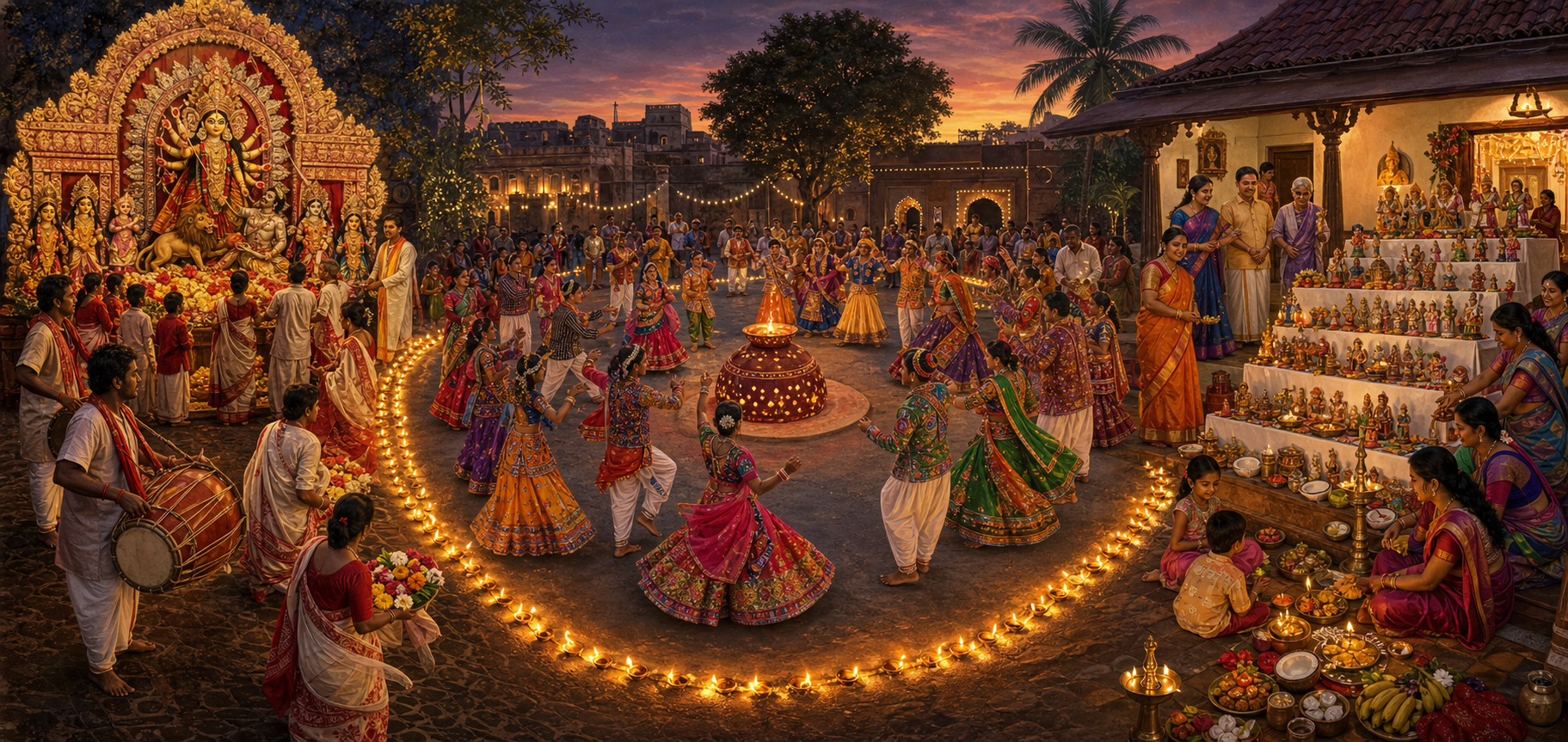
Regional variation is not noise surrounding an otherwise uniform festival. Each form makes a different dimension of worship visible. When you attend a celebration outside your inherited tradition, ask what spiritual capacity its structure is cultivating. That question turns cultural appreciation into learning.
- In Bengal, Durga Puja unites sacred image, public art, neighborhood organization, and collective worship. Sandhi Puja at the transition between Ashtami and Navami concentrates attention on decisive transformation. The pandal and the shared puja make moral imagination a public act. Do more than photograph the image: learn what its arrangement communicates, support the community maintaining the worship, and enter the sacred space with the discipline expected of a participant.
- In Gujarat and parts of Rajasthan, Garba and Dandiya move in circles around the lighted garbha-deepa. The lamp represents Shakti as the creative center, while the dancers enact coordinated life around that center. The spiritual lesson is not individual display but rhythm, reciprocity, and attentiveness. Keep the center in view, respect the movement of the group, and remember that joy itself can be ordered around the sacred.
- In Tamil and Telugu households, Golu or Bommala Koluvu arranges dolls and sacred scenes in tiered displays. These become household libraries of epic memory, ethical teaching, and folk tradition. Ask an elder to explain a scene, invite a child to retell it, and record names or meanings that might otherwise disappear between generations.
- In Kerala, Saraswati Puja and Vidyarambham connect worship with learning. Vijayadashami becomes a time to begin or recommit to study. Adults need not leave that symbolism to children. Open the text you have postponed, resume a discipline worth mastering, and place learning in the service of wisdom rather than status alone.
- In Mysuru and Kullu, major processional traditions place worship in a civic setting. Mysuru Dasara joins royal memory, illumination, and procession, while Kullu Dussehra gathers deities from surrounding valleys after Vijaya Dashami. These public forms connect sacred authority, regional identity, and collective life. Notice the institutions and workers that make the festival possible, and treat civic cooperation as part of the celebration rather than invisible infrastructure.
- In Nepal, Dashain places renewal within kinship through visits, blessings, tika, and jamara. In diaspora communities, public Garba, temple worship, music, and cultural education help younger generations inhabit a tradition they may not encounter in daily public life. Festival continuity depends on families and institutions transmitting meaning along with performance. Teach why an action is done, not only how to reproduce its outward form.
Recognize dharmic resonances without erasing differences
Shakti also provides a vocabulary for civilizational conversation across dharmic traditions, but the conversation requires precision. Buddhist reverence for Tara illuminates compassionate and responsive power. Jain traditions include guardian figures such as Ambika and Padmavati while placing ahimsa and self-mastery at the center of ethical discipline. The Sikh Chandi di Vaar engages the language of courage and righteous struggle. These are meaningful resonances around compassion, restraint, protection, and valor, not proof that distinct traditions are interchangeable.
When speaking across the dharmic family, use the word resonance rather than forcing equivalence. Ask how a tradition understands compassionate power, fearlessness, disciplined action, or protection of the good. You will find genuine kinship without asking anyone to surrender the integrity of a particular path.
At Kolhapur, legend becomes place, image, and light
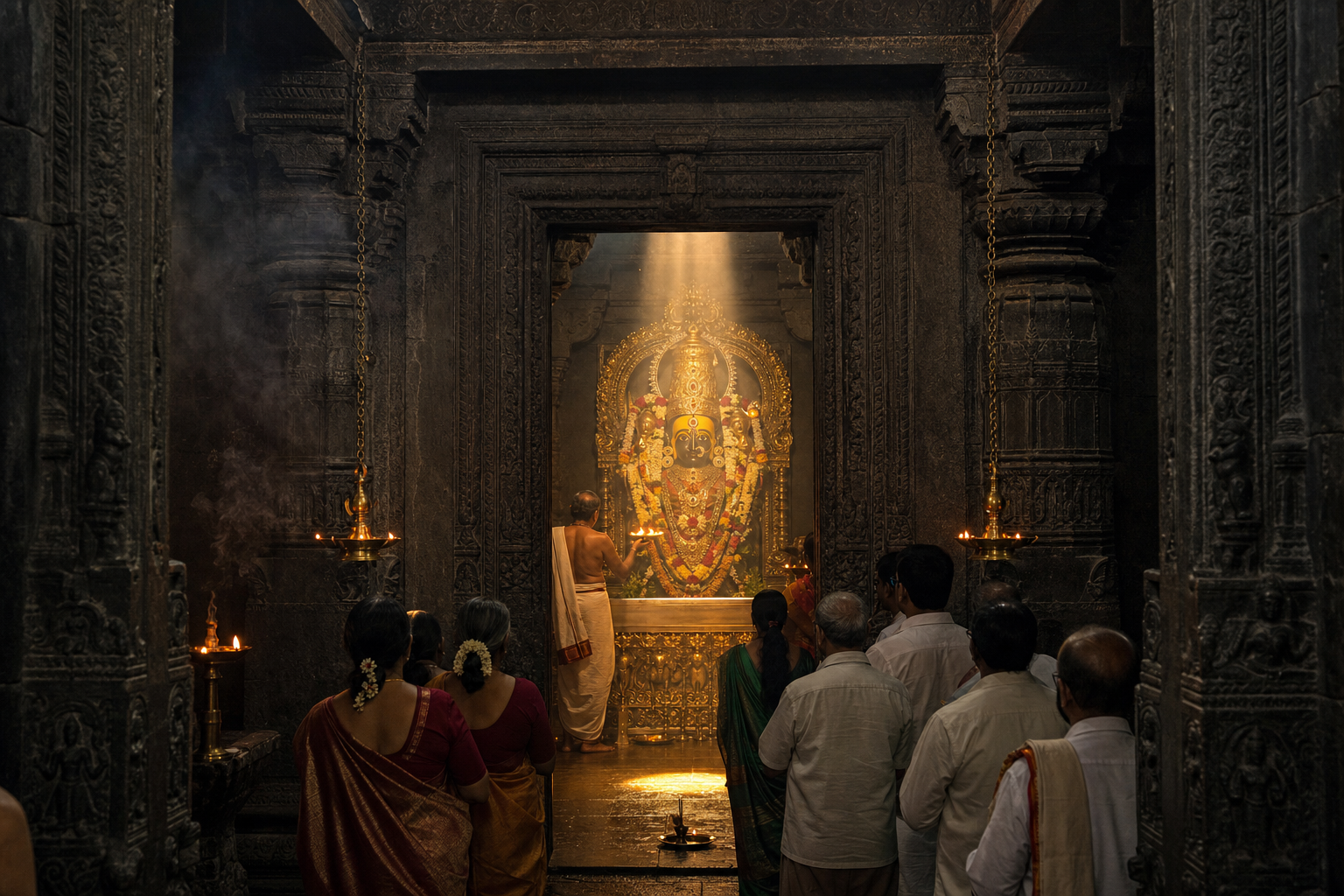
Kolhapur demonstrates how a Shakti legend can inhabit an entire city rather than remain confined to a narrated past. Within the Karavira Mahatmya of the Skanda Purana, the land’s rivers, ghats, shrines, and pilgrimage merits form a sacred geography. Ambabai’s abiding presence makes Karavira a continuing field of worship, while the name Kolhapur preserves the transformed memory of Kolhasur.
The temple’s fabric carries layers of history. Its early medieval core is visible in black basalt masonry, with later Yadava and Maratha additions. The ritual axis moves through the mandapa toward the garbhagriha, while lamp towers, subsidiary shrines, and carved stone elements make the sanctum part of an integrated precinct. Stone, movement, and ritual direct attention toward the Goddess.
Ambabai’s four-armed image holds a matulinga, shield, mace, and small vessel, and the lion signifies royal power and fearless protection. The combination resists a shallow reduction of Mahalakshmi to private wealth. Her icon joins auspicious abundance to strength and protection. The Sriyantra and nearby shrines also express the Shakta-Vaishnava interweaving characteristic of the region’s devotional life.
During the biannual Kiranotsava, a solar beam follows the sanctum’s alignment and illuminates the deity over successive evenings, moving from feet to torso to face. Architecture and solar geometry become a liturgy of light. If you hope to witness it, verify the local schedule before traveling; the event occurs on selected days, and a generic festival calendar is not enough for planning.
Daily abhisheka, alankara, naivedya, and arati give the temple its recurring rhythm. Margashirsha Fridays, Navratri, processions, music, dana, seva, and shared meals widen that rhythm into community life. The temple has endured as both a spiritual center and a civic anchor, supported across generations by rulers, artisans, devotees, and local communities.
Approach the pilgrimage as a practice
- Before arriving, learn the names Ambabai and Karavira Nivasini, and understand why Kolhasur remains in the city’s memory. Recognition changes darshan from visual consumption into encounter with a living tradition.
- At the temple, let queuing become part of the discipline. Follow local customs, protect the movement of other pilgrims, and do not let the desire for a photograph disturb worship.
- Choose offerings that do not burden the precinct. Responsible pilgrimage includes eco-conscious materials, proper disposal, support for heritage care, and respect for those who maintain the temple.
- Observe before interpreting. Notice the matulinga, shield, mace, vessel, lion, ritual axis, and surrounding shrines. Allow the iconography to correct any assumption that Lakshmi represents wealth detached from courage, order, and public welfare.
- After darshan, identify the inner Kolha you intend to confront. Name the behavior through which its hold will be weakened, and pair the intention with a constructive duty. Redemption becomes credible when conduct changes.
If travel is not possible, the same discipline can begin at home. Learn the legend accurately, invoke Devi through the practice received in your tradition, support the preservation of sacred institutions where you can, and connect prayer to a visible act of restoration in your own sphere of responsibility.
Key takeaways
- Read a Shakti legend by identifying the disorder, the form of divine power required, the restoration achieved, and the fate of memory after conflict.
- Durga’s victory over Mahishasura teaches decisive resistance to adharma; Ambabai’s response to Kolhasur adds a lesson in transformation, grace, and enduring responsibility.
- Use Navratri’s Durga-Lakshmi-Saraswati sequence to remove a harmful tendency, establish a constructive practice, and deepen the knowledge that will sustain it.
- Treat regional forms such as Durga Puja, Garba, Golu, Vidyarambham, Dasara, and Dashain as different disciplines of public imagination, rhythm, memory, learning, civic life, and kinship.
- Let puja, fasting, celebration, and pilgrimage change conduct. Ritual becomes transformative when prayer is followed by restraint, seva, learning, protection, or repair.
Before your next worship, write down the adharma you are confronting, the quality of Shakti you need, and the act that would begin restoring order. Keep that intention near the altar. When Vijaya Dashami arrives, do not ask only whether the festival was beautiful. Ask what has actually begun to change.
References
- DharmaRenaissance Blog – Kolhasur’s Redemption, Ambabai’s Grace: The Legend Powering Kolhapur’s Mahalakshmi Temple
- COHNA – Navratri 2026: Dates, Rituals, Regional Traditions, and the Transformative Power of Shakti