

If you are a temple trustee, manager, archaka, lawyer, or concerned devotee, the danger to temple land may not arrive as one dramatic takeover. It may begin with a missing mutation entry, an access path that becomes narrower each year, an expired lease that nobody reviews, or a boundary remembered by elders but never placed on an accurate map.
Maharashtra’s public commitment to address encroachments creates an opening, but a political pledge is not a survey, title determination, eviction order, or governance system. Your immediate task is to turn institutional memory into a parcel-by-parcel record that the trust can use before revenue officials, the Charity Commissioner, local authorities, police, mediators, or an appropriate legal forum.
Key takeaways for trustees and devotees
- Begin with the land record, not the accusation. Reconcile the trust deed, archival papers, revenue entries, official parcel map, leases, easements, and present conditions on the ground.
- Classify each problem correctly. A missing revenue entry, disputed boundary, unauthorized occupation, unauthorized structure, blocked access route, and misused lease do not follow the same remedial path.
- Do not use physical force or informal demolition. Contested claims require due process, while police and local bodies should be asked to implement lawful decisions safely.
- Treat every lease, licence, easement, mutation request, survey, representation, and order as part of one permanent asset file.
- Measure protection publicly: cases reported, cases resolved, land secured, time taken, unresolved bottlenecks, and compliance milestones.
Build one defensible record for every parcel

The most useful temple-land register is not a spreadsheet containing only area and location. It is a reconciled evidence file. Someone unfamiliar with the property should be able to open it and understand what the trust claims, which records support that claim, what the official map shows, who occupies the land, and where the uncertainty lies.
This is especially important because temple-land disputes often combine several weaknesses: incomplete title histories, old surveys, delayed mutation entries, undocumented arrangements, and physical conditions that no longer match the papers. A portal entry by itself cannot resolve all of those questions. Maharashtra’s digitized land-record system, Mahabhulekh, is most useful when its entries are reconciled with trust and archival records rather than treated as the entire file.
- Start with the trust’s own description of the asset. Record every survey, plot, or other parcel identifier appearing in the trust deed, schedules, registers, grants, previous orders, and correspondence. Preserve older names and identifiers instead of silently replacing them.
- Collect the historical chain. Place grants, conveyances, sanctioned transactions, maps, tax or revenue material, litigation papers, and older trustee resolutions in chronological order. Mark every missing link instead of filling it with assumption.
- Obtain the available current land and revenue entries. Compare names, parcel identifiers, area, land classification, recorded interests, and mutation history with the trust’s papers.
- Compare the cadastral map, meaning the official parcel map, with the physical site. Where the boundary or area is uncertain, seek a properly documented survey and a standardized site plan.
- Create a dated ground-condition record. Photograph boundary markers, access paths, structures, utilities, neighbouring uses, signboards, fencing, and visible occupation. Label each image by location rather than storing an unsearchable folder of photographs.
- List every lease, licence, easement, access arrangement, and third-party occupation. Attach the governing document, permitted use, payment terms, approval record, and current status.
- Write a neutral discrepancy note. For example: the revenue entry differs from the trust schedule; the map and occupied boundary do not align; the access path is obstructed; or a structure exists without a document in the trust file.
- Keep a protected digital copy and an indexed physical file. Record who may update it, who verifies changes, and where certified or original records are held.
Do not erase contradictions to make the file look tidy. A visible discrepancy can be investigated. A hidden discrepancy can emerge later in litigation, undermine credibility, and delay relief.
Give priority to parcels where construction is continuing, access to worship is obstructed, records are deteriorating, lease terms are being ignored, or a limitation or adverse-possession argument has been raised. Those situations warrant prompt review by a lawyer familiar with Maharashtra property law and public religious trusts. Do not assume that a representation to an office pauses a legal deadline.
Diagnose the problem before choosing the remedy
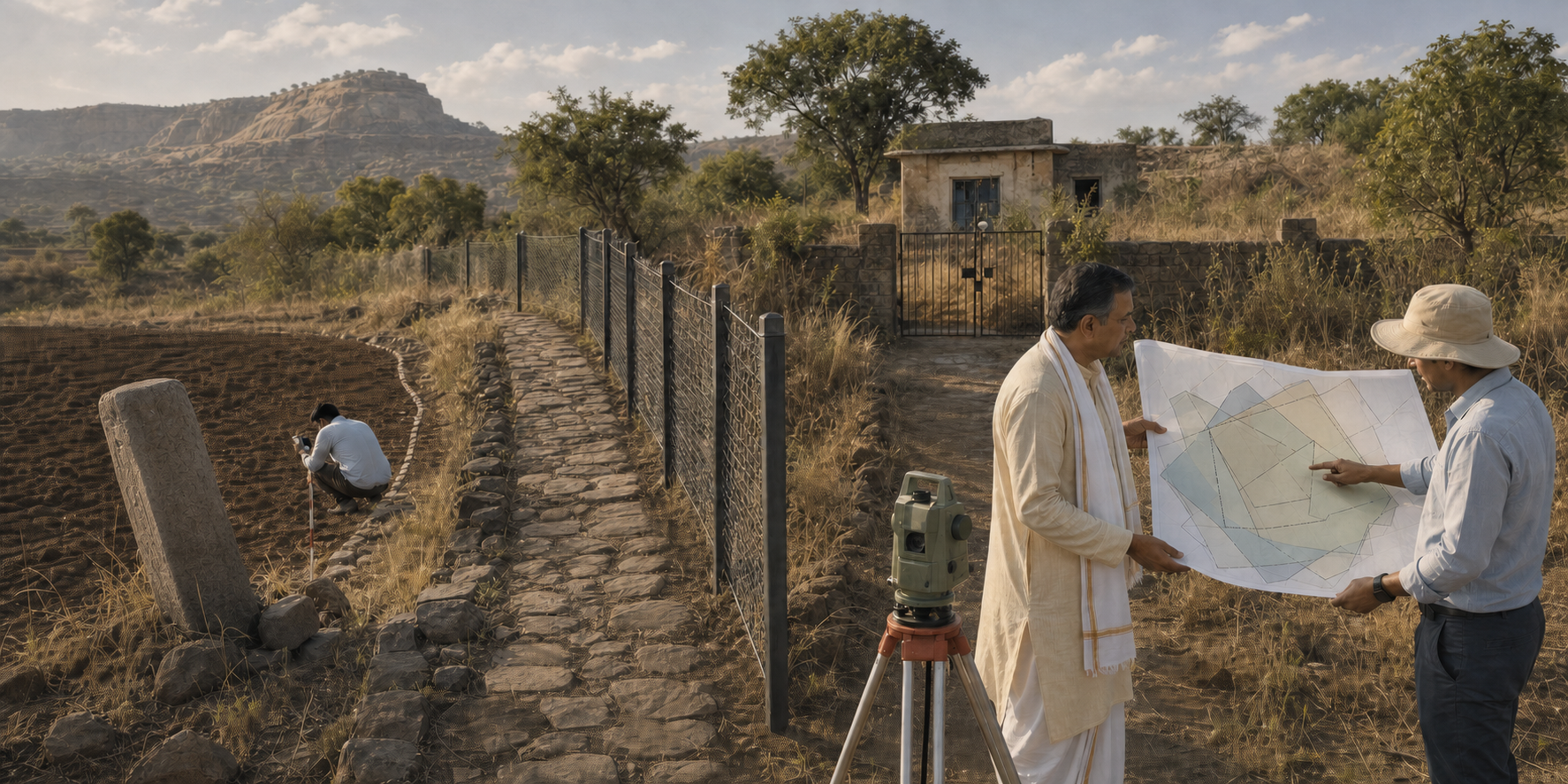
Calling every difficulty an encroachment may rally attention, but it can produce the wrong application to the wrong authority. Before escalating, assign the matter to a primary problem type and record any secondary issues.
Record and survey defects
This category includes inconsistent parcel numbers, incomplete mutation history, a mismatch between trust and revenue records, an outdated survey, or uncertainty about the boundary. The immediate objective is correction and reconciliation. Assemble the documentary chain, identify the precise disputed entry, obtain the relevant map, and request the appropriate revenue or survey action. A general complaint that the land record is wrong gives an official little to act upon; a marked comparison tells the office exactly what must be examined.
Unauthorized occupation, construction, or blocked access
Here the papers may support the trust, but present occupation or construction conflicts with them. Document the location, extent, nature, and apparent duration without provoking a confrontation. Record whether worship, festivals, maintenance, emergency access, or community services are being obstructed. Then identify whether the matter requires a land proceeding, action by a rural or urban local body, adjudication of a contested claim, or implementation of an existing lawful order.
Lease, licence, and easement failures
A person may have entered lawfully but remained beyond the agreed period, changed the permitted use, transferred control, stopped complying with payment terms, or occupied more land than the instrument allows. Do not discard the governing document and reframe the matter as simple trespass. Review the instrument, approvals, correspondence, payments, renewal history, and remedies together. A hurried settlement or fresh document can weaken the trust’s position, so obtain legal review before changing terms, waiving claims, or recognizing new rights.
Heritage and protected-area constraints
Securing land does not automatically authorize unrestricted building, fencing, excavation, or repair. Where a temple or its surroundings fall within a protected or regulated heritage area, coordinate with the Archaeological Survey of India or the State Archaeology Department before work begins. Use qualified conservation advice for older fabric, document existing conditions, and account for ritual access, fire safety, drainage, crowd movement, and disaster risk in the same plan.
The institutional path reflects this division of work. Public religious trusts operate under the public-trust framework administered by the Charity Commissioner’s office, while land and revenue processes fall under the Maharashtra Land Revenue Code, 1966. Heritage regulation, local-government powers, policing, and legal adjudication may also become relevant. Maharashtra therefore needs coordinated case management, not a single office to which every dispute is indiscriminately forwarded.
Use a coordinated and lawful escalation path

At the Fourth Maharashtra Mandir Nyas Parishad, more than 1,100 temple representatives gathered in Satara on 22 March as the state government pledged support for temple protection, land-encroachment resolution, and better administration. That commitment matters because it can improve coordination and administrative attention. It should not be represented to occupants, devotees, or officials as though it has already decided an individual parcel dispute.
For each case, prepare a short cover sheet followed by the evidence file. The cover sheet should identify the trust, parcel, claimed area, present problem, effect on the institution, documents enclosed, action already taken, authority now approached, and precise relief requested. Keep assertions factual. If a boundary or title is disputed, say so.
- Authorize the action properly within the trust. Record who is responsible for the case, who may communicate with authorities, and who may approve legal expenditure or a proposed settlement.
- Stabilize the evidence. Secure records, obtain available official entries, commission an appropriate survey where needed, and preserve dated photographs before physical conditions change.
- Send the issue to the authority that can address it. Questions about trust governance and compliance belong within the Charity Commissioner’s framework; revenue entries and surveys require revenue administration; planning or unauthorized-structure questions may involve the local body; contested rights require an appropriate legal forum.
- Ask for a written acknowledgement. Maintain a case log containing the submission date, receiving office, receipt or inward number, documents supplied, response, next action, and responsible trustee.
- Consider mediation only where the facts and authority to settle are clear. Put proposals in writing, obtain professional review, and complete any required approvals before recognizing occupation, altering a boundary, changing a lease, or surrendering a claim.
- Move genuinely contested claims into time-bound adjudication through the proper legal route. If adverse possession, competing title, forged records, or an irreversible transaction is alleged, obtain individualized legal advice rather than relying on a generic administrative representation.
- After a lawful order is obtained, coordinate implementation with the relevant local body and police. Plan for safety, continued worship, protection of records and sacred objects, and avoidance of unnecessary escalation.
Do not attempt self-help eviction, forced entry, demolition, or the removal of occupants’ property. Apart from the danger to people and communal peace, such action can damage evidence, affect heritage fabric, and create civil or criminal exposure. The safe alternative is to preserve the site, seek urgent professional advice where necessary, and ask the competent authority for lawful interim and final relief.
Mediation can resolve some cases, particularly where the disagreement concerns a measurable boundary, access arrangement, or correctable lease failure. It is not a device for converting an undocumented occupation into a permanent right without scrutiny. Every settlement should answer four questions: what land is covered, what right is being recognized or ended, what approvals are required, and how future compliance will be verified.
Turn one-time protection into permanent governance

Recovering or clarifying one parcel is only a partial victory if the trust returns to weak records and informal arrangements. The durable objective is an operating system that prevents the next dispute.
Inspect boundaries and access before a crisis
Schedule documented site inspections, update photographs, and record changes to access, neighbouring construction, drainage, utilities, and boundary markers. Use lawful fencing or visible boundary identification where appropriate, supported by an accurate site plan. GIS mapping can help compare parcels and flag variances, but the map should remain linked to the documentary file and ground verification.
Make property dealings visible
Maintain a current register of leases, licences, easements, encumbrances, payments, expiry points, approvals, and responsible officers. Use a documented policy for selecting occupants, setting terms, reviewing fair market value, handling renewals, and responding to default. Publish key contracts and conflicts in a form devotees can understand, subject to legitimate privacy and legal restrictions.
Maintenance money should be identifiable rather than absorbed into ad hoc spending. Ring-fenced maintenance funds, regular independent audits, documented procurement, and clear investment rules reduce the chance that urgent repairs will be funded through poorly considered property arrangements.
Train the people who hold institutional memory
Trustees, managers, and archakas do not all need to become lawyers or surveyors. They do need to recognize a mutation discrepancy, an undocumented licence, a procurement conflict, an unsafe repair, and a record that must not be discarded. Training should cover public-trust duties, land documents, lease controls, financial governance, heritage maintenance, evidence preservation, and escalation. Partnerships with law schools, universities, and conservation institutes can provide continuing technical support instead of one-off lectures.
Demand district-level accountability
A statewide pledge becomes credible when citizens can see district-wise action. A public dashboard should distinguish cases reported from cases verified, cases under mediation from cases under adjudication, and orders passed from land actually secured. It should also show the area involved, average resolution time, pending compliance steps, and the office responsible for the next action. District action plans and quarterly updates would make bottlenecks visible instead of allowing files to disappear between departments.
Community oversight should include people who understand the site’s ritual use, services, history, access patterns, and neighbourhood. Participatory mapping and social audits can reveal a festival route, water source, service lane, or shared space that a bare revenue entry does not explain. Hindu temples can also exchange methods with Jain derasars, Buddhist viharas, and Sikh gurdwaras facing comparable record, heritage, and endowment problems. Dharmic cooperation is most useful when it produces shared survey capacity, legal training, conservation knowledge, and transparent monitoring.
If you are a trustee, choose the trust’s highest-risk parcel and complete its discrepancy sheet, document index, ground-condition record, and action owner before expanding the exercise. If you are a devotee, ask whether the trust has a parcel-wise asset register, a current lease list, documented boundaries, identified disputes, and a named person responsible for each case. Specific questions create accountability without prejudging a legal dispute.
The next encroachment is easiest to prevent before occupation hardens, records scatter, or access disappears. Start with one parcel, make its record defensible, and use that file as the standard for every temple asset under your care.