
Perhaps you have been told that hundreds of Ramayanas make it impossible to speak of an authoritative telling. Or perhaps you have heard the opposite: only Valmiki matters, so every later version is a distraction. If you are choosing a text, teaching the epic, or answering a heated claim, neither shortcut helps.
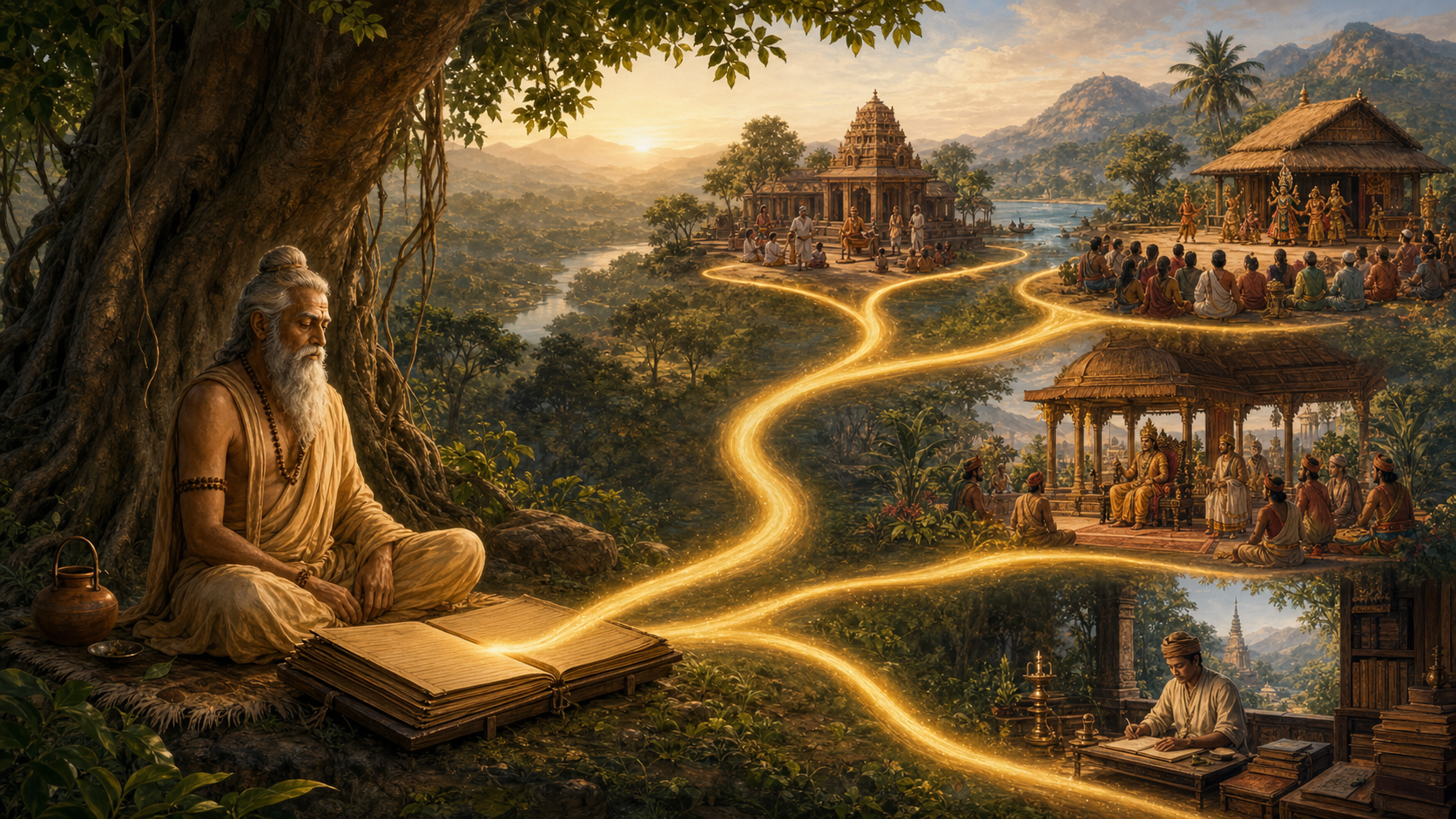
You can recognize a vast family of Rama narratives without treating them as interchangeable. Valmiki remains the starting point because the Sanskrit Ramayana supplies the foundational narrative, aesthetic design, and ethical bearings against which later tellings become intelligible. Your practical task is to identify what kind of work you have, what it changes, and what that change is meant to accomplish.
The false choice between one Ramayana and many
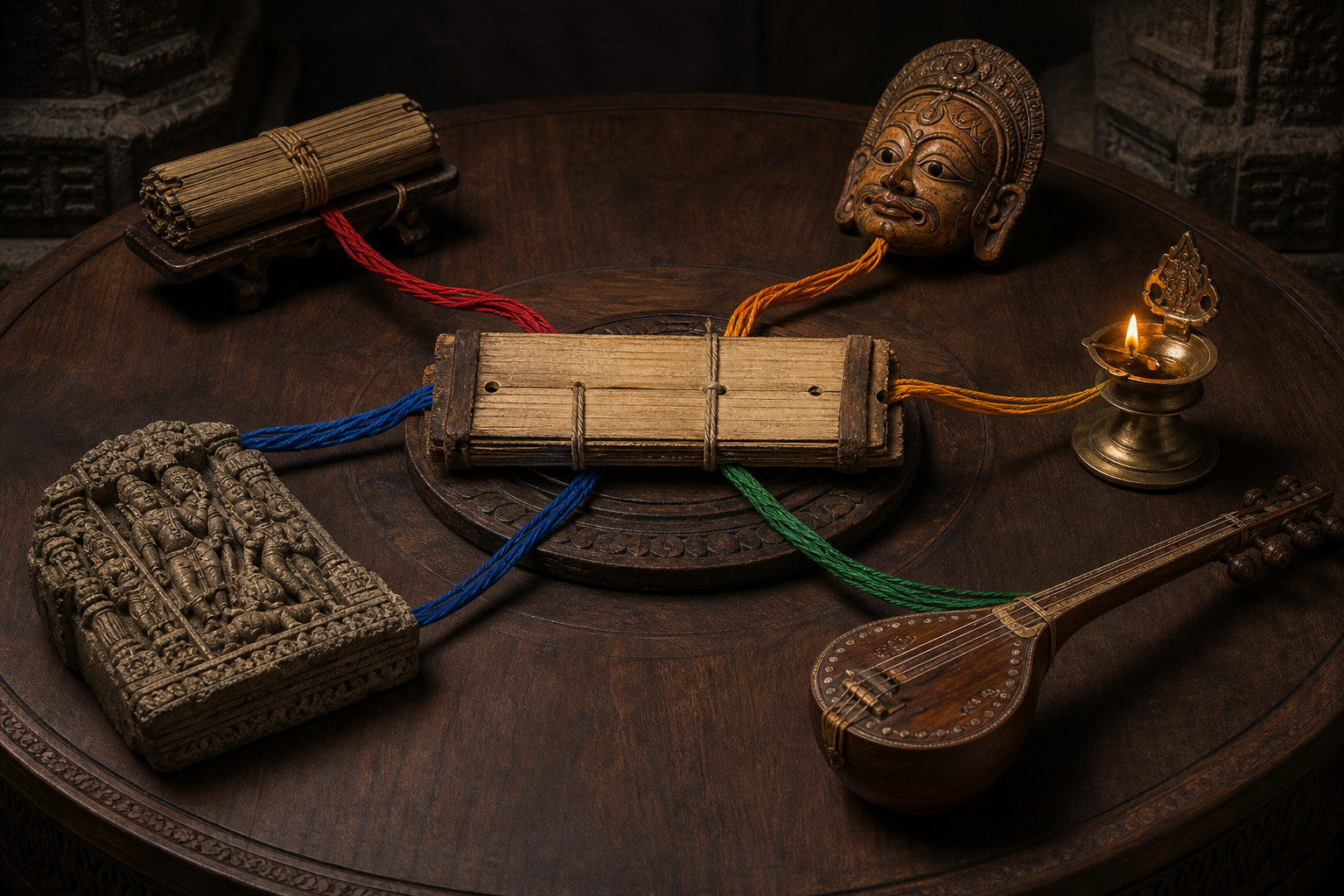
Plurality is a fact of reception. Equivalence is a judgment. Confusing the two causes most of the argument.
The name Ramayana can be used loosely for very different things: the Sanskrit epic attributed to Valmiki, a Buddhist or Jain recasting, a devotional expansion, a regional literary composition, a Sanskrit play, a village performance, or a Southeast Asian adaptation. These works belong to the same civilizational conversation, but they do not have the same genre, purpose, chronology, or relationship to Valmiki.
Counting versions tells you how far Rama’s story travelled and how deeply communities made it their own. A number cannot tell you which narrative supplied the baseline, which work achieved the greatest literary authority, or why a particular variation arose. The phrase "300 Ramayanas" usefully points to plural reception when used with care. It does not prove that the tradition lacks a centre.
The opposite inference is no better. Valmiki’s primacy does not make the Kampa-ramayanam, Ramacaritamanasa, Paumacariya, Ramakien, or a local performance worthless. An adaptation can possess devotional depth, literary distinction, or ethical seriousness without becoming the ancestor of the narrative it adapts. Primacy and later excellence are separate questions.
Use two axes whenever someone invokes "another Ramayana." First ask how the work is related to Valmiki: does it translate, condense, expand, dramatize, relocate, reinterpret, or substantially recast the story? Then ask what the work is trying to do: cultivate bhakti, teach a doctrine, create theatrical rasa, transmit household ethics, serve ritual performance, or apply a modern theory. Once those questions are answered, difference stops being a slogan and becomes something you can examine.
Why Valmiki remains the indispensable starting point

Valmiki’s position rests on more than a claim to age. The Ramayana is honoured as the adi-kavya, the foundational poem whose union of narrative, character, ethical conflict, and rasa became a standard for later poets. Subsequent tellings become recognizable as Ramayanas because a durable narrative and moral architecture already exists for them to inherit, emphasize, or alter.
Rasa is essential to that architecture. It is not merely the private emotion of a character or the reader’s opinion about a plot decision. It is the shaped aesthetic experience through which grief, courage, devotion, conflict, and moral consequence become contemplatively intelligible. If you reduce the epic to a checklist of who behaved correctly, you miss how poetry forms ethical perception before it produces a verdict.
Maryada matters for the same reason. It refers to ethical boundedness: the limits and disciplines within which duty, authority, loyalty, and personal desire must be negotiated. Rama’s importance is not exhausted by one isolated decision. His character is disclosed through a sustained pattern of conduct under pressure. A retelling may interpret that pattern differently, but it should not be allowed to smuggle in a new moral premise and then present it as the only possible meaning of Valmiki.
Murari captured the creative side of this relationship in Anargha-raghava. Earlier poets had already used Rama’s story, yet its abundance of noble qualities still gave later poets worthy material through which to repay their debt to language. Repetition was not the problem. The real question was whether a new poet could reveal the old narrative’s qualities through fresh artistry.
Anandavardhana supplied the corresponding restraint: an accomplished rasa-structure should not be subjected to arbitrary innovation that works against its governing aesthetic logic. That does not forbid every change. It gives you a way to distinguish a purposeful liberty from a distortion. A new scene, emphasis, or characterization may deepen the experience; an alteration made only to reverse the epic’s moral direction requires much stronger justification.
This is why Valmiki should be your first comparison text. If a later work rehabilitates Kaikeyi, changes the presentation of Ahalya, expands Sita’s story, or turns Rama into the vehicle for a particular philosophical teaching, begin by establishing what the Valmiki narrative actually does. Otherwise, you may unknowingly use a later detail to judge the foundational epic.
Exact dating and the history of textual layers remain debated, so an exact year should not be manufactured for the sake of certainty. The more defensible claim is relative: the Ramayana follows Vedic revelation and precedes the redaction of the Mahabharata, which remembers Rama’s story in several places, while the Ramayana does not refer to Mahabharata events. A prudent chronology can recognize a pre-Buddhist core alongside later accretions shaped by transmission, performance, and teaching. Primacy does not require pretending that a living epic passed through history without layers.
Put each Ramayana telling on the right shelf
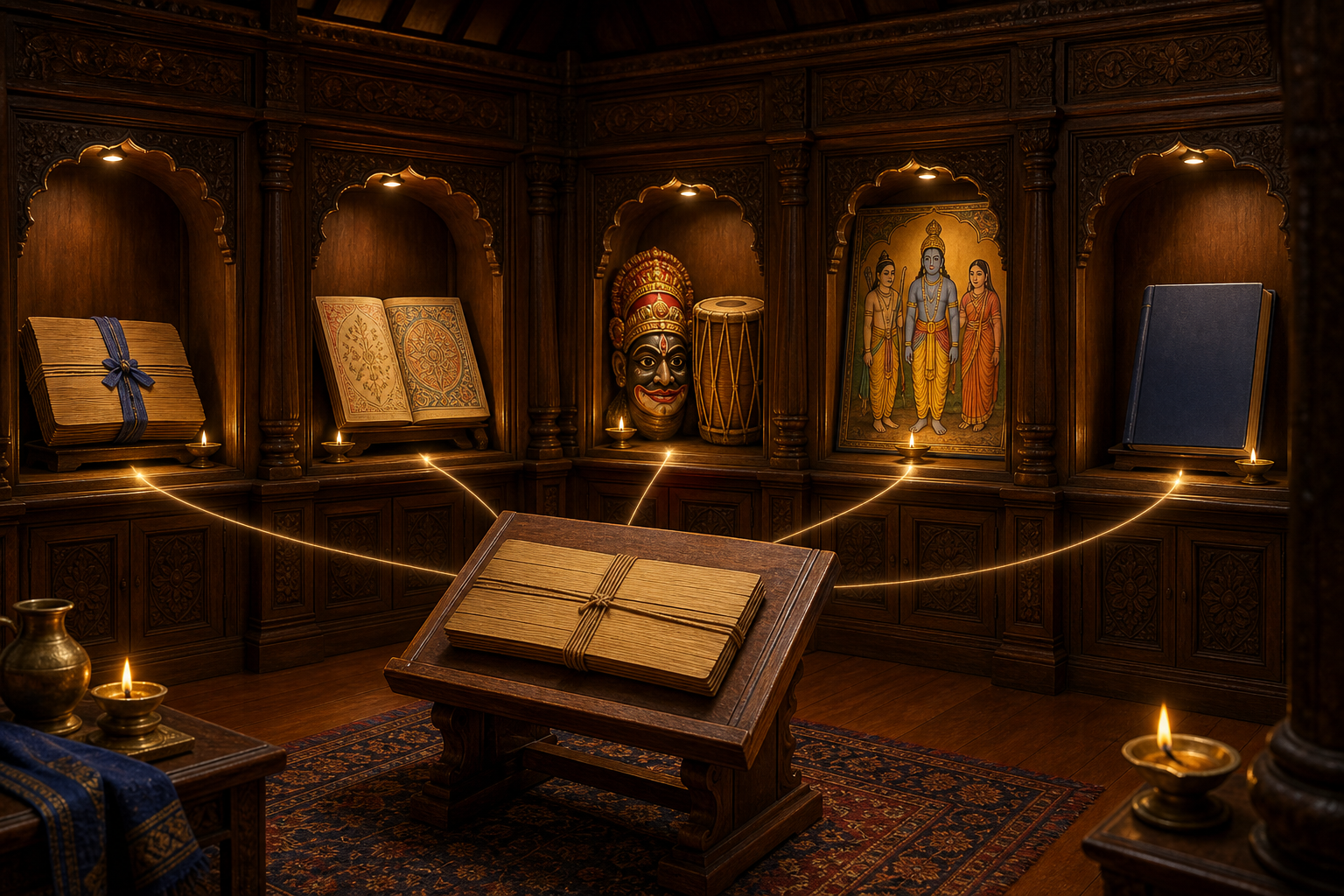
You will read more accurately if you classify a work before interpreting its variations. The categories overlap, but they prevent a Buddhist teaching narrative, a courtly drama, and a folk performance from being treated as though they made the same kind of claim.
| Kind of telling | Representative examples | Best first question | Common mistake |
|---|---|---|---|
| Foundational Sanskrit epic | Valmiki Ramayana | How do rasa, character, maryada, and statecraft work together? | Reading it through a detail introduced by a later composition. |
| Dharmic doctrinal recasting | Pali Dasaratha Jataka; Vimalasuri’s Paumacariya | Which Buddhist or Jain ethical concern governs the adaptation? | Treating doctrinal difference as proof that no shared moral horizon exists. |
| Devotional, didactic, or expansive Sanskrit composition | Adhyatma-ramayana; Ananda-ramayana; Adbhuta-ramayana; Yoga-vasistha | What theology, dialogue, teaching, or marvel has been added? | Assuming that attribution to Valmiki makes every work identical in purpose or textual status. |
| Regional literary and bhakti tradition | Kampa-ramayanam; Krittivasa-ramayana; Ramacaritamanasa | How do language, devotion, regional taste, and household ethics reshape the telling? | Calling an independent literary achievement a mere translation. |
| Classical kavya and drama | Bhasa; Kalidasa’s Raghuvamsa; Bhavabhuti’s Uttararama-carita; Murari’s Anargha-raghava | How does poetic or theatrical license heighten rasa or recast a character? | Back-projecting a playwright’s invention into Valmiki. |
| Living performance and transregional adaptation | Bharatanatyam; Kathakali; Yaksagana; Kutiyattam; Tolubommalata; Ravanachhaya; Kakawin Ramayana; Ramakien; Reamker | What does the medium or cultural setting require the performers to make visible? | Using local distinctiveness either to deny Indian ancestry or to erase local creativity. |
| Modern analytical interpretation | Marxian, psychoanalytic, subaltern, or narrowly political readings | What reception-historical or social question does the lens illuminate? | Allowing the analytical framework to replace the epic’s aesthetic and spiritual horizon. |
These shelves are navigational, not rigid. The Ramacaritamanasa is both regional and devotional. The Kakawin Ramayana is literary as well as transregional. Yaksagana is a performance tradition rooted in a regional cultural world. Classification should help you ask a sharper question, not force a living tradition into one box.
The doctrinal retellings deserve particular care. The Dasaratha Jataka and Paumacariya use Rama’s moral stature within Buddhist and Jain pedagogical worlds. Their emphases can redirect reflection toward renunciation, liberation, non-violence, or a community’s understanding of exemplary conduct. You should neither dismiss them as defective copies nor use their differences to erase the genealogy that makes the recasting intelligible.
Shared dharmic concerns do not require identical theology. Hindu, Buddhist, and Jain tellings can reason differently about ahimsa, kingship, duty, and liberation while remaining part of a recognizable moral conversation. Sikh relevance is best understood as ethical resonance through discipline, rectitude, and service, not as a claim that precisely the same Ramayana textual genealogy applies.
Classical poets show how variation can be deliberate rather than careless. Bhāsa offers a striking rehabilitation of Kaikeyi. Kalidasa’s Raghuvamsa gives the Ahalya episode its famous stone-transformation treatment. The Citra-pata-ramayana imagines Sita drawing only Ravana’s feet because she had never looked at his face. These are memorable interpretive choices, but each belongs to a particular later act of literary or popular imagination. None should be cited casually as proof of what every Ramayana says.
The same discipline applies across regions. Tamil, Bengali, and Avadhi tellings nourished regional bhakti and public ethical instruction. The Old Javanese Kakawin Ramayana, Thailand’s Ramakien, Cambodia’s Reamker, Laos’s Phra Lak Phra Lam, Myanmar’s Yama Zatdaw, and the Malay Hikayat Seri Rama show how extensively the epic could be localized. Adaptation across South and Southeast Asia demonstrates both continuity and invention. Ancestry does not erase local authorship, and local authorship does not cancel ancestry.
Performance adds another mechanism of change. A dance form must embody emotion through gesture. A play must make conflict visible within stage time. Puppetry depends on strong silhouettes, recognizable voices, and memorable scenes. These pressures can amplify an episode or character without declaring that the amplification belongs to the oldest recoverable narrative. When you know what the medium demands, variation becomes easier to interpret.
Key takeaways: how to assess a Ramayana retelling
- Name the work precisely. Replace "the Ramayana says" with the title, tradition, language, or performance form you actually mean. This prevents one local detail from being universalized.
- Identify its function before judging its changes. A Jain pedagogical epic, an Avadhi bhakti composition, a Sanskrit drama, and a shadow-puppet performance solve different artistic and ethical problems.
- Establish the Valmiki baseline. Read the corresponding episode in the foundational epic before deciding whether a later version clarifies, intensifies, redirects, or contradicts it.
- Track the exact alteration. Note whether the retelling changes an event, motive, character, outcome, theological claim, or simply the scene’s emphasis. Do not treat every variation as equally consequential.
- Apply three tests. Ask whether the change preserves aesthetic integrity, supports a coherent ethical purpose, and is being interpreted with contextual humility.
- Keep the conclusion at the scale of the evidence. A feature of one play proves something about that play. It does not automatically prove what Valmiki, every regional tradition, or all dharmic communities believe.
The aesthetic test asks what the alteration does to rasa. Does it deepen your encounter with courage, grief, devotion, restraint, or moral cost? Does it make an implicit tension dramatically visible? Or does it produce a reversal that exists mainly to shock the inherited tradition? Fidelity need not mean literal sameness, but creative freedom should have an intelligible artistic purpose.
The ethical test asks whether the telling forms a coherent reflection on dharma. In a Buddhist or Jain work, that coherence may place greater weight on the doctrinal priorities of that tradition. In a bhakti composition, devotion may move to the foreground. A difference can therefore be meaningful within its own work without becoming the controlling interpretation of Valmiki.
The humility test works in both directions. Traditional reverence should not force you to pretend that every beloved detail appears in the foundational epic. Modern criticism should not pretend that Marxian, psychoanalytic, subaltern, or political categories are the narrative’s own complete explanation. Modern frameworks can illuminate reception and social texture, but they become reductive when they make rasa, spiritual purpose, and ethical formation disappear.
For a reading group or classroom, sequence matters. Begin with one complete episode in Valmiki, not a summary assembled from popular memory. Read one later handling of the same episode next. Record four things: the baseline, the variation, the likely literary or doctrinal purpose, and the effect on rasa or dharmic reasoning. Only then introduce a modern analytical lens. This order makes it harder for a theory or a familiar later detail to replace the narrative before students have encountered it.
If Valmiki is not the first version available to you, you can still read responsibly. Note the exact title in front of you, enjoy it on its own terms, and suspend universal claims until you have compared the relevant scene. Accessibility may determine where you begin; it need not determine what you later treat as foundational.
This method also improves public debate. When someone claims that "in one Ramayana" a decisive event happens differently, ask for the named work and episode. Then ask whether the variation changes a secondary detail, a character’s motive, or the story’s ethical destination. A citation to an adaptation may prove that the adaptation exists. It does not, by itself, settle the meaning or authority of the Valmiki Ramayana.
The next time "which Ramayana?" appears in a family discussion, classroom, or online argument, answer with two questions: which named work, and what was it made to do? Then return to the corresponding Valmiki episode before judging the variation. That small discipline will improve the conversation more than another argument about how many versions can be counted.