
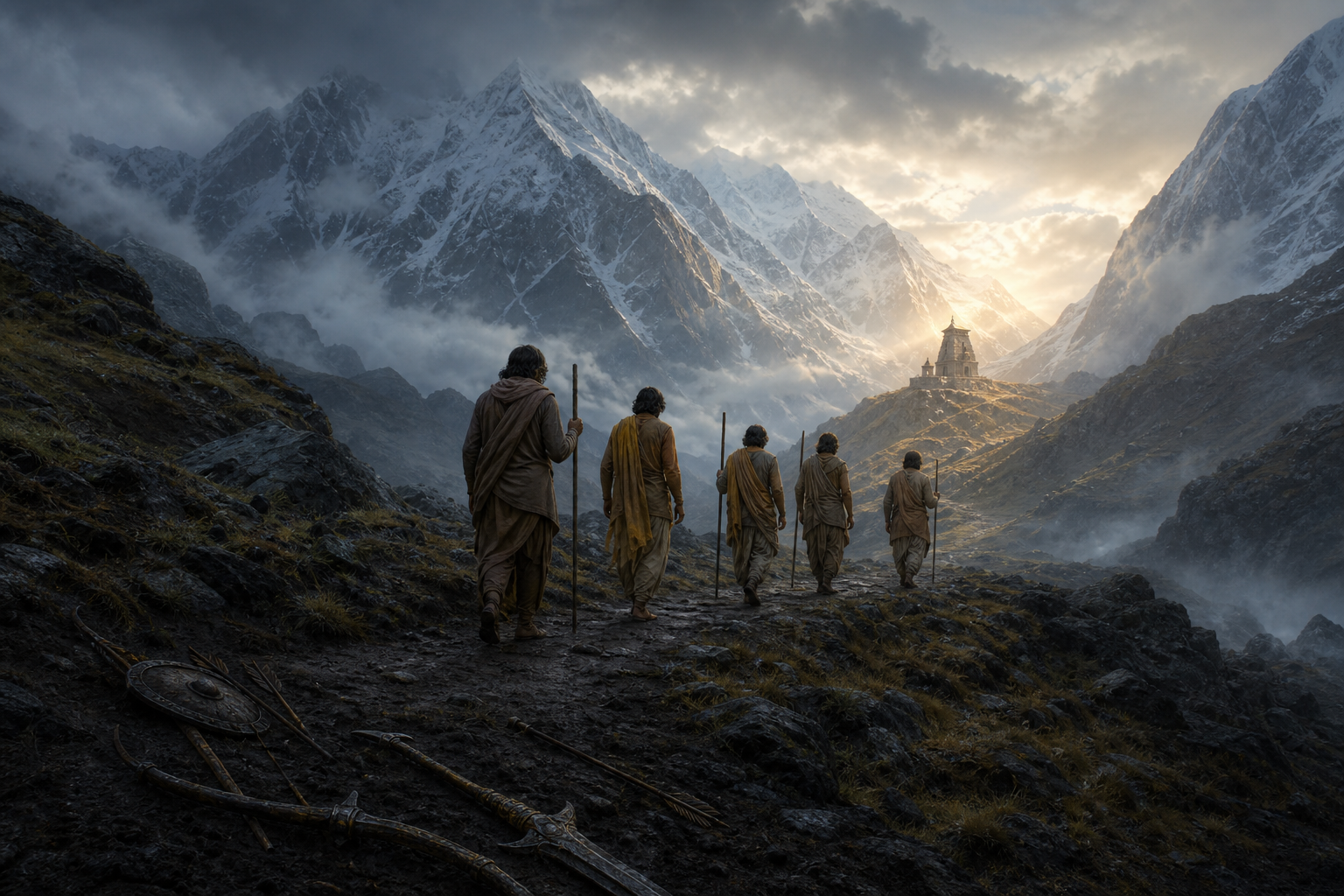
If you have ever done what seemed necessary and still felt troubled by how you did it, the Pandavas’ journey after Kurukshetra speaks directly to your problem. Their victory did not quiet their conscience, and Shiva did not offer them instant relief.
The lesson is demanding but practical: a just cause does not purify every method, and remorse becomes useful only when it leads to examination, repair, discipline, and changed conduct. Panch Kedar gives that movement a sacred geography.
A just cause does not make every method pure
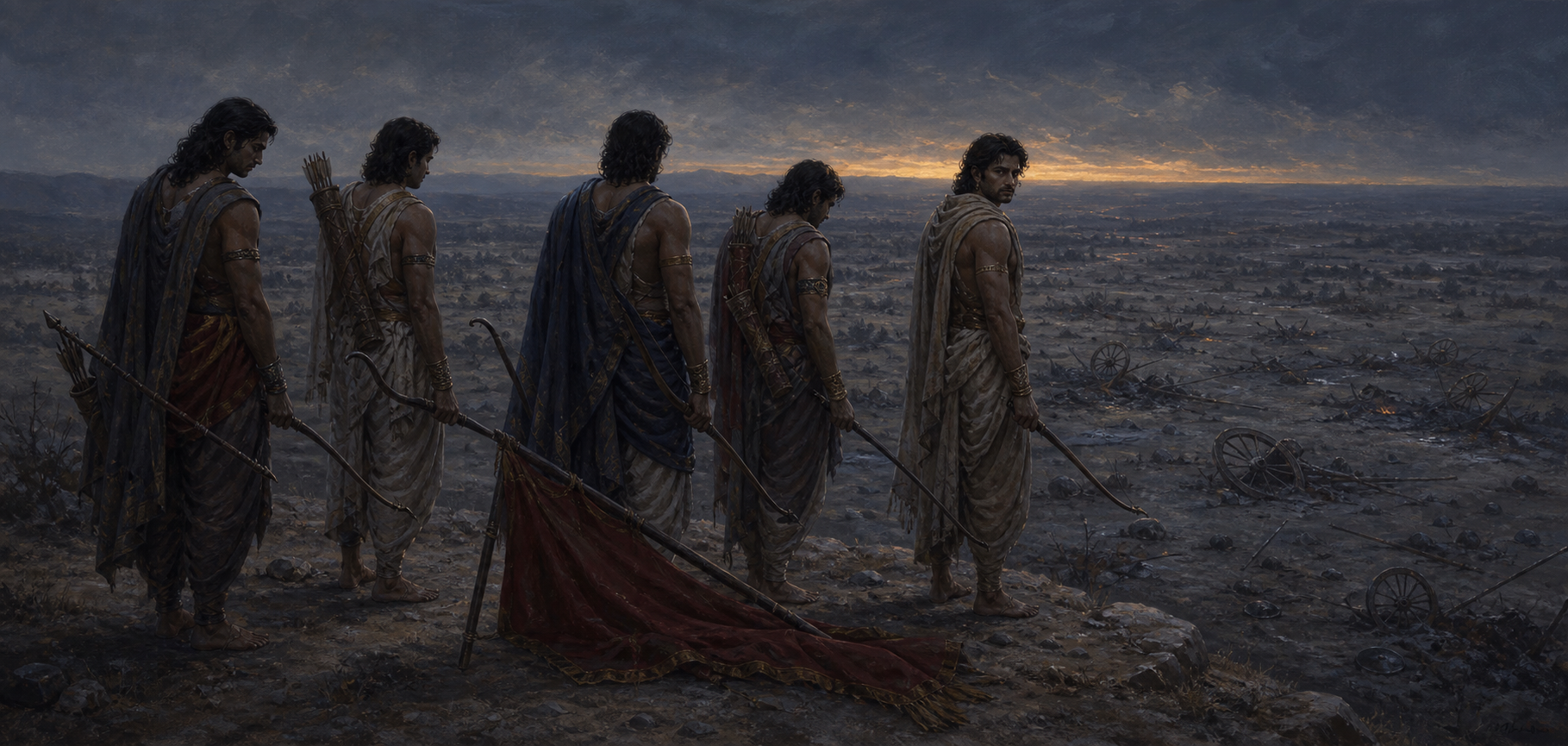
Kurukshetra is remembered as a dharma-yuddha, a war fought over the restoration of rightful order. Yet victory did not leave the Pandavas morally untouched. Bhishma was defeated with Shikhandi positioned before him. Drona was broken by the carefully framed declaration concerning Ashvatthama. Karna was killed while struggling with his chariot wheel. Bhima struck Duryodhana below the waist. Within the epic’s moral world, these acts remain part of the victors’ burden, even when they occurred within a larger struggle against adharma.
This is what the familiar principle that dharma is subtle asks you to notice. Moral judgment cannot be reduced to a scoreboard. Winning does not prove that every decision was righteous, just as remorse does not necessarily prove that the entire cause was wrong.
The Shanti and Anushasana Parvas place Yudhishthira under Bhishma’s extended instruction after the fighting has ended. The subjects include the duties of rulers, conduct during emergencies, charity, restraint, and prayaschitta, or expiation. The sequence matters. The epic does not move directly from victory to celebration. It moves from victory to moral inquiry and from moral inquiry to the work of restoring order.
When you examine a difficult decision, separate three questions that people often collapse into one:
- Intention: What legitimate good were you trying to protect, and where did anger, pride, fear, or revenge enter?
- Method: Did you use deception, humiliation, coercion, or disproportionate force even if your objective was defensible?
- Consequence: Who now carries the cost of your decision, including people you did not intend to harm?
Atonement begins when you can answer all three without using a good intention to conceal a harmful method. The Pandavas did not renounce their responsibility for resisting adharma. They accepted responsibility for the residue left by the way the war was fought.
Why Shiva withdrew instead of granting quick absolution

The textual layers of the tradition should be kept clear. The Mahabharata supplies the profound remorse, ethical uncertainty, and postwar teaching. The pursuit from Kashi into the Himalayas, Shiva’s concealment as a bull, and the manifestation at five shrines are preserved more explicitly in the Kedarakhanda of the Skanda Purana and in Garhwal’s regional memory. This distinction prevents a careless claim that every detail belongs to one passage, while preserving the theological continuity of the tradition.
The Pandavas first sought Shiva at Kashi, but he withdrew. Their pursuit continued northward, with Guptkashi, the hidden Kashi, preserving the memory of concealment in its name. In the Himalayan culmination of the narrative, Shiva assumed the form of a bull. Bhima recognized him and tried to seize him, but the bull began to disappear into the earth. The manifestations that followed became associated with the five sanctuaries of Panch Kedar.
Shiva’s withdrawal is best understood as spiritual instruction, not divine petulance. The Pandavas wanted darshana, but an immediate audience could have been mistaken for an easy acquittal. Delay forced them to remain with the burden they hoped to resolve. The journey converted regret into tapas.
That distinction still matters. Regret asks, “How can I stop feeling bad?” Prayaschitta asks, “What must become different because of what I did?” The first can remain centered on your discomfort. The second turns toward truth, restitution, restraint, and the people who bore the consequences.
Shiva is Ashutosha, readily pleased, but grace is not a ritual purchase. His elusiveness teaches that forgiveness cannot be used to bypass transformation. If your apology pressures another person to reassure you, or if your worship leaves the harmful pattern intact, you are still trying to seize absolution on your own terms. Mature repentance accepts that repair may be slow and that another person’s forgiveness cannot be demanded.
How the five shrines map the work of reintegration

The bull is especially meaningful because the vrishabha is an emblem of dharma, the sustaining order the Pandavas had fought to defend but had also wounded through morally costly acts. Shiva’s manifestation across five places turns a single encounter into a circuit. The seeker cannot grasp the whole at once.
One fruitful devotional reading treats each manifestation as a stage of ethical repair. This is an interpretive map, not a claim that every temple lineage assigns one fixed psychological meaning to each shrine.
| Shrine | Manifestation in the lore | Discipline it can represent | Question to carry |
|---|---|---|---|
| Kedarnath | The hump | Restoring the strength to bear responsibility | What cost of repair have I been avoiding? |
| Tungnath | The arms | Disciplining action | Which behavior must stop, begin, or be corrected? |
| Rudranath | The face | Purifying identity and self-presentation | What truth about myself have I refused to face? |
| Madhyamaheshwar | The navel and stomach | Digesting intention and consequence | Which motive am I still defending instead of examining? |
| Kalpeshwar | The matted hair | Surrendering pride and control | Can I do what is right without controlling whether I am praised or forgiven? |
This reading changes how you approach the yatra. Panch Kedar is not merely five opportunities to request blessings. It can become a staged examination of burden, action, identity, motive, and pride. Physical ascent may support that work by demanding patience and vigilance, but hardship alone is not repentance. A difficult trek does not repair a neglected duty or erase harm done to another person.
If you undertake the pilgrimage, give each shrine a corresponding practice. At Kedarnath, name the responsibility you must carry. At Tungnath, commit to a changed action. At Rudranath, relinquish a flattering self-description that no longer survives honest scrutiny. At Madhyamaheshwar, examine the motive beneath your stated reason. At Kalpeshwar, release the demand for recognition or immediate closure. Then bring those commitments home. A yatra that ends when the traveler returns has not yet completed its moral purpose.
How to begin atonement before you reach the Himalayas

The Pandavas’ pattern does not require you to imitate a king, a warrior, or a Himalayan pilgrim. It asks you to stop treating remorse as either useless self-punishment or automatic proof of virtue. Remorse is valuable when it reveals a duty.
Traditional prayaschitta can include vrata, dana, tapas, and tirtha-yatra: a vow that places a limit on future conduct, giving that loosens possessiveness, austerity that retrains desire, and pilgrimage that removes the seeker from ordinary habits. None of these should become a substitute for direct repair. If property can be returned, a falsehood corrected, a duty resumed, or an injured person given meaningful restitution, the devotional act should support that repair rather than displace it.
The wider Dharmic family offers related disciplines without making the traditions interchangeable. Jain pratikraman gives structured attention to lapses involving ahimsa and truth, followed by resolve. Buddhist teaching places weight on intention and the purification of conduct through sila; the transformation of Angulimala is meaningful because his way of living changes, not because the past is declared unreal. Sikh practice joins humility and remembrance in ardas with seva, directing moral seriousness outward into service even where pilgrimage is not mandatory.
The shared grammar is more important than superficial sameness: acknowledge the lapse, examine the intention, restrain repetition, repair what can be repaired, and cultivate a different way of acting. At the public level, this also explains why post-conflict penance cannot be confined to private ritual. A ruler or institution must translate remorse into just governance, disciplined power, charity, and reforms that reduce the chance of repetition.
Key takeaways
- A righteous objective and righteous conduct are related, but they are not identical.
- Examine intention, method, and consequence separately; a good answer in one category cannot erase failure in another.
- Shiva’s withdrawal represents purification through delay, not permanent rejection of the repentant seeker.
- Panch Kedar can be approached as a five-stage discipline of responsibility, action, truthful identity, examined motive, and surrendered pride.
- Ritual, charity, austerity, and pilgrimage should accompany concrete repair, never replace it.
- Grace may be received, but forgiveness from another person cannot be seized, scheduled, or demanded.
Choose one victory, decision, or quarrel that still troubles you. Write down its intention, method, and consequence. Then identify one repair you can make and one discipline that will prevent repetition. Begin there, without waiting for the mountains. That is where the road to Panch Kedar truly opens.