
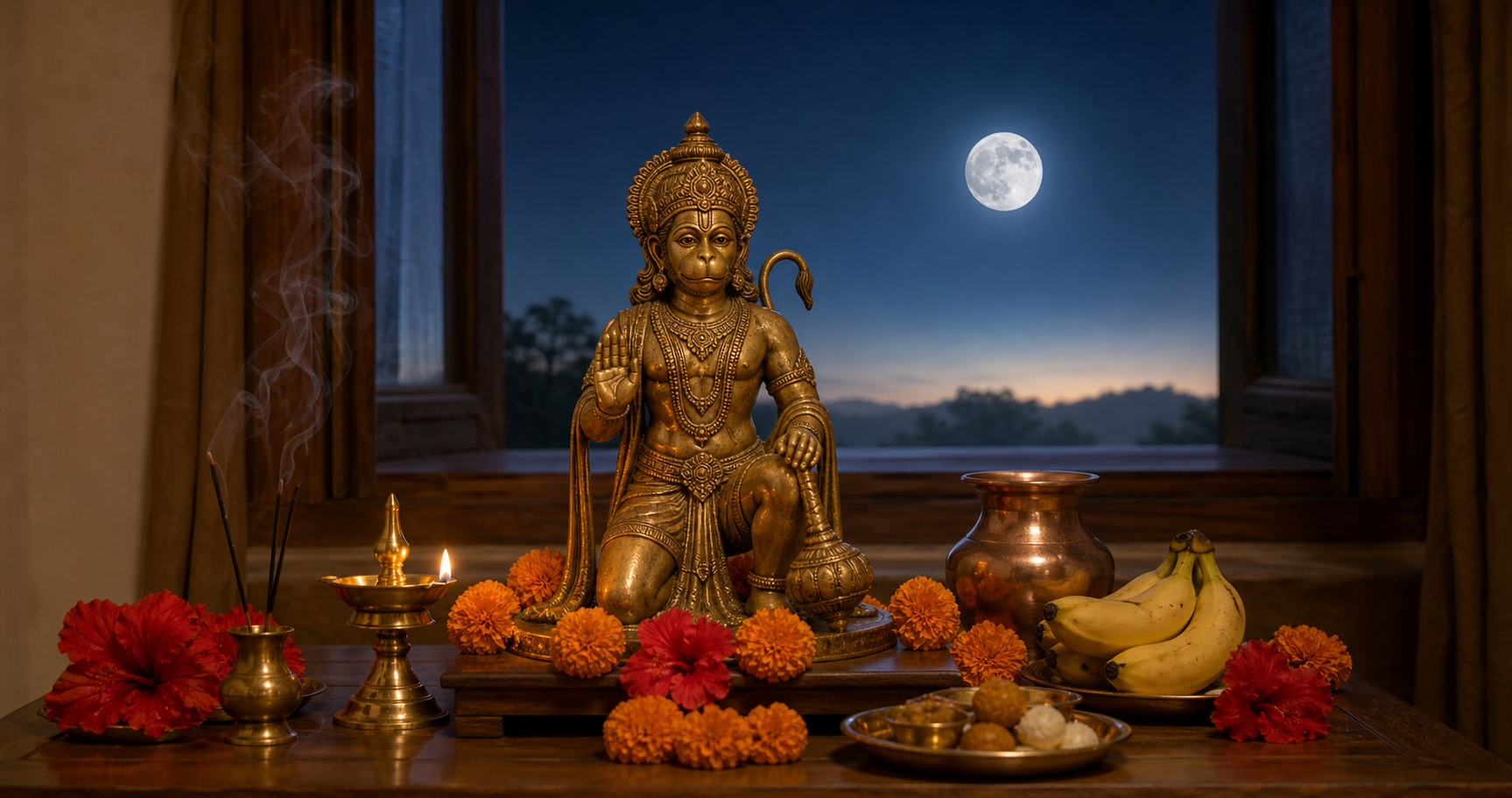
You may see April 1 marked for Hanuman Jayanti Upvaas and April 2 marked for Hanuman Jayanti or Chaitra Purnima. That is not necessarily a calendar error. The fast, the festival worship, and the Purnima tithi can occupy different parts of two consecutive civil dates.
For most Indian households following the Chaitra Purnima observance in 2026, the practical sequence is straightforward: keep the preparatory fast on Wednesday, April 1, then complete Purnima-dependent Hanuman worship before 6:28 AM IST on Thursday, April 2. Your local Panchang and sampradaya remain decisive because regional Hanuman Jayanti traditions are not uniform.
The two-day calendar sequence for 2026
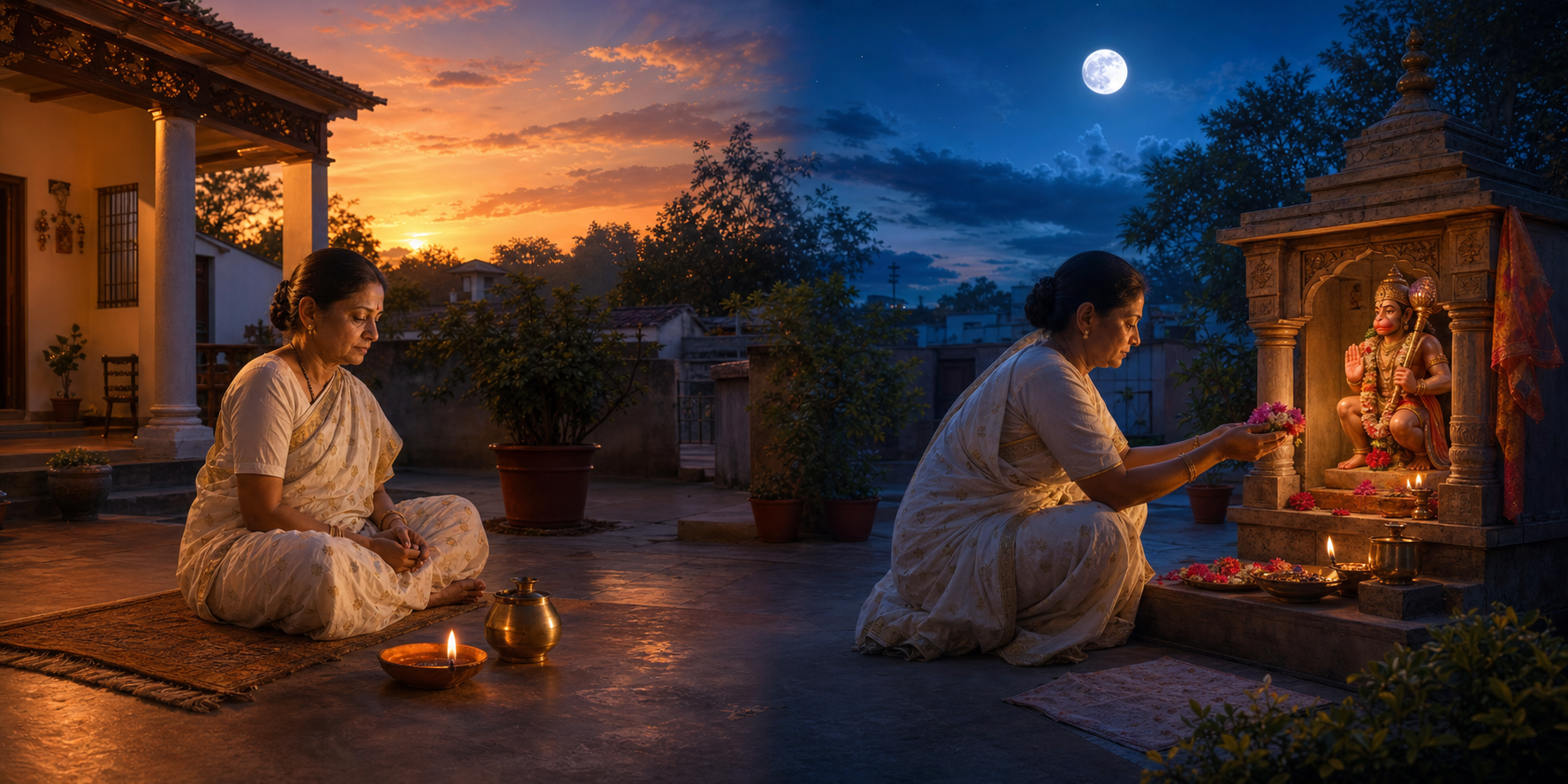
The cleanest way to plan the observance is to treat April 1 and April 2 as one devotional sequence. Chaturdashi provides the period of restraint and preparation; Purnima provides the culminating worship window.
| Date and time | Calendar position | What to plan |
|---|---|---|
| April 1, sunrise to sunset | Chaitra Shukla Chaturdashi is used for the Upvaas in most of the regional practice covered here | Take your sankalp, keep the appropriate form of fast, recite Hanuman Chalisa or Sundara Kanda, perform seva, and make parana after sunset |
| April 1 evening | The relevant tithi at a particular place must be checked locally | If your family also performs an evening-dependent Purnima rite, such as a customary Satyanarayan Puja, verify that Purnima is in force rather than assuming from the printed date |
| April 2 before 6:28 AM IST | Chaitra Purnima | Use the pre-dawn period for the principal Purnima-aligned Hanuman puja, japa, offering, and prayer |
| April 2 from 6:28 AM IST | Krishna Paksha Pratipada begins | You may continue Hanuman worship, temple attendance, charity, and recitation, but a rite that strictly requires Purnima should already be complete |
| April 3 at 7:16 AM IST | Krishna Paksha Pratipada ends | Use this only as a Panchang boundary; it does not extend the earlier Purnima ritual window |
The 6:28 AM boundary is not a deadline after which devotion becomes meaningless. It marks the astronomical change of tithi. A temple aarti, community meal, Hanuman Chalisa recitation, or act of charity held later on April 2 can still be a sincere part of the celebration. The distinction matters only when a ritual rule specifically requires Purnima tithi.
Do not infer the beginning of Purnima on April 1 from the information above. If an evening observance depends on Purnima being present, look up the exact start and end times for your city. This is especially important for a rite whose tradition gives precedence to the evening rather than the following morning.
Why April 1 and April 2 can both be correct
A Gregorian date and a tithi do not run on the same clock. The printed civil date changes at midnight. Hindu festival decisions often consider the tithi present at sunrise or during another prescribed part of the day. The tithi itself changes whenever the angular separation between the Sun and Moon crosses the next 12-degree division, regardless of midnight or sunrise.
Purnima is the fifteenth tithi of Shukla Paksha, when the Sun-Moon separation approaches 180 degrees. In this 2026 sequence, Purnima ends at 6:28 AM IST on April 2 and Krishna Paksha Pratipada then begins. That early transition explains why a full-moon festival can appear under April 2 even though most of the later civil day belongs to Pratipada.
Minute-level differences between Panchangs can arise from location, longitude, computational conventions, ayanamsha, and interpolation. If two calendars differ by a few minutes, use the one consistently followed by your temple or family. If they differ by an entire date, check whether they are applying different regional festival rules, locations, time zones, or Hanuman Jayanti traditions rather than assuming that one calculation is simply defective.
- Set the Panchang to the city where you will actually perform the worship.
- Confirm that the displayed time zone is local. The stated 6:28 AM endpoint is in IST, which is UTC+5:30.
- Read the tithi start and end times, not only the festival label printed beside a date.
- Check which part of the day your sampradaya requires: sunrise, pre-dawn, evening, or the mere presence of the tithi.
- Ask your regular temple which regional Hanuman Jayanti convention it follows before combining its program with a calendar from another region.
This last check matters because Chaitra Purnima is not the universal Hanuman Jayanti date across Bharat. Some South Indian traditions use observances connected with Margazhi or Dhanu and Moola Nakshatra, while other local customs use different tithis. A family rooted in one of those traditions should not abandon it merely because a national calendar highlights April 2.
A workable observance from Upvaas to Purnima puja
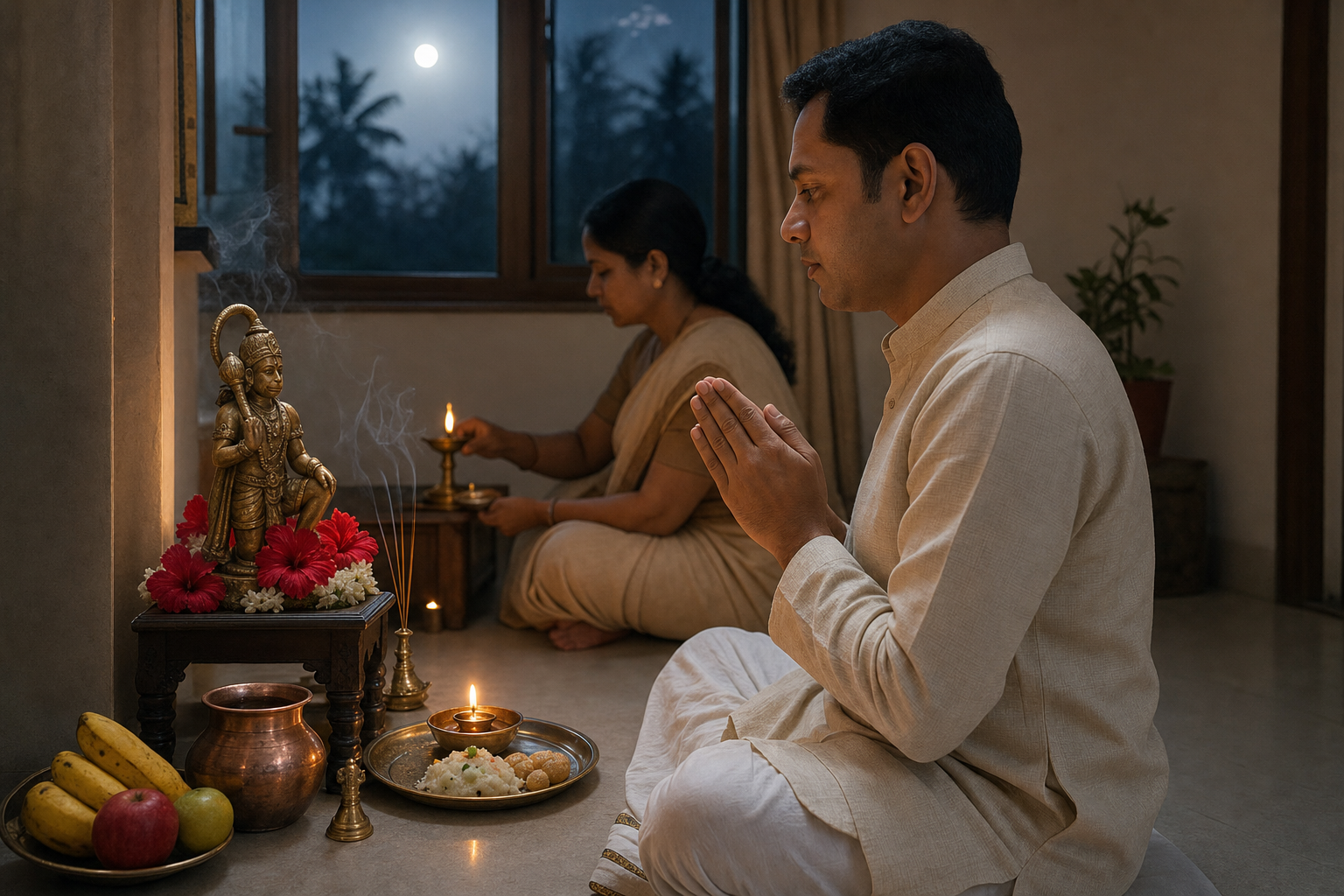
April 1: restraint, recitation, and seva
Begin with a sankalp you understand rather than a formula you cannot follow. State that you are keeping the observance in devotion to Shri Rama and Shri Hanuman, for greater truthfulness, self-restraint, courage, service, and the welfare of all beings. The purpose of the fast is to concentrate attention, not merely to accumulate hours without food.
- Before sunrise, bathe, clean the worship space, and place a murti or image of Shri Hanuman. An image of Shri Rama with Sita, Lakshmana, and Hanuman is equally suitable.
- Light a lamp and make your sankalp. Decide at this point whether you are keeping nirjala, phalahar, or ek-bhojan; do not make the fast harsher midway through the day.
- Offer a calm morning recitation of Hanuman Chalisa. If your household follows traditional multiples such as 11, 21, or 108, choose only a count you can complete with attention.
- Use the middle of the day for Sundara Kanda, Rama-nama japa, Maruti Stotra, Hanumat Kavach, or quiet study according to your lineage and available time.
- Make seva concrete. You might support annadanam, help with a temple activity, prepare food for someone in need, or quietly take responsibility for a task another person has been carrying.
- After sunset, conclude with a lamp, prayer, and simple prasad before taking a light sattvik meal if that is your chosen form of parana.
If feeding animals is part of your local practice, do it through responsible community arrangements. Food placed indiscriminately can harm wildlife, create conflict, and leave waste around a sacred space. Seva should reduce suffering rather than transfer the consequences elsewhere.
April 2: complete the Purnima-aligned worship early
Brahma Muhurta is commonly reckoned as roughly 96 to 48 minutes before local sunrise. It is useful for japa and meditation, but it must actually overlap Purnima if your aim is a Purnima-specific rite. Do not calculate it from an assumed sunrise or copy another city’s schedule. Check your local sunrise and the tithi endpoint together.
- Rise early enough that you are not beginning the puja a few minutes before the tithi changes.
- After bathing, light an oil or ghee lamp in a reusable holder. Keep the altar orderly rather than crowding it with offerings.
- Offer red or orange flowers if locally customary. Bananas, roasted chana, jaggery, boondi, or besan laddus are suitable customary offerings; follow your family practice for sindoor, betel leaves, and other sampradaya-specific items.
- Remember Shri Rama before or with Hanuman worship. Recite Hanuman Chalisa, Rama-nama, or the text your family normally uses.
- Complete any component that explicitly depends on Purnima before 6:28 AM IST, subject to the few-minute adjustment shown by your trusted local Panchang.
- Dedicate the fruit of the practice to wise strength, humility, and service. Share prasad without waste.
Do not let a large recitation target consume the whole ritual window. One attentive recitation completed within the correct period serves the observance better than rushing through a number selected for appearance. Longer parayana can begin on April 1 or continue later on April 2 without pretending that the later hours are still Purnima.
Hanuman’s example joins bala, buddhi, and dhairya with humility and seva. That combination gives you a practical test for the day: the discipline should make your conduct steadier and more useful to others. Fasting without patience, recitation without attention, or worship followed by avoidable waste misses that balance.
The Hanuman liturgy is distinctly Hindu, while disciplined reflection, ethical restraint, compassion, and service also resonate across Buddhist, Jain, and Sikh community life. A shared Dharmic ethos does not require us to erase different scriptures, calendars, or forms of worship. At a community gathering, unity is better expressed through respectful participation and useful seva than by claiming that every tradition observes the same festival.
Choose a fast that preserves health and attention
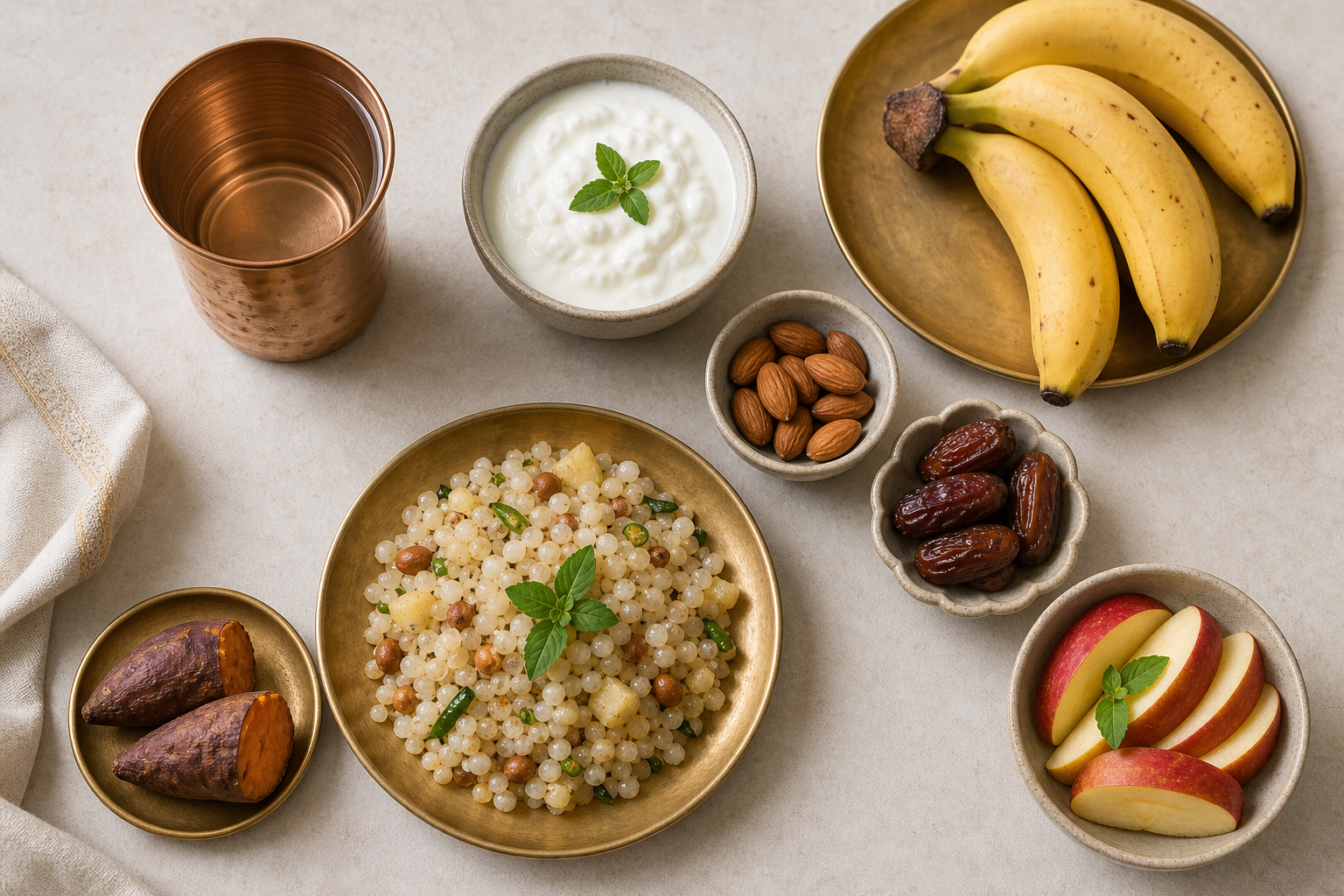
The demanding form of a vrata is not automatically the most appropriate form. The stated 2026 Upvaas is generally kept from sunrise to sunset on April 1, with parana after sunset, but the food and water discipline should match your health, work, and established practice.
- Nirjala: No food or water. This is rigorous and should be attempted only by experienced practitioners in good health. It is not a suitable experiment for someone who has never fasted this way.
- Phalahar: Fruit, water, milk, soaked nuts, or other foods accepted by your household’s vrata rules. This allows many householders to retain energy for prayer, work, and seva.
- Ek-bhojan: One simple sattvik meal, timed according to family custom. Upvaas preparations may use sabudana, rajgira, kuttu, or singhada flour where those ingredients are accepted locally.
People who are pregnant, elderly, managing diabetes or another chronic condition, taking regular medication, or doing strenuous physical work should not force a no-food or no-water fast. Children also need an age-appropriate observance. Seek medical guidance where a condition or medicine affects eating and hydration, and do not skip prescribed food, water, or medication to preserve the appearance of austerity. A gentler phalahar, ek-bhojan, additional japa, or seva can preserve the intention without creating avoidable harm.
If you keep phalahar, decide the permitted foods before the fast begins. Many families avoid onion, garlic, tea, and coffee, but rules differ. Following one coherent household or sampradaya discipline is more useful than collecting the strictest restrictions from unrelated traditions.
Break the fast after sunset with a small amount of prasad, fruit, roasted gram, or another simple accepted food. Eat slowly before deciding whether you need a light meal. If an accidental lapse occurs, do not answer it with unsafe compensatory fasting. Continue the devotion through japa, recitation, charity, and honest reflection.
Quick answers when calendars disagree
Is the Hanuman fast on April 1 or April 2 in 2026?
In the Chaitra Purnima sequence described here, the preparatory Upvaas is kept on April 1, associated in most regions with Chaitra Shukla Chaturdashi. The main Purnima-aligned worship follows early on April 2. If your lineage keeps a different Hanuman Jayanti date or fast rule, follow that established regional practice.
Can an April 2 evening puja still count as Purnima worship?
Not under the stated IST tithi boundary, because Purnima has ended by 6:28 AM and Pratipada is in force that evening. An evening Hanuman puja, aarti, recitation, or community program can still be devotional and worthwhile; it simply does not satisfy a rule that strictly requires Purnima tithi.
Does Abhijit Muhurat make a later Purnima rite acceptable?
No. Abhijit Muhurat near local solar noon can be used for suitable general undertakings, but a generic auspicious period does not restore a tithi that has ended. For a Purnima-specific rite, tithi predominance comes first.
What should devotees outside India do with 6:28 AM IST?
Convert the instant to your time zone, then consult a Panchang calculated for your actual location and local sunrise. Do not copy the Indian civil date after converting only the clock time. The tithi boundary refers to an astronomical instant, while the festival date can also depend on which tithi prevails at local sunrise or another prescribed period.
Before buying offerings or committing your family to a schedule, open the Panchang set to your city and write down just three things: local sunrise, the Purnima endpoint, and your temple’s rule for the observance. Once those agree, keep the puja simple enough to finish with attention and leave room for one genuine act of seva.
References
- DharmaRenaissance Blog – April 2, 2026 Panchang: Precise Purnima End, Krishna Paksha Start, and Sacred Timings for Rituals
- DharmaRenaissance Blog – Hanuman Jayanti Upvaas 2026: Chaitra Shukla Chaturdashi Guide, Vrat Vidhi, Timings, Benefits