

If you are trying to decide whether NHRC intervention will make Hindus in Jammu and Kashmir safer, look past the words “urgent report.” The decisive question is whether that demand produces a verifiable record of what happened, why the victims were selected, and what the authorities are doing to prevent another attack.
The allegations must be treated seriously, but they remain allegations until the evidence establishes an identity-based motive. An NHRC notice is not a finding of targeted violence, a declaration of guilt, or proof of police negligence. It is a mechanism for forcing those questions into an accountable process. You can insist on Hindu safety without claiming more than the investigation has established.
Key takeaways
- The NHRC’s request creates an accountability trail; it does not decide whether the killings were targeted.
- Investigators must establish not only the victims’ identity, but evidence connecting their selection to that identity or to a perceived affiliation.
- Arrests are only one measure of progress. Evidence preservation, witness safety, preventive deployment, victim support, and prosecutorial readiness matter just as much.
- Authorities can disclose case status, institutional responsibility, pending stages, and review dates without exposing witnesses or operational details.
- Effective advocacy separates verified facts, official allegations, and reasonable inferences instead of collapsing them into one claim.
An urgent NHRC report is leverage, not a verdict
The NHRC has sought an urgent factual report from the Jammu and Kashmir Police concerning allegations that Hindu civilians were deliberately targeted. That intervention matters because it requires the police response to be assembled, reviewed, and placed before an external human-rights institution.
Under Section 12 of the Protection of Human Rights Act, 1993, the Commission may inquire into alleged human-rights violations or negligence by public servants, call for official reports, recommend remedies, and monitor compliance. Its recommendations are not criminal convictions or self-executing court decrees. Their practical force comes from deadlines, follow-up questions, public scrutiny, and the obligation placed on authorities to explain what they did or failed to do.
A useful factual report should let the Commission distinguish four separate issues:
- What happened: a verified chronology, the case identifiers, the reported circumstances of each killing, and the present status of the alleged identity motive.
- How the case is being built: the investigating unit or Special Investigation Team, the offences invoked, witness statements, scene documentation, post-mortem and medico-legal material, and the status of forensic submissions.
- What is being done about continuing risk: protection for threatened people, patrol and response arrangements, security around vulnerable locations, and procedures for handling distress calls.
- How affected families are being supported: access to relief, medical or psychological care where needed, educational continuity for dependants, victim liaison, and witness-protection assessment.
Some details may properly remain confidential. The names or locations of protected witnesses, intelligence methods, and tactical deployments should not be released merely to satisfy public curiosity. Confidentiality, however, does not excuse a blank status report. Authorities can still identify the responsible agency, the stage reached, the next review point, and whether each required safeguard has been activated.
The word “targeted” must be proved with precision

The Hindu identity of a victim must never be treated as irrelevant. Nor can identity alone prove the motive for a killing. The proper question is whether evidence shows that a person was chosen because the person was Hindu, was believed to represent a Hindu institution or community, or carried some other perceived affiliation that motivated the attack.
Investigators therefore have to keep three questions separate:
- Was the killing intentional?
- Was this particular victim deliberately selected rather than encountered at random?
- What evidence explains that selection?
A single incident can be targeted; a series of similar attacks is not a prerequisite. A pattern may strengthen an inference about motive or organization, but the absence of a publicly visible pattern does not rule targeting in or out. The answer can come from words used during the attack, prior threats, reconnaissance, victim selection, communications among suspects, claimed responsibility, digital activity, or links between the incident and an organized network.
Different evidence answers different parts of the problem. Scene photographs and weapon trajectories help reconstruct the act. Ballistic comparison can connect a weapon or related incidents. CCTV, mobile video, call records, geofencing, and online communications may reveal movement, coordination, or motive. Witness accounts can explain what attackers said and how victims were selected. These methods become reliable only when investigators preserve original files, authenticated copies, forensic hashes, and an unbroken chain of custody.
This is why forwarding a clip through multiple messaging groups is not the same as preserving evidence. If you possess relevant material, retain the original file and device where possible, record when and how it was obtained, and provide it directly to the investigating authority or legal counsel. Do not edit it, add captions, publish a witness’s identity, or circulate a suspect’s unverified name. Public circulation can expose a witness, alert an offender, distort metadata, and make later authentication harder.
Precision is not a retreat from advocacy. It is what makes an allegation capable of surviving forensic examination, prosecution, and hostile scrutiny. The strongest demand is not “accept our conclusion immediately,” but “investigate the identity motive explicitly, preserve the evidence capable of proving it, and disclose the reasoned status when it is safe to do so.”
Protection should not wait for a completed prosecution
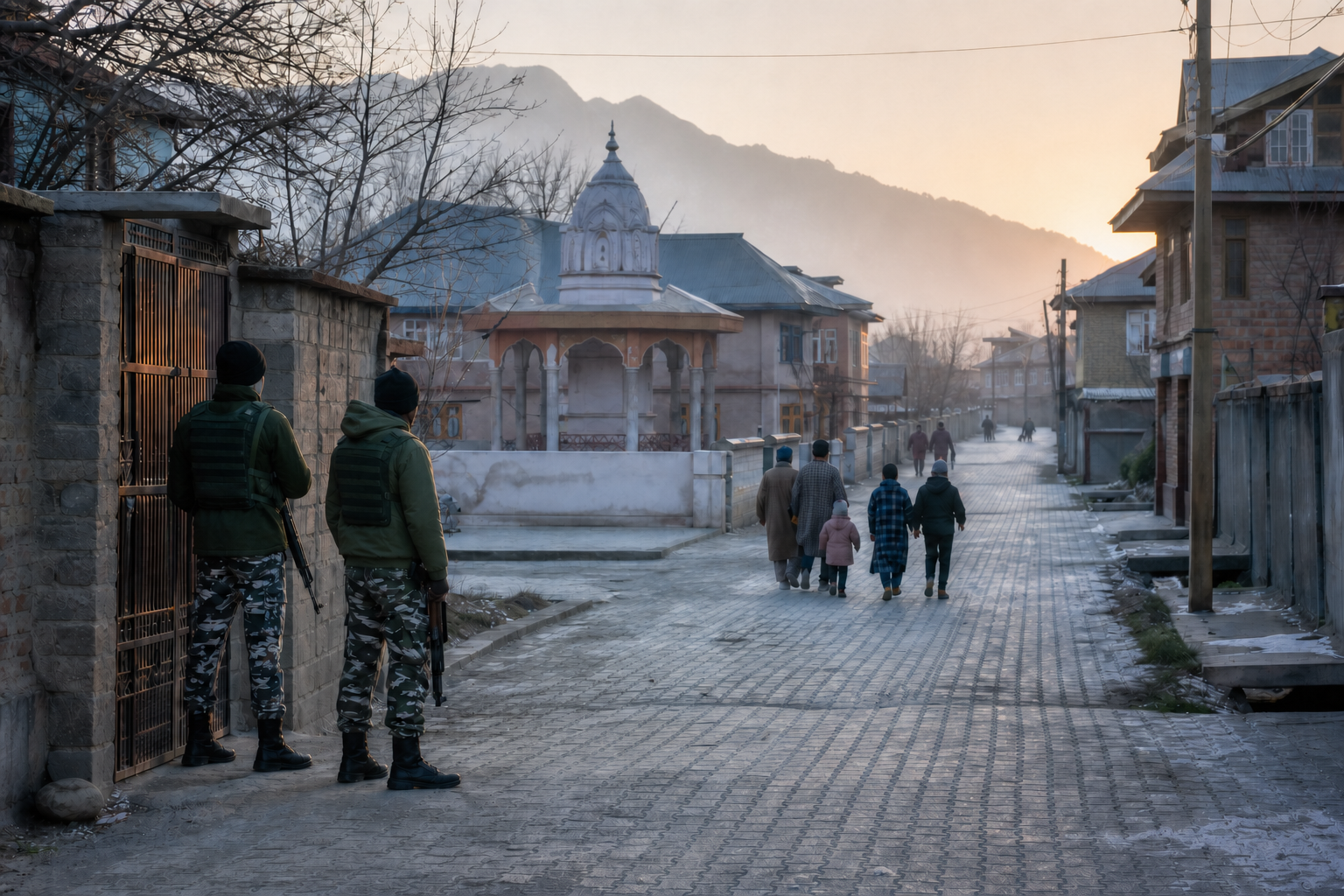
A criminal case may take time. A threat can mature much faster. Police do not need to wait for a charge sheet or final determination of motive before taking proportionate steps to protect people in an affected locality.
The immediate safety test is concrete. Have authorities assessed which families, schools, temples, markets, work routes, and commuter points face an elevated risk? Are quick-response arrangements, visible patrols, route checks, local liaison officers, and verified distress channels actually operating? Do residents know whom to contact, what information to give, and how a threat report will be acknowledged?
Witness safety deserves separate attention. The Witness Protection Scheme, 2018 provides measures such as identity shielding, relocation, and security cover according to assessed risk. A witness should not have to wait for intimidation to become physical violence before seeking an assessment. Protection should also be reviewed as the case changes, especially after an arrest, identification, public disclosure, or court appearance.
If you live in an affected area or are helping a family document threats, use a disciplined sequence:
- Save verified police and local liaison contacts in more than one household phone and keep an offline copy.
- Record the date, time, medium, exact words, caller or account details, and any earlier related incident. Preserve the original message, recording, envelope, or file.
- Report the threat through an official channel and request an acknowledgement, diary reference, complaint number, or other traceable identifier appropriate to the report.
- State the immediate risk plainly: who is threatened, whether an address or routine was mentioned, whether children or elderly relatives are exposed, and whether the suspected person knows the family’s movements.
- Ask for a threat assessment and a named follow-up contact. If a witness is involved, ask specifically whether witness-protection measures should be considered.
Do not publish a threatened person’s address, travel route, school, telephone number, or proposed relocation. Do not confront a suspected attacker or form an informal armed patrol. Community defence arrangements, where legally constituted, require clear authorization, training, command, and oversight; improvised action can endanger residents, contaminate evidence, provoke misidentification, and create legal exposure.
If danger appears imminent, contact the local emergency response and police immediately. An NHRC representation, public campaign, or accountability tracker is not an emergency-response mechanism. Families facing case-specific legal or security decisions should also obtain qualified legal assistance rather than relying on general public guidance.
Use an accountability tracker when official updates appear

A forceful statement can still leave the essential questions unanswered. When the police, administration, or NHRC publishes an update, test it against the same checkpoints each time. This prevents attention from fading after an announcement and makes gaps easier to identify.
| Checkpoint | Precise question | Evidence of meaningful progress |
|---|---|---|
| Incident classification | Is an anti-Hindu or other identity-based motive confirmed, unconfirmed, or excluded? | A reasoned status tied to available witness, digital, forensic, or intelligence material, with sensitive details withheld where necessary. |
| Case integrity | Are the case identifier, investigating body, legal provisions, scene record, and forensic stages accounted for? | Dated milestones, assigned responsibility, preserved exhibits, laboratory status, and an explanation of material delays. |
| Continuing protection | Which risks were identified, what safeguards were deployed, and when will they be reviewed? | A functioning liaison channel, locality-specific measures, verified distress procedures, and a scheduled reassessment. |
| Witnesses and families | Have threat assessment, protection, relief, care, and dependant support been considered in each eligible case? | A named point of contact, documented decisions, reasons for any refusal, and a route for correcting omissions. |
| NHRC follow-through | Once directions or recommendations are issued, who owns each action and when is compliance due? | A specific action, responsible office, target date, completion status, and evidence that the measure operates in practice. |
Not every box must contain publicly releasable evidence. “Investigation details cannot be disclosed” may be legitimate in relation to a witness, suspect, or intelligence lead. It is not a complete answer to questions about administrative ownership, whether a forensic submission is pending, whether a protection review occurred, or when the Commission expects a compliance response.
Watch for substitution between categories. Compensation does not replace prosecution. An arrest does not prove motive or guilt. A large deployment does not prove that distress calls are answered effectively. A new committee does not establish that evidence has reached the laboratory. Each measure should be credited for what it accomplishes, then tested for what remains undone.
Advocacy is strongest when every claim has a status
Hindu organizations, local associations, journalists, and concerned citizens can keep legitimate pressure on the process without turning uncertainty into rumor. The simplest discipline is to give every public claim one of three labels:
- Verified fact: supported by an identifiable official record, authenticated evidence, or an attributable public statement.
- Official allegation or case status: recorded by an authority but not yet proved through the completed investigative and judicial process.
- Inference: a conclusion drawn from known circumstances that still requires evidence or adjudication.
Keep a dated incident and response log. Record the case identifier, agency, last official update, protection request, acknowledgement, promised action, deadline if one was given, and actual completion. Link to the original notice or statement instead of copying a cropped screenshot. If a correction appears, add it to the same entry rather than quietly deleting the earlier claim. A transparent correction protects the credibility of the wider demand for justice.
If you are preparing a representation for the NHRC, organize it around the Commission’s actual human-rights role. Give a concise chronology; identify the affected people without exposing sensitive personal data; include complaint or case references; describe any prior warning, protection request, or administrative omission; state the immediate risk; and request a concrete remedy. That remedy might be a factual status report, a threat assessment, witness protection, victim liaison, relief processing, preservation of specified evidence, or time-bound compliance monitoring.
Avoid bundles of unverified social-media claims. Submit copies while preserving originals, separate direct knowledge from second-hand information, and explain why each attachment matters. If disclosure could expose a witness or affect a prosecution, let qualified counsel advise on what should be filed publicly, confidentially, or directly with investigators.
When the next official update appears, take five minutes to fill in the tracker. Where a field remains empty, ask one precise question: What is the present classification? Which office owns the action? What stage is pending? When will it be reviewed? What safe proof of completion can be released? That is how concern for Hindu lives becomes durable pressure for immediate protection, a prosecutable case, and institutional change.