
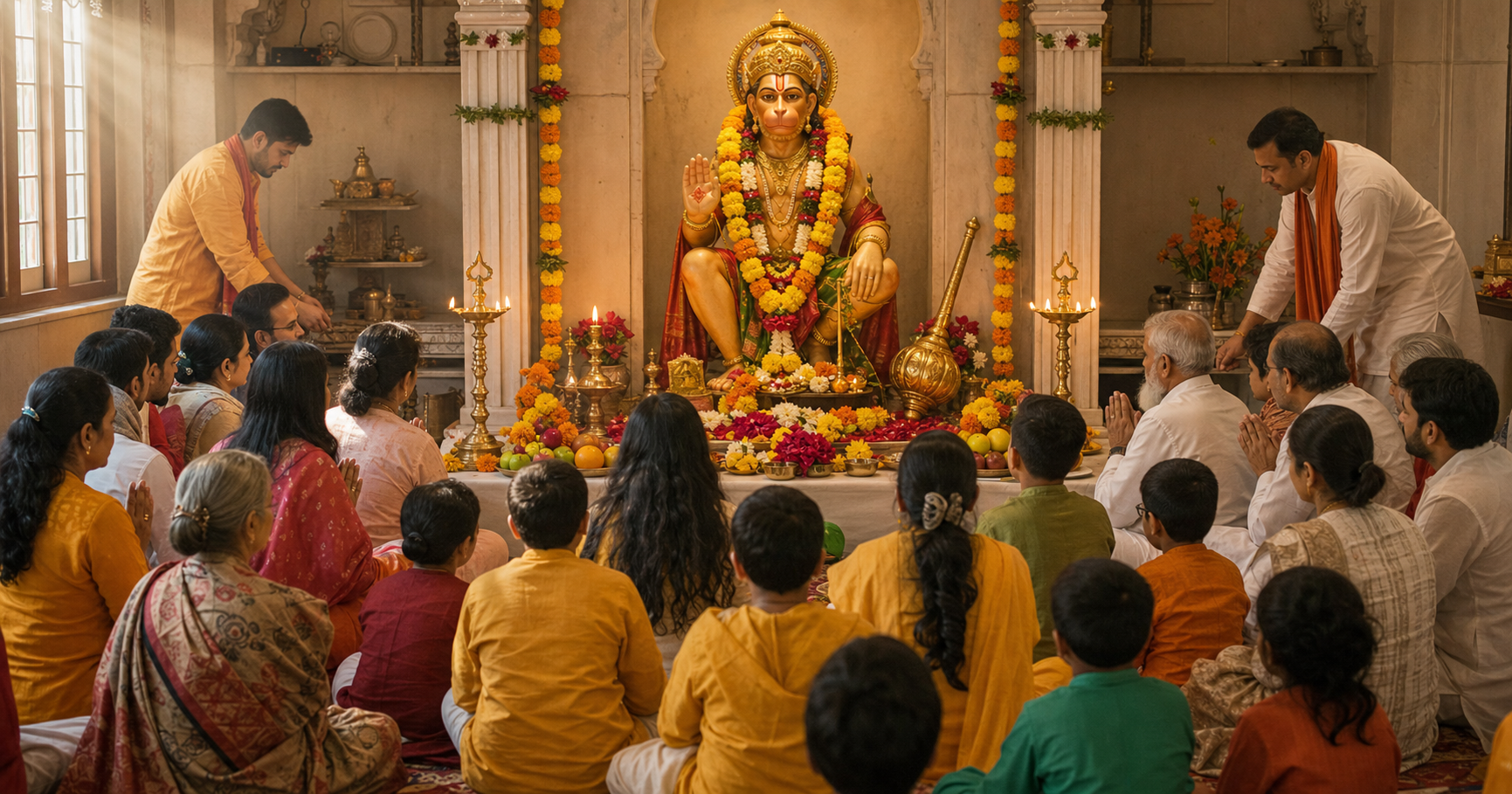
You have volunteers, families, and a place to gather for Hanuman Jayanti, but you may still be unsure how to keep the occasion from becoming either a hurried puja or a display of the gada without its ethical meaning. Begin with a clear sankalpa: Shri Hanuman’s strength belongs to devotion, self-command, protection, and seva.
Once that intention governs the program, the practical decisions become easier. Keep Shri Hanuman at the devotional centre, use a safe symbolic gada, explain what is being worshipped, and give the community a service commitment it can carry beyond the celebration.
Set the sankalpa before arranging the schedule
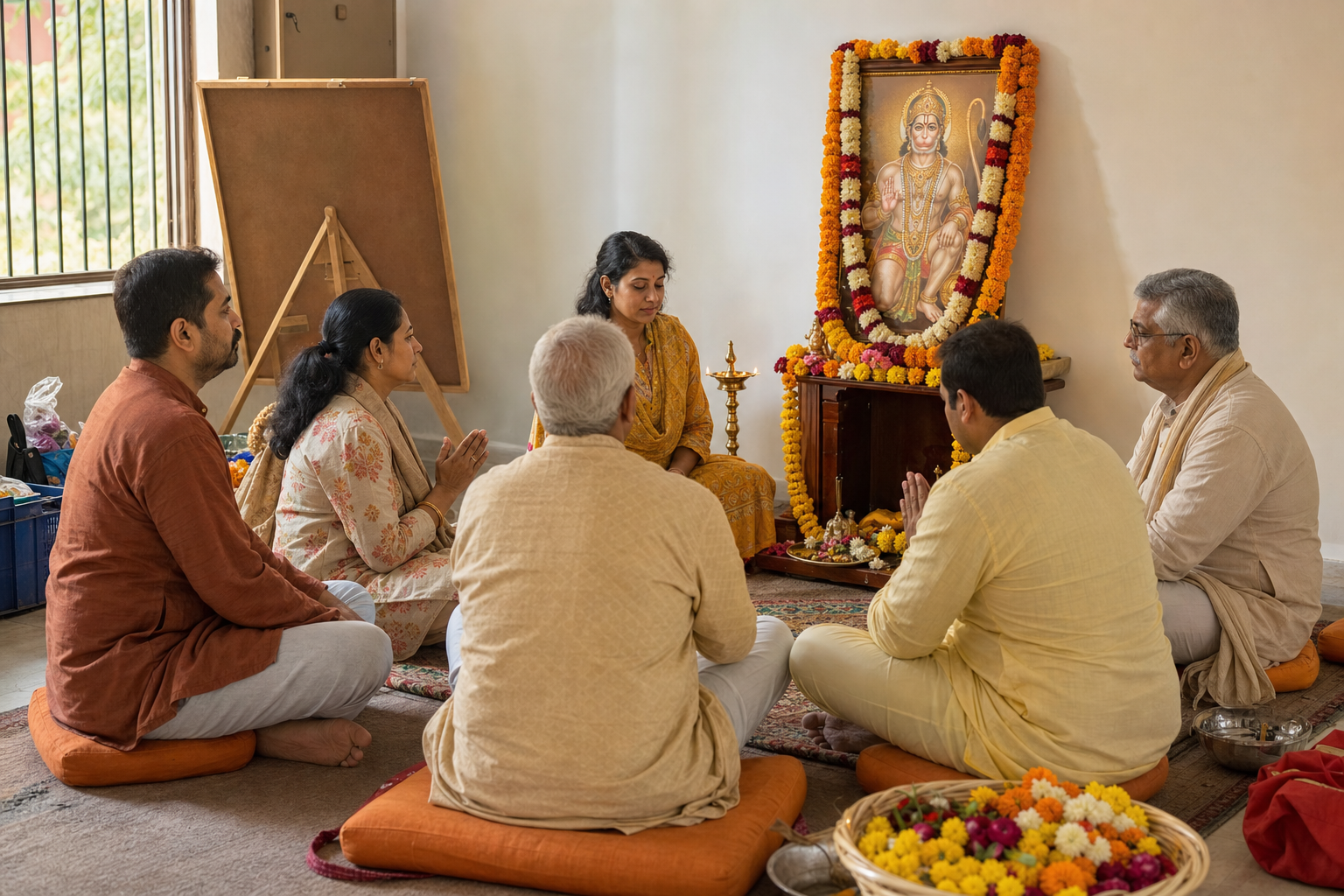
Do not begin with the procession, stage, menu, or decorations. First ask the organizing group to agree on what the gada will mean in this gathering. In Hanuman worship, it can teach four closely related virtues: balam, or strength; dhairya, or fortitude; kshama, or forbearance; and raksha, or protective vigilance. The important relationship is strength restrained by wisdom and directed toward the welfare of others.
This distinction matters because a gada can be misunderstood when it is separated from Shri Hanuman’s humility and seva. You are not venerating aggression. You are asking the community to cultivate the strength needed to master anger, persevere through difficulty, protect vulnerable people, and accept responsibility for the common good.
A workable community sankalpa can be stated plainly: May the strength we honour today become discipline in our own conduct, courage in the defence of others, and service offered without pride. Adapt the wording to your parampara, but preserve the moral direction.
Use the following questions to test every proposed activity:
- Will participants see courage joined to humility, or only strength displayed?
- Does the activity encourage self-mastery, restraint, and responsible protection?
- Can children understand how it relates to Shri Hanuman’s bhakti and seva?
- Does it produce a benefit for the neighborhood beyond the event itself?
The Mahabharata’s rule-bound gada-yuddha offers a useful teaching frame: even martial power is subject to limits. Kshatra Dharma does not treat force as self-justifying. It asks whether power is proportionate, disciplined, and directed by dharma. That lesson should be visible in the tone of the worship as well as in the words spoken from the stage.
Keep gada pujan simple and centred on Shri Hanuman
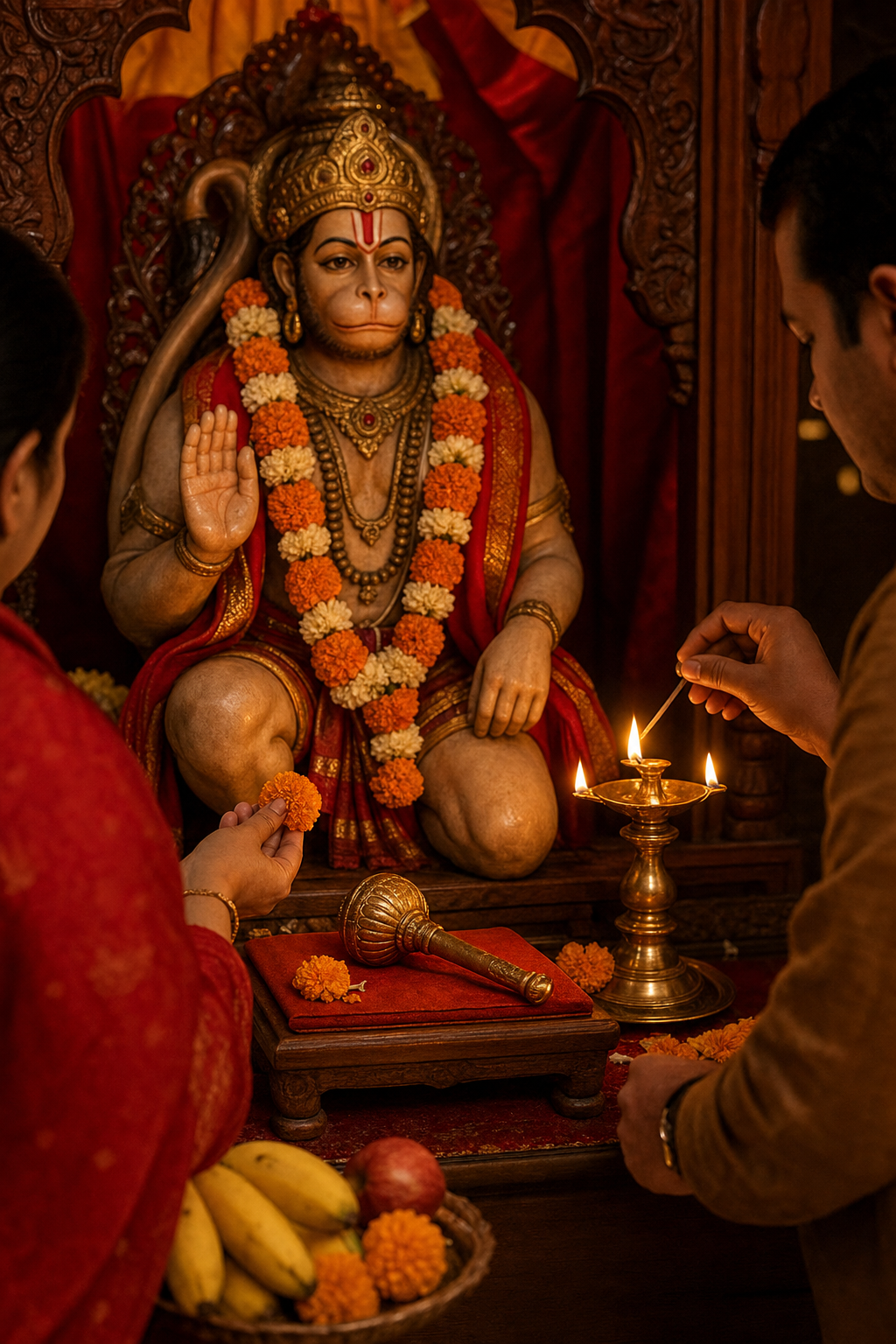
Ritual practice varies by region and parampara. If a temple, acharya, or established devotional body is guiding the observance, follow that tradition. A neighborhood group without such guidance should prefer a clean, reverent Panchopachara arrangement over an elaborate sequence it cannot perform confidently.
The gada is a consecrated focus placed near the murti or image of Shri Hanuman. It does not displace him as the object of devotion. You may use a traditional metal or wooden gada, a child-safe crafted representation, or an image of the gada set on a clean patra. A red or saffron cloth can mark the space.
Prepare only what the chosen puja requires:
- A murti or image of Shri Hanuman and the symbolic gada.
- A clean patra and red or saffron vastra.
- A lamp, gandha, akshata, flowers, and dhupa.
- Jasmine or marigold garlands where locally available.
- Sindura where its use accords with local Hanuman worship.
- Simple satvik naivedya such as banana, jaggery, and water.
- The text selected for collective recitation and the materials needed for arati.
A minimal Panchopachara worship sequence can proceed as follows:
- Clean and arrange the worship area, placing the gada beside Shri Hanuman’s murti or image.
- Begin with acamana and shuddhi according to the practice being followed.
- Light the lamp.
- Offer gandha and akshata, followed by pushpa and dhupa.
- Offer the satvik naivedya.
- Recite Om Hanumate Namah, the Hanuman Chalisa, or the Sankatmochan Hanuman Ashtak. Select the principal recitation beforehand so the gathering can participate together.
- Conclude with arati and appropriate shanti mantras, then distribute prasad in an orderly way.
A community with trained ritual guidance may adopt Shodashopachara, treating the gada as a consecrated focus in a manner comparable to a kalasha while keeping the worship directed to Shri Hanuman. More steps do not automatically create more devotion. Choose the form your community can perform with attention, cleanliness, and understanding.
If the program also includes an exercise demonstration, use a separate practice prop. That keeps the consecrated gada undisturbed and prevents children from treating the puja object as play equipment.
Build the gathering around devotion, learning, and seva
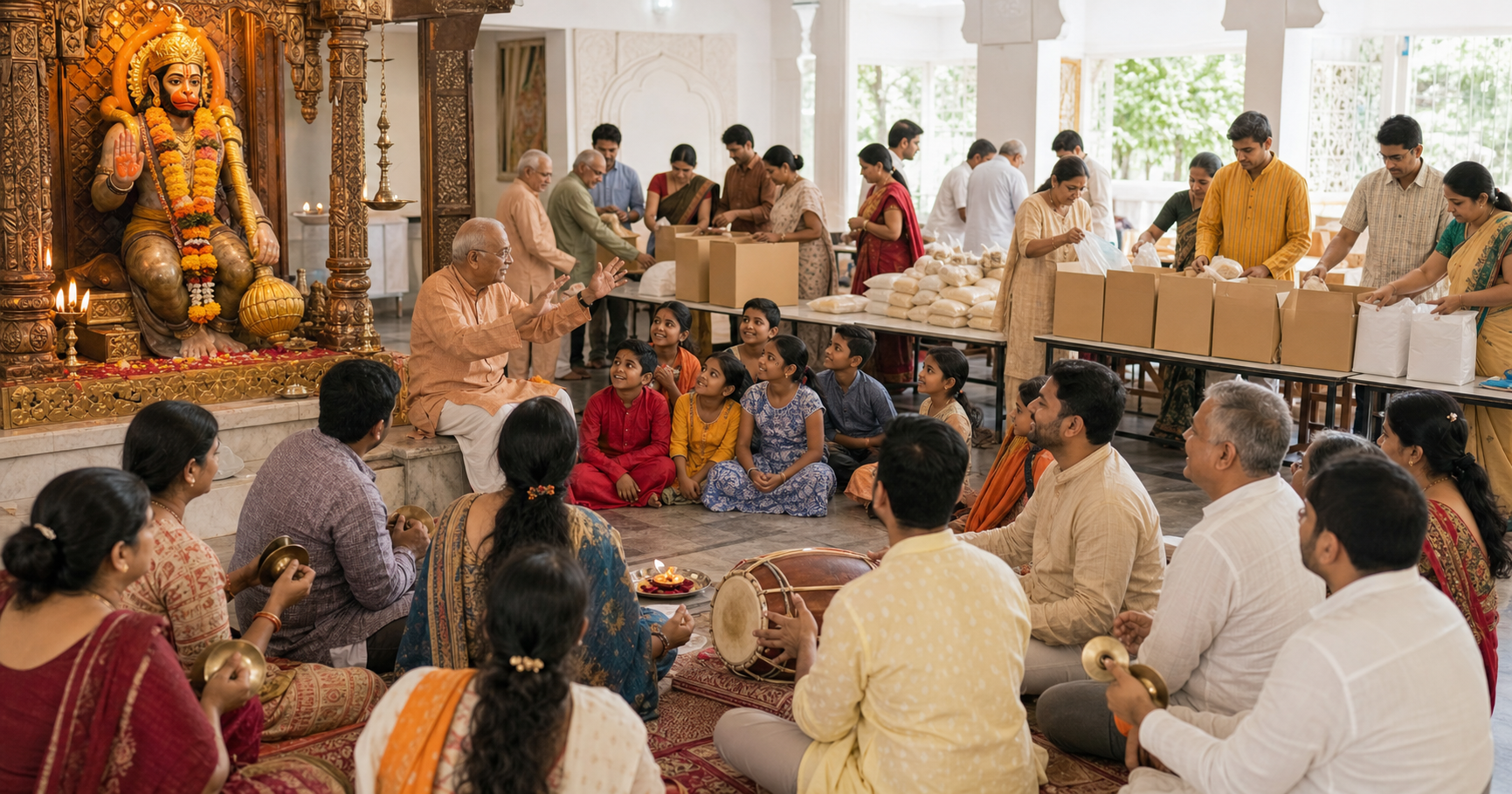
A strong community observance has an intentional arc. Worship gathers attention, teaching interprets the symbol, embodied practice shows disciplined effort, and seva converts intention into conduct. When any part is missing, the program can become either passive or merely performative.
- Open with worship. Establish the sankalpa and conduct gada pujan without rushing the offerings or allowing announcements to interrupt the devotional space.
- Create a shared voice. Use collective japa of Om Hanumate Namah, the Hanuman Chalisa, the Sankatmochan Hanuman Ashtak, or a selected recitation from the Sundara Kanda. Provide the words in a script and language participants can follow.
- Teach the meaning. Ask an elder or knowledgeable speaker to connect the gada with Shri Hanuman’s humility, steadfast bhakti, courage, and service. The teaching should answer the practical question: what does disciplined strength require from us after the worship ends?
- Give young people an embodied lesson. Surya namaskar or non-contact gada movements can emphasize balance, breathing, control, and attention. Mallakhamb should be included only where trained supervision and proper equipment are already available; it should never be improvised for a festival audience.
- Complete a defined seva activity. Choose annadanam or langar, a neighborhood cleanliness effort, or a blood-donation pledge organized with a qualified service provider. If no medical partner is present, collect pledges and contact details rather than attempting an unsupervised donation activity.
- Close with responsibility. After arati, name the people responsible for completing the seva commitment, cleaning the venue, and communicating the next community action.
Choose the seva project while planning the puja, not after the worship program has already been printed. Give it an owner, a practical scope, and a way to record the outcome. Depending on the activity, that may mean meals served, waste removed, blood-donation pledges collected, or young people enrolled in a continuing fitness or ethics program.
This follow-through is what makes the gada a living teaching aid. A symbol of service loses force if volunteers leave behind litter, if guests are poorly treated, or if promised assistance never reaches anyone.
Invite Dharmic neighbours without flattening differences
Hanuman Jayanti remains a Hindu observance centred on Shri Hanuman. Dharmic unity does not require Buddhist, Jain, or Sikh guests to perform identical worship or pretend that different symbols have exactly the same theological meaning. It asks whether distinct traditions can meet honestly around compatible duties such as courage, compassion, restraint, protection, and seva.
There are meaningful points of conversation. The Buddhist vajra can express indestructible resolve joined to compassionate action. Maces carried among the ayudhas of Jain dvarapalas and yaksha figures can signify protective stewardship. Sikh shastar-vidya preserves gada-yuddh within a martial discipline shaped by the sant-sipahi ideal, in which spiritual life and the defence of justice are not separated. These are ethical convergences across distinct Dharmic settings, not grounds for erasing their differences.
Make the invitation concrete. A Buddhist, Jain, or Sikh neighbour could offer a short reflection, reading, or kirtan related to courageous service. Guests could also co-lead the cleanliness effort, food service, or another shared activity without being expected to take a ritual role that does not fit their tradition.
Your public invitation might read: Join our neighborhood Hanuman Jayanti observance, a Dharmic gathering dedicated to courage guided by compassion. The program includes gada pujan, collective devotion, a reflection on responsible strength, and community seva. Neighbours from across the Dharmic family are welcome.
When contacting participating groups, explain the ritual in advance, identify which parts are devotional and which are open community activities, and ask each guest how they would prefer to contribute. Inclusion becomes credible when participation is informed and voluntary.
Treat responsible organization as part of the worship
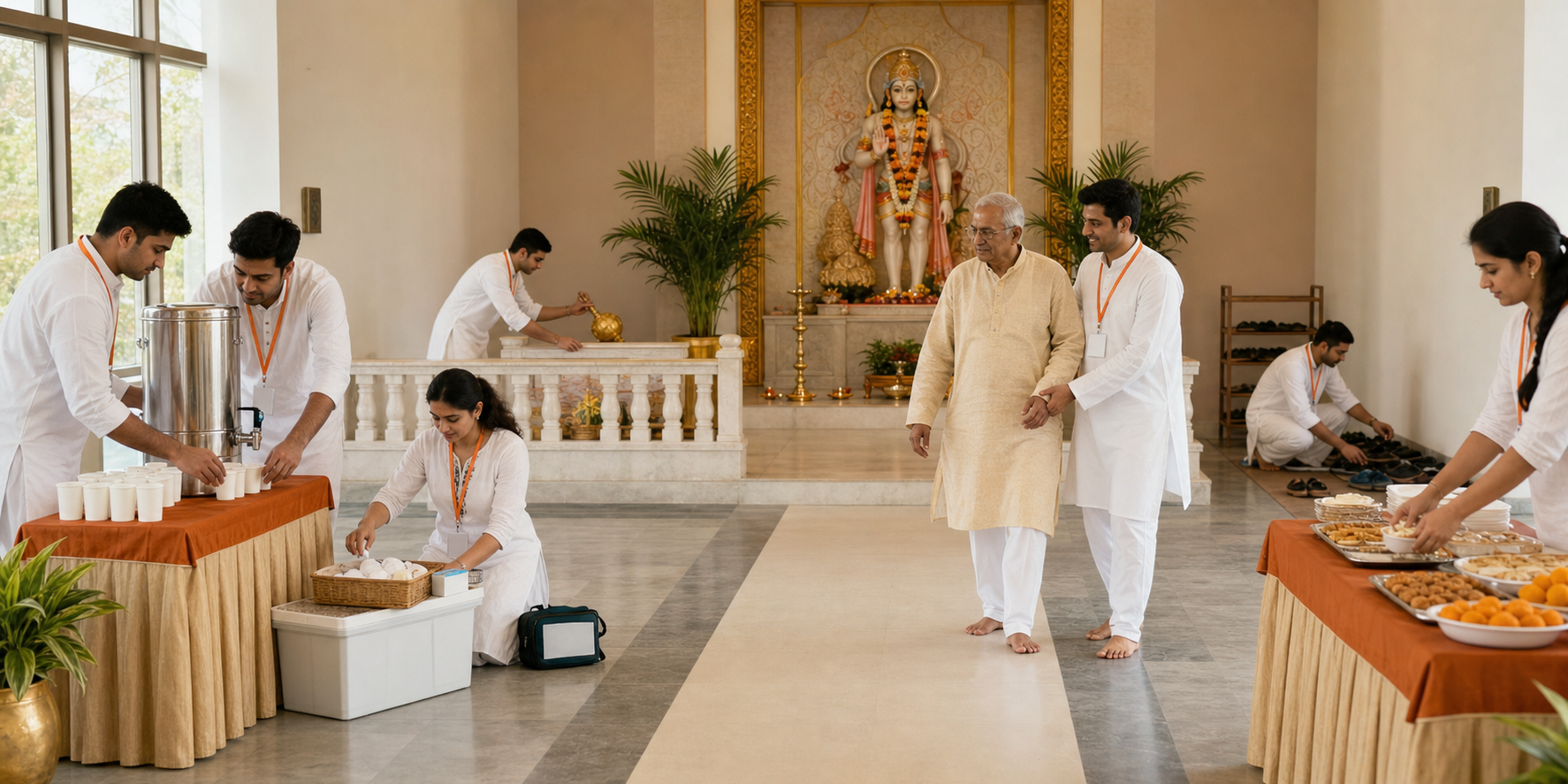
The ethics represented by the gada must govern the event itself. Protective vigilance begins with ordinary duties: lawful use of public space, safe movement of families, care for children, attention to first aid, and complete cleanup.
Before announcing the gathering, confirm the following:
- Obtain venue and civic permissions wherever they are required.
- Keep any procession local, orderly, and non-obstructive.
- Use amplified sound only during the permitted hours and at a level appropriate to the neighborhood.
- Use child-safe symbolic maces and keep all demonstrations non-contact.
- Assign trained volunteers to welcome guests, guide the crowd, supervise the youth area, manage prasad, provide first-aid support, and complete the cleanup.
- Brief volunteers before participants arrive so they know the event plan, emergency contacts, and their areas of responsibility.
Environmental care is also an expression of shraddha. Use biodegradable flowers and serving materials, avoid disposable plastic where practical, reuse decorations, and source local produce for prasad when available. Plan the handling of oil, sindura, flowers, and food waste before the puja begins. Oil and sindura should not be washed into drains or discarded where they can contaminate soil.
After the gathering, record participation and the actual seva outcome. Then decide what the sankalpa will become during the rest of the year: a recurring fitness practice, youth sessions on ethics and the epics, a mutual-aid network, or continued neighborhood service. Local worship becomes durable when a festival gives people their next responsibility rather than only a memory.
Key decisions at a glance
- Ritual form: Use a simple Panchopachara sequence unless qualified guidance and community capacity support Shodashopachara.
- Meaning of the gada: Present it as disciplined, protective strength governed by humility, restraint, and dharma.
- Youth participation: Prefer storytelling, surya namaskar, and safe non-contact practice; do not improvise specialized physical demonstrations.
- Dharmic inclusion: Invite guests to speak from their own traditions or co-lead seva without demanding ritual sameness.
- Community result: Select the seva commitment during planning, assign responsibility for it, and record what was completed.
- Continuity: Convert the annual sankalpa into a continuing practice of fitness, ethical learning, or mutual aid.
Before you publish the invitation, write the sankalpa and choose the seva commitment. Those decisions will tell you what belongs in the program and what is merely decoration. If the community leaves with a clearer understanding of Shri Hanuman and a concrete duty already underway, the worship has moved from symbol to practice.