

When the people who were meant to protect you disappeared, rejected you, or kept you at the edge of the family, adulthood can feel like a life built without a safety net. You may look capable while privately planning for disaster, overextending yourself, or accepting poor treatment because any connection seems safer than another loss.
Healing does not require you to excuse what happened, force forgiveness, or restore contact. It means grieving what was missing, helping your body recognize present-day safety, and making choices from discernment rather than fear. Dharmic practice can support that work, provided it is not used to suppress pain or replace appropriate mental health care.
Name the loss before trying to fill it
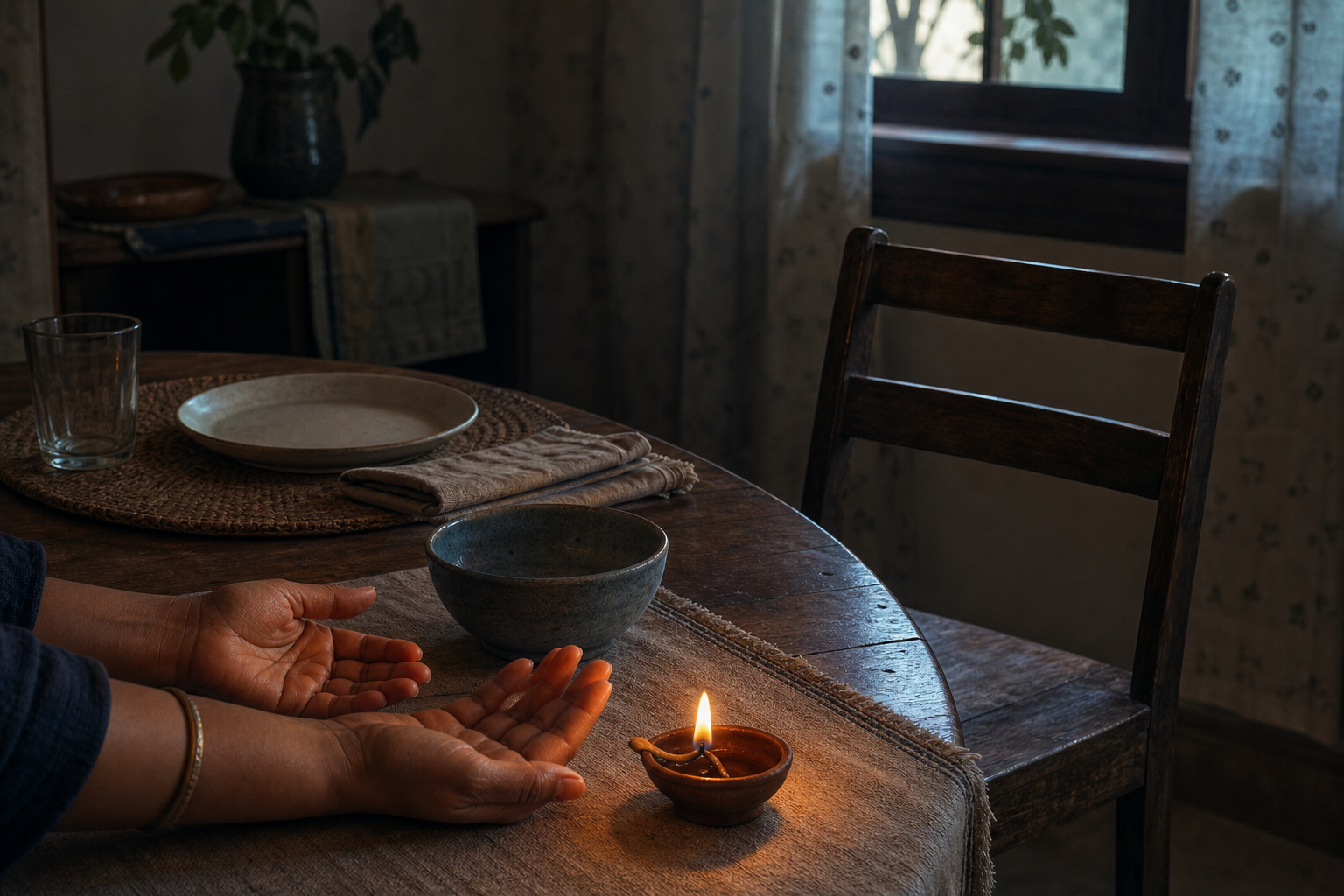
Family abandonment creates an unusual form of grief. You may be grieving someone who is still alive, a relationship that never became safe, or a childhood role that nobody fulfilled. You may also be grieving ordinary things other people take for granted: protection, guidance, festival gatherings, financial backup, a home to return to, or a person who remembers your early life with tenderness.
This grief often hides beneath competence. If nobody reliably helped you, self-reliance was not merely a personality trait; it was an adaptation. The same adaptation can later become rigid. You may find it hard to rest, ask for help, take a worthwhile risk, or believe that another person will remain dependable. The pattern of practical strength existing alongside hypervigilance and painful relationship choices is not a contradiction. One part of you learned to function while another remained prepared for rejection.
Before deciding what healing should look like, separate four things that can otherwise collapse into one painful story:
- The observable fact: State what happened without explaining the other person’s motives. For example: “My parent stopped contacting me,” or “My relatives included others but repeatedly excluded me.”
- The missing function: Name what you did not receive, such as protection, consistent care, guidance, practical support, affection, or belonging.
- The survival rule: Identify the conclusion you formed to get through it: “I must never need anyone,” “I have to earn my place,” or “I should accept whoever is willing to stay.”
- The present correction: Choose a safer rule grounded in adult reality: “I can ask trustworthy people for specific help,” “I can pause before agreeing,” or “Interest alone does not make a relationship safe.”
This exercise does not turn abandonment into a lesson you were somehow meant to receive. It stops the event from silently writing every later decision. What another person failed to provide is evidence about that relationship, not a final judgement on your worth.
It also clarifies why replacing family immediately with a large “chosen family” can disappoint you. Supportive friendships matter, but another person cannot retroactively supply the childhood, protection, or unconditional welcome you lost. When you ask a new relationship to erase that void, you may overlook incompatibility or mistreatment because the relationship is carrying an impossible assignment. Let people become trustworthy through repeated conduct instead of appointing them to a family role because the role is vacant.
Help your body distinguish memory from present danger

You can understand intellectually that your circumstances have changed and still feel braced for collapse. Catastrophic planning, bodily tension, constant scanning for rejection, and rumination in otherwise ordinary situations can persist after you have obtained a safe home, steadier finances, or trustworthy companionship. Your reasoning mind may see the present while your nervous system continues to answer an earlier environment.
When activation rises, do not begin by arguing with yourself. First establish where you are and what is true now:
- Orient outward. Look around the room and notice its boundaries, exits, light, and familiar objects. State where you are and remind yourself that you have choices in the present.
- Find physical support. Feel the chair, floor, or wall carrying some of your weight. Let your body receive evidence that it does not have to hold itself up alone at this moment.
- Let the breath move gently. Allow the diaphragm and lower ribs to move without forcing a deep breath. If focusing on breathing increases distress, return to visual orientation or another neutral physical sensation.
- Separate a threat from a task. Ask, “Is something dangerous happening now, or has something reminded me of an earlier danger?” If there is a present task, reduce it to the smallest safe action you can actually take.
- Check your current safety net. Name what exists now: a secure room, income, savings, transportation, professional support, a dependable person, or your ability to leave a conversation. Do not claim resources you do not have; the purpose is accurate orientation, not positive thinking.
Use grounding to regain choice, not to make legitimate anger or grief disappear. If a family member is presently threatening, coercing, stalking, or harming you, the problem is not merely a nervous-system memory. Prioritize physical safety and confidential professional support rather than trying to meditate through an active danger.
Some experiences are difficult to process safely without skilled care. A licensed, trauma-informed mental health professional can help you assess whether approaches such as EMDR, group therapy, cognitive work, or body-based regulation are appropriate. EMDR involves structured trauma processing and should not be recreated from an online description. Group therapy can also provide recognition and emotional language, but the quality of facilitation and the group’s boundaries matter.
When evaluating a therapist or group, ask direct questions: Do they have experience with abandonment, emotional neglect, or complex developmental trauma? How do they establish stability before approaching painful memories? What happens if you become overwhelmed during a session? How are confidentiality and interpersonal safety handled in a group? A useful practitioner should be able to explain the process without pressuring you to disclose everything immediately or reconcile with relatives.
If distress remains overwhelming, repeatedly interferes with daily functioning, or leaves you unable to keep yourself safe, seek prompt help from a qualified local mental health professional. If you are in immediate danger of harming yourself or someone else, use local emergency services or urgent crisis care rather than relying on a contemplative exercise.
Choose relationships by reciprocity, not relief

Abandonment can make the first sign of interest feel disproportionately valuable. You may think, “This person wants me, so I should make it work.” That reverses the order of discernment. Interest earns consideration; it does not earn trust, unlimited access, or exemption from your boundaries.
Assess relationships through conduct rather than family labels, intensity, or promises:
- Can you say no, disagree, or change your mind without retaliation, ridicule, or withdrawal?
- Does the person show curiosity about your needs, or does contact consistently reorganize itself around theirs?
- When harm occurs, can they acknowledge it and participate in repair without making you responsible for their reaction?
- Do their actions remain broadly consistent with their words?
- After contact, do you usually feel respected and clear, or confused, diminished, indebted, and on guard?
- Are you choosing this relationship because it is mutual, or because losing it would seem to confirm an old belief that nobody stays?
No single answer proves that a relationship is safe or unsafe. The pattern is what matters. Someone can disappoint you without abandoning you, and a disagreement is not automatically rejection. Conversely, biological kinship, shared religion, or affectionate language does not cancel repeated coercion or contempt.
Use a boundary ladder so that every situation does not feel like a choice between total compliance and permanent estrangement:
- Delay: “I need time before I answer.”
- Limit: “I can speak for a short while, but I am not discussing that subject.”
- Condition: “We can continue if we speak respectfully.”
- Exit: “This conversation is no longer constructive, so I am ending it now.”
A boundary is a statement about what you will do. It is not a strategy for forcing another person to understand, apologize, or change. If the person ignores the limit, your follow-through supplies the meaning. Where confrontation could provoke violence or severe coercion, do not announce a boundary merely to prove courage. Make a safety plan with qualified local support and choose the least dangerous form of distance available.
Reconciliation and healing are separate decisions. Reconciliation requires accountability, changed conduct, and participation from more than one person. Healing can continue without an apology and without renewed access. You do not have to settle the question of lifelong contact while highly activated; you can decide what level of access is safe now and reassess it when there is new evidence.
Festivals, family ceremonies, and parent-focused occasions deserve deliberate planning because social assumptions can sharpen the absence. Decide beforehand where you will be, whom you want to contact, which rituals genuinely nourish you, and how you will leave an uncomfortable gathering. If you want company, ask clearly rather than hoping friends will infer the need: “This day is difficult for me. Would you share a meal or attend the observance with me?” Their availability is not a measure of your worth, but a direct request gives the relationship a fair opportunity to become reciprocal.
Let Dharmic practice deepen discernment, not denial

Hindu, Buddhist, Jain, and Sikh traditions are distinct paths with their own doctrines and disciplines. They should not be flattened into one therapeutic system. Yet practices associated with ahimsa, dhyana, japa, maitri, simran, and seva can each offer a way to cultivate steadiness, compassion, remembrance, or ethical action while you heal.
- Ahimsa: Include yourself within non-harm. Refusing to repeat another person’s contempt inside your own mind is not selfishness. Neither is limiting access to someone who repeatedly harms you.
- Dhyana, japa, or simran: Use the contemplative or devotional discipline proper to your path as an anchor for attention. The purpose is not to delete memory but to create enough inner space to choose your response.
- Maitri: Direct warmth toward the younger self who had to survive without adequate protection. Ask what that child needed to hear or receive, then identify a safe adult action that embodies it now.
- Seva: Let service reconnect you with meaningful community, but choose roles with clear responsibilities and limits. Service ceases to be healing when it becomes another way to earn belonging by ignoring exhaustion or mistreatment.
A simple practice before difficult contact is to settle physically, repeat a sacred name, mantra, or remembrance meaningful within your own tradition, and ask: “What does non-harm require here, including non-harm toward me?” The answer may be patient listening. It may be a shorter conversation, a delayed decision, a request for help, or no contact that day. Finish by choosing one observable action so that contemplation leads to discernment rather than rumination.
Be wary when spiritual language is used to make accurate perception feel immoral. Pressure to forgive immediately, accept mistreatment as duty, explain abuse away as karma, or reunite before safety and accountability are present can turn spirituality into avoidance. Compassion does not require unlimited access. Forgiveness, if it becomes meaningful to you, is not the same decision as reconciliation.
Spiritual practice also cannot substitute for trauma treatment when symptoms are persistent or disabling. Its proper role is accompaniment: helping you remain present, act according to values, and meet pain without adding self-hatred. Therapy can address patterns and traumatic memory; practice can help you live your ethical and spiritual commitments. The two need not compete.
You may discover that “getting back to your old self” is the wrong goal. If survival demands shaped your earliest development, there may be no untouched former identity waiting to be recovered. You can build a self that retains the strengths hardship produced without remaining governed by the fear that produced them. Budgeting can serve freedom instead of anticipated collapse. Careful planning can support a meaningful risk. Independence can coexist with selective interdependence.
To test whether this construction is happening, ask regularly: “What did I choose because it mattered to me, rather than because rejection or disaster felt imminent?” Then place some of your reclaimed energy into a value-bearing activity: learning, research, physical movement, volunteering, creativity, worship, or reciprocal community life. The activity is not a distraction from grief. It is evidence that grief no longer controls the whole field of action.
Key takeaways
- Family abandonment can involve grief for missing protection, guidance, belonging, and an imagined family life, even when the people involved are still alive.
- Competence and hypervigilance can develop together. Before making a major relationship decision, help your body orient to present conditions.
- Chosen family can support healing, but no new relationship should be expected to erase the original loss.
- Evaluate people by reciprocity, respect, accountability, and response to boundaries, not by intensity, promises, or biological title.
- Healing does not depend on reconciliation. Renewed contact requires present-day evidence of safety and changed conduct.
- Dharmic practices can strengthen non-harm, attention, compassion, remembrance, and service, but they should not be used to excuse abuse or replace needed professional care.
Begin with one page, not a total reinvention of your life. Write down what was missing, the survival rule you formed, and one safe action that contradicts that rule now. Ask for a specific kind of help, delay an automatic yes, leave a depleting conversation, or keep one promise to yourself. Healing becomes visible when your next choice is no longer dictated by the person who left.