
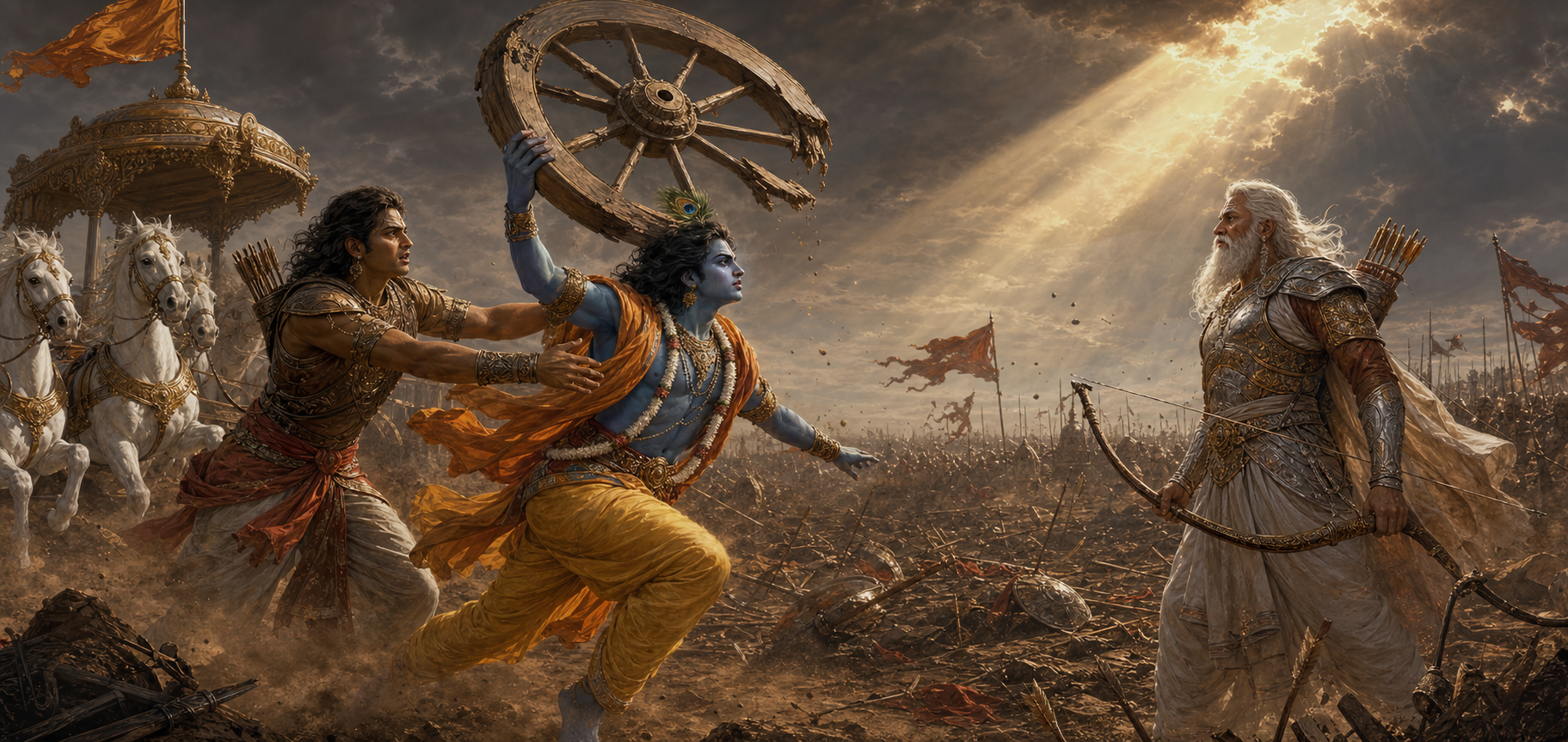
You made a promise in good faith. Then the situation changed. Keeping your word now appears likely to betray the very person, principle, or responsibility the promise was meant to serve. Do you remain consistent, or do you depart from your words to remain faithful to their purpose?
Krishna’s charge toward Bhishma at Kurukshetra gives you a demanding answer. A vow is sacred because it disciplines the person who takes it and places that person in the service of dharma. It is not sacred because verbal consistency outranks justice, protection, and responsibility. Yet the episode also closes the door on convenient excuses: departing from a vow can be Dharmic only under strict conditions.
The wheel brings two vows into open conflict
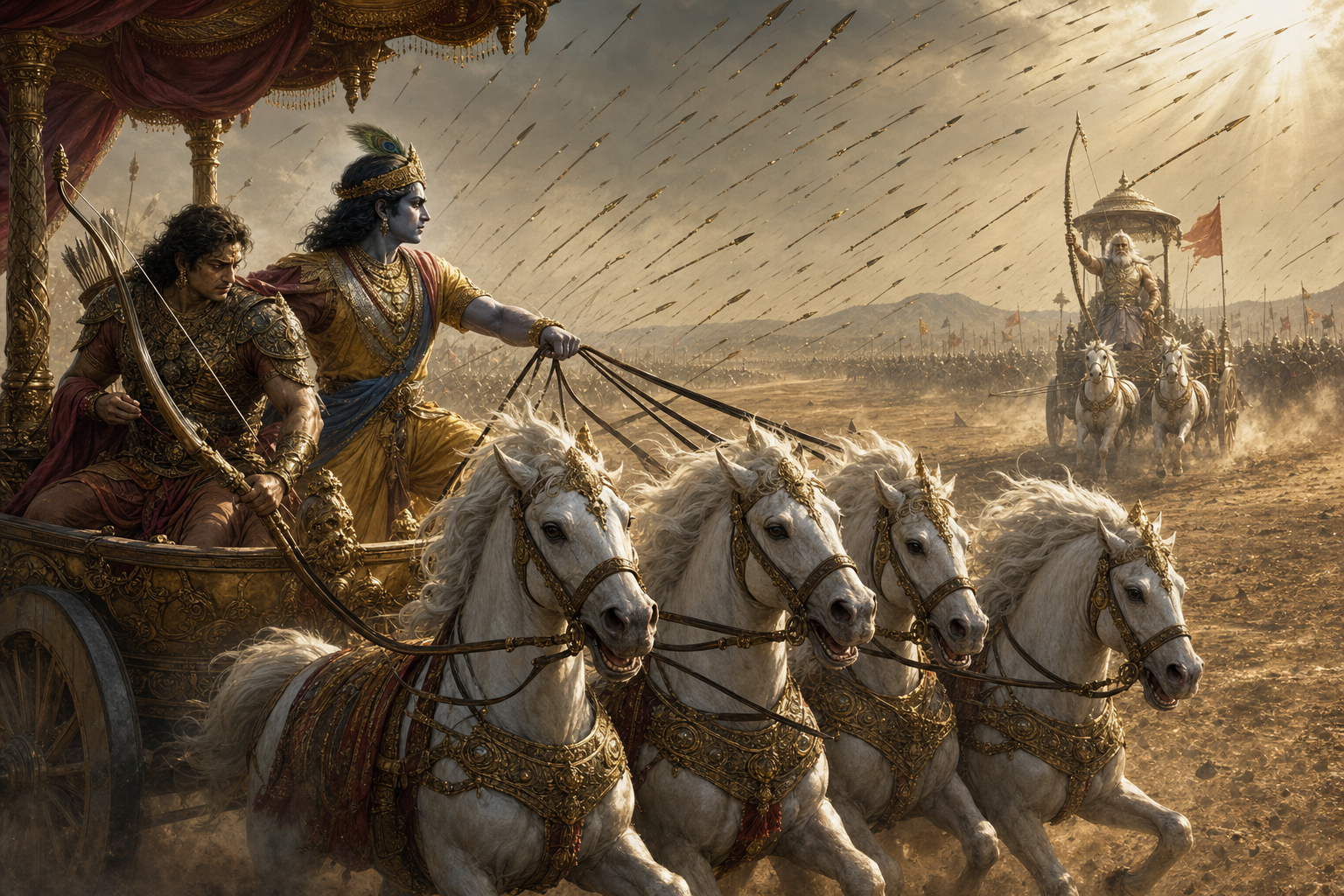
Bhishma’s archery had become a nearly continuous wall of shafts. Arjuna and his charioteer were disappearing behind the assault, and the danger was no longer theoretical. Krishna had entered the war under a clear restraint: He would guide Arjuna but would not wield weapons. Bhishma, meanwhile, had resolved to fight with such intensity that Krishna would be compelled to intervene.
The vows converged when Krishna seized the wheel of a disabled chariot and rushed toward Bhishma. The object matters. It was a battlefield remnant, not a weapon Krishna had carried into the war. But He raised it with the evident resolve of one prepared to use force. Arjuna ran after Him, pleaded that He preserve His word, and drew Him back before the charge became a blow.
This is therefore not a simple story in which Krishna casually breaks a promise. No strike lands. The broken wheel is not an ordinary battlefield weapon, yet it is being treated like one. Krishna reaches the boundary of His vow, and Arjuna prevents the possible violation. The tension cannot be dissolved by technical language about whether the wheel counted as a weapon. The moral disclosure lies in Krishna’s readiness to risk His reputation for perfect consistency rather than passively watch His devotee and the cause He was guiding be overwhelmed.
Bhishma’s response makes the scene stranger and deeper. He does not see only an enraged opponent. As a devotee, he receives Krishna’s advance as a cherished vision. Later, on his bed of arrows, he remembers the dust-covered, battle-marked Krishna coming toward him with the wheel raised. Military opposition and spiritual affection occupy the same moment. The Mahabharata does not require us to pretend that a revered person must therefore be on the right side of every practical decision.
That distinction is useful whenever loyalty clouds judgment. You can honor a person’s sacrifice, knowledge, or devotion while still opposing the consequences of the position that person has chosen. Respect does not require moral blindness.
A vow receives its authority from the dharma it serves
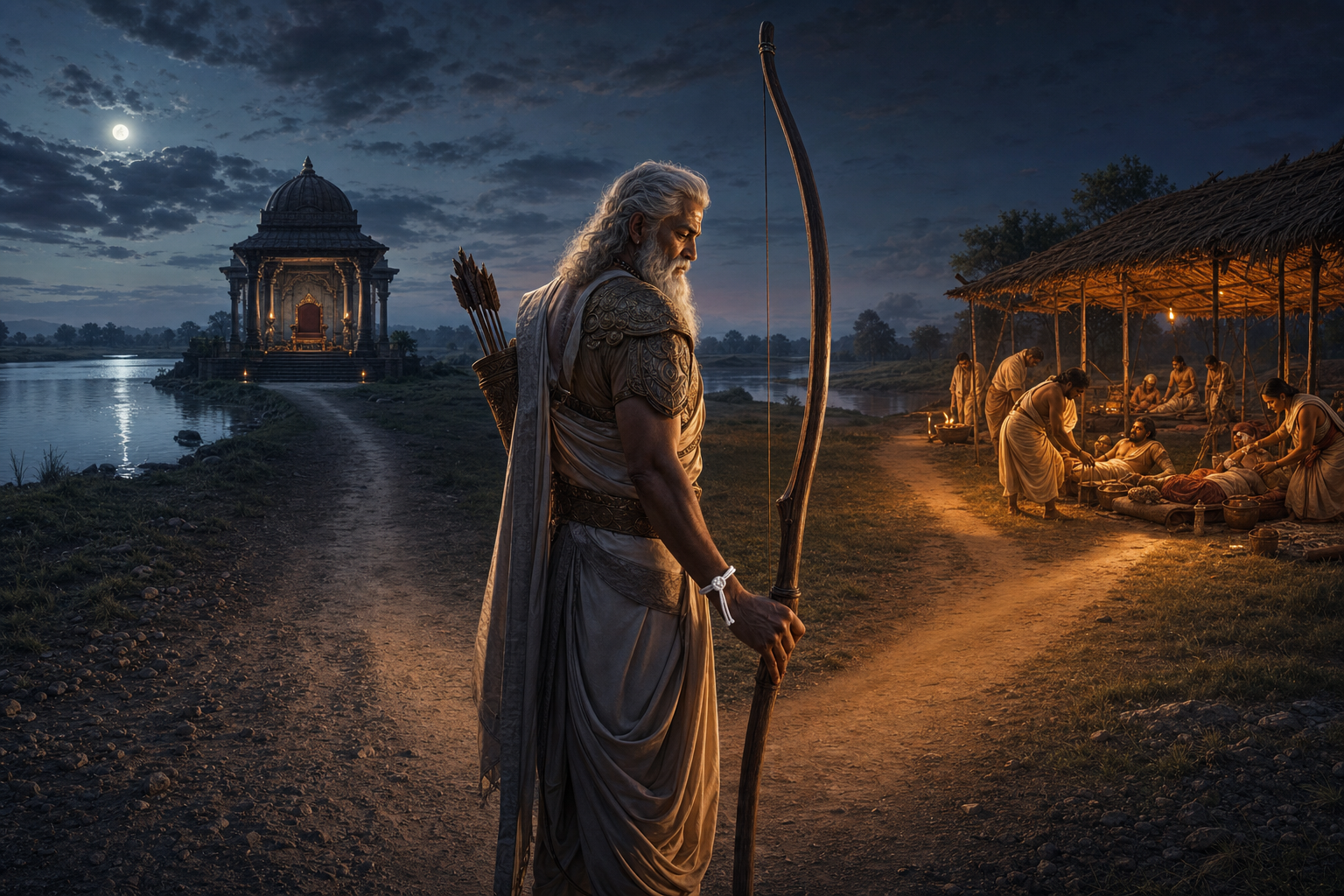
A vow is a discipline of the self. It limits appetite, removes convenient escape routes, and makes conduct dependable. Without that discipline, duty can be rewritten whenever desire changes. The lesson at Kurukshetra is therefore not that promises are disposable. It is that a promise remains a means rather than the final end of moral life.
You can examine a difficult commitment through three connected levels:
- The end: What aspect of dharma was the commitment meant to uphold – truth, protection, justice, trust, social order, or the welfare and cohesion expressed by loka-sangraha?
- The role: What duty belongs to the position you actually occupy? Arjuna cannot use Krishna’s protection as a reason to abandon his own kshatra-dharma.
- The rule or vow: What restraint did you accept so that the higher purpose and role would be served reliably?
These levels are not a formula for automatically cancelling the lower one. They are a way to locate the real conflict. If circumstances make literal obedience to a rule defeat the purpose for which the rule exists, you must reconsider how the rule applies. If no such reversal has occurred, invoking a higher principle may be nothing more than a noble-sounding excuse.
Suppose a community organizer has promised that an important gathering will proceed on a fixed date. A serious safety problem then makes that date irresponsible. Cancelling for convenience would show poor discipline; postponing to protect participants would preserve the purpose of the gathering by departing from its schedule. The organizer should change only what the danger requires, explain the reason plainly, and offer a credible new plan. The promise is not discarded. Its underlying responsibility governs how it is revised.
The decisive question is not, “How can I get out of my promise?” It is, “What was this promise for, and what will my conduct protect now?” That change in question exposes both rigid formalism and self-serving flexibility.
Krishna, Arjuna, and Bhishma reveal three kinds of duty
Krishna refuses to make consistency an idol
Krishna’s vow governs His own participation. When Arjuna faces immediate danger, however, Krishna’s protective responsibility presses against that self-imposed limit. His movement toward Bhishma reveals the priority He assigns to the devotee and to the restoration of justice. The personal cost would be His own apparent inconsistency, not a burden imposed only on someone else.
That cost is a useful test for you. People often invoke necessity when an exception benefits them and makes another person pay. Krishna’s action runs in the opposite direction: He is prepared to bear the damage to His own pledge in order to protect another. A claimed exception becomes more credible when the decision-maker accepts its cost rather than exporting it.
Arjuna does not outsource his duty to divine protection
Arjuna’s intervention is as important as Krishna’s charge. He does not simply enjoy being rescued. He asks Krishna to stop and recommits himself to the warrior’s responsibility that had brought them to the field. Divine care does not turn the devotee into a passive spectator.
This corrects a common spiritual mistake. Help, grace, or protection does not release you from the task that is properly yours. If another person must violate a sound boundary because you repeatedly refuse to carry your share, the problem is not the boundary. Your neglected duty has forced the crisis. Before asking whether someone else should make an exception for you, ask what responsibility you can resume yourself.
Bhishma shows why virtue and alignment must be judged separately
Bhishma is neither spiritually trivial nor personally contemptible. His devotion is real enough for him to treasure Krishna’s fierce advance as darshan. Yet his arrows still create the danger that precipitates Krishna’s intervention. Personal nobility does not neutralize the effects of one’s chosen alignment.
When you assess a leader, elder, teacher, or institution, make two judgments rather than collapsing everything into one. First ask what virtues deserve recognition. Then ask what the person’s present commitments are producing. Admiration answers the first question; it cannot answer the second. This is how you avoid both contempt for a worthy adversary and obedience to a harmful course.
Emergency dharma is narrower than expediency
Kurukshetra does not begin with Krishna reaching for a wheel. Diplomacy has already failed, including Krishna’s rejected peace mission. On the battlefield, Bhishma’s attack creates an immediate threat. Only then does the exceptional action occur. The order matters because apad-dharma, duty under emergency, is not permission to declare every obstacle a crisis.
The episode sits beside two other duties. Raja-dharma concerns the ethical exercise of power and the preservation of order. Kshatra-dharma concerns the disciplined use of martial force in the protection of justice. None of these means “do whatever works.” Each places power under purpose, proportion, and responsibility.
Before treating an exception as Dharmic, look for all of these safeguards:
- A real change in conditions: The original commitment now operates in circumstances materially different from those in which it was made.
- Serious and approaching harm: The problem is not embarrassment, inconvenience, or a reduced chance of success. Delay would expose someone or something entrusted to you to substantial harm.
- Exhausted ordinary means: Dialogue, correction, and less disruptive options have been attempted or are plainly unavailable in the time that remains.
- A protective purpose: The exception serves justice, safety, or loka-sangraha, rather than anger, prestige, appetite, or factional advantage.
- The smallest necessary departure: You alter only the part of the commitment that blocks the higher duty. You preserve every restraint that can still be preserved.
- Visible accountability: You can name what changed, who is being protected, what the exception costs, and when the normal rule should resume.
If one of these elements is missing, pause. Urgency without exhausted alternatives can be impatience. Protection without proportionality can become domination. A higher purpose without accountability can conceal self-interest. Dharma requires discernment precisely because moral language can be used to disguise desire.
Why the wheel matters beyond the battlefield
The wheel is first a practical object lifted in an emergency. Symbolically, it also evokes the movement of moral order into action. A principle that never leaves speech has not yet become protection. Krishna does not merely explain why Arjuna must stand; He moves when the danger reaches its decisive point.
The comparison has a wider Dharmic resonance without making distinct traditions interchangeable. Buddhist Dharma Wheel imagery, the Jain dharma-chakra motif, and the chakkar in the Sikh khanda are not identical symbols with a single doctrine. They nevertheless allow a shared reflection on teaching that must shape conduct. The ethical emphases also remain distinct: Jainism gives ahimsa exceptional rigor; Buddhism foregrounds non-harm and skillful means; Sikh tradition understands dharam yudh as a last resort; and Hindu thought holds non-harm beside the duty of just defense.
The practical common ground is restraint. Force does not become righteous merely because its user invokes dharma. Dialogue must fail before coercion becomes a last resort; action must seek a just peace rather than violence for its own sake; and the person acting remains responsible for the suffering caused. Read this way, the raised wheel does not glorify aggression. It shows moral insight being mobilized under extreme pressure.
Use this test when two commitments cannot both be kept

When you face a conflict of vows, write down the answers to the following questions before defending either course. Writing matters because urgency makes vague claims feel more convincing than they are.
- What did I actually promise? State the words and scope without enlarging or softening them after the fact.
- What was the promise meant to protect? Name the trust, person, duty, or social good that gave it moral force.
- What has changed? Identify a concrete condition that was absent, unknown, or reasonably unforeseeable when the commitment was made.
- Who bears the harm if I keep it literally? Name the affected person or community. “The greater good” is too vague unless you can identify the actual consequence.
- Have ordinary remedies failed? Look for an honest conversation, a revised timetable, consent, delegation, mediation, or another path that preserves both duties.
- What is the minimum departure required? Break no more of the commitment than the higher responsibility demands.
- Can I explain the decision to those who bear its cost? If the action depends on concealment, inflated urgency, or a story that changes with the audience, it probably lacks Dharmic discipline.
- How will I restore the norm? An emergency measure without an end condition easily becomes a new habit.
Put your answers under two headings: “purpose of the vow” and “present consequence of keeping it.” If you cannot state the changed condition and the harmed party precisely, do not claim apad-dharma. Keep the promise while you seek a solution. If you can state them, choose the smallest transparent action that protects the higher duty and preserves as much trust as the crisis permits.
Several warning signs should make you distrust your own reasoning: the exception benefits you more than the people you claim to protect; the urgency was created by avoidable delay; the departure is broader than the danger; you resist scrutiny; or you have no plan to return to the original restraint. In such cases, the language of higher duty is probably being used to protect preference.
Key takeaways
- Krishna’s charge stages the boundary of His vow rather than an uncomplicated breach: Arjuna stops Him, and no blow with the wheel lands.
- A vow is a disciplined means of serving dharma. It cannot become a shield for allowing the purpose of dharma to be defeated.
- Arjuna shows that receiving protection does not cancel your own role-based duty.
- Bhishma shows that devotion, courage, and personal greatness do not make every practical alignment righteous.
- Emergency duty requires changed conditions, serious harm, exhausted alternatives, proportionate action, and accountability.
- The right question is not whether you can escape your words, but what those words were meant to protect.
The next time consistency and responsibility pull you in opposite directions, do not begin by defending your reputation. Name the purpose of your promise, identify who will bear the consequence, and take the narrowest action that preserves the higher duty. That is how a vow remains an instrument of dharma instead of becoming its substitute.