
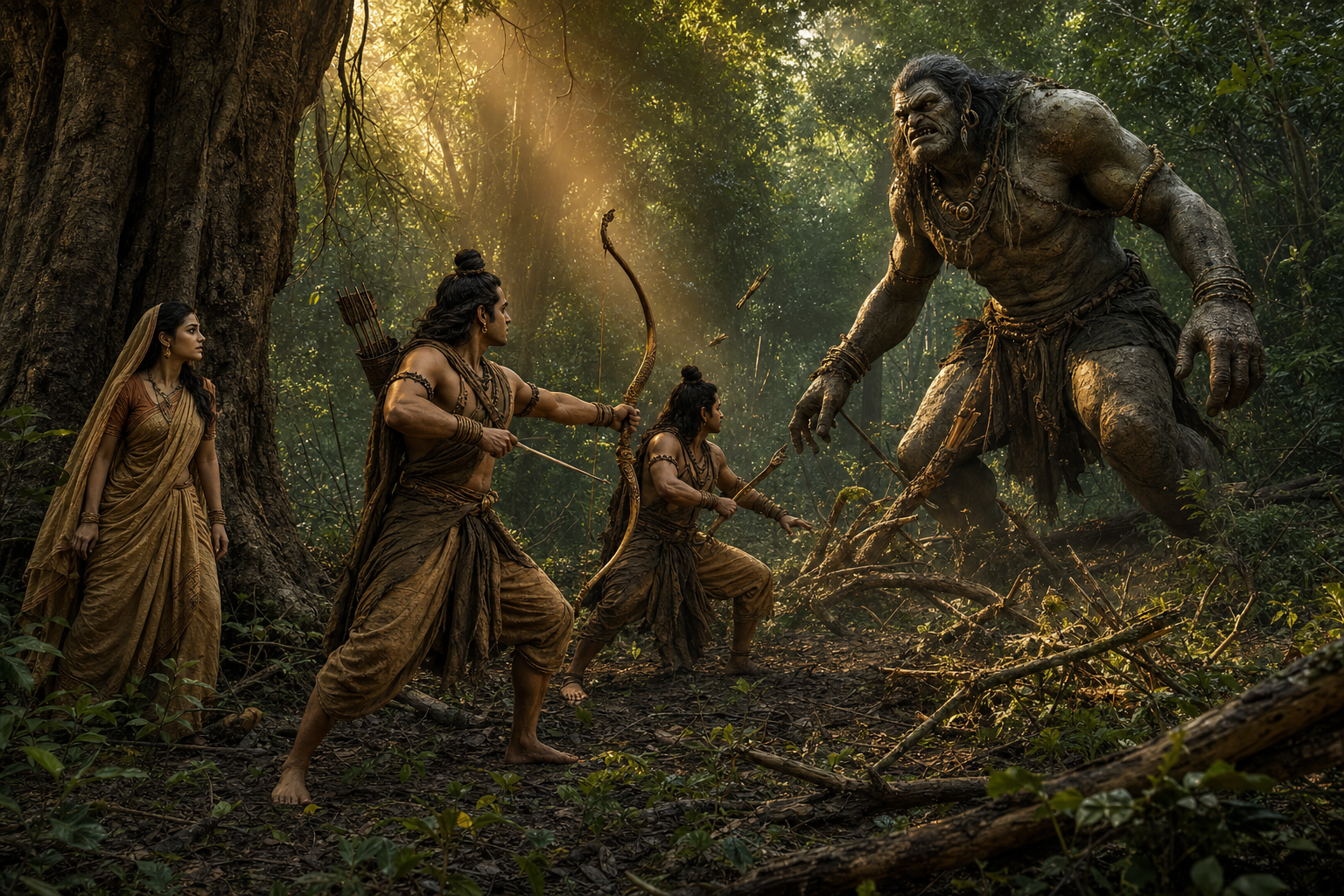
If you have wondered why Rama and Lakshmana do not simply kill Viradha with their arrows, you have found the question that unlocks the episode. The battle is built around a binding limit: Viradha cannot be killed by weapons. The brothers must therefore do more than overpower him. They must understand the condition, protect Sita and find a response that defeats adharma without treating a boon as meaningless.
Read this encounter carefully and you get a compact lesson in applied dharma. It teaches you to distinguish strength from stubbornness, lawful ingenuity from deceit, punishment from revenge and liberation from indulgence. Its value lies not only in what Rama and Lakshmana do, but in the order in which they do it.
The forest makes dharma a matter of character
Life in Ayodhya comes with visible institutions: a court, a royal household, established duties and a social order that can support right conduct. Dandakaranya offers none of that security. Rama, Sita and Lakshmana have entered a landscape where hermitages coexist with predatory forces and where protection may have to be provided immediately, without an army or tribunal nearby.
This is why vanvas should not be mistaken for Rama’s withdrawal from public duty. Exile removes the outward apparatus of kingship, but it does not remove the responsibility to act as a protector. In fact, the forest makes that responsibility more demanding. Rama must uphold dharma when rank, palace and political authority cannot do the work for him.
Viradha’s appearance turns that principle into an urgent test. He blocks the travellers’ path and fixes his desire upon Sita. His offence is not merely that he looks frightening or belongs to a hostile class of beings. His declared intention treats Sita as an object to be seized. Unrestrained kama has become aggression.
That distinction matters when you interpret the battle. Rama and Lakshmana are not hunting an unfamiliar forest-dweller because he is different from them. They respond to a specific violation: an armed predator has threatened Sita and attempted to place appetite above her dignity and safety. The ethical centre of the scene is therefore protection, not conquest.
When reading other confrontations in the Ramayana, ask the same first question: what precise act of adharma requires a response? That keeps moral analysis anchored in conduct rather than appearance, affiliation or power.
Read the battle in four movements
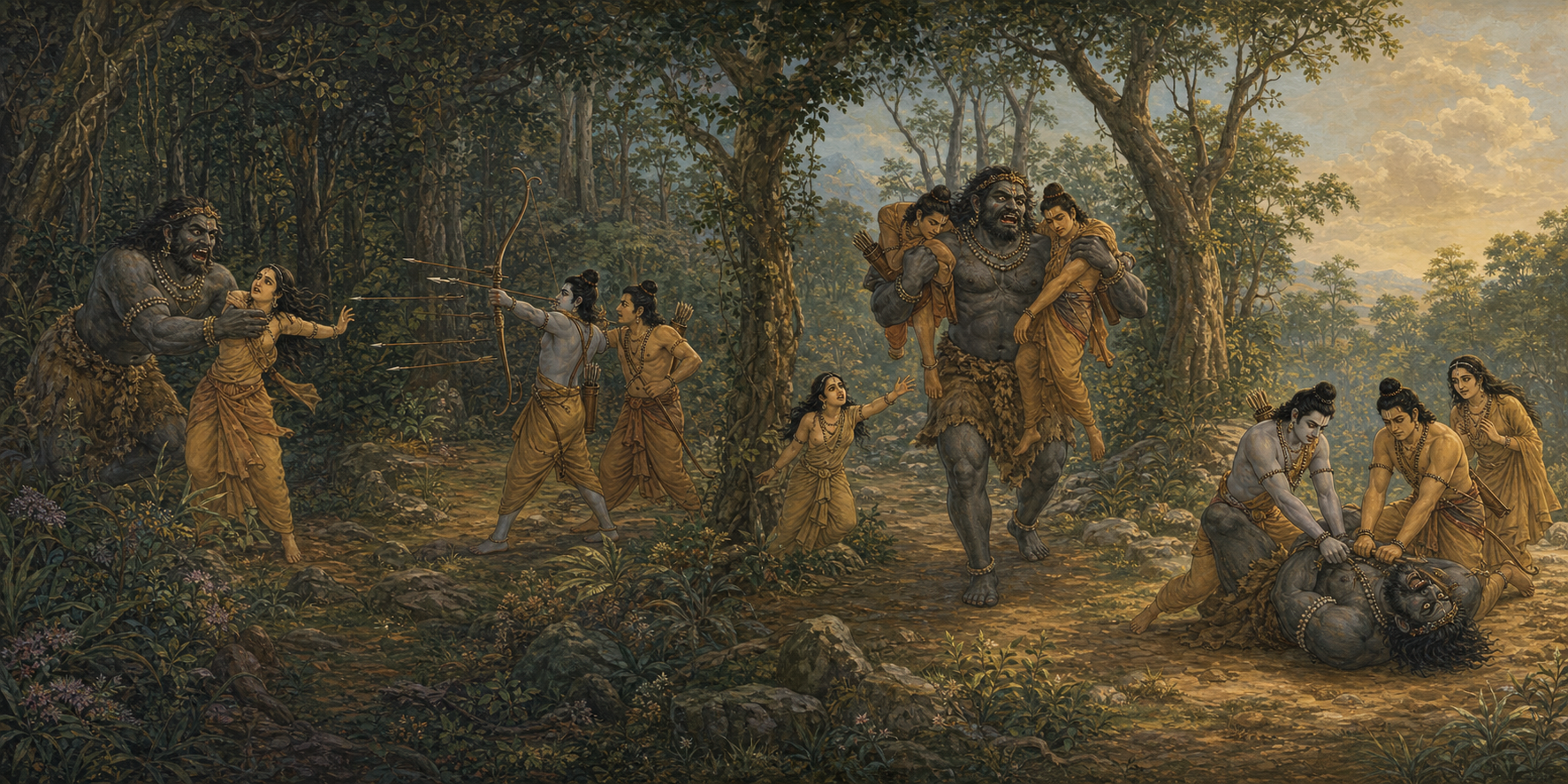
The encounter becomes clearer when you follow its sequence rather than reducing it to the statement that Rama defeats a rakshasa.
- Viradha commits a concrete violation. He obstructs the exiles and directs predatory desire toward Sita. The brothers have an immediate protective duty.
- The conventional response proves insufficient. Rama and Lakshmana shoot their arrows, but the attack does not bring the conflict to an end.
- The adversary’s condition becomes known. Viradha boasts that weapons cannot kill him. What first looked like a contest of force is now a problem of judgment.
- The brothers change the method without abandoning the duty. They close the distance, disable Viradha and use a non-weapon resolution that does not contradict the stated protection of his boon.
The critical moment is the transition between the second and third movements. Rama and Lakshmana do not keep repeating a failed attack merely to display resolve. Once they understand why the arrows cannot finish the battle, they adapt. Their courage includes the ability to learn under pressure.
This is also where Lakshmana’s presence deserves attention. The episode does not present dharmic action as the performance of an isolated hero. The brothers confront the danger together, move from ranged combat to close engagement together and share the physical burden of the solution. Lakshmana is not ornamental support standing beside Rama. Their disciplined companionship is part of their capacity to protect Sita.
You can use these four movements as a reading method. First identify the violation. Then identify the initial response. Notice what new fact changes the situation. Finally, judge whether the adapted response still serves the original duty. This prevents the supernatural details from obscuring the moral logic of the narrative.
Why the boon changes the method, not the duty
Viradha’s boon is not a declaration that his conduct has become righteous. It is a condition governing how he can be defeated. The distinction is essential: protection from one consequence does not convert predation into moral authority.
Rama and Lakshmana therefore refuse two errors. They do not surrender to Viradha as though the boon placed him beyond dharma. They also do not pretend that divine words and metaphysical conditions cease to matter whenever those conditions become inconvenient. Their task is to preserve both the protective purpose of action and the binding force of truth.
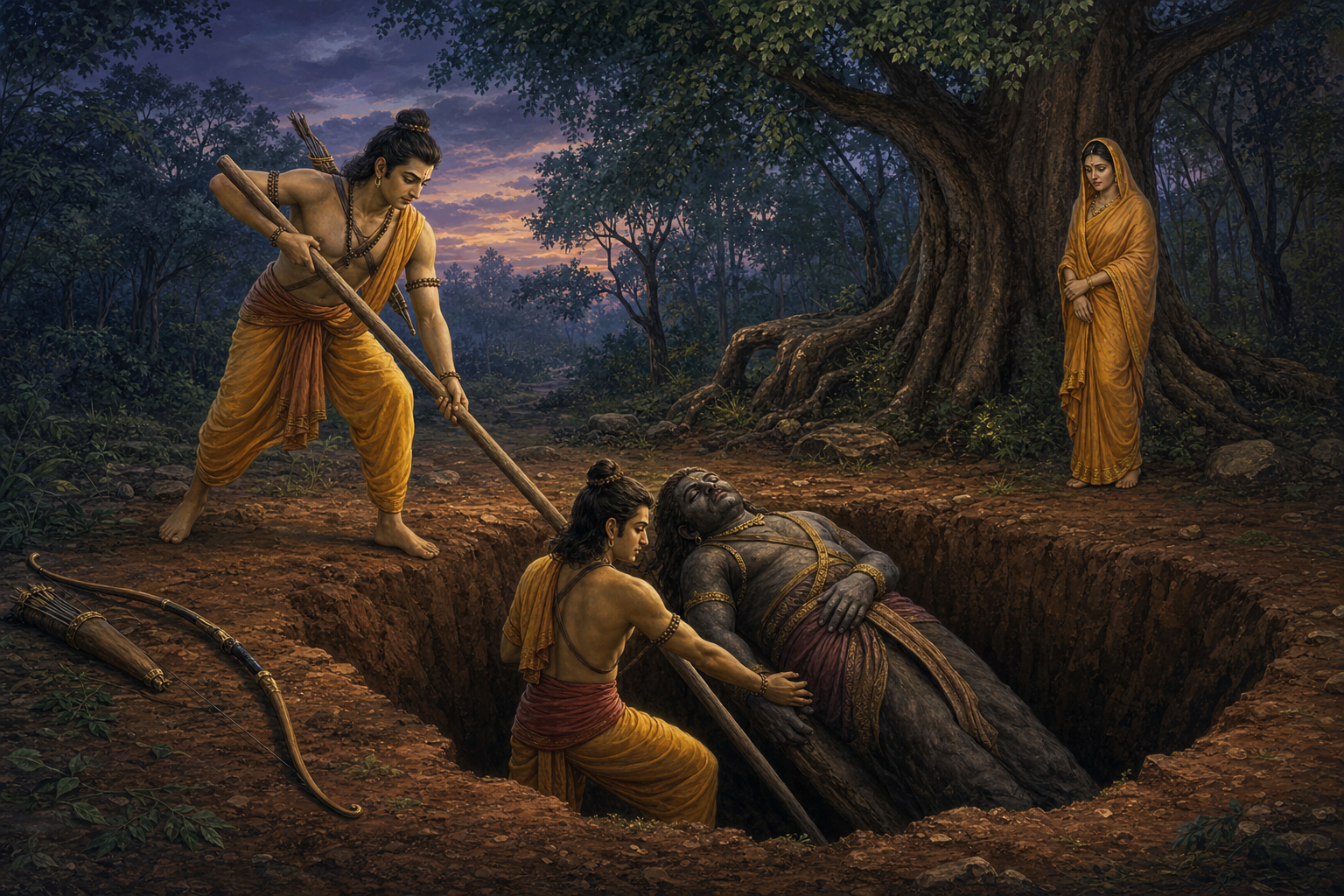
The tactical answer is exact. The brothers sever Viradha’s arms, destroying his immediate power to grasp and attack. They then consign the subdued rakshasa to a deep pit, using a method outside the weapon-based death against which he is protected.
This is sometimes described as finding a loophole, but that word is too shallow. A loophole normally implies manipulation of wording for a self-serving result. Rama’s adaptation is directed toward the defence of Sita and the restoration of safety. He does not break the boon, deny it or use false speech. He understands its limit and acts within that limit.
The episode consequently rejects the lazy claim that a righteous purpose makes every means acceptable. Dharma governs the means as well as the end. The brothers must stop the aggressor, but they must do so without behaving as though cosmic commitments have no force. Their ingenuity is lawful because it answers the actual terms of the problem rather than erasing them.
There is a practical discipline here for any difficult decision. Before applying more force, identify the constraint accurately. Ask whether it forbids the goal itself or only one method of reaching it. Then look for an alternative that honours the constraint without abandoning your legitimate responsibility. Persistence repeats an effort because the duty remains; stubbornness repeats it after the method has plainly failed.
Viradha’s release changes the meaning of victory
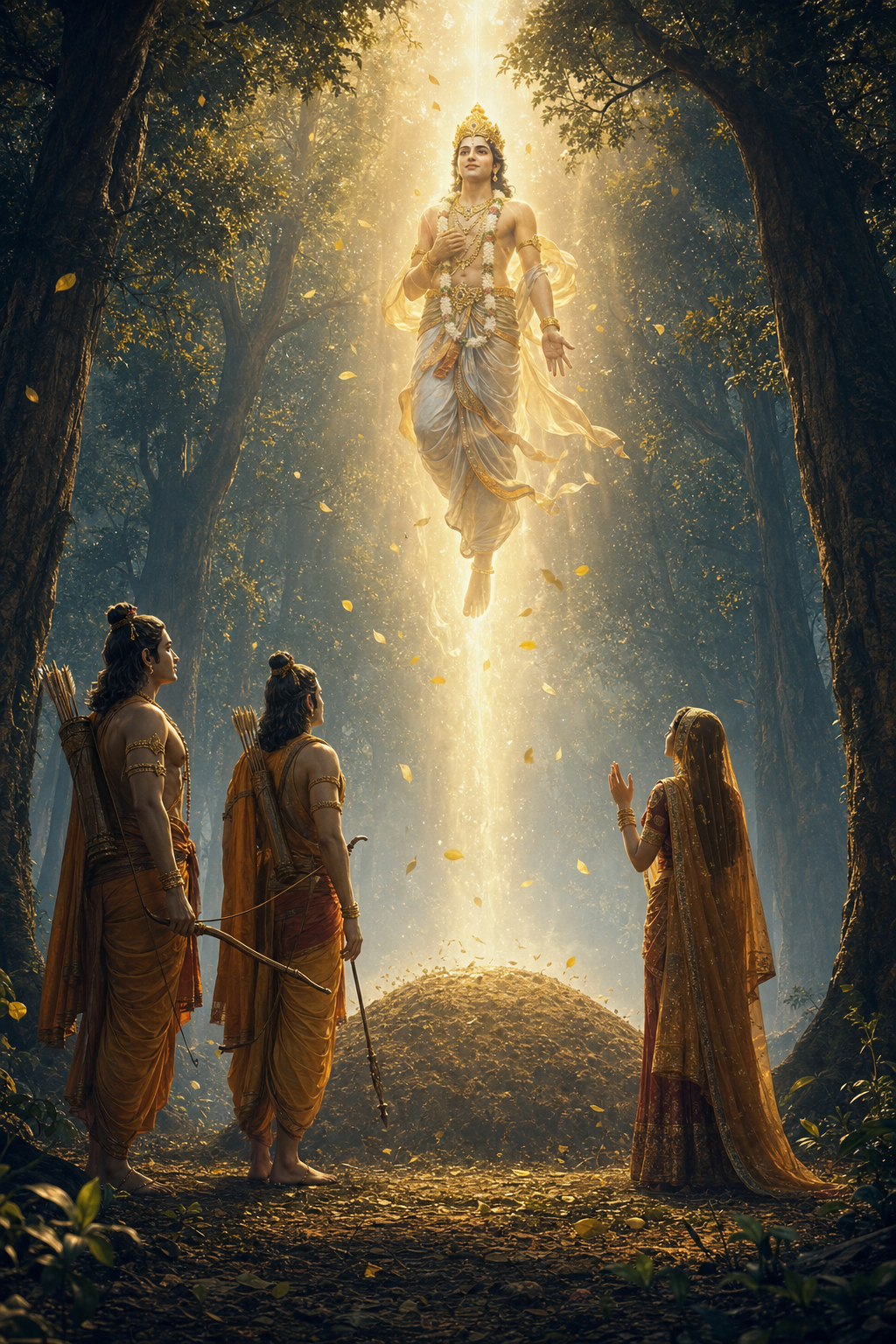
The encounter does not end with a dead enemy and triumphant warriors. Once his demonic condition is broken, Viradha emerges in a luminous celestial form. The being hidden beneath the rakshasa state is released, and the journey can continue toward the forest sages, including Sharabhanga and Suteekshna.
This transformation requires careful reading. It does not retroactively excuse Viradha’s threat to Sita. Nor does his potential for release require Rama and Lakshmana to tolerate ongoing harm. The sequence is decisive: the brothers protect Sita, end Viradha’s capacity to attack and only then does release become visible.
The Ramayana is therefore holding justice and restoration together without confusing them. Justice sets a boundary against predation. Restoration reveals that a degraded condition need not be the final truth of a being. If you retain only the punishment, you miss the release. If you speak only of release, you erase the danger that made protective action necessary.
This order also clarifies the place of force in the forest. Rama’s strength is not used to enlarge his territory or feed his pride. It creates safe passage for Sita and space in which ascetics can pursue their disciplines. Kshatra-dharma appears here as service: power accepts the burden of protecting conditions in which spiritual life can survive.
The episode shares a wider Dharmic concern with mastering the inner causes of outward harm. Buddhist reflection identifies attachment and pride as afflictions; Jain aparigraha disciplines grasping; Sikh nimrata opposes ego through humility and alignment with divine order. These traditions are not interchangeable, but each helps you notice why Viradha’s problem begins before the physical attack. A mind ruled by craving first misperceives another person, then tries to possess what it has refused to honour.
Viradha’s celestial release adds one more insight: a being is not necessarily identical to the worst condition under which that being appears. Dharma can oppose harmful conduct without declaring degradation to be an eternal essence. That is neither sentimental leniency nor moral confusion. It is justice ordered toward the healing of a damaged moral world.
Key takeaways for reading the Viradha episode
- Begin with the violation, not the spectacle. Viradha’s size and ferocity make the scene dramatic, but his attempt to seize Sita supplies the moral reason for intervention.
- Treat failure as information. The arrows reveal that ordinary weapons cannot conclude the encounter. Rama and Lakshmana change tactics instead of confusing repetition with courage.
- Read a boon precisely. Viradha is protected from death by weapons, not granted permission to act without restraint and not made immune to every possible response.
- Notice the brothers’ cooperation. Their combined action shows that companionship, trust and shared duty are forms of strength, not secondary decorations around heroism.
- Keep protection and restoration in their proper order. The threat is stopped first; Viradha’s release follows. Compassion does not require leaving Sita exposed to danger.
- Judge victory by what it makes possible. The obstruction is removed, the journey toward the sages continues and protective power returns to the service of spiritual life.
When you next read this passage, pause at the moment the arrows fail. That is where the deepest lesson begins. Ask what the brothers learn, what they refuse to compromise and what their eventual victory restores. The answers turn a brief forest battle into a durable method for thinking about dharma under pressure.