
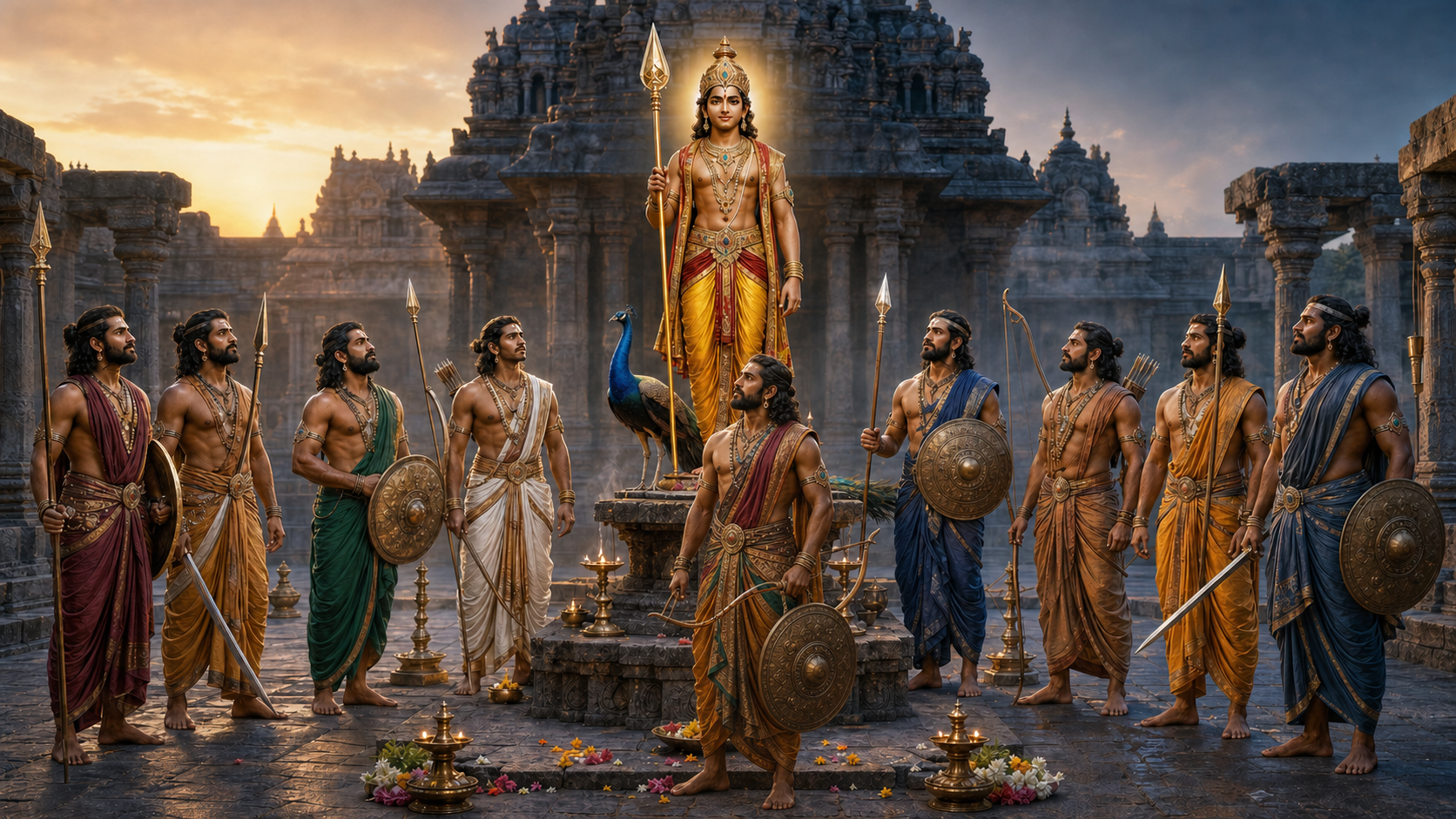
If you have seen nine armed figures near Muruga, heard Veerabahu invoked during a festival, or encountered two different lists of the Nava Veeras, the variation can be confusing. You do not need to decide that one temple is correct and another is mistaken.
The reliable way to understand the Nava Veeras is to separate their shared identity from their local names. Their relationship to Muruga, their martial duties, and their ethical meaning are more consistent than a single universal roll call. Once you know that distinction, you can read a shrine or festival on its own terms without losing sight of the larger tradition.
Start with their relationship to Muruga, not a fixed roster
The Nava Veeras are the nine valiant attendants of Lord Muruga, who is also worshipped as Skanda, Kartikeya, and Subrahmanya. Muruga is Deva Senapati, commander of the celestial hosts, so the nine heroes belong to the ordered divine force through which he confronts adharma. They are not rival deities competing for his authority. They serve under it.
In many South Indian oral and temple traditions, the Nava Veeras arise from the Nava Shaktis, manifestations of Mata Parvati’s power. They may therefore be described as sons or emanations of those nine Shaktis. This lineage explains why their courage is more than physical aggression: it is the protective energy of the Goddess placed at the service of Muruga’s wisdom and command.
This is a particularly clear Shaiva-Shakta synthesis. Muruga supplies direction, discrimination, and leadership. Shakti supplies the force required to defend order and overcome obstruction. The Nava Veeras stand where those two dimensions meet. Their strength has a source, a commander, and a dharmic purpose.
The Sanskrit Skanda Purana supplies the wider sacred setting of Muruga as divine commander. The Tamil Kanda Puranam, traditionally attributed to Kacciyappa Sivachariar, develops his campaigns and retinue in much greater narrative detail. Temple liturgy, oral recitation, sculpture, procession, and drama then give those sacred narratives a distinct local form.
Veerabahu is the most widely recognized member of the nine. He is commonly presented as Muruga’s chief lieutenant and as an envoy who seeks parley before battle. That detail is essential. The leading warrior does not rush to violence merely because he possesses the power to fight. He communicates, warns, and offers an opportunity to choose rightly before force becomes necessary. Veerabahu’s bravery is governed by judgment.
The number nine also invites symbolic reflection. It can suggest completeness, renewal, the Navagrahas, or the eight directions gathered around a sacred center. These are useful contemplative correspondences, but you should not turn them into a single mandatory explanation for the historical origin of the Nava Veeras. The devotional tradition is firm about the ninefold company while allowing more than one layer of meaning for the number.
Why the nine names differ, and what remains dependable
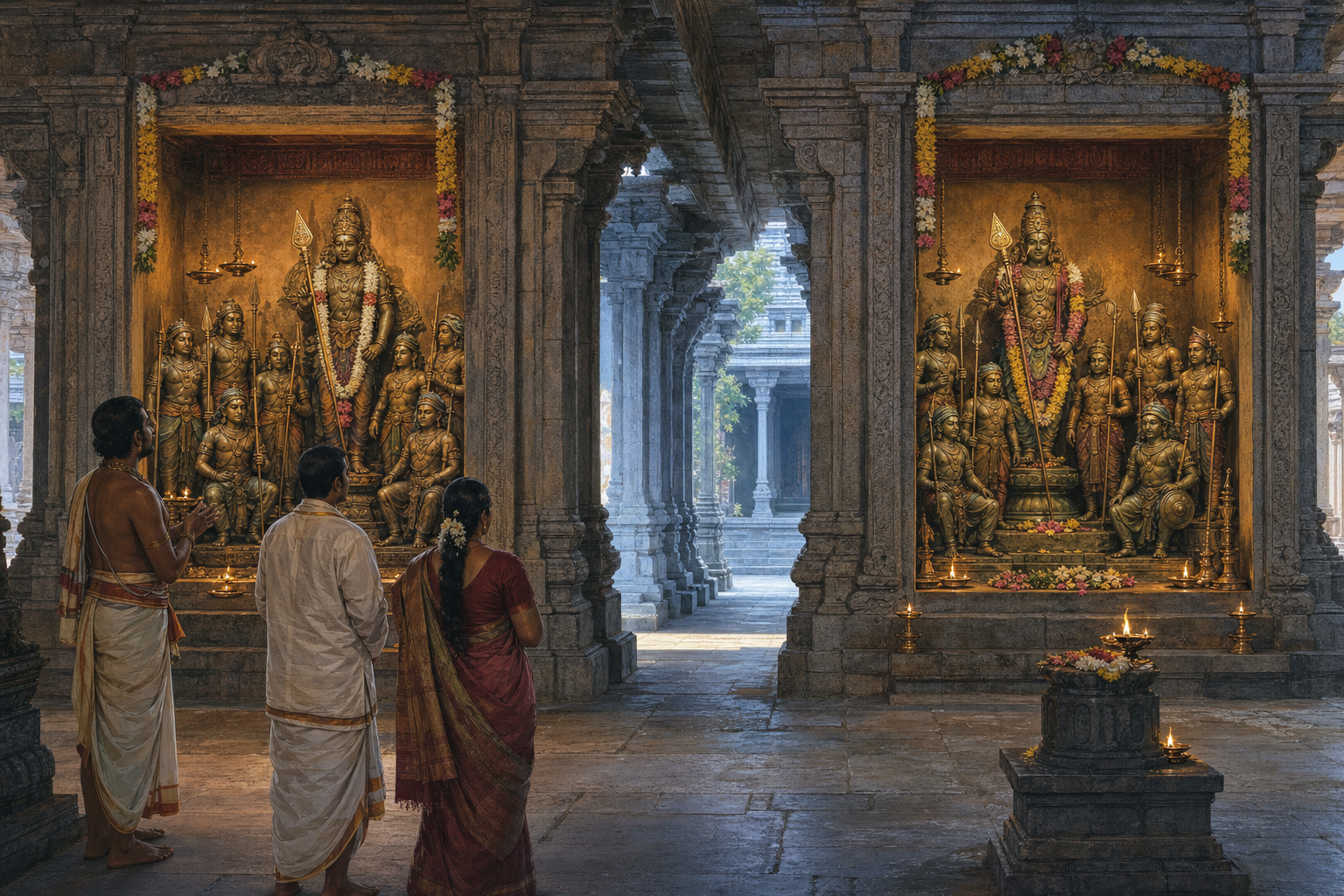
Veerabahu is the stable point in most accounts. The names, order, and individual descriptions of the other eight can change with region, textual recension, temple lineage, and festival repertoire. A list learned in one place may therefore fail to match the names used somewhere else.
That does not make the tradition incoherent. Hindu sacred memory often lives through several connected channels at once: a Purana preserves a broad narrative, a temple maintains its liturgy, a festival script assigns dramatic roles, an inscription records a local form, and an oral repertoire carries what the community actually sings and enacts. The Nava Veeras belong to this living intersection.
The common mistake is to take one regional list and present it as the only legitimate enumeration. That turns a local inheritance into a universal test of orthodoxy. A more accurate approach is to identify the tradition attached to the list and state its scope.
- Establish the setting. Ask whether the names come from a particular temple, Tamil recension, regional Purana, oral performance, or family tradition.
- Use local evidence locally. At a shrine, follow its inscriptions, icon labels, liturgy, and festival usage rather than replacing them with a list imported from elsewhere.
- State uncertainty honestly. If the lineage of a list is unknown, say “the Nava Veeras, led by Veerabahu” instead of supplying eight names that you cannot securely place.
- Compare functions before spellings. Two traditions may divide the same protective duties among figures bearing different names or titles.
- Do not make variation a devotional crisis. The shared theological relationship survives even when the local roster changes.
The dependable functional pattern is much clearer than the disputed enumeration. The company includes command, advance and rear protection, reconnaissance, care of standards and sacred emblems, security for the camp and routes, and support for the movement of the divine army. These are not ornamental tasks. They show that a righteous campaign depends on information, preparation, communication, protection, and disciplined coordination.
This functional reading also prevents a shallow interpretation of kshatra dharma. The warrior’s duty is not simply to strike the enemy. Someone must protect the flank, watch the route, carry the standard, gather intelligence, preserve order behind the advance, and speak before the battle. Valour without discipline becomes recklessness; discipline without a just purpose becomes mere obedience. The Nava Veeras embody courage ordered toward dharma.
Read the icons as a company of service, not nine decorations
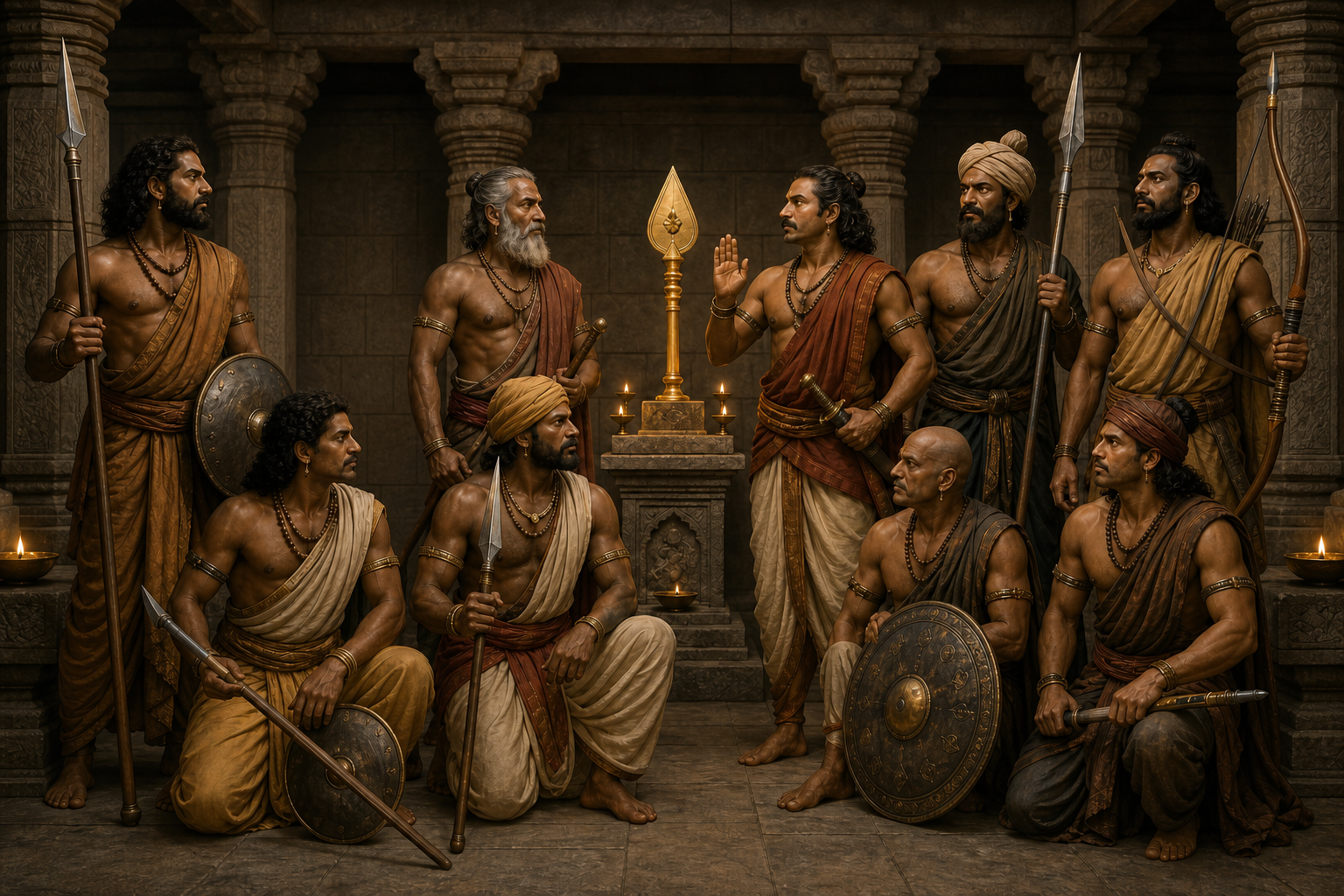
Nava Veera images are often youthful and martial. Depending on the shrine, you may see crowns, moustaches, swords, spears or vel-like weapons, maces, bows, shields, and alert or dynamic postures. Such features communicate vigilance and readiness, but a weapon by itself usually cannot establish a figure’s individual name.
Begin with placement. The nine may appear as parivara devatas, the attendant deities who surround and support the principal deity. They can occupy a prakara, a mandapam, or a space connected with processional activity. Their location tells you something important: divine protection extends outward from the sanctum into the routes, thresholds, gatherings, and public life of the temple.
Use five observations when you encounter a possible Nava Veera group:
- Count and grouping: Look for a deliberate company rather than assuming that every armed attendant belongs to the Nava Veeras.
- Relationship to Muruga: Notice whether the figures face, flank, precede, or accompany Muruga in a way that indicates service under his command.
- Emblems: A vel, peacock-associated standard, shield, or processional object can reveal the company’s connection to Muruga, though it may not identify an individual hero.
- Posture: Readiness, movement, and guarded stances communicate duty. They need not represent uncontrolled fury.
- Local identification: Treat a label, inscription, liturgical name, or established festival role as stronger evidence than a guess based on facial hair or weapon type.
Veerabahu may receive special prominence as commander or envoy, but confirm that identification through the temple’s own usage. A central or imposing warrior is not automatically Veerabahu. The same caution applies to attempts to assign the other eight by weapon alone.
The six celebrated abodes of Muruga are Thirupparankundram, Tiruchendur, Palani, Swamimalai, Tiruttani, and Pazhamudircholai. They sustain the wider memory of Muruga’s divine mission and retinue, but you should not expect an identical nine-image arrangement at every site. Dedicated icons become especially visible where processions and sacred drama give the attendants defined public roles.
This distinction matters when photographing, cataloguing, or explaining a shrine. Record what the temple actually presents. Note the location, number of figures, attributes, labels, and ritual use. Do not fill a missing name from memory merely to make the description look complete. A precise local account is more useful than a falsely universal one.
Let festival drama and daily worship teach disciplined courage
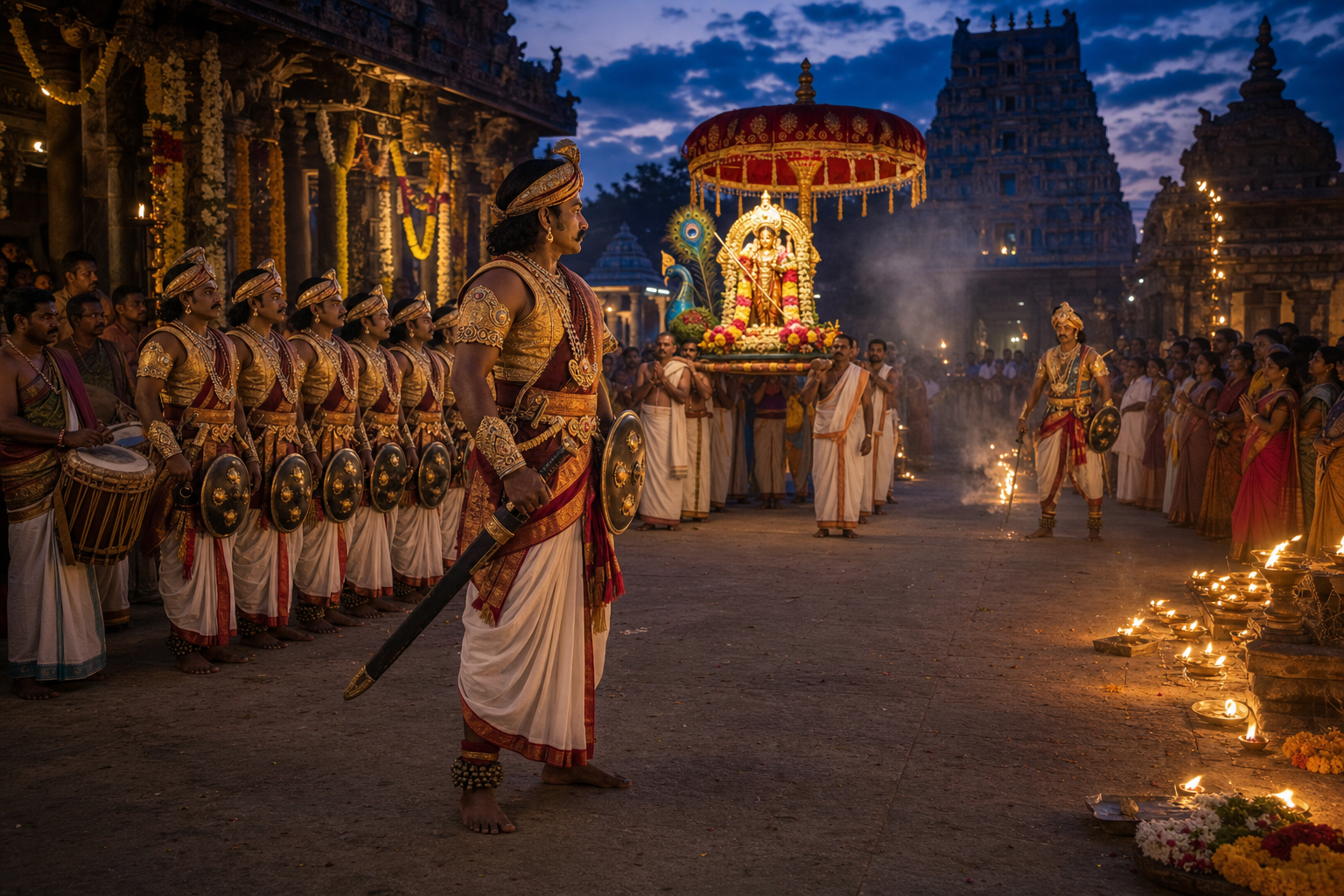
The Nava Veeras become easiest to understand when the divine army moves. During Skanda Sashti, the sequence leading to Soorasamharam presents Muruga’s victory as an ordered campaign rather than an isolated burst of power. Pay attention not only to the final defeat of Surapadman but also to command, warning, preparation, movement, and the work of the attendants. The moral drama begins before the climactic confrontation.
Thaipusam places Muruga devotion within vows, penance, thanksgiving, Kavadi-bearing, and public acts of endurance. The Nava Veera ideal helps interpret that discipline: strength is offered, governed, and turned toward something sacred. Karthikai observances may bring the same memory into lamps, music, procession, and devotional theatre. The prominence of the nine will vary by locality, so watch how each community actually invokes them.
Tiruppugazh praises Muruga’s valour and grace within the world of his divine retinue. Kanda Shasti Kavasam intensifies the devotee’s sense of Muruga’s protecting presence and is often recited in settings where his attendants, particularly Veerabahu, are also honoured. Neither work should be treated as a guaranteed universal catalogue of nine names. If your immediate purpose is to identify a local roster, the temple’s liturgy and festival repertoire are the better guides.
You can honour the Nava Veeras without inventing a new ritual or pretending to possess a lineage-specific practice. A simple observance can connect their symbolism to a duty already present in your life:
- Begin with Muruga. Light a lamp before his image or vel according to your household practice. This keeps the attendants in their proper relationship to the deity they serve.
- Name one duty clearly. Choose an actual responsibility requiring courage, such as protecting someone vulnerable, correcting an injustice, keeping a promise, or facing a difficult conversation.
- Apply Veerabahu’s test. Before escalating a conflict, ask whether you have communicated truthfully, offered a fair opportunity to change, and distinguished firmness from anger.
- Recite with intention. If Kanda Shasti Kavasam or another Muruga hymn already belongs to your practice, let the words direct your attention toward protection, restraint, and service rather than mere personal victory.
- Complete one act of seva. Turn the prayer outward by helping your family, temple, pilgrimage group, or wider community in a concrete way. Guardianship becomes real through work.
Do not manufacture a nine-step rite, nine-day vow, or set of nine invocations merely because the company contains nine heroes. Follow an established temple, family, or guru tradition when a formal observance is required. Symbolic reflection can support worship, but it should not be passed off as inherited liturgy.
The Nava Veeras also illuminate a wider Dharmic conviction: spiritual cultivation and the protection of others need not be opposites. Buddhist Dharmapalas protect the path; Jain yaksha and yakshini attendants guard sacred figures and pilgrims; Sikh tradition gives powerful expression to the Sant-Sipahi, the saint-soldier. These are analogies, not interchangeable doctrines. Their shared ethical question is still worth carrying: can strength remain compassionate, restrained, and answerable to a sacred purpose?
Key takeaways
- The Nava Veeras are nine martial attendants serving Muruga as divine commander.
- Many traditions connect them to the Nava Shaktis and therefore to Mata Parvati’s protective power.
- Veerabahu is the most consistently identified member; names and ordering for the other eight vary by region and lineage.
- Their recurring duties include command, diplomacy, reconnaissance, flank and route protection, standards, camp security, and logistical support.
- Temple placement, labels, liturgy, and festival roles are safer guides to identity than weapons or appearance alone.
- Their practical lesson is courage under discipline: communicate before conflict, protect rather than dominate, and turn devotion into seva.
The next time you encounter the Nava Veeras, begin with three questions: whom do they serve, what are they guarding, and how does this temple remember them? Then carry one part of that answer beyond the shrine. Speak before you strike, stay steady at your post, and use whatever strength you have to protect rather than intimidate.