

You may recycle carefully, carry reusable bags, and still feel that environmental responsibility has been reduced to buying greener versions of the same abundance. That discomfort points to the deeper problem. Before asking which product is less harmful, aparigraha asks whether you need to acquire it at all, what duty comes with taking it, and when keeping it becomes hoarding.
This change of question turns ecology from a consumer identity into a daily Dharmic discipline. It gives you a practical way to examine your home, work, worship, and community without confusing non-possessiveness with forced poverty. It also joins inner restraint to public responsibility: consuming less matters, but so do fair institutions, repairable goods, protected commons, and care for people who cannot choose austerity.
Enough is defined by dharma, not by deprivation

Aparigraha is commonly rendered as non-possessiveness, non-hoarding, or freedom from grasping. None of these means that a householder must own nothing. A teacher may need books, an artisan needs tools, a family may require medical supplies, and a person living through a severe winter needs more protection than someone in a mild climate. The relevant question is not how few objects you can display. It is whether what you keep serves a real duty, supports legitimate well-being, or merely feeds fear, status, and the habit of accumulation.
A useful working rule is this: keep what you use, what reliably supports a foreseeable responsibility, and what has deliberate sacred, cultural, or relational value. Everything else should have a clear reason for occupying material, money, attention, and storage. This is a rule for discernment, not a universal possession count. Your health, occupation, household size, caregiving duties, local climate, and access to shared services all affect what enough looks like.
The distinction becomes vivid in Śiva’s Pichandavar or Bhikshatana form. The Lord of the cosmos appears as a wandering mendicant bearing a skull-bowl. His poverty is chosen and pedagogical: it exposes pride, loosens identification with possessions, and asks whether the person controls an object or has begun arranging life around protecting and displaying it. The image does not sanctify destitution. In living temple practice, the mendicant’s appeal for alms can prompt annadana and charity, directing voluntary restraint toward the relief of involuntary need.
That distinction is indispensable for environmental ethics. A well-paid household refusing an unnecessary upgrade is practicing restraint. A poor household being denied energy, transport, nutritious food, or secure shelter is experiencing deprivation. Aparigraha cannot be used to tell the dispossessed to accept less while affluent consumers and powerful institutions continue taking more. Its demand becomes stronger as wealth, consumption, and decision-making power increase.
Ecologically, aparigraha intervenes at three points: taking, holding, and releasing. At the point of taking, it challenges an unnecessary purchase. While holding, it requires maintenance, repair, sharing, and full use. At release, it rejects careless dumping and asks where the material will go next. Recycling addresses only part of the third point. Non-acquisition, durable use, and responsible return reach the problem earlier.
This is why decluttering alone is not aparigraha. Throwing away usable objects to create a minimalist appearance can increase waste. Selling possessions only to replace them with a fashionable minimalist collection simply changes the style of consumption. The test is not whether a room looks empty. The test is whether desire has become more governed, useful things remain in service, surplus reaches someone who can use it, and harmful material is handled responsibly.
Four Dharmic lenses keep restraint from becoming a lifestyle fad

Hindu, Jain, Buddhist, and Sikh traditions do not teach identical doctrines, and their differences should not be flattened into a generic spirituality. Yet each gives you a way to notice that possession is relational. What you take comes through soil, water, energy, labor, animals, communities, and inherited knowledge. Non-possessiveness begins when those relationships become morally visible.
Hindu thought: receive as a trustee and return through yajña
The opening verse of the Īśā Upaniṣad presents the world as divinely pervaded and joins enjoyment with renunciation and freedom from coveting. Its ecological force lies in grateful use without the conceit of absolute ownership. If the world is not spiritually empty matter, then land, water, animals, forests, and minerals cannot be treated as objects whose only meaning is the price a buyer will pay.
The Bhūmi Sūkta describes Earth as mother and the human being as her child. The language is intimate, but its obligation is concrete. A child does not prove love for a mother by praising her while poisoning her water or exhausting her soil. When you evaluate an action, pair reverence with a material question: what will this do to land, water, air, living beings, and the people who depend upon them?
Bhagavad Gītā 3.14-3.16 links living beings, food, rain, yajña, and action in a cycle of reciprocity. Read ecologically, yajña becomes work offered to sustain the larger whole, not merely a private ritual transaction. Taking food therefore creates duties toward soil and water. Taking energy creates a duty to limit waste and support cleaner systems. Taking manufactured goods creates duties of maintenance, repair, reuse, and responsible end-of-life handling.
Yoga makes the inner discipline explicit. Aparigraha works with ahimsa, asteya, brahmacarya, and the niyamas rather than standing alone. Ahimsa asks who or what is harmed. Asteya asks whether you are appropriating more than your share of a common good. Brahmacarya moderates appetite. Śauca refuses to externalize filth into another neighborhood, river, or habitat. Santoṣa weakens the chronic sense that the next acquisition will finally be enough. If one of these checks fails, a purchase can be legal and affordable while still being difficult to defend as Dharmic.
Jain thought: reduce harm at the smallest visible scale
Jain aparigraha places exacting limits on attachment and accumulation. Tattvārthasūtra 5.21, Parasparopagraho Jīvānām, affirms mutual support among living beings. Its practical consequence is careful attention to diet, water, livelihood, waste, and forms of life that convenience usually overlooks.
You can apply that attentiveness without pretending to have taken a monastic vow. Before dismissing a harm as negligible, ask whether it is repeated, scaled, or transferred out of sight. A small disposable object used once may look insignificant in your hand; a system designed around constant single use is another matter. Jain ethical precision trains the mind to examine the recurring pattern rather than excuse each isolated act.
Buddhist thought: trace the conditions behind the object
Pratītyasamutpāda, dependent arising, undermines the fantasy that a consumer choice is isolated. Every object depends on causes and conditions: materials, labor, transport, energy, financing, marketing, use, and disposal. Mindfulness allows you to see those conditions before habit completes the purchase; karuṇā asks you to care about the beings affected by them. This combination supports action attentive to consequences, justice, and unintended harm.
The practical move is to lengthen attention. When desire says now, pause long enough to reconstruct the chain. Where did the item come from? What suffering or pollution may have been displaced from view? Will owning it create further demands for storage, maintenance, accessories, or replacement? Mindfulness is doing ecological work when it interrupts automatic acquisition before remorse begins.
Sikh thought: turn reverence into shared service
Guru Granth Sahib honors air as teacher, water as father, and Earth as great mother. Seva and sarbat da bhala then move ecological kinship into common action. Tree planting, water restoration, responsible langar operations, and community resilience are not private badges of purity. They improve the conditions through which everyone lives.
This lens corrects an overly individual reading of aparigraha. You may refuse an unnecessary possession, but the freed money, time, skill, or storage capacity should not automatically be absorbed by another private desire. Some of that capacity can become seva: feeding others, repairing shared facilities, restoring water, planting appropriate native species, or supporting people during an environmental crisis.
Across these traditions, the point is not to assemble a single blended theology. It is to notice four complementary disciplines: stewardship, fine-grained non-harm, causal awareness, and service to all. Together they prevent aparigraha from shrinking into an aesthetic of tidy shelves.
Use a six-step aparigraha audit before buying or clearing out

Do not begin by trying to purify your entire life in one weekend. Choose one material stream where decisions recur: food, clothing, electronics, furniture, worship supplies, transport, or household energy. A narrow audit will show you the mechanism of attachment more clearly than a sweeping promise to consume less.
- Name the duty. State the function the purchase or possession is meant to serve. Be specific: work, health, caregiving, safety, worship, learning, hospitality, or recreation. If you can name only status, boredom, novelty, or a vague future possibility, pause.
- Define enough before exposure. Decide what adequate function looks like before browsing shops, reviews, or advertisements. A pre-set standard protects the decision from being rewritten by whatever is most attractive in front of you.
- Check what is already available. Ask whether an existing item can be maintained, repaired, adapted, borrowed, rented, or shared. The purpose is not to refuse every purchase; it is to avoid creating a new material demand when the duty can already be met.
- Examine the whole relationship. Consider materials, labor, animal welfare, energy, packaging, durability, repairability, and likely disposal. You may not have perfect information. Look for the most consequential facts you can actually verify, and do not let a green label replace the examination.
- Plan the exit before the entry. Know whether the item has a realistic repair route, second user, producer take-back option, composting pathway, or locally accepted recycling stream. A theoretical possibility is not an end-of-life plan if no suitable facility or recipient exists where you live.
- Redirect surplus deliberately. When restraint frees money, time, space, food, or equipment, decide where the surplus will go. Give useful goods while they are still useful, support seva or dana, and strengthen a shared ecological good. Otherwise the next desire will usually claim the newly opened capacity.
Repeat the audit after a change in work, health, climate, household composition, or caregiving responsibility. Enough is not a permanent number. The discipline lies in revisiting it honestly rather than allowing every new circumstance to become a permanent justification for more.
Food and worship require planning before disposal
For food, aparigraha begins with buying and preparing quantities that match the people you will actually serve. Use edible leftovers safely, segregate unavoidable organic waste where a suitable system exists, and connect procurement to farming that cares for soil, water, and seed diversity. Waste is not made harmless merely because the original food was sacred or vegetarian.
At temples, festivals, and household pūjā, preserve the sanctity of worship by planning material flows with equal care. Durable vessels and decorations can replace unnecessary single-use items. Flowers can be composted or transformed into suitable products where the necessary knowledge and facilities exist. Materials should be segregated at the point of use, before wet and dry waste become difficult to recover. Temple and community initiatives using flower composting, source segregation, and reduced single-use plastic show how śauca can govern the full ritual cycle rather than only the altar.
Do not discard consecrated objects, mūrtis, scriptures, or inherited cultural material as if they were ordinary clutter. Their proper care, repair, transfer, or ritual disposition depends on the tradition and object involved. Aparigraha asks you to relinquish possessiveness; it does not authorize careless treatment of what has been entrusted to you.
Clothes, devices, and furniture reveal whether you value use or novelty
Keep maintenance instructions, use protective care that genuinely extends life, and repair an item when repair is proportionate and safe. Share or lend occasional-use equipment when trust and access make that workable. When replacement is necessary, compare durability, repair access, spare parts, and take-back arrangements instead of treating purchase price as the whole cost.
Beware the sunk-cost form of attachment: keeping an unused object because you paid for it does not recover the money or materials. Find the highest responsible future use. That may be continued use by you, repair for another person, sale, donation, return to the producer, or recovery through an accepted local system. Passing unusable waste to a poorer household is not generosity.
Water, energy, and buildings call for demand reduction as well as cleaner supply
Clean energy matters, but aparigraha first asks how much demand is necessary. Correct avoidable waste, maintain equipment, and use shade, ventilation, courtyards, or other climate-responsive features where they are suitable for the building and local conditions. Traditional forms such as shaded colonnades, courtyards, lime plasters, and local materials offer design principles that can be combined with contemporary engineering rather than copied without regard to climate or safety standards.
Apply the same reasoning to water. Reduce preventable loss, keep pollutants out of drains and waterways, and support systems that replenish the watershed. Personal frugality cannot substitute for functioning infrastructure, but it can align your habits with the public measures you expect institutions to take.
Make institutions carry the duties that individuals cannot
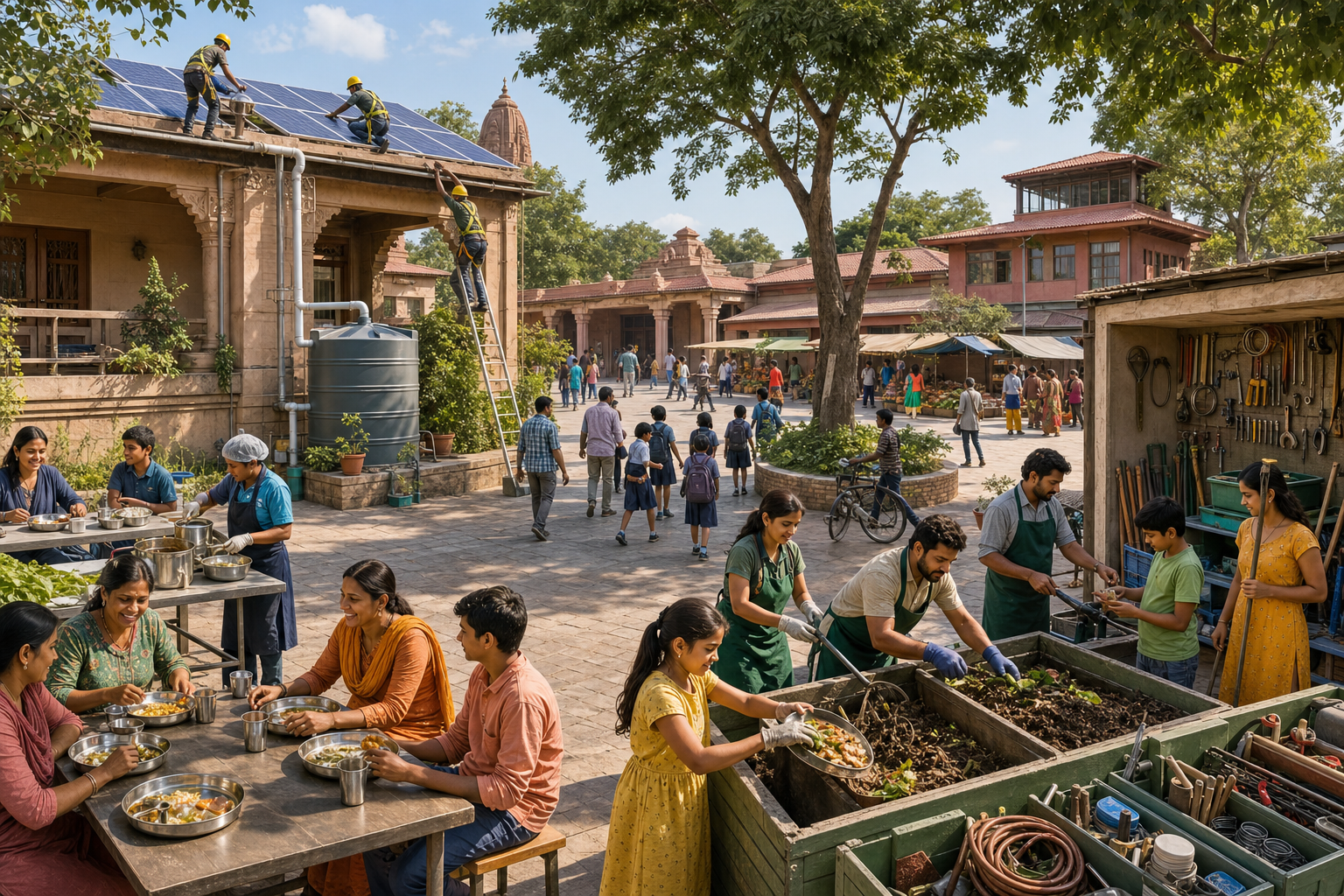
Aparigraha is easily weakened when ecological responsibility is assigned entirely to households. An individual cannot redesign a product, require spare parts, operate a municipal recovery system, restore an entire river basin, or enforce protection of a forest. Dharma governs artha and public authority as well as private conduct. Responsibility must therefore follow power.
| Role | Dharmic question | Practical next action |
|---|---|---|
| Householder | What is enough for my actual duties? | Set an acquisition rule, maintain what you own, share usable surplus, and segregate waste correctly. |
| Temple, gurdwara, or community steward | What do our collective purchases teach and normalize? | Adopt procurement standards, reduce single-use materials, plan food quantities, segregate at source, care for water, and direct volunteers toward measurable local needs. |
| Business owner or professional | Who carries the consequences after the sale? | Use lifecycle thinking, design for repair, disclose care and disposal routes, reduce packaging, and provide credible take-back where feasible. |
| Citizen or public official | Are common goods protected fairly? | Support ecological accounting, transparent enforcement, watershed and habitat protection, public transport, and transitions that do not abandon vulnerable workers or communities. |
For a religious or cultural institution, procurement is a powerful starting point because it turns values into recurring market decisions. Ask suppliers about durability, repair, packaging, labor, animal harm, and end-of-life responsibility. Set rules for reusable serviceware where hygienically appropriate. Put labeled collection systems where people make disposal decisions, not only behind the building. Assign responsibility for checking what happens after materials leave the premises.
For a manufacturer or retailer, producer responsibility expresses a straightforward moral principle: creating and profiting from a material flow creates obligations downstream. Lifecycle assessment, repair-and-reuse systems, right-to-repair measures, and producer take-back schemes give practical form to that obligation. A take-back promise should identify what is accepted and what actually happens to returned material; otherwise it is reassurance without accountability.
For governments, the relevant possessions are often collective: air, water, soil, forests, wildlife, and the infrastructure on which ordinary life depends. Protecting these goods requires fair rules, ecological accounting, monitoring, and transparent enforcement. Climate action must also account for vulnerable communities and workers affected by the transition. Restraint imposed downward while environmental benefits and profits flow upward is not an adequate expression of dharma.
Bhāratīya practice offers models of community restraint that are neither purely private nor purely bureaucratic. Sacred groves such as devrai, kavu, and devarakāḍu place cultural protection around habitats. Temple tanks and stepwells embody water storage and groundwater care. These forms should not be romanticized or copied mechanically, but they demonstrate an important principle: custom, devotion, local knowledge, and public administration can reinforce one another.
If you serve on a temple committee, manage a business, donate to a community organization, or vote on public priorities, ask for evidence at the scale of that institution. What material, water, and waste streams does it control? Who is responsible for downstream effects? Can a product be repaired? Are environmental burdens being shifted to workers, farmers, poorer neighborhoods, animals, or future generations? What will be measured, and who will report it? Aparigraha becomes institutional ethics when these questions change budgets, contracts, designs, and enforcement.
Key takeaways
- Aparigraha does not require owning nothing. It requires keeping possessions subordinate to dharma rather than identity, fear, or status.
- Define enough according to real duties, health, climate, household needs, and access. Minimalist appearance is not an ethical standard.
- Intervene before disposal: question acquisition, maintain and repair what you keep, and plan a responsible exit before bringing a new object home.
- Chosen restraint must not be confused with imposed poverty. Surplus should support dana, seva, fair access, and protection of shared ecological goods.
- Ahimsa, asteya, santoṣa, interdependence, mutual support among living beings, and sarbat da bhala keep non-possession connected to harm, justice, and service.
- Match responsibility to power. Households can reduce excess, but producers, institutions, and governments must govern material systems and protect the commons.
Choose one material stream this week. Write down what enough means before the next purchase, identify one neglected item to repair or transfer responsibly, and decide where any freed capacity will go. Then take the same question to one institution you influence. The practice becomes ecological dharma when less grasping creates more care.
References
- Dandavats – Vedic Environmentalism: Dharmic Ethics for Sustainability, Ahimsa, and Planetary Care
- DharmaRenaissance Blog – Pichandavar Shiva: The Divine Mendicant Who Unmasks Ego and Teaches Aparigraha