
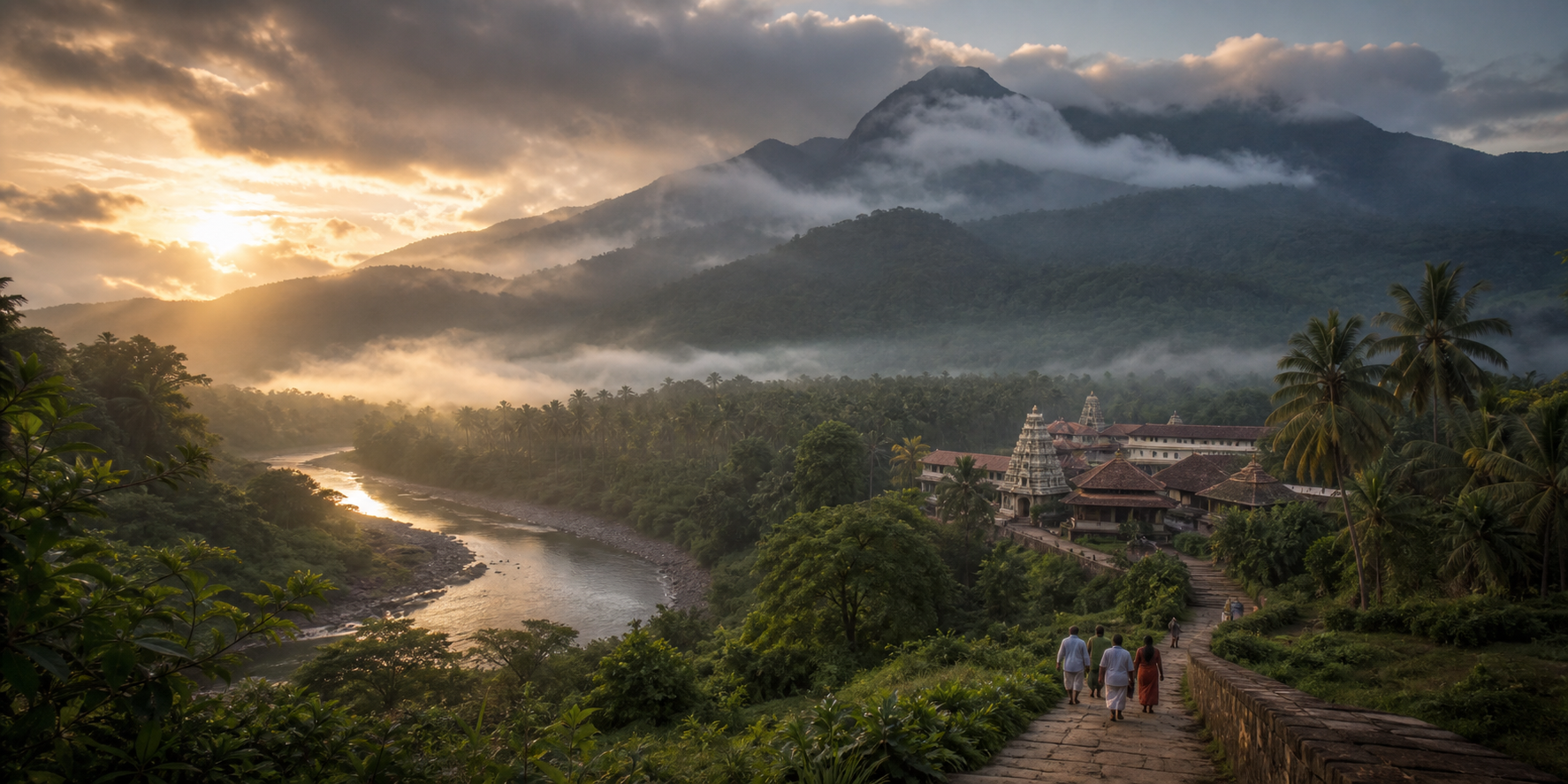
If you are preparing to visit Kukke Subramanya, a list of sevas and darshan points will not give you the whole map. The kshetra becomes intelligible only when you see how Subrahmanya’s victory, Vasuki’s refuge, the Kumaradhara River, Kumara Parvatha, and the smaller sanctums belong to one sacred story.
That understanding changes the way you move through the pilgrimage. The river is not merely a place to wash before entering. Adi Subrahmanya is not an optional extra. Even the modest form of KukkeLinga tells you something about the historical and theological layers gathered at this forest shrine.
Begin with the landscape, not the temple queue
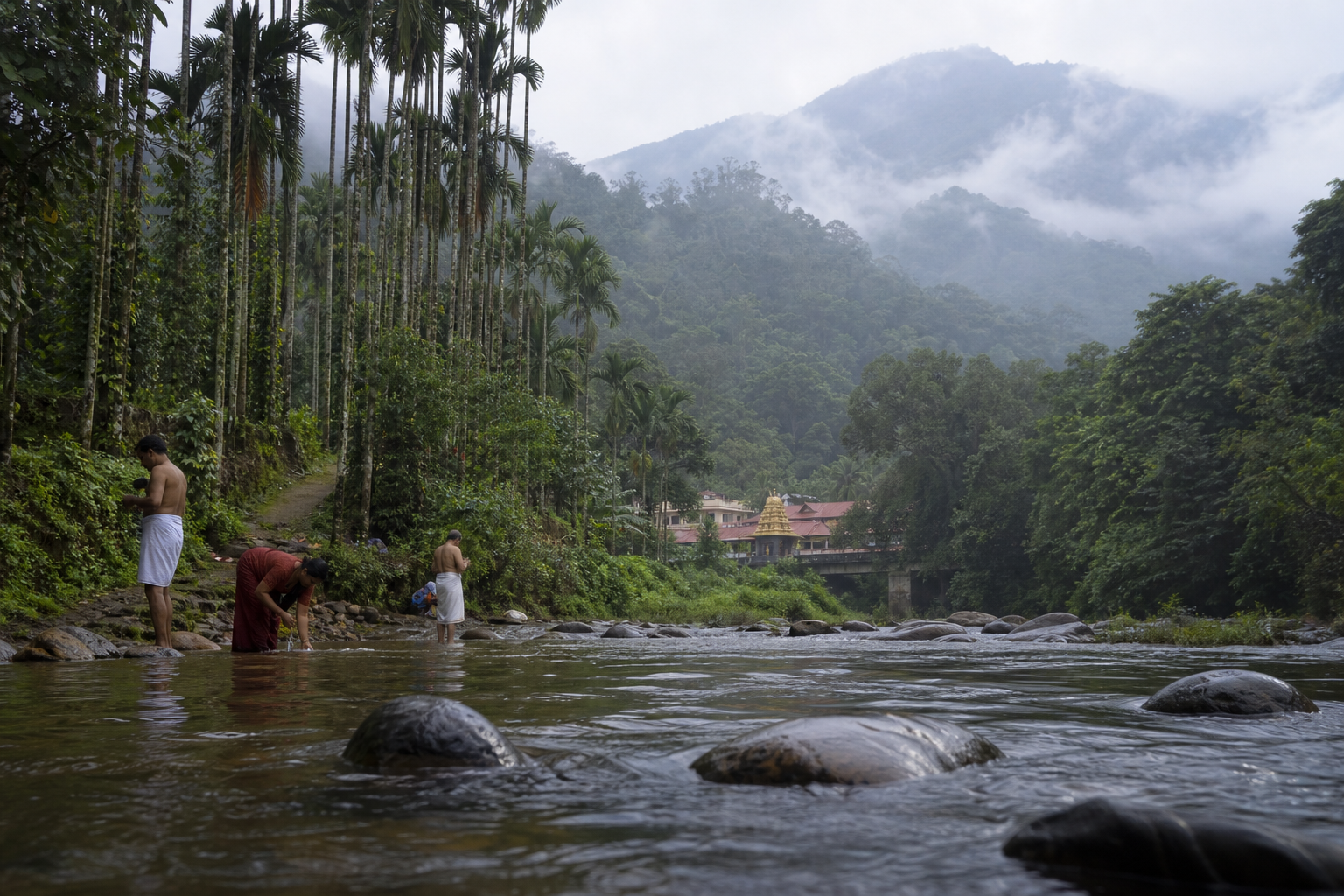
Kukke Subramanya stands in Subrahmanya village in Karnataka’s Dakshina Kannada district, at the forested base of Kumara Parvatha and beside the Kumaradhara. These are not scenic accessories around an otherwise self-contained temple. Mountain, river, cave, forest, and sanctum form a single field of pilgrimage.
- Kumara Parvatha: The massif rises behind the kshetra and gives the shrine its enclosing horizon. Its watershed feeds the river below, so the mountain-river relationship is physically present before it becomes a religious symbol.
- Kumaradhara: Pilgrims traditionally approach the river for snana or mindful ablutions before darshan. The point is purification and recollection, not merely getting wet. If a full bath is unsuitable or contrary to current instructions, a reverent ablution preserves the intention without turning the river into a checklist item.
- Biladwara: Local memory associates this nearby cave with Vasuki’s search for sanctuary. Even if it is not part of your practical route, it belongs to the kshetra’s inner map: the protected serpent is linked to the earth itself, not confined to an image inside a building.
- The shrine network: The main sanctum, KukkeLinga, Naga stones, and Adi Subrahmanya distribute different parts of the theology across several places. Completing the circuit lets the story unfold in space.
This is an aranya-kshetra, a sacred place held within a forest environment. Ecological care is therefore part of worship. Avoid plastic, do not disturb anthills or vegetation, place permitted offerings gently, and never treat a living snake as a ritual object to be approached or handled. The legend celebrates sanctuary for Nagas; careless pilgrimage would contradict its central ethic.
The buildings also respond to their landscape. Timber construction, laterite, enclosed halls, square sanctums, and sloping tiled roofs suit a high-rainfall coastal environment. Kukke’s visual language is intimate and functional rather than dependent on monumental height. When you look closely at the rooflines, mandapas, and enclosed sanctums, climate adaptation becomes part of the temple’s living heritage.
Four legends explain what you encounter at Kukke
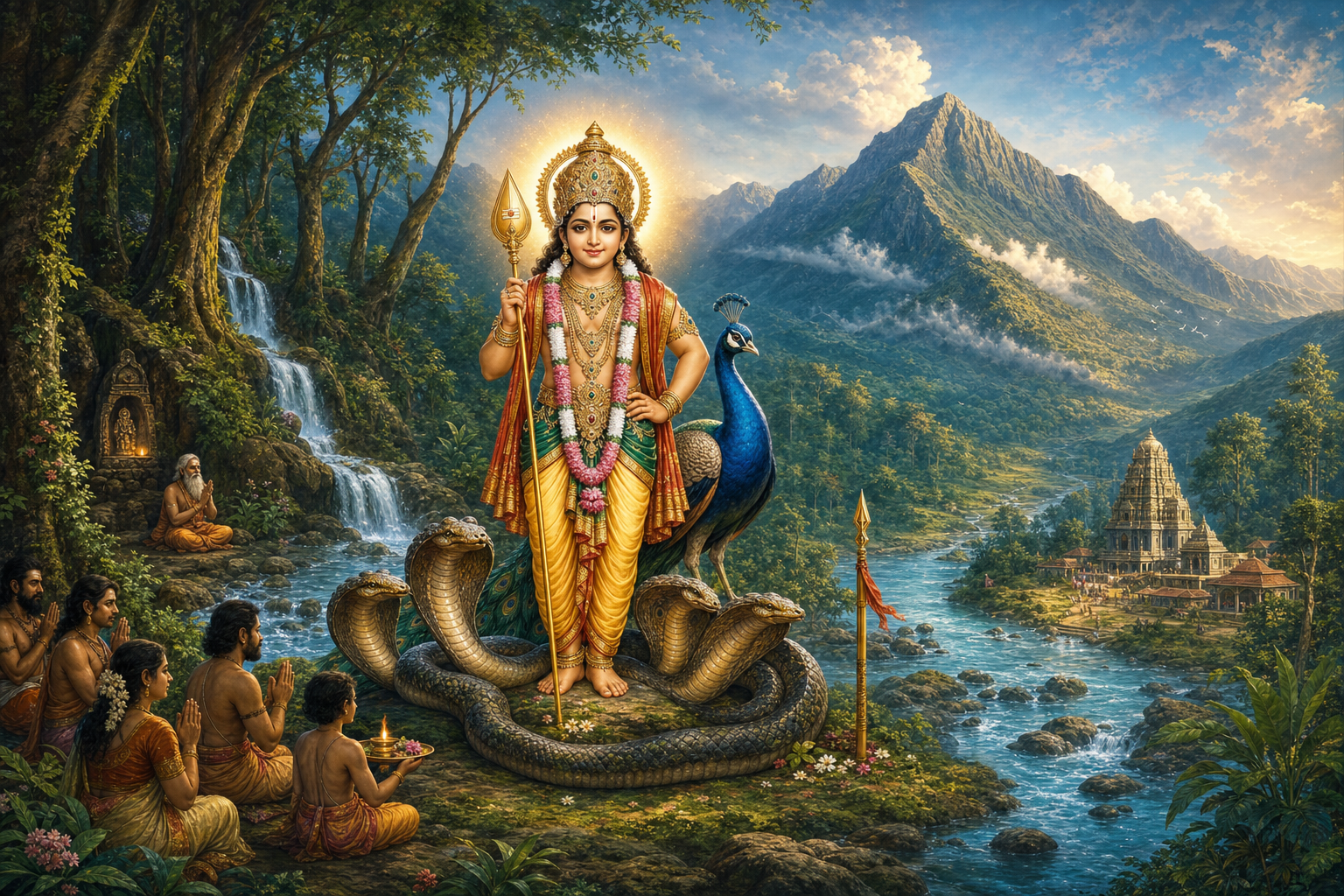
A sthala purana communicates why a particular place is sacred and how a devotee should understand it. It is theological memory, not a modern chronological record. Kukke’s traditions, associated with the Sahyadri Khanda of the Skanda Purana as well as local liturgy and oral memory, should be read in that spirit.
Subrahmanya restores order
Subrahmanya, also known as Skanda, Kartikeya, and Kumara Swamy, comes to the region as the power that defeats adharma. The local cycle places his victory over Tarakasura at the heart of the kshetra; broader Skanda traditions also remember the conflict with Shurapadma. Ganapathi accompanies the divine movement, marking the removal of obstacles before decisive action.
The vel, Subrahmanya’s spear, is therefore more than a weapon. It represents the concentrated discernment required to pierce confusion. His peacock vahana points toward mastery of pride and the conversion of turbulent impulses into disciplined strength. His title Deva-senapati, commander of the divine forces, joins courage to order.
This matters when you stand before the main sanctum. If you approach only with the demand that a difficulty be removed, you miss half the teaching. Ask what disorder in your own conduct requires discipline, truthfulness, courage, or restraint. The deity’s protection does not separate grace from responsibility.
The marriage to Devasena joins courage to household welfare
After the victory comes union. Subrahmanya marries Devasena, the daughter of Indra, linking martial virtue with auspiciousness and the prosperity of the worlds. This explains why a shrine centered on a divine commander also attracts prayers concerning marriage, children, lineage, and household well-being.
If you bring a family vow, frame it accordingly. A prayer for progeny or prosperity is not isolated from dharma; it carries obligations toward the family, ancestors, community, and living world. Kukke’s marriage tradition turns a private request into a question about how well you will steward the blessing you seek.
Vasuki receives refuge rather than conquest
The defining Kukke legend concerns Vasuki, the Naga king pursued by Garuda. Vasuki seeks safety in this forested region, and Subrahmanya grants protection to him and the Nagas. This covenant explains the serpent imagery, the prominence of Naga-related vows, the association with Biladwara, and the ritual importance of Adi Subrahmanya.
The distinction is important: the serpent is not presented merely as a dangerous force to be expelled. Vasuki is a being who asks for sanctuary and is placed under divine protection. Naga worship at Kukke is therefore better understood as the repair of a relationship than as a frightened attempt to eliminate an enemy. Devotees may pray about sarpa dosha, lineage continuity, progeny, ancestral impediments, or family welfare, but the theological center remains guardianship.
This grammar of protection has resonances across the wider Dharmic world without making the traditions identical. The Naga Mucalinda shelters the meditating Buddha in Buddhist memory, while Jain images often place Parshvanatha beneath a many-hooded serpent canopy. Kukke gives the Hindu Skanda-Naga relationship its own distinct form: power proves its righteousness by giving refuge.
The name Kukke preserves more than one memory
Two traditional explanations of the name coexist. One connects kukke with the Kannada word for a basket and remembers the sacred image being protected in a basket, possibly during flooding of the Kumaradhara. Another remembers acharyas safeguarding and stabilizing the murti during difficult circumstances. Neither needs to be promoted as settled archaeology. Both preserve the same devotional value: a community protects the sanctum entrusted to it.
The subshrines form a coherent sacred circuit
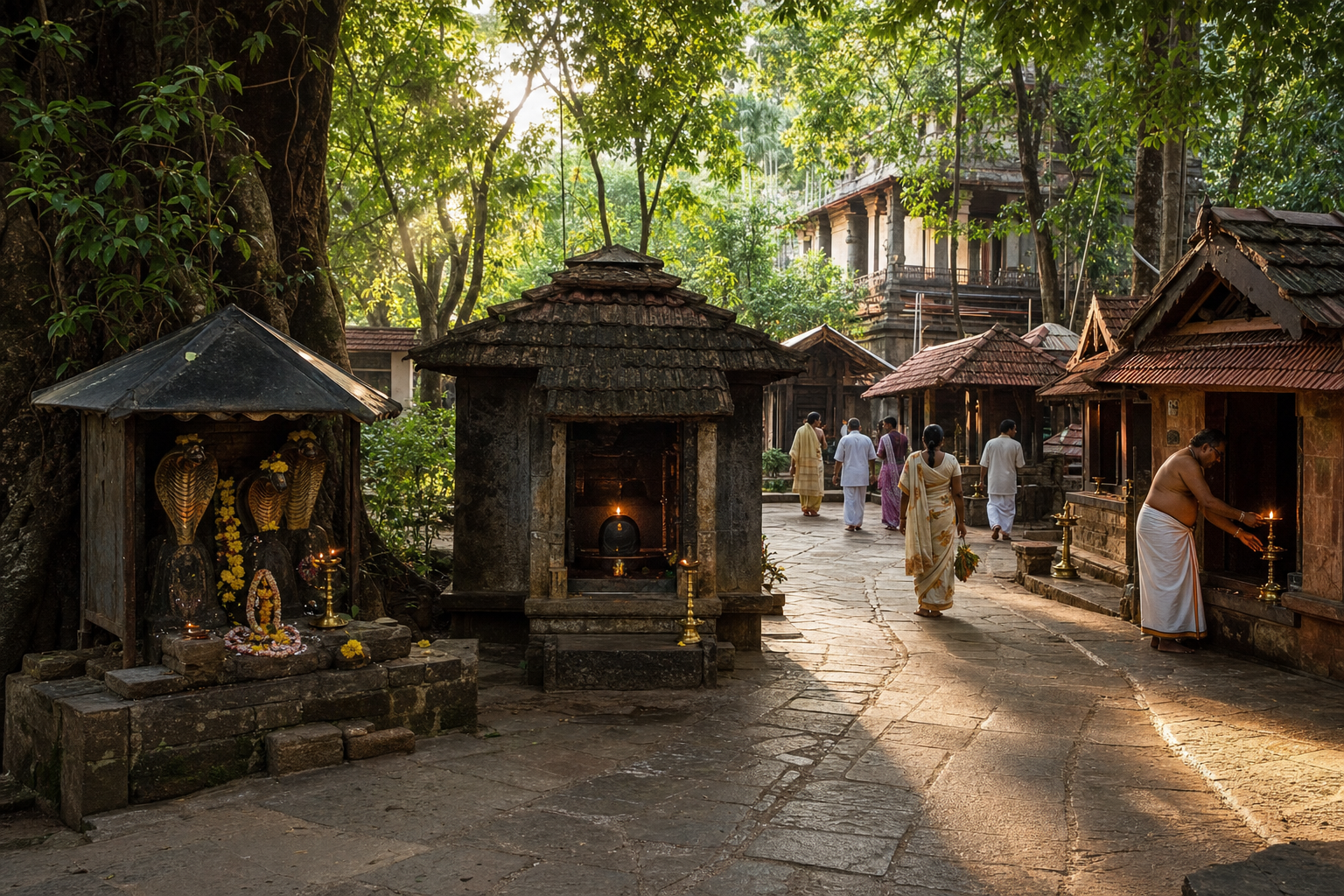
The main sanctum remains the center, but it does not carry every ritual function by itself. The surrounding sacred nodes express threshold, protection, Shaiva continuity, planetary time, and the presence of Nagas. Use this table as a map of meaning rather than as a guarantee of current access; conservation work and festival arrangements can alter the path.
| Place | Ritual or theological role | What to notice or do |
|---|---|---|
| Main Subrahmanya sanctum | Subrahmanya’s sovereignty, protection, and relationship with Vasuki and Shesha | Make this your central darshan. Notice how martial symbols and Naga protection belong to the same deity. |
| KukkeLinga | An anciently regarded Shaiva presence within the larger Skanda-Naga kshetra | Pause rather than passing it as a minor side altar. Its inward architectural form is part of its character. |
| Adi Subrahmanya | Anthill and Naga-stone focus associated with serpent veneration and specialized vows | Include it deliberately in your circuit, especially when undertaking an authorized Naga-related rite. |
| Naga-devata stones | Prayers concerning progeny, family welfare, ancestry, and restored relationship with Naga beings | Follow local instructions. Do not disturb the earth, stones, or natural substrate. |
| Mahaganapathi presence | Removal of obstacles at the threshold of worship | Where the current route provides access, begin with recollection and steadiness before proceeding inward. |
| Kshetrapala Bhairava and Navagraha nodes | Guardianship of the sacred boundary and alignment with planetary rhythms | Where present and accessible, follow the indicated pradakshina route rather than imposing a sequence from memory. |
Why KukkeLinga looks different
KukkeLinga is an indoor, square-sanctum shrine described locally as purathana and lacking a visible external vimana. Here, “no vimana” does not mean that an essential theological element is missing. Coastal shrines can be absorbed into larger roofed halls, leaving the worshipper with an inwardly focused chamber rather than a towered exterior.
Purathana means that devotional memory recognizes the shrine as ancient. It should not be converted into a precise dating claim without inscriptions or material analysis. That distinction lets you honor inherited memory without pretending that reverence and archaeological proof are the same kind of evidence.
Why Adi Subrahmanya is not an afterthought
Adi Subrahmanya, reached by a short walk from the principal complex, centers worship on an anthill and Naga stones. It is closely connected with Nagapratishta, Ashlesha Bali, and related vows. The main sanctum reveals the divine protector; Adi Subrahmanya directs attention toward the beings and earthen presence placed under that protection.
Completing both encounters prevents a common misreading. Kukke is not simply a Subrahmanya temple that happens to offer remedies for serpent afflictions. It is a kshetra whose identity arises from the inseparable relationship between Subrahmanya and the Nagas.
Follow a darshan sequence that preserves the meaning
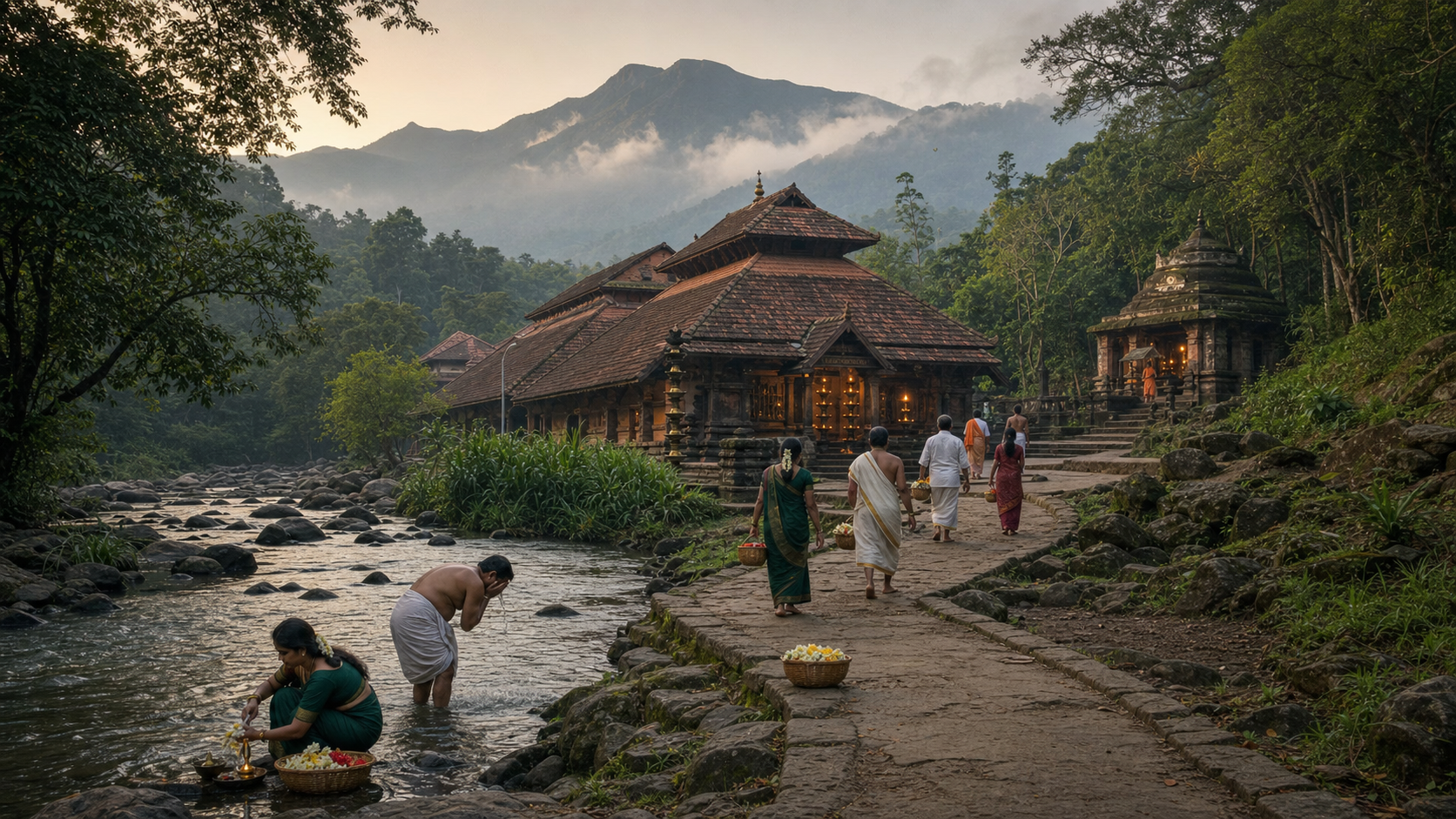
No single route should override current temple directions, but a coherent pilgrimage normally moves from purification to central presence, then toward the more particular obligations represented by the subshrines. Use the sequence below as an interpretive framework and adjust it to official instructions on the day.
- Check current access and seva arrangements first. Pathways can change during conservation, festivals, or periods of heavy attendance. If you intend to perform a specialized rite, confirm its booking and participation requirements through authorized temple channels before building the rest of your journey around it.
- Approach the Kumaradhara with restraint. Undertake snana or mindful ablutions as conditions and instructions permit. Do not leave packaging, soap, food waste, cloth, or ritual debris in the river.
- Enter through the threshold sequence. Where accessible, offer respect to Mahaganapathi, pass the dhvaja-stambha attentively, and let the movement from forecourt to sanctum quiet your attention.
- Make the main Subrahmanya darshan the center. Hold together the vel, the victory over disorder, the marriage to Devasena, and the protection of Vasuki. These are not unrelated stories competing for your attention; they show disciplined power serving life, order, and refuge.
- Complete the internal circuit without rushing the smaller sanctums. Visit KukkeLinga and the indicated Naga-devata nodes according to the current pradakshina route. A smaller structure does not imply a lesser historical or devotional function.
- Proceed to Adi Subrahmanya deliberately. If your visit concerns a Naga vow, this is an integral part of the pilgrimage. Even without a specialized seva, the anthill and Naga stones make the refuge legend tangible.
- Let gratitude take a social form. Participate respectfully in annadana where available, avoid waste, and treat service to fellow pilgrims as part of worship rather than as an amenity attached to it.
Choose a Naga rite by obligation, not anxiety
Being told that you have sarpa dosha can create pressure to book whatever ritual sounds strongest. That is the wrong decision rule. Family tradition or astrological counsel may explain why you are considering a rite, but the temple’s authorized guidance should determine the actual procedure, eligibility, schedule, and offerings.
- Sarpa Samskara is a structured, multi-step expiatory observance associated with Naga-related obligations. It should be undertaken under authorized guidance, not improvised from online instructions.
- Ashlesha Bali uses prescribed mantra, bali, and homa elements and is customarily associated with Ashlesha Nakshatra. Confirm the relevant schedule rather than assuming it is available as an ordinary walk-in offering.
- Nagapratishta involves the proper consecration of a Naga image and continued worship. Treat it as an ongoing devotional responsibility, not as the purchase of a symbolic object.
These rites are directed toward different forms of obligation and should not be treated as interchangeable products. Nor should they replace the main darshan, ethical self-examination, or care for the natural world. If the kshetra remembers Subrahmanya protecting serpents, then harming habitat while performing a serpent rite empties the practice of its moral center.
Ordinary conduct matters as well. Wear modest clothing, keep queues quiet, handle offerings carefully, follow priestly direction, and observe photography restrictions near sanctums. During Subrahmanya Shashti, Skanda-related observances, or Nagara Panchami, allow the on-site ritual order to govern your movement rather than insisting on a personal itinerary.
Key takeaways
- Kukke is a sacred network of mountain, river, cave, forest, main sanctum, and subshrines, not a single isolated building.
- The Vasuki legend is about refuge. Naga worship therefore carries an ecological and ethical obligation, not only a promise of relief from dosha.
- KukkeLinga preserves a Shaiva layer within the Skanda-Naga kshetra; its square indoor sanctum and lack of a visible vimana suit an inward, regional architectural form.
- Adi Subrahmanya is essential to understanding the kshetra because its anthill and Naga stones give ritual form to the covenant with serpent beings.
- A meaningful route moves from Kumaradhara purification to the main darshan, the internal subshrines, and Adi Subrahmanya, while yielding to current temple directions.
- Sarpa Samskara, Ashlesha Bali, and Nagapratishta are distinct commitments. Confirm the appropriate rite and current protocol through authorized temple guidance.
When you visit, leave enough time to encounter the whole kshetra instead of measuring the journey only by minutes before the principal murti. Begin at the river with care, ask for the current subshrine route, complete Adi Subrahmanya without haste, and let your treatment of the forest show whether you understood Vasuki’s refuge.
References
- HinduPad – Kukke Subramanya Sthala Purana: Timeless Serpent-Lord Legends, Ritual Science, and Sacred Landscape
- HinduPad – Kukke Subramanya’s Sacred Sub-Temples: A Timeless, Comprehensive Guide to Subshrines