
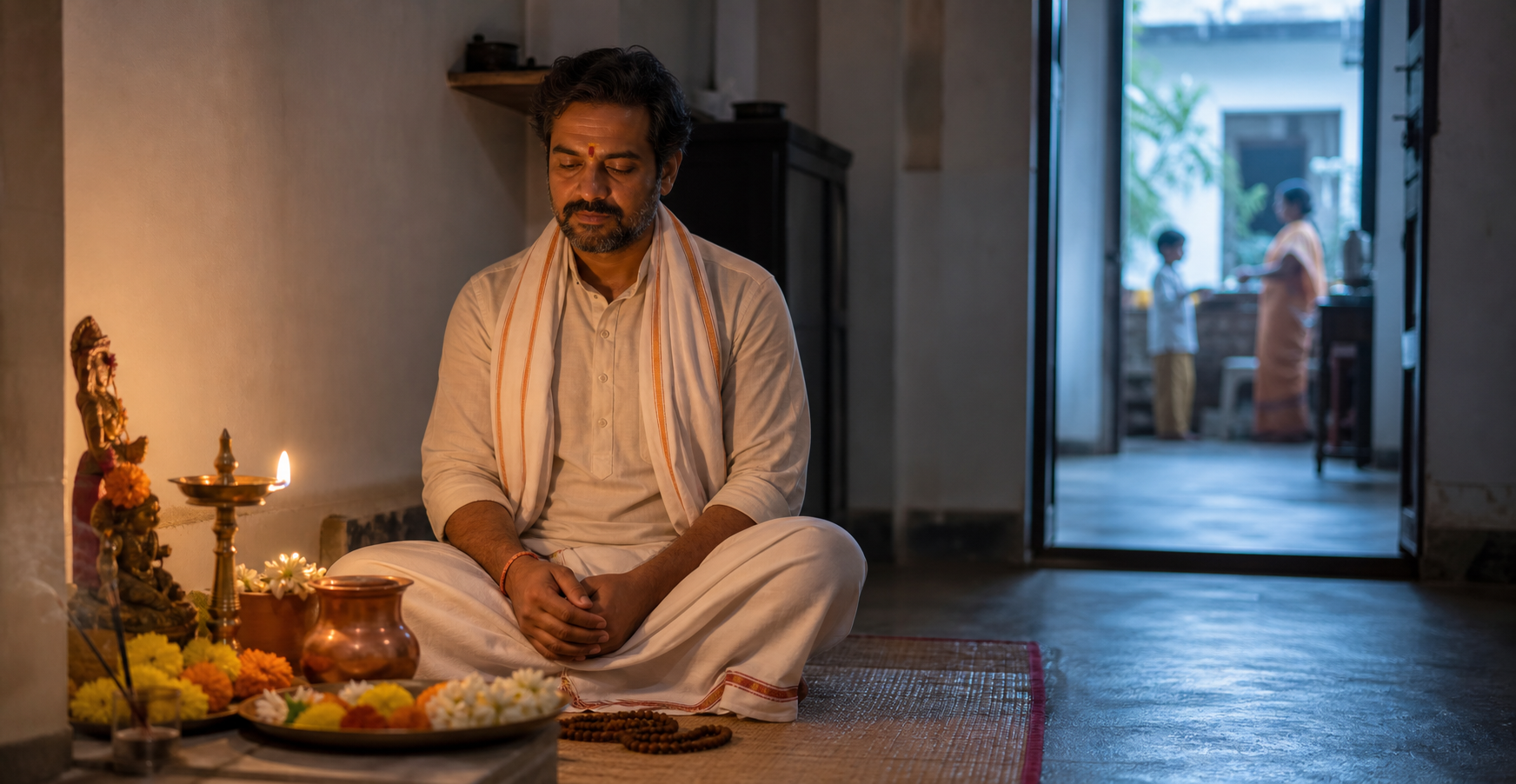
You can complete a pūjā, recite every mantra, and still carry the same impatience into the next conversation. When that happens, the useful question is not whether ritual works. It is whether the outer act has been connected to attention, intention, and conduct.
Hindu practice does not force you to choose between ritual and inner spirituality. It asks you to inhabit the form until the form begins to reshape the person performing it. The change becomes visible not in the complexity of your altar, but in how you speak, choose, serve, and respond when life refuses to follow your preferences.
The real work of ritual begins beneath the visible act
Reducing ritual to either a transaction with the divine or a psychological relaxation technique misses its breadth. Depending on the sampradāya and the practitioner’s iṣṭa, worship may be loving attendance upon a real divine presence, the fulfilment of dharma, a discipline of concentration, a consecrated offering, or several of these at once.
The visible form gives the body and senses something definite to do. You sit or stand in a chosen place. You light a lamp. Your hands make an offering. Your speech follows mantra rather than wandering into habitual commentary. Your mind returns to a name, form, teaching, or presence. Repetition establishes a dependable route from distraction to collectedness.
That route is preparatory rather than trivial. The traditional movement from karma-kāṇḍa, the domain of disciplined action and worship, toward jñāna-kāṇḍa, the domain of liberating knowledge, treats outer discipline as a support for inner realization. The two are not enemies. A ritual can train capacities that contemplation requires: steadiness, memory, restraint, reverence, and the ability to remain with one object without immediately seeking another.
Bhakti adds relationship to that discipline. An offering is no longer merely an object moved from one place to another; it becomes an expression of gratitude and surrender. Karma yoga carries the same orientation into ordinary work by loosening the demand to possess every result. Jñāna then asks the deeper question: who is the doer who claims the action, the virtue, and the reward?
Before beginning a ritual, therefore, ask three practical questions:
- What is my body learning through this sequence: composure, care, restraint, or only haste?
- Where is my attention returning when it wanders?
- What should become different in my conduct after I leave the shrine?
If the third question has no answer, the practice can remain sealed inside its ritual space. It may preserve continuity and belonging, which are real goods, but its transformative movement is incomplete.
Build one complete sādhana instead of collecting practices
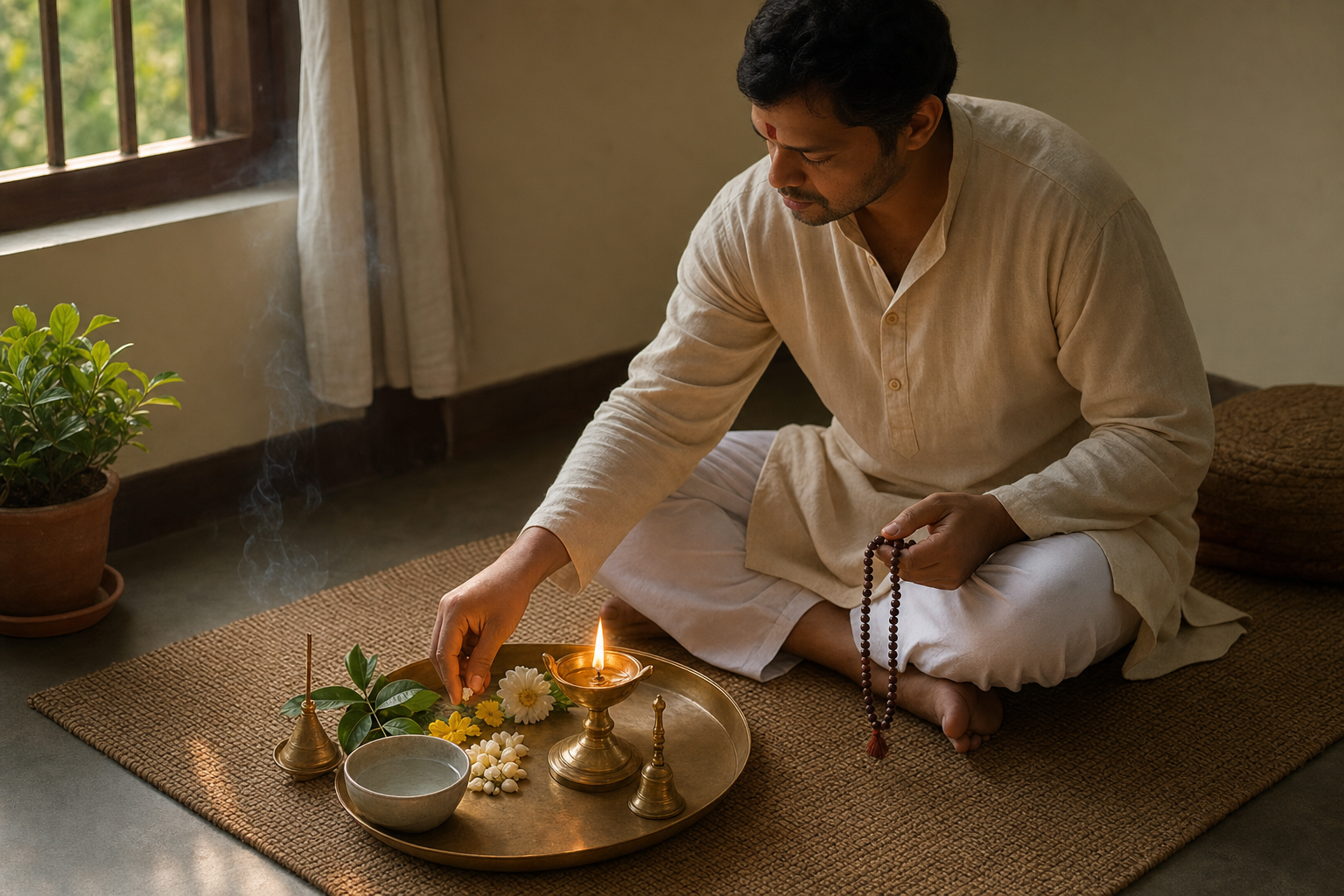
A crowded routine is not necessarily a deep one. Adding more chants, vows, videos, teachers, or techniques can scatter attention under the appearance of spiritual seriousness. Begin with one practice that belongs naturally to your family tradition, sampradāya, or chosen relationship with the divine. Then connect its layers deliberately.
| Layer | Ritual vehicle | What to notice | Practical correction |
|---|---|---|---|
| Body | Posture, breath, gesture, circumambulation | Rushing, restlessness, careless handling | Let each movement finish before beginning the next |
| Speech | Mantra, nāma-japa, stotra, prayer | Speed without listening or meaning | Pronounce carefully and hear the sound you are making |
| Heart | Bhakti, gratitude, offering, surrender | Bargaining for a preferred outcome | Offer the demand to control the result along with the material offering |
| Understanding | Śravaṇa, manana, contemplation | Words recited without assimilation | Carry one teaching into reflection rather than gathering many |
| Action | Sevā, ahiṃsā, truthful speech, niṣkāma karma | Devotion that ends at the shrine | Choose one situation in which the practice must govern your behaviour |
You can use the following sequence to join those layers without casually redesigning the ritual itself:
- Choose a stable anchor. Select one daily act you can sustain: lamp-lighting, pūjā, nāma-japa, Gāyatrī japa where appropriate to your tradition, meditation, or a short stotra. Fit matters. Hindu plurality allows different gateways for different temperaments; constant switching prevents any gateway from becoming familiar.
- Name the inner direction. Form a concise saṅkalpa connected to conduct. Instead of seeking a dramatic spiritual state, orient the practice toward something observable, such as truthful speech, patience with a particular duty, or freedom from grasping at one result.
- Settle before acting. Arrive physically. Put aside the device, straighten the place of worship, and allow the breath to become comfortable. If you begin while mentally continuing an argument or task, the ritual inherits that momentum.
- Give attention a definite home. During mantra, listen to the mantra. During darśana, attend to the form before you. During an offering, know what you are offering and why. When the mind wanders, return without turning the wandering into a second drama.
- Close with assimilation. After the final gesture, remain quiet long enough to notice what the practice disclosed. Recall the day’s main lesson, acknowledge harm without self-excusing, ask forgiveness where appropriate, and give thanks without pretending every event was pleasant.
- Carry one consequence into life. Decide where the saṅkalpa will be tested. If you invoked ahiṃsā, it may be tested in the next disagreement. If you practised surrender, it may be tested when work produces an unwanted result. This transfer from shrine to conduct is where ritual becomes yoga.
Preserve the distinction between personal attentiveness and technical improvisation. Formal disciplines such as sandhyā-vandanam and Agnihotra contain prescribed elements and, in the latter case, carefully observed timings. Learn such practices through competent lineage guidance. You can deepen your attention without inventing a new procedure or removing an inherited core you do not yet understand.
Use the evening transition as a daily training ground

Twilight makes the relationship between outer form and inner condition unusually easy to observe. Activity is declining, light is fading, and attention is beginning to withdraw from the demands of the day. Hindu accounts describe this transition through the guṇas: rajas gives way to a stronger tamasic tendency. Tamas here is not simply evil or inauspicious. Guided well, its downward movement supports quiet, rest, and inwardness; left unguided, it can settle into distraction, dullness, or agitation.
Fading light also changes circadian signalling, giving the traditional preference for evening downshifting a complementary physiological context. This does not make a ritual reducible to biology. It does explain why light, breath, sound, and a deliberate reduction of stimulation can form a coherent transition rather than an arbitrary collection of customs.
A concise evening sādhana can take fifteen to twenty minutes:
- End the outward phase. Put work and screens aside rather than carrying them into the shrine space. The boundary is part of the practice.
- Light a lamp. Place it safely before the household shrine or in the customary place. Let the change in light mark a change in the quality of attention.
- Balance the breath gently. Use a few comfortable cycles of nāḍī-śodhana, or a gentle bhrāmarī exhalation if that belongs to your practice. Do not strain, race, or turn calming breath into a performance of endurance.
- Keep one mantra central. Complete one attentive mālā of a mantra appropriate to your path, such as Om, Om Namaḥ Śivāya, the Mahāmṛtyuñjaya mantra, or Gāyatrī where it is properly part of your discipline. Fidelity and attention matter more than assembling a long playlist of sacred sounds.
- Review the day ethically. Identify the main lesson, one instance of avoidable harm or carelessness, and one reason for gratitude. A brief kṣamā-prārthanā turns remorse toward correction instead of rumination.
- Protect the descent into night. Follow the ritual with a lighter sensory environment, unhurried conversation, and a conscious step away from needless stimulation. Otherwise, the mind is recollected at the shrine and immediately dispersed again.
Śaiva practitioners may recognise pradoṣa-kāla, approximately the ninety-minute period around sunset, as a particularly significant time for worship. Other traditions organise twilight differently. The shared practical principle is to meet the transition consciously rather than treating dusk as leftover time.
If work, caregiving, season, or latitude makes the exact sunset impractical, preserve a clear evening boundary as close to it as your duties allow. Consistency is more important than anxiety about perfection. The exception is a rite whose prescribed timing is intrinsic to the rite; in that case, follow its discipline rather than relabelling a convenient hour as equivalent.
Measure transformation by its fruits, then repair the weak link

A powerful feeling during worship can be meaningful, but it is not a dependable scorecard. Emotion varies with fatigue, temperament, music, setting, and expectation. Nor is perfect concentration a sensible entry requirement. Attention is trained precisely because it wanders.
Look instead for changes that survive beyond the ritual: greater discernment between a passing impulse and a worthy action; less compulsive grasping at outcomes; more responsibility without constant self-display; a quicker willingness to correct harm; steadier conduct under praise and blame; and compassion that becomes practical. These are among the recognisable fruits of sādhana, even when no dramatic experience accompanies them.
When the ritual is complete but the change is absent
- If you finish every item but remember none of it, examine speed. Simplify optional additions while preserving the inherited or prescribed core. A shorter voluntary sequence inhabited fully can train attention better than an expanding routine performed in a hurry.
- If the practice calms you only inside the shrine, add an ethical bridge. Before rising, name the conversation, duty, desire, or conflict in which the practice must become conduct.
- If you keep chasing yesterday’s devotional feeling, release the demand for repetition. Bhakti is relationship, not emotional consumption. Offer dryness, distraction, and disappointment as honestly as joy.
- If guilt after a missed day keeps you away, resume at the next available anchor. Do not manufacture compensatory punishment. Where a tradition prescribes a specific response to omission, learn that response from the appropriate teacher.
- If repetition has become detached from meaning, reconnect practice with learning. Use śravaṇa to hear a teaching accurately, manana to examine it, and nididhyāsana to assimilate it. The point is not to accumulate quotations, but to let understanding enter the act you already perform.
- If private devotion coexists with habitual harm, treat ethics as foundational. Ahiṃsā, satya, non-grasping, service, and accountability are not decorations added after spiritual attainment. They prepare the mind for clear seeing and reveal whether insight is becoming embodied.
Community and guidance also matter. A guru, knowledgeable elder, or stable saṅgha can distinguish an ordinary dry period from a misunderstanding of method. Good guidance does not replace your responsibility; it helps you see the habits that private self-assessment conveniently overlooks.
Questions to ask before changing your practice
Does ritual have to feel devotional every day?
No. Feeling may deepen the act, but regularity, attention, and ethical fruit remain meaningful when emotion is quiet. Continue without pretending to feel what you do not feel. Honest steadiness is more transformative than staged fervour.
May I adapt an inherited ritual that feels mechanical?
First separate its prescribed core from optional household additions. Deepen your presence immediately, but seek competent guidance before changing mantras, sequence, initiation-bound elements, or essential timings. Mechanical performance may be an attention problem rather than a design problem.
How do I choose among pūjā, japa, meditation, and sevā?
Begin with the practice that fits your iṣṭa, inherited commitments, temperament, and present duties. Then connect it to the other dimensions instead of treating the paths as rival products. Pūjā can contain japa and contemplation; meditation can shape service; sevā can become niṣkāma karma; knowledge can clarify devotion.
What if I cannot practise at the traditional time?
For a flexible personal observance, establish the clearest repeatable boundary your life permits. For a formally timed rite, learn what that tradition allows rather than assuming all times are interchangeable. Adaptability protects practice when it serves the principle; convenience weakens practice when it erases the discipline.
Tonight, do not add a new spiritual ambition. Take one act you already recognise as sacred, perform it without haste, and give it one consequence in the life that follows. Tomorrow’s evidence will be the quality of that consequence.
References
- DharmaRenaissance Blog — When Darkness Falls: Vedic Science of Twilight, Tamas, and Transformative Evening Rituals
- DharmaRenaissance Blog — Beyond Ritual and Dogma: Hindu Wisdom on Moving from Religion to Transformative Spirituality