
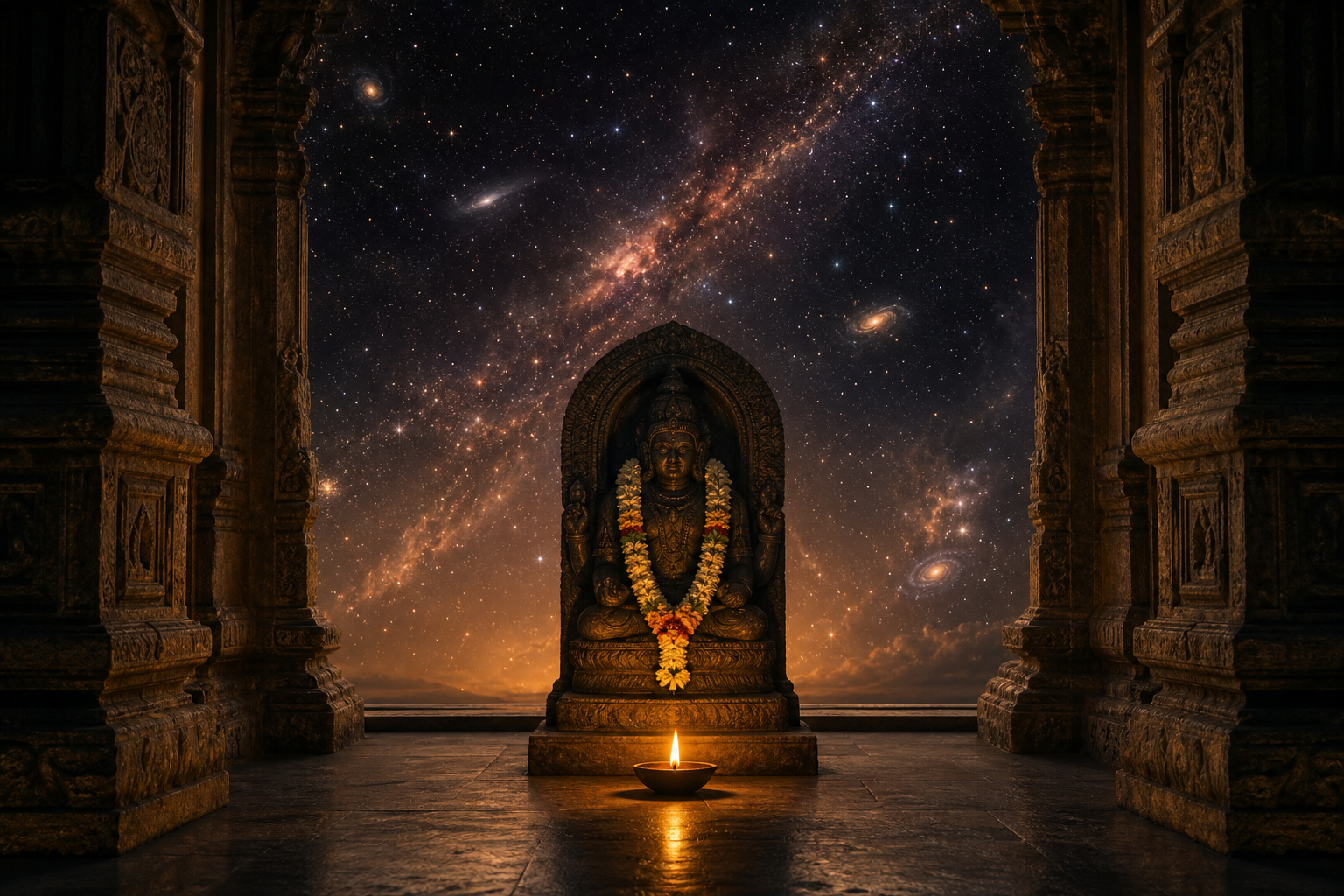
You stand before a murti and an honest question interrupts your darshan: if the Divine is the all-pervading Purusha, present throughout the cosmos and beyond it, what could it mean to bathe, dress, feed, or offer a lamp to one sacred form?
You don’t have to choose between cosmic vastness and intimate devotion. You do need to distinguish personhood from human limitation, a consecrated murti from an ordinary object, and arcana from religious spectacle. Those distinctions let you approach Deity Worship intelligently, respect differences among dharmic traditions, and begin serving without pretending to possess priestly competence.
Key takeaways
- Purusha does not mean a very large human being. Cosmic personhood points to an unlimited conscious reality that pervades the visible universe without being exhausted by it.
- In theistic Vedanta, the murti is not a piece of matter alleged to contain all of God. It is a traditionally established form through which the Divine freely becomes available for relationship and service.
- Advaita, Vishishtadvaita, Dvaita, and Gaudiya Vaishnavism do not explain sacred form in identical ways. Learn the account taught by the sampradaya whose worship you are entering.
- Arcana is disciplined hospitality. Invitation, bathing, clothing, fragrance, food, lamp, and arati organize your senses around seva rather than acquisition.
- Begin with a simple authorized practice. Add mantras, abhishekam, elaborate offerings, or sanctum duties only after appropriate instruction.
- Do not judge worship by visions or emotional intensity. Look for steadier remembrance, greater care, less transactional prayer, and service that continues after you leave the altar.
The Infinite does not become finite by being present

The apparent contradiction usually begins with an unstated assumption: if the Divine is present in a particular form, the Divine must be absent everywhere else. That conclusion would follow if a murti were supposed to be a container. It does not follow when sacred form is understood as a mode of accessible presence.
Rig Veda 10.90 presents Purusha through the celebrated image of a thousand heads, eyes, and feet. Here, thousand signals unbounded plenitude rather than an anatomical count. The same vision holds together two truths: Purusha pervades the worlds, yet the manifest cosmos does not exhaust Purusha. Its quarter and three-quarter imagery marks the difference between what becomes perceptible and the fullness that remains beyond decay; it is not a physical measurement of God.
Cosmic personhood therefore should not be confused with a human body enlarged to astronomical size. In theistic Vedanta, personhood indicates consciousness, agency, knowledge, and the capacity for relationship. Bodily limitation belongs to an embodied creature; it is not built into the very meaning of person. An unlimited person can be intimately present without surrendering unlimited existence.
This gives you a precise answer to the central objection. Deity Worship does not require you to believe that the Infinite has been compressed into stone, metal, wood, paint, or clay. It asks whether the Supreme, already immanent within matter and consciousness, can freely accept service through a form recognized by revelation, lineage, consecration, and practice. If the Divine truly is all-pervading, presence at the altar is not the difficult part. The important question is how that presence is disclosed and approached.
The answer varies across Vedantic schools. Advaita Vedanta can treat worship of a personal form as a valid discipline directed toward saguna Brahman, while maintaining that final knowledge transcends every limiting conception. Vishishtadvaita understands the universe as the body of Narayana, preserving real distinctions within an all-embracing divine unity. Dvaita maintains a real distinction between the sovereign Supreme Person, individual souls, and the world. Gaudiya Vaishnavism approaches the deity as archa-avatara, the Lord’s worshipful and mercifully accessible form. These are substantive interpretations of immanence, transcendence, unity, and difference, not interchangeable labels.
Before joining a ritual, ask one clarifying question: what does this lineage understand to be happening here? That question is more useful than importing a generic explanation of images into every temple. It lets the practice explain itself on its own theological ground.
A murti establishes a relationship, not a visual theory
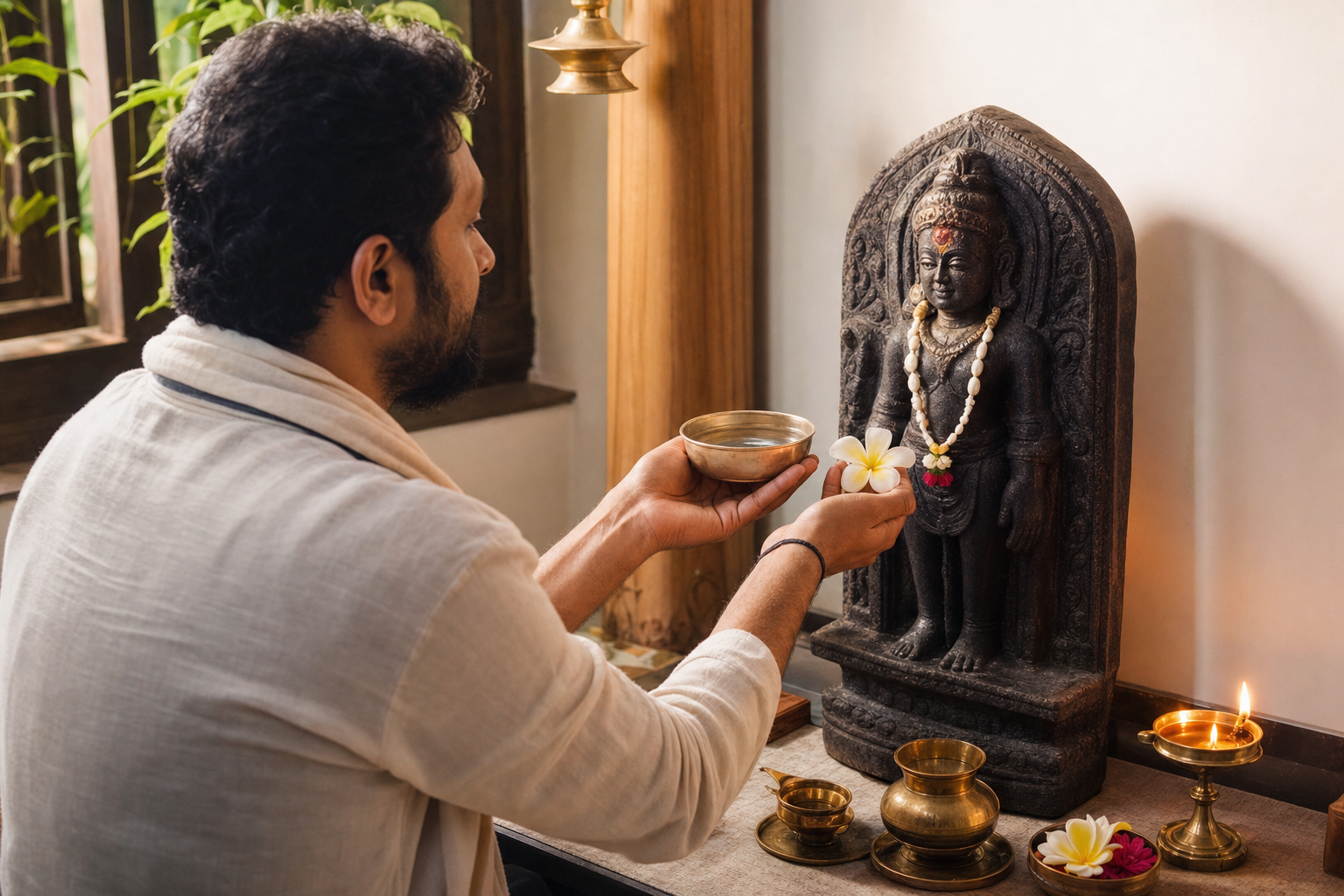
You can describe an ordinary statue by naming its material, dimensions, maker, and subject. Those facts do not fully describe a murti within arcana. Ritual status, consecration, mantra, lineage, and a continuing discipline of service establish a relationship that material description alone cannot capture. Not every image has the same ritual status, and not every beautiful representation is treated as an installed deity.
Calling the murti a symbol may identify one dimension of sacred imagery, but calling it only a symbol can misstate the theistic claim. In Gaudiya Vaishnava practice, for example, the archa-avatara makes the Supreme approachable to embodied senses. The worshipper does not manufacture divine presence by concentrating hard enough. The worshipper receives an offered means of relationship and responds through regulated seva.
This is why darshan is more than looking at religious art. You come to see, but also to be reoriented. The deity occupies the center; you become the attendant. Food becomes naivedya before it becomes prasada. A flower becomes an offering before it becomes decoration. Time becomes an appointment for service rather than an empty period to fill. The change in direction, from consumption toward offering, is one of arcana’s most practical teachings.
Shodashopachara, the familiar framework of sixteen offerings, makes this relational logic visible. Its sequence can include invitation, a seat, bathing, clothing, fragrant substances, food, a lamp, and arati. Details and mantras vary by lineage, but the governing image is recognizable: the worshipper receives the Divine with attentive hospitality. The sequence prevents devotion from remaining a vague feeling. It gives love duties, materials, timing, and form.
That structure also explains why accuracy matters without making technical perfection the object of worship. Clean vessels, permissible ingredients, correct sequencing, careful pronunciation, and timely offerings protect attention. They stop avoidable disorder from consuming the mind. Yet a flawless checklist performed for prestige has missed the direction of seva. Form should carry intention; it cannot replace intention.
Shared dharmic vocabulary must also be handled carefully. Buddhist and Jain communities may bathe, adorn, and reverence images of Buddhas or Tirthankaras. Sikh practice centers reverent darshan of the Guru Granth Sahib and collective seva in the gurdwara. These practices can share a civilizational grammar of darshan, discipline, and sacred hospitality without making identical claims about divine incarnation or the ontological status of an image. Unity in spiritual diversity requires both recognition and restraint.
Begin with authorized service, not borrowed complexity
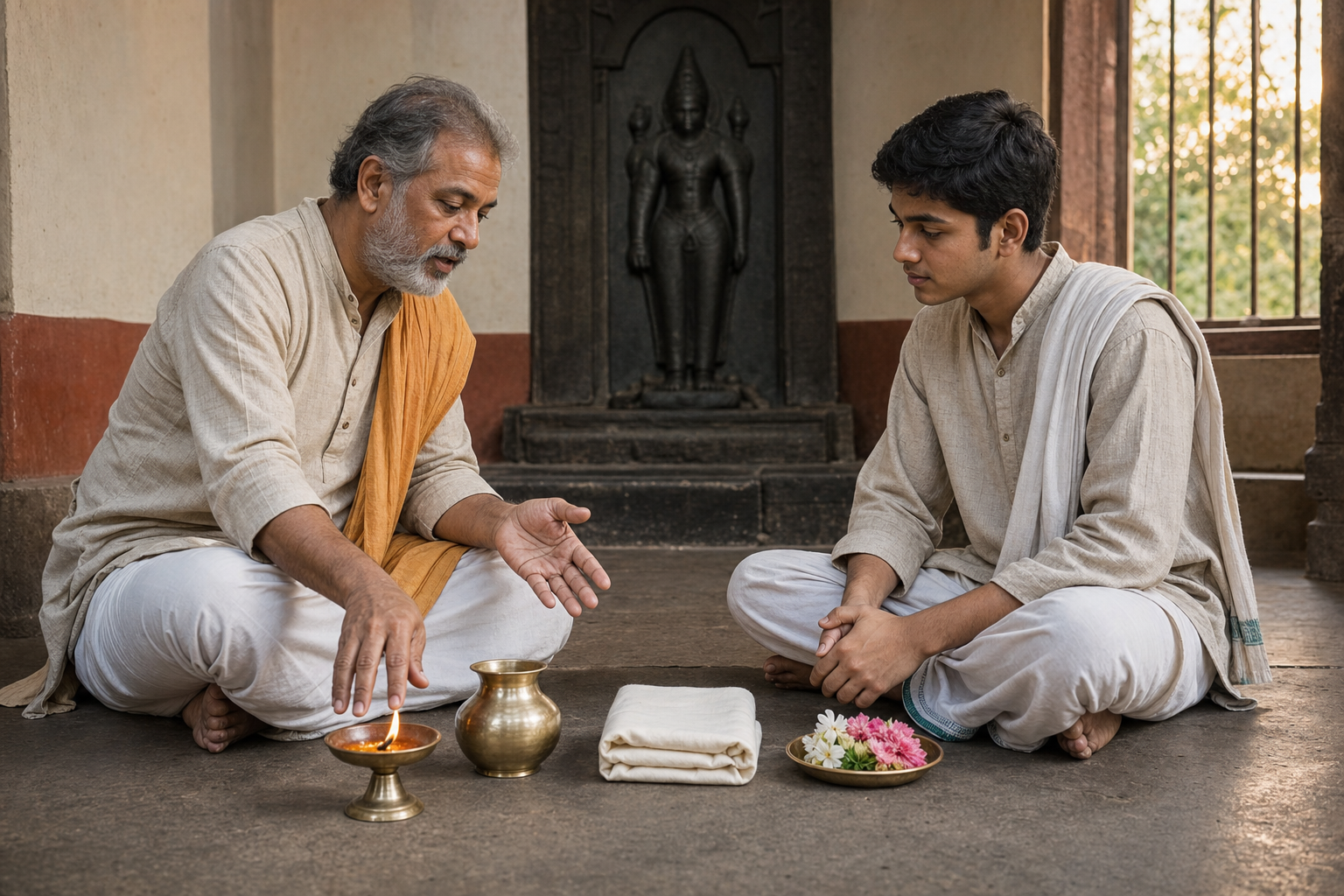
If you want to begin Deity Worship, do not reproduce an elaborate temple sequence merely because you have watched it. A temple deity, a formally installed home deity, and a devotional image may carry different obligations. Your sampradaya’s instructions determine which form, mantra, food, purity standard, and ritual actions are appropriate. A generic checklist cannot override them.
Use this progression to begin without turning caution into passivity:
- Choose the tradition before choosing the technique. Identify the lineage, temple, or qualified teacher whose standards you intend to follow. Ask what form is appropriate for a beginner and which daily commitments accompany it.
- Start at the smallest level you can sustain respectfully. At a temple, this may mean regular darshan and a supervised service role. At home, it may mean maintaining a clean place for an accepted image and making one simple offering permitted by your tradition.
- Create a clear boundary around worship. Wash your hands, keep the altar clean, use designated clean articles, and prepare offerings before you begin. The point is not anxiety about contamination; it is freedom from preventable distraction and casual handling.
- Make a sankalpa. State inwardly whom you are serving and why. A simple intention to offer attention and care is better than entering the ritual while mentally bargaining for an outcome.
- Offer only what you can handle properly. Water, a permissible flower, or food prepared according to the lineage’s dietary discipline may be enough. Use a lamp only on a stable surface and only when it can remain attended. Do not improvise abhishekam on a deity whose material and ritual requirements you do not understand.
- Join sight, sound, and action. Look during darshan, chant or hear the authorized names and prayers, and perform a concrete act of service. Arcana becomes more stable when joined with kirtan, remembrance, and scriptural hearing.
- Close the act deliberately. Offer gratitude, receive prasada as your tradition directs, clean the place, and return every article properly. Post-worship care is part of the offering, not housekeeping that begins after devotion ends.
- Add complexity through training. Mantra pronunciation, timing, dressing, bathing, food preparation, conch or bell coordination, and sanctum service are skills. Learn them under supervision instead of treating confidence as competence.
If you belong to a congregation, you do not need immediate access to the sanctum to become a participant. Flower preparation, garland-making, kitchen assistance, altar preparation, inventory care, prasada service, and post-ritual maintenance can draw you into the same devotional arc. A sound community uses training, defined responsibilities, and service rotation so that inclusion does not dilute standards.
Look for practical signs of responsible administration. Lamps and camphor should be managed safely. Platforms used for bathing should be stable. Wet areas should not become slipping hazards. Food intended for public prasada distribution needs both sampradaya-appropriate preparation and ordinary food-safety care. Children should receive age-appropriate, supervised roles. These arrangements do not secularize worship. They protect people, sacred articles, and the continuity of seva.
Judge the practice by what it trains you to notice
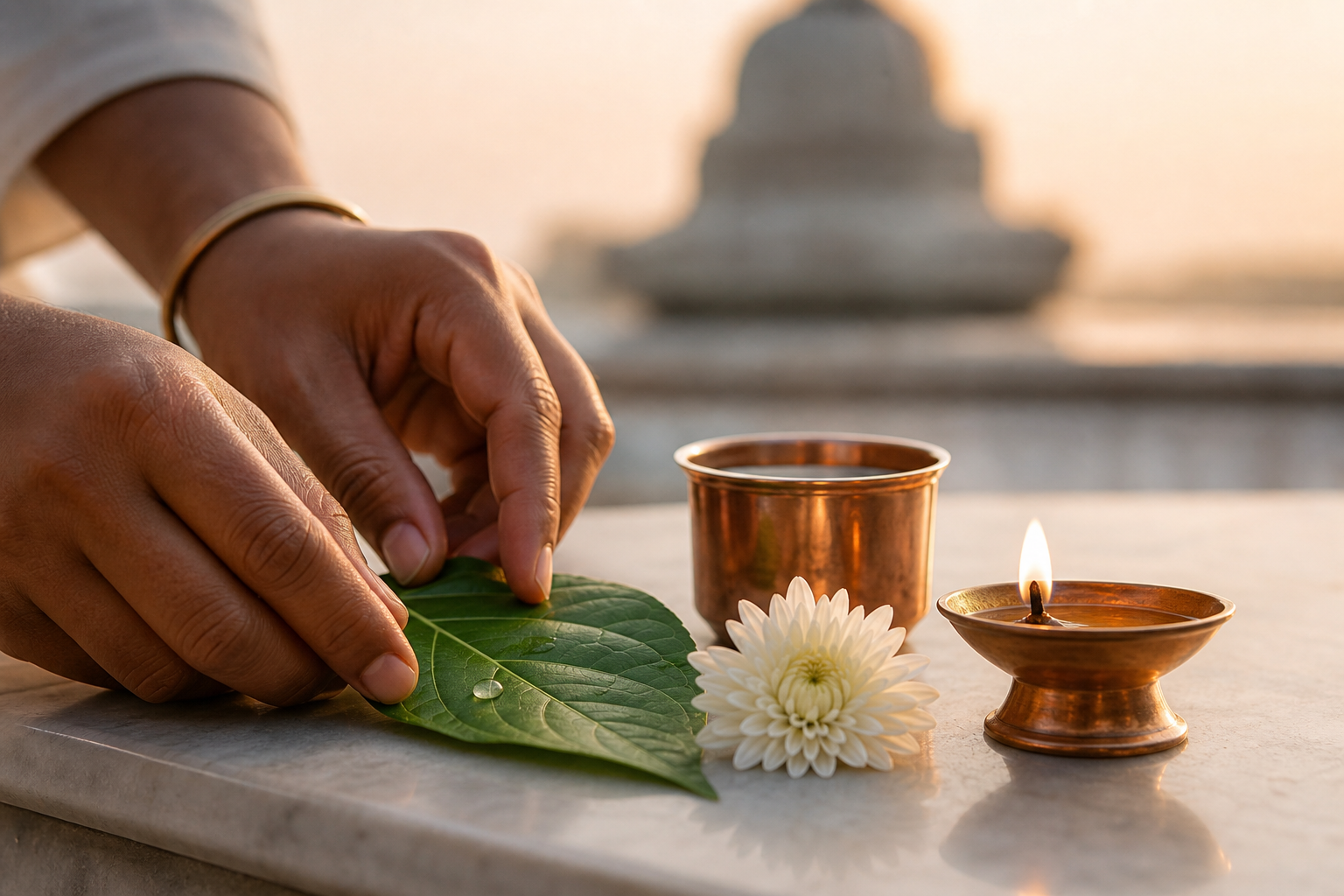
Do not make extraordinary experience your test. Devotional narratives themselves treat full theophany as rare, even among exalted practitioners. Repeatable worship stabilizes remembrance without requiring a vision. The ordinary offering rendered faithfully is not a consolation prize; it is the discipline.
You can examine your practice through five concrete questions:
- Is your attention becoming more specific? You should gradually know more than the altar’s appearance. Learn the deity’s name, qualities, associated teachings, and the meaning of the actions you perform. If the ritual has become visual habit, add a brief period of hearing or recitation before it.
- Is your prayer becoming less transactional? Asking for help has a legitimate place, but arcana reverses the usual question. Instead of asking only what the Divine will provide, ask what service is needed from you. Renew your sankalpa when bargaining begins to dominate.
- Does reverence survive contact with ordinary life? Greater care with food, shared spaces, commitments, other worshippers, and vulnerable beings indicates that altar discipline is reaching conduct. Ritual neatness combined with contempt outside the shrine signals a fracture that more decoration will not repair.
- Are you becoming a servant or merely a spectator? Darshan is not invalid because you have no formal role, but sustained participation should make some form of seva imaginable. Ask the temple for a trained, bounded responsibility rather than waiting to be noticed.
- Can you remain steady when worship feels emotionally quiet? Devotion will not always produce the same mood. When the practice becomes mechanical, simplify the sequence, pause for japa, recover the meaning of one offering, and close with gratitude. Do not multiply ritual actions merely to manufacture intensity.
These signs do not function as laboratory proof of a metaphysical doctrine. They tell you whether the sādhana is doing its immediate work: gathering attention, purifying intention, and converting religious interest into responsible relationship. Conviction then grows through participation rather than through an argument borrowed from someone else.
There is also a social test. Healthy arcana makes room for newcomers without pretending that every role requires no preparation. It honors experienced pujaris without reducing the congregation to an audience. It teaches children through safe, intelligible tasks and allows responsibility to grow with skill. When the altar becomes the center of coordinated service, cosmic personhood stops being a distant concept: different hands begin acting as parts of one dharmic body.
At your next darshan, carry three questions instead of trying to force certainty: Who is being served here? What am I actually offering? What should this encounter change when I leave? Begin with one answer you can embody. The path from cosmic vision to living presence is made through faithful acts small enough to repeat and meaningful enough to reshape you.
References
- Dandavats – Transforming Longing into Living Presence: Arcana, Bhakti-Yoga, and Inclusive Community Darshan
- DharmaRenaissance Blog – Mudgala Upanishad and the Purushasukta: Decoding Cosmic Personhood, Unity, and Dharma