

You can leave a sectarian argument convinced that you defended dharma and still feel that something went wrong. The facts may have mattered, yet the exchange quietly turned a tradition, community, or opinion into a complete verdict on another person.
Dharmic unity asks more of you than polite tolerance. It asks you to preserve real distinctions without turning them into weapons of identity. That begins by noticing how avidyā and ego convert a limited difference into an absolute division, then interrupting that conversion in thought, speech, and action.
Catch the moment when difference becomes division

Difference is not the problem. Hindu, Buddhist, Jain, and Sikh traditions do not teach identical doctrines, use identical disciplines, or make interchangeable claims about the self and ultimate reality. A family, temple, sangha, gurdwara, or public institution also needs meaningful distinctions to function. Confusion begins when a useful distinction is treated as the whole truth about a person or group.
The classical Yoga sequence of afflictions gives you a practical diagnostic map: avidyā, asmitā, rāga, dveṣa, and abhiniveśa. Avidyā is not merely a shortage of information. It is mis-knowing: seeing what is partial, changing, or conditional as though it were complete and final. Asmitā then fastens that perception to I-ness. Rāga and dveṣa supply attraction and aversion, while abhiniveśa clings to the threatened identity.
In an argument, the sequence often moves quickly. You notice a difference. You identify yourself with one side of it. Loyalty makes criticism of your side feel personal. Aversion converts the other side into a danger. Clinging then makes concession feel like self-erasure. By the time harsh words appear, perception has already narrowed.
Watch for the hinge sentence in your own mind: People like that are always this way. It takes a specific act, teaching, or dispute and turns it into an essence. Nāma-rūpa, name and form, is necessary for ordinary communication, but a label becomes deceptive when you mistake it for an exhaustive account of the person carrying it.
The pañca-kośa model helps you locate the distortion before you theologize it. You may be physically tired at the annamaya level, agitated in prāṇa, and rehearsing an injury in manas. Those states are real, but they do not automatically constitute clear discernment. If rajas is driving urgency or tamas is obscuring context, do not promote that state into a permanent conclusion about an entire community. Wait until sattva makes careful discrimination possible.
Key takeaways
- A real difference becomes divisive when you treat it as a complete and permanent identity.
- The first place to interrupt prejudice is perception, before it hardens into speech or policy.
- Equal regard for persons does not require equal approval of every belief or action.
- Dharmic unity is credible only when it changes how you disagree, serve, and exercise power.
Seek unity without inventing a single Dharmic theology

The quickest way to make Dharmic unity fragile is to claim that every Dharmic tradition says exactly the same thing. It does not. A stronger unity respects the integrity of each path while recognizing a shared civilizational discipline: weaken egoic absolutism, reduce harm, cultivate self-restraint, and act for a good larger than the isolated self.
Advaita Vedānta offers one influential Hindu account of underlying unity: Brahman pervades the apparent multiplicity of name and form. The Bhagavad Gita makes this ethically demanding through sama-darśana. In 5.18, the wise see with equality across striking social and embodied differences. In 6.29, the yogin sees the Self in all beings and all beings in the Self. Equal seeing here is not social blindness. It prevents surface categories from cancelling the spiritual worth of a being.
Buddhist analysis must not be squeezed into that language of a universal Self. Anatta denies an independent, enduring self, while pratītya-samutpāda shows phenomena arising through conditions and relationships. The practical result still challenges ego: the supposedly self-sufficient identity you defend is neither independent nor fixed. Mindfulness, insight, mettā, compassion, appreciative joy, and equanimity train you to meet experience without immediately grasping or rejecting it.
Jain Anekāntavāda addresses a different failure: the ego’s demand that one standpoint exhaust reality. Syādvāda disciplines speech by making claims conditional upon standpoint and circumstances. This is not a licence to declare every assertion equally sound. It is a method for separating a defensible partial truth from an unjustified claim to totality.
Sikh teaching exposes self-centred separation as haumai, the veil that obscures Ik Onkar. Simran turns attention toward the One; seva prevents remembrance from remaining private; and sarbat da bhala directs action toward the welfare of all. Hindu devotion through an iṣṭa supplies another grammar of principled plurality: you may approach the Divine through a chosen form without needing to invalidate every other sincere approach.
| Dharmic lens | Egoic error it exposes | Corrective discipline | Contribution to unity |
|---|---|---|---|
| Hindu Yoga and Vedānta | Avidyā and asmitā turn name and form into an absolute identity | Japa, dhyāna, self-study, ethical restraint, and sama-darśana | See spiritual worth beneath difference and act for lokasaṅgraha |
| Buddhist traditions | Delusion and grasping defend an independent, enduring self | Mindfulness, vipassanā, and the brahmavihāras | Recognize conditioned existence and respond with compassion |
| Jain traditions | A partial standpoint claims exclusive and final truth | Anekāntavāda, Syādvāda, samayik, and ahiṃsā | Practice rigorous many-sidedness without abandoning discernment |
| Sikh tradition | Haumai places the self at the centre and obscures the One | Simran, seva, and disciplined daily remembrance | Serve the same Light through commitment to the welfare of all |
You therefore do not need a synthetic creed before you can cooperate. Dharmic unity can be a covenant of conduct: represent one another accurately, protect legitimate diversity, resist dehumanization, correct falsehood without collective hatred, and work together where dharma plainly requires service.
Use a disciplined protocol when disagreement activates ego
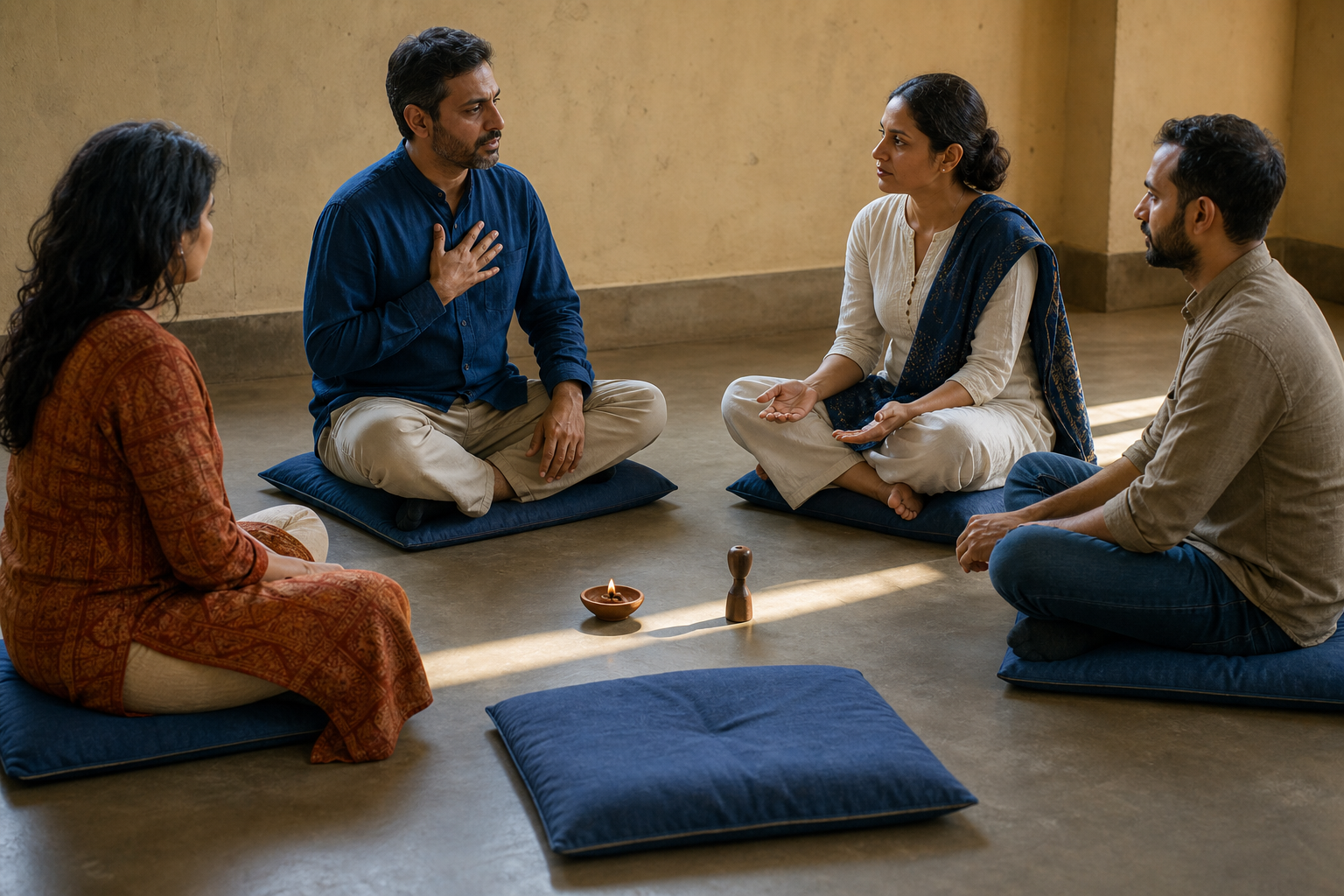
The best time to prepare for a divisive exchange is before you are inside one. Once identity has fused with the issue, even a modest correction can feel like surrender. Use the following protocol in family disputes, inter-sampradāya debates, community meetings, and online conversations.
- Pause for three breaths. Do not use the pause to prepare a sharper reply. Notice bodily contraction, urgency, humiliation, or the desire to defeat. You are identifying the conditions under which your judgment is operating.
- Reduce the dispute to its actual claim. Replace a verdict about a people with a statement about a teaching, decision, action, or consequence. A claim about conduct can be examined; a totalizing label usually cannot.
- Add the Syādvāda qualification. Silently append from this standpoint and under these conditions to your own view. Then state which standpoint and conditions you mean. This makes your reasoning clearer without forcing you to abandon conviction.
- Find the limited truth on the other side. Ask what fact, experience, value, or fear the other position may be protecting. Recognizing that element is not the same as accepting the whole conclusion.
- Test your response through satya, ahiṃsā, and lokasaṅgraha. Is it truthful? Does it avoid needless injury? Will it protect the cohesion required for shared life without concealing adharma? If one of these tests fails, revise the response.
- Choose the smallest adequate action. You may ask a question, correct a fact, set a boundary, refuse to forward a message, oppose a harmful decision, or propose shared work. Not every disagreement needs public escalation.
This protocol avoids four common errors. The first is false harmony: pretending substantive differences do not exist. The second is relativism: assuming that many-sidedness makes evidence irrelevant. The third is moral symmetry: believing that because ego can distort every side, every side has caused equal harm. The fourth is collective condemnation: treating the misconduct of particular people as the permanent nature of everyone who shares a label.
Ahiṃsā in perception does not prohibit judgment. It changes the object and manner of judgment. You can name a false claim as false, oppose coercion, and protect someone facing harm. What you refuse to do is turn necessary opposition into pleasure in humiliation or hatred of a whole population.
Sama-darśana is similarly demanding. Equal vision does not make teacher and teaching, victim and aggressor, or wise and unwise conduct indistinguishable. It means that your response to wrongdoing remains governed by truth and dharma rather than by the intoxicating belief that another person’s spiritual worth has disappeared.
Train perception before the next conflict arrives
An intellectual commitment to unity will fail under pressure if your habits continually reinforce self-centred reaction. Sādhanā is where the idea becomes a capacity. You do not need to assemble an indiscriminate mixture of practices. Keep a root discipline within your own tradition and use the shared Dharmic insights to examine what that discipline is meant to transform.
- Begin the day by loosening self-importance. Use japa, simran, mindfulness, prayer, or quiet contemplation. Set one concrete intention: during disagreement, you will examine your own reaction before assigning motives to another person.
- Use the pañca-kośa check at the moment of friction. Notice the body’s condition, the agitation or dullness of energy, the mind’s narrative, and the quality of discernment available. If the outer sheaths are turbulent, postpone the public reply when circumstances allow.
- Apply an antidote matched to the affliction. Use mettā when aversion is dominant, vipassanā when permanence is being projected onto a changing situation, samayik when partiality is distorting judgment, and seva when self-concern has crowded out the common good.
- Review speech at the end of the day. Look for exaggeration, selective evidence, motive-reading, and labels that replaced an argument. Repair a misrepresentation promptly rather than defending it to preserve face.
- Anchor conduct in your tradition’s ethical commitments. The yamas and niyamas, Buddhist pañca-sīla, Sikh nitnem, and Jain anuvratas differ in form, but each prevents spiritual insight from being detached from disciplined behaviour.
Do not use the guṇas as labels for your opponents. Calling another community tamasic simply gives ego a Sanskrit vocabulary. Use sattva, rajas, and tamas first as a state check on your own attention. If you are agitated, compulsively refreshing a feed, or eager to share an accusation before verifying it, rajas is already shaping the act. If you are indifferent to another person’s suffering because of a group label, tamas is obscuring moral perception.
Digital life makes this training especially urgent. Outrage rewards speed, categorical language, and public allegiance. Treat deliberate consumption as pratyāhāra for the attention economy. Before forwarding divisive material, take three breaths, identify the factual claim, check whether the label exceeds the evidence, and ask whether sharing it advances lokasaṅgraha. If you cannot establish the claim, do not recruit others into your reaction.
Exposure to a different standpoint should also be deliberate. Read or hear the strongest account that its adherents would recognize, not only the version selected by its opponents. The goal is not compulsory agreement. It is to prevent ignorance of another position from masquerading as mastery of it.
Give Dharmic unity an institutional form

Unity cannot depend entirely on unusually calm individuals. A community needs structures that make accurate understanding and shared responsibility easier, especially when controversy arrives.
- Place shared seva before symbolic declarations. Work on a concrete need through the principle of sarbat da bhala. Service lets people encounter one another as responsible partners instead of abstract representatives of competing identities.
- Use case-based study circles. Take one ethical conflict and examine it through Advaita, Buddhist dependent origination, Jain Anekāntavāda, Sikh Ik Onkar, and the relevant community’s own teachings. Require participants to name both a genuine convergence and a genuine difference.
- Create hospitable devotional encounters. Inter-tradition kirtan, satsang, and visits can reduce social distance when hosts explain the meaning and boundaries of the practice. Iṣṭa-based pluralism means honouring another path without pretending that every participant relates to every form in the same way.
- Adopt rules for public disagreement. Ask speakers to state the disputed proposition, present evidence, distinguish individuals from groups, and describe an opposing view in terms its adherents could recognize before criticizing it.
- Correct your own side visibly. A community that challenges distortion only in outsiders trains loyalty, not truthfulness. Internal correction shows that dharma outranks collective vanity.
You can judge whether these structures are working without demanding doctrinal consensus. After a difficult discussion, can participants state the opposing position fairly? Can they identify where evidence ends and inference begins? Can they continue a shared service commitment? Can they challenge misconduct without attributing an evil essence to a whole tradition? Those are practical signs that unity is becoming resilient.
Vasudhaiva Kutumbakam should not be reduced to a slogan of pleasant feeling. Families contain obligations, disagreements, boundaries, and correction. Seeing the world as one family means refusing both indifference and dehumanization. It requires you to protect the common good while remembering that an opponent is more than the position currently separating you.
At your next point of friction, do one thing differently: identify the exact claim before naming the group. That small act deprives avidyā of its favourite shortcut. Repeated through sādhanā, speech, service, and community rules, it gives Dharmic unity a foundation stronger than sentiment.