

You may be keeping your count, moving the beads, and saying every syllable, yet finishing with the uneasy sense that you barely met the Holy Name. Or you may be so worried about attention, speed, pronunciation, and rules that japa has begun to feel like an examination.
You do not have to choose between a serious discipline and a merciful spiritual life. Guru’s grace gives you the vision to understand what the discipline is for. Discipline then gives that received vision a daily form. The practical task is to protect both: a standard firm enough to shape you and an atmosphere compassionate enough to keep you honest, receptive, and willing to continue.
Grace does not cancel effort; it tells effort where to go
In the devotional Sankhya setting of Srimad-Bhagavatam 3.25.8, Devahuti addresses Lord Kapila as the means of deliverance from ignorance. Her spiritual sight is not presented as an intellectual possession earned in isolation. It is received by mercy.
You are my transcendental eye, which, by Your mercy only, I have attained after many, many births.
Srimad-Bhagavatam 3.25.8
The image of a transcendental eye gives you a precise way to understand the guru. The guru is not a replacement for Bhagavan. The guru helps you see Bhagavan, recognize the path of service, and detect the habits that repeatedly turn your attention away from it. Shastra provides the governing truth, sadhu confirms its lived form, and genuine instruction helps you apply it without bending it around your preferences.
That changes the meaning of japa. Discipline is not a fee you pay to purchase grace. Nor is grace permission to remain careless. Discipline is the responsible use of sight you did not manufacture for yourself. You receive a mantra, a method, a relationship, and a direction; your daily practice is the answer you give.
Within Vaishnava theology, nama and nami – the Divine Name and the Divine Person – are understood as nondifferent. The immediate purpose of japa, therefore, is not to produce a particular mood, finish quickly, or prove endurance. It is to meet the Name through attentive hearing. Emotion may come or go. The available duty remains concrete: pronounce, hear, remember, and return when the mind wanders.
Before beginning, use a simple intention rather than an elaborate internal speech: “Let me hear this Name as service, under the guidance I have received.” That one sentence places effort inside grace. It also exposes a common mistake. If your hidden intention is to outperform someone, preserve an image, or escape criticism, more repetition may strengthen anxiety instead of remembrance.
Build a daily japa method you can actually keep

If you have received formal instructions concerning mantra, count, pronunciation, audibility, or conduct, those instructions govern your practice. A general routine can improve execution, but it should not silently replace the covenant established through diksha or the continuing guidance received through shiksha.
- Choose a repeatable time before choosing an impressive time. Brahma-muhurta can offer unusual quiet and clarity before the day’s impressions gather, but a pre-dawn schedule that you repeatedly abandon is not yet a discipline. Arrange sleep and duties so that the chosen window can become regular. Consistency gives the mind fewer opportunities to negotiate.
- Remove the predictable interruptions. Put the phone out of reach, prepare your beads and seat beforehand, and settle any ordinary need that would otherwise become an excuse to stand up. The aim is not ceremonial perfection. It is to prevent avoidable decisions from occupying the attention needed for hearing.
- Sit upright without turning posture into an austerity contest. Let the body be stable, the chest open, the jaw unforced, and the breath relaxed. A collapsing posture encourages dullness; a rigid posture spends attention on discomfort. Upright and easeful is the useful middle.
- Use a volume that lets your own ear receive the mantra. In many bhakti settings, japa is voiced softly enough to be audible to oneself while remaining considerate of others. If silence is required, or your lineage and level of concentration call for mental japa, follow that context. Do not confuse private japa with kirtana: collective voiced chanting has its own purpose, setting, and discipline.
- Give each syllable a real acoustic form. Do not make speed the hidden master of pronunciation. Let the mouth articulate and the ear verify. If you are uncertain about a sound, ask a qualified teacher and practice the correction directly instead of repeatedly guessing.
- Let breathing support the mantra rather than control it. A calm rhythm can steady attention, but forcing the breath can create strain and turn japa into a breathing exercise. Keep the breath natural, relax unnecessary tension, and allow articulation to remain clear.
- Count as an act of fidelity, not self-ranking. If you have undertaken a vowed count, keep it as instructed. If you have not received a numerical vow, choose a stable measure with suitable guidance rather than copying another practitioner’s commitment. A count tells you whether you completed a commitment; it does not measure the depth of another person’s devotion.
- Close by identifying one correction. Notice whether haste, sleepiness, indistinct syllables, agitation, or environmental noise caused the greatest loss of attention. Carry one practical adjustment into the next session. Trying to repair every weakness at once usually produces a complicated routine that is difficult to sustain.
Use a short quality check while chanting: Can you hear the mantra you are presently speaking? Are the syllables recognizable? Is the body needlessly strained? Has the pace accelerated because you are looking toward the end? These questions are more useful than repeatedly asking whether the session feels spiritual. They direct you back to actions available now.
Correct the actual failure instead of punishing yourself
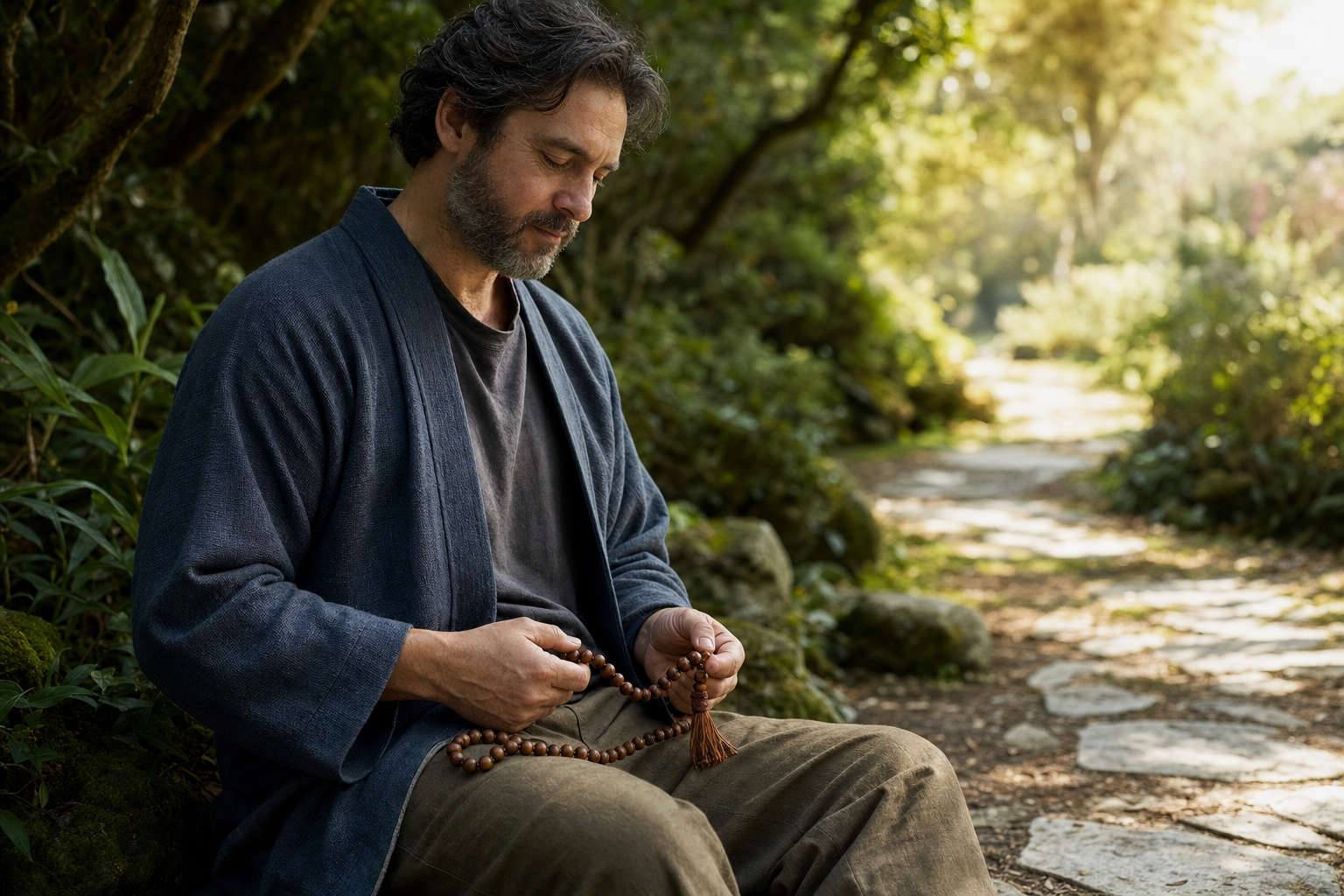
A difficult session can arise from several different causes. Treating all of them as insufficient determination leads to crude remedies: more force, more guilt, more speed, or a more ambitious schedule. First identify what is failing. Then make the smallest correction that restores contact with the Name.
- When the mouth continues but the ear stops listening: finish the present repetition, pause briefly, and deliberately receive the next audible syllable. Do not spend the pause prosecuting the mind. The return itself is the training.
- When you discover that several repetitions passed unnoticed: avoid a prolonged internal argument about how many were “lost.” Resume attentive hearing unless your teacher has given a specific rule for such moments. Shame consumes the same attention you are trying to recover.
- When the pace keeps increasing: check whether you started too late, are protecting a completion time, or are comparing your speed with someone else’s. Make the next repetition clear rather than forcing an exaggerated slowness across the entire session. If rushing is chronic, the schedule needs attention as much as the tongue does.
- When pronunciation becomes blurred: separate the words and syllables at a deliberate pace, verify the correct form with a teacher, and then restore a natural rhythm. Repeating an uncertain sound faster does not resolve uncertainty.
- When drowsiness dominates: restore an upright posture, use an appropriately audible voice, and reconsider whether your chosen time reliably supports alertness. If illness, caregiving, work, or another real constraint has changed what is possible, discuss the form of your practice with your guide instead of concealing the difficulty.
- When counting produces anxiety: separate two questions. Did you honor the commitment? Did you chant attentively? Completion matters, but it does not make inattention irrelevant; a distracted session matters, but it does not justify casually discarding a vow. Bring repeated conflict between the two to your guru or shiksha-guru.
- When another person’s japa irritates you: determine whether there is a genuine shared-space problem or merely a difference in pace and temperament. Protect your attention first. If correction is necessary, use the community’s agreed norm or ask a responsible mentor to address it privately.
- When japa feels emotionally dry: do not treat the absence of feeling as proof that the Name is absent. Check intention, articulation, hearing, regularity, and service. Continue faithfully and seek instruction if dryness is becoming neglect. Manufactured emotion is not a substitute for attention.
This method keeps humility distinct from self-contempt. Humility admits, “My attention wandered, and I need help.” Self-contempt declares, “I am incapable of real practice,” and then uses that verdict to avoid the next honest effort. Guru’s grace supports the first movement because it keeps you teachable. It does not require the second.
Do not respond to weak attention by immediately stacking new austerities onto an unstable foundation. First make the existing instruction clear and repeatable. Additional commitments are useful when they deepen remembrance and can be carried responsibly, not when they function as punishment for an imperfect day.
Receive correction without turning spiritual life into fear

Diksha and shiksha answer related but different needs. Diksha establishes transmission, authorization, and commitment within a lineage. Shiksha continues the work through pronunciation guidance, practical correction, theological understanding, and help applying a vow under changing conditions. Both should direct you toward the Lord rather than making the teacher the final object of dependence.
No quick checklist can establish a guru’s authenticity, but several practical signs help you examine the direction of instruction. It should remain faithful to shastra, align with sadhus of tested character, and cultivate shanta, daya, and nishkama-bhakti: greater tranquility, compassion, and service without bargaining for personal gain. These fruits mature gradually, so they are not a demand for instant serenity. They are a direction of travel.
- Good correction names the practice problem. “The syllables are becoming indistinct” gives you something to repair. A sweeping attack on your worth does not.
- Good correction preserves standards. Compassion does not mean pretending that careless chanting is attentive chanting. It means explaining the standard in a way that helps sincere effort rise toward it.
- Good correction considers context. Volume appropriate in a private place may disturb a shared room. Mental japa appropriate under a requirement of silence should not automatically become the rule for every setting.
- Good correction reduces performance anxiety. You should leave knowing what to practice, not merely fearing that someone will observe you failing.
- Good mentorship corrects privately when possible and affirms sincere progress publicly. This protects dignity without concealing the work that remains.
If you receive conflicting advice, resist the temptation to assemble a private system from whichever instruction feels easiest on a given day. Write down the exact conflict – count, volume, pronunciation, posture, or timing – and seek clarification from the teacher responsible for your practice. Precision makes the conversation useful.
Communities also carry responsibility. Clear quiet hours, an audible-to-oneself baseline for shared japa, and separate areas for more voiced practice prevent many disputes before they become personal. Teachers can model the expected volume and pace rather than relying on public reprimands. Firm norms protect the practice; considerate enforcement protects the practitioner.
This balance belongs to a wider dharmic family without erasing doctrinal differences. Hindu mantra-japa, Buddhist recitation such as Om mani padme hum, Jain reverence for the Navkar Mantra, and Sikh Naam Simran each join disciplined remembrance with guidance and ethical transformation. They do not make identical theological claims, and their mantras should not be treated as interchangeable techniques. You can recognize the shared grammar – sound, intention, recollection, instruction, and compassion – while respecting each tradition’s authority, purpose, and form.
Key takeaways
- Guru’s grace provides spiritual sight; japa discipline trains you to use that sight through repeated, attentive remembrance.
- If you have received formal instructions about mantra, count, or method, work within them and seek clarification before making a significant change.
- For many private or shared bhakti settings, a useful baseline is clear articulation at a volume audible to yourself without disturbing others.
- When attention wanders, use a brief pause and return to the next audible repetition. Do not turn the correction into an extended exercise in shame.
- Count measures the completion of a commitment, not your superiority, another practitioner’s devotion, or the full spiritual quality of a session.
- Look for progress in clearer hearing, steadier remembrance, tranquility, compassion, and service without demand for personal gain.
At your next session, change one thing. Set the intention before the first repetition, hear the next Name fully, and note the single obstacle that most often breaks contact. Keep working on that obstacle until the correction becomes stable. If you need help, take a precise question to your guru or shiksha-guru. Grace has already given the direction; your task is to answer it, one attentive Name at a time.