
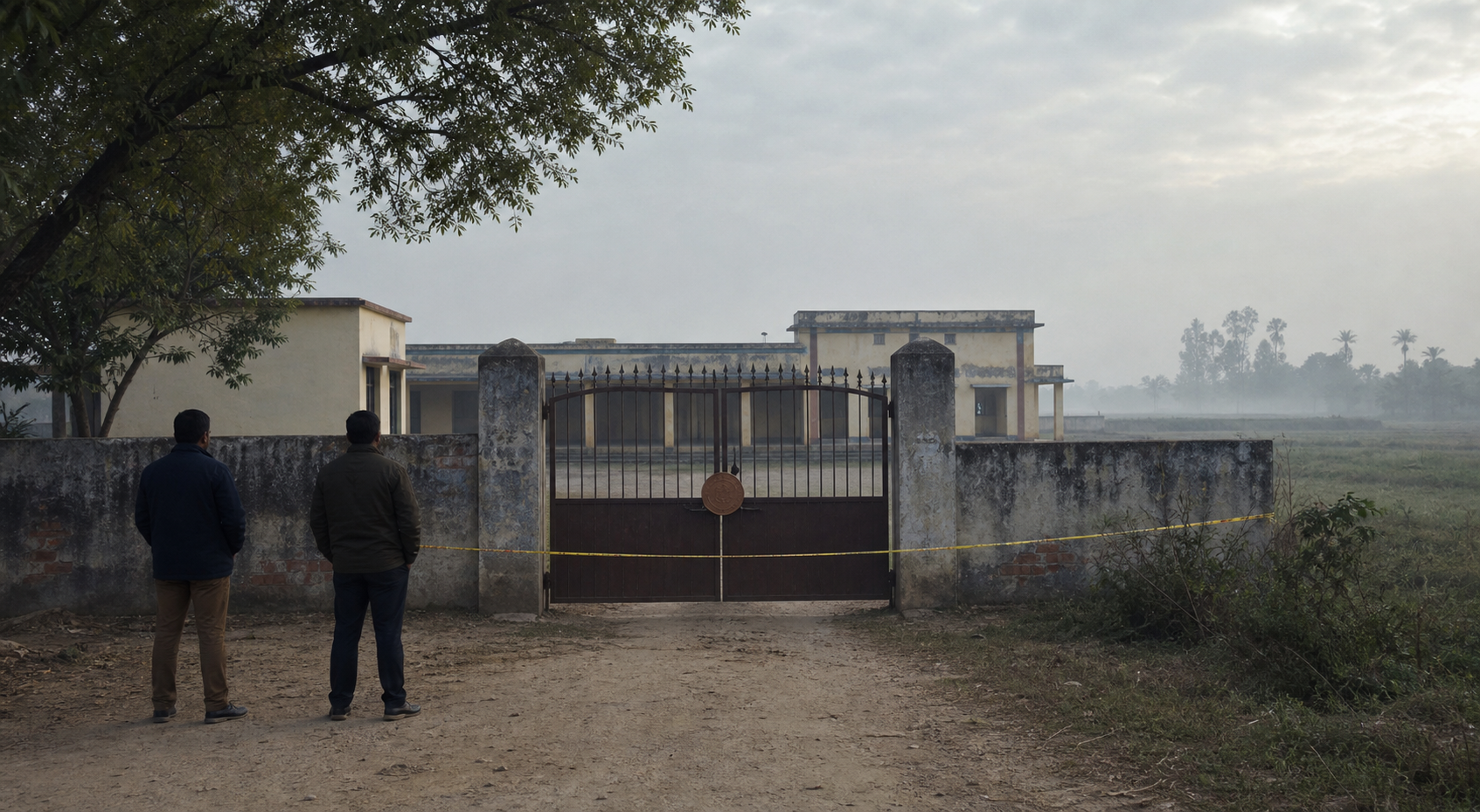
You may have seen alarming claims about a madrassa, recovered weapons and a possible interstate connection. Before you decide what the West Champaran case proves, separate the seriousness of the reported discovery from the much larger conclusions now circulating around it.
On April 6, 2026, Bihar Police reportedly sealed a madrassa in the West Champaran region after recovering arms, detained three people for questioning and began examining a possible Andhra Pradesh connection. Those are the starting points. They do not yet establish who owned the weapons, who knew they were present, how they reached the premises or whether they were connected to a wider conspiracy.
Key takeaways
- Treat the reported recovery of arms at an educational premises as a serious public-safety matter, but do not turn an allegation into a verdict.
- Sealing the premises protects evidence. Detention permits questioning. Neither action proves guilt.
- The most consequential next evidence will come from the seizure record, ballistic examination, ownership and access evidence, digital and financial trails, and an intact chain of custody.
- A possible Andhra Pradesh connection is an investigative lead, not proof of terrorism or even proof that the lead will survive scrutiny.
- Judge progress by official records: the FIR provisions, court orders, forensic findings, any charge-sheet and any formal decision concerning the National Investigation Agency.
- A firm Dharmic response demands both complete investigation and protection of innocent students, families and communities from collective blame.
Separate the reported facts from the unanswered questions

The quickest way to lose clarity is to place a police action, a media inference and a social-media accusation in the same mental category. Keep three separate ledgers: what has been publicly reported, what investigators are testing and what remains unproved.
The preliminary public account supports a narrow description: arms were reportedly recovered during a search, the premises was sealed, three individuals were detained for questioning and an interstate angle was being examined. Even the word “recovered” does not answer the questions that determine culpability.
- Possession: Who exercised actual control over the place where each weapon was found?
- Knowledge: Who knew the arms were there, and what evidence demonstrates that knowledge?
- Access: Was the relevant room or container restricted, shared, rented, abandoned or accessible to outsiders?
- Legality: Was any item licensed, prohibited, functional, modified or unlawfully possessed?
- Origin: Can serial numbers, tool marks or supplier records identify where the items came from?
- Purpose: Is there admissible evidence connecting the arms to trafficking, planned violence, intimidation or some other offence?
- Institutional involvement: Did an office-bearer authorize, facilitate or conceal the storage, or did particular individuals misuse the premises without institutional knowledge?
- Interstate coordination: Does the Andhra Pradesh lead reveal communication, travel, money or logistics connected to the recovered items?
Until those questions are answered, categorical phrases such as “terror centre,” “institutional plot” or “entirely innocent misunderstanding” all run ahead of the evidence. The disciplined description is less dramatic but more accurate: this is an arms investigation with a possible interstate lead.
Understand what sealing, detention and an interstate lead mean
Sealing a premises is primarily an evidence-preservation measure. It restricts access while officers document the scene, catalogue exhibits and prevent removal, substitution or contamination. In this case, the seal should be read as protection of the suspected crime scene, not as a judicial finding against every person associated with the madrassa.
Detention for questioning is equally easy to misread. Investigators may need to establish identity, access, movements, communications and knowledge. A detained person is not thereby convicted, and the public account does not permit you to replace “detained” with “guilty,” “terrorist” or even “charged.” Watch later court records for the legal status of each person rather than relying on labels added by commentators.
The possible Andhra Pradesh link may prove important because an arms supply route, financing arrangement or group of contacts can cross state borders. Investigators can test such a lead through call-detail records, travel history, financial transactions, supplier networks and documented meeting patterns. Bihar and Andhra Pradesh police may exchange leads through interstate coordination mechanisms. None of that predetermines what they will find.
The same restraint applies to discussion of the National Investigation Agency. State police and specialized units ordinarily handle the initial work. The NIA can enter when a Scheduled Offence is involved or when the Union government formally directs a transfer under the NIA Act, 2008. A transfer would signal jurisdictional and national-security significance; it would not itself prove that any accused person committed an offence.
The evidence that can turn suspicion into a prosecutable case
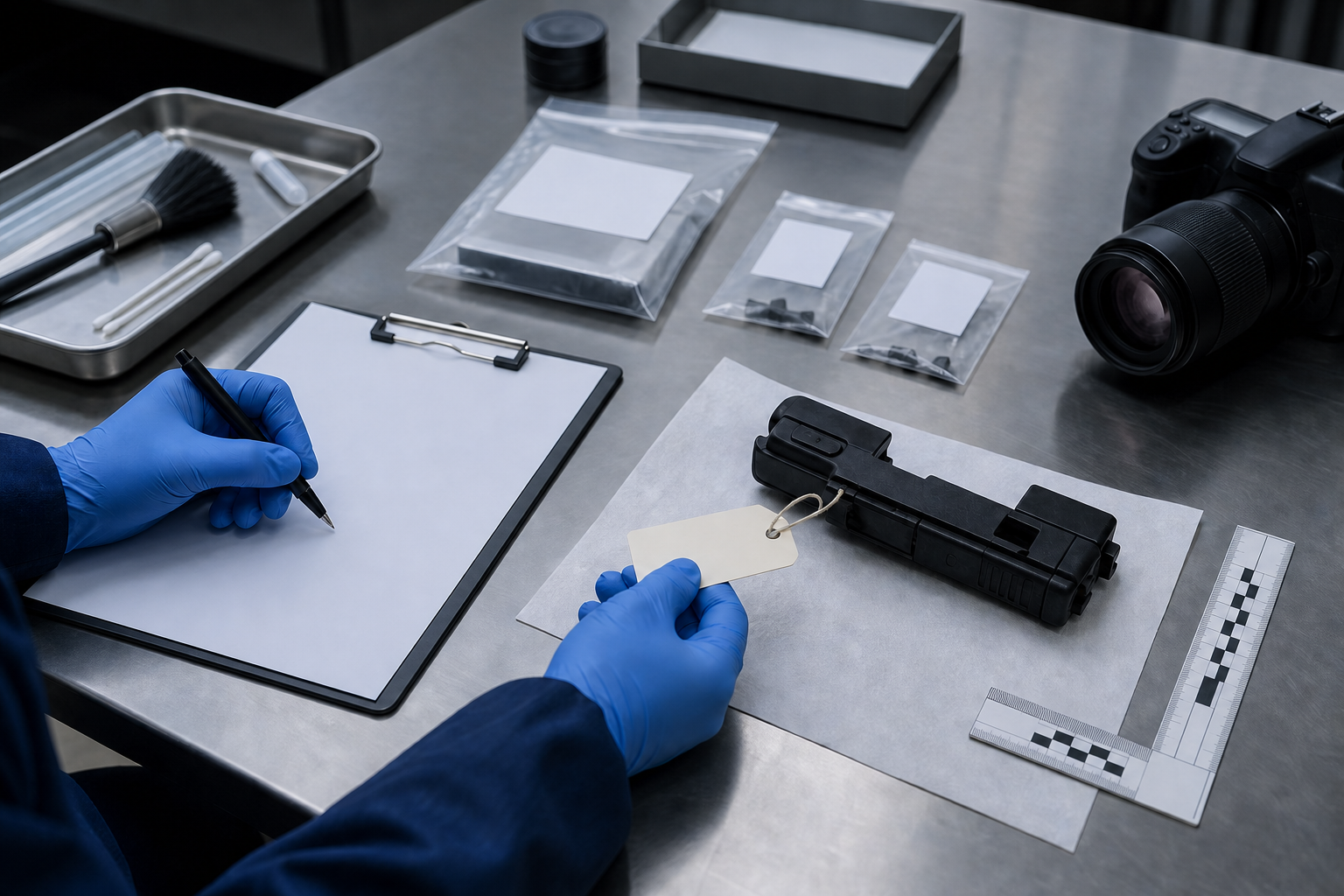
A photograph of weapons may explain why the public is concerned, but it cannot establish lawful possession, functionality, ownership, fingerprints, prior use or the integrity of the seizure. Those questions require forensic work and records that can withstand scrutiny in court.
Ballistics and tracing
Ballistic specialists can determine whether a firearm functions and can test-fire it under controlled conditions. Marks left on bullets and cartridge cases may then be compared with other material. Serial numbers, microscopic impressions and signs of alteration can help trace origin or reveal attempts to obscure it. These findings matter because “an object resembling a firearm was displayed” and “a working, unlawfully possessed weapon was forensically identified” are not equivalent claims.
Physical links to particular people
Fingerprints, DNA traces and gunshot residue may help connect an exhibit to a person, but each result must be interpreted alongside access and context. A trace may support handling; it does not automatically explain when, why or under what circumstances the handling occurred. Investigators still need evidence showing knowledge and control.
Communications, travel and money
Phones, storage devices and online accounts can reveal communications and logistics. Call records can show contact patterns, while travel and financial records can test whether people, payments and suspected suppliers intersected. If investigators suspect an informal money-transfer channel, they must still connect particular transactions to particular acts. A contact in another state is not incriminating by itself.
Chain of custody
Every exhibit should be identifiable from seizure through storage, transport and laboratory testing. The record should show who handled it, when it changed custody and whether its seal remained intact. That chain of custody protects the admissibility and reliability of ballistic, biological and digital evidence. If the chain has unexplained gaps, even technically impressive test results can face serious challenge.
When a new claim appears, ask a simple question: what kind of evidence could prove or disprove it? A claim about ownership needs possession and access evidence. A trafficking claim needs a supply trail. A conspiracy claim needs communication, agreement and action, not merely association. A claim of institutional complicity needs proof tied to responsible decision-makers rather than the building’s name.
Read the legal milestones without treating them as verdicts

The Arms Act, 1959 is the natural starting point when firearms or ammunition are recovered. Section 3 addresses the licensing requirement for acquisition or possession, while Section 25 contains penalties for specified contraventions. The precise sections in the FIR and any later charge-sheet will show what conduct police actually allege. Do not infer the provisions from a headline.
Provisions of the Unlawful Activities (Prevention) Act may be considered only if investigators develop evidence supporting the relevant elements of a wider unlawful or terrorist conspiracy. That is a higher and more consequential threshold than an allegation of unlawful weapons possession. Invoking UAPA would expand the case; it would not eliminate the prosecution’s obligation to prove its allegations.
- FIR: Read it for the alleged acts, named or unidentified accused, locations and statutory provisions. It begins the criminal case; it does not decide it.
- Seizure documentation: Look for the description, location and condition of each item, as well as the witnesses and sealing procedure. This is more probative than an unlabeled photograph.
- Remand order: It can show what investigative tasks police say require custody and what the court authorized. Remand is not a finding of guilt.
- Bail order: It may reveal the strengths and gaps argued at that stage. Grant or denial of bail is not the final adjudication of the charges.
- Forensic report: It can answer whether the weapons function, how they are classified and whether physical or digital traces support particular links.
- Charge-sheet: It sets out the prosecution’s developed theory and supporting material. The evidence remains subject to challenge and trial.
- Formal NIA decision: Look for an actual transfer or assumption of the case, not speculation that the agency “may” become involved.
This sequence also helps you detect recycled news. A later headline that merely repeats the original recovery is not a new development. A laboratory result, a newly invoked section, a reasoned court order, a documented interstate arrest or a formal agency transfer is.
Demand security without assigning collective guilt

A pro-Dharma position need not choose between public safety and fairness. It should be uncompromising about illicit weapons, networks planning violence and officials who neglect credible evidence. It should be equally uncompromising about satya: no person, institution or community should be declared guilty through exaggeration, edited clips or guilt by association.
Ahimsa is not passivity in the face of a possible arms offence. It requires protection of life and restraint from conduct that creates new victims. Hindu, Buddhist, Jain and Sikh traditions articulate duty, self-command, justice and the protection of innocents in distinct ways. In a sensitive investigation, those commitments become practical disciplines.
- Use exact status words. Say “reportedly recovered,” “detained for questioning” and “possible interstate link” until official records justify stronger language.
- Do not confront anyone or enter a sealed location. If you possess direct information about weapons or an imminent threat, preserve the original material and give it to the police. Public confrontation can endanger people and contaminate evidence.
- Check the date and underlying event before sharing. A newly uploaded video may show an old search. Confirm whether the claimed update adds a court record, police statement or forensic result.
- Do not publish personal details of students or uninvolved families. Children attending an institution are not evidence against it, and exposure can create lasting harm unrelated to the case.
- Reject retaliatory language. Calls for violence, collective punishment or attacks on places of worship make the public less safe and divert attention from the individuals whose conduct must be investigated.
- Ask local representatives precise questions. Request the status of the forensic examination, the legal provisions invoked, arrangements for students and the authority responsible for the sealed premises.
Students should not lose classes or examinations merely because investigators need control of a campus. District authorities can arrange alternative venues or schedules while the seal remains necessary. Families can press for a named contact, a written continuity plan and clear instructions about retrieving essential educational records without interfering with the scene.
Prevention should also be institution-neutral. Madrassas, gurukuls, convent schools, private schools and other campuses should face the same lawful safety expectations: visitor logs, controlled access to restricted rooms, clear responsibility for keys, rules for reporting suspicious storage, staff escalation procedures and periodic coordination with local police. Applying those controls across institutions makes it harder for criminals to exploit any educational premises while reducing the risk of religious profiling.
For the next claimed development, set one rule: do not react until you can identify what genuinely changed. A forensic finding, court order, charge-sheet or formal interstate action deserves attention. A louder repetition of the original allegation does not. That standard allows you to demand a complete investigation while keeping public judgment aligned with evidence, law and Dharma.