
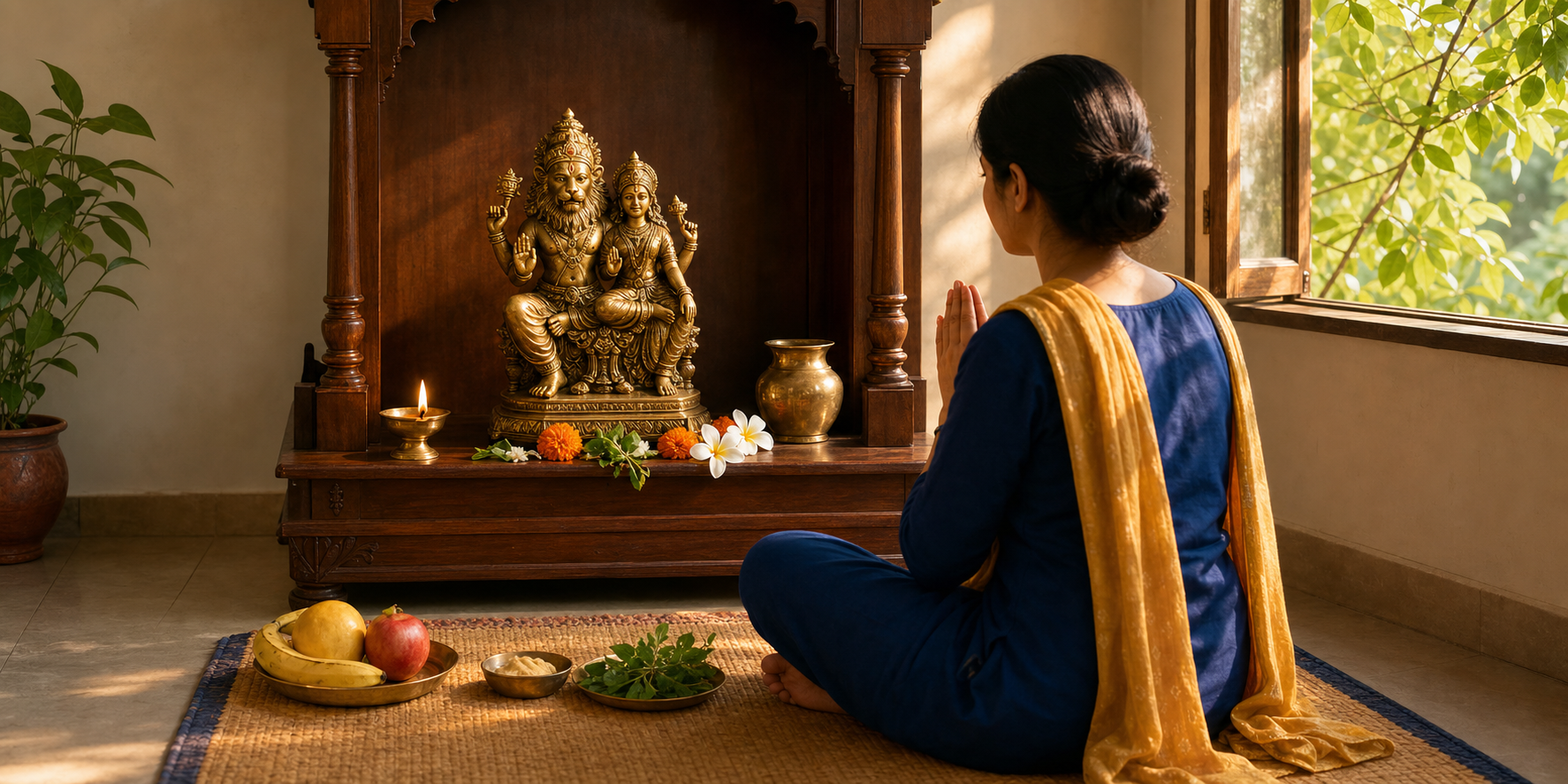
You want to worship Narasimha during Vaishakha, but the practical questions arrive first. Should you keep all nine nights or only Narasimha Jayanti? Is the main puja at midday or dusk? Must you fast completely? A sound observance begins by settling those questions without turning differences between traditions into confusion.
You do not need an elaborate altar or a temple-scale ritual. You need a trustworthy local Panchang, respect for your family or sampradaya practice, and a daily discipline you can keep. The purpose is not to cultivate anger in the name of Ugra-Narasimha. It is to become less ruled by fear, more steadfast in truth, and more capable of protecting others without crossing the boundaries of dharma.
Settle the tithi and puja time before planning the vrata
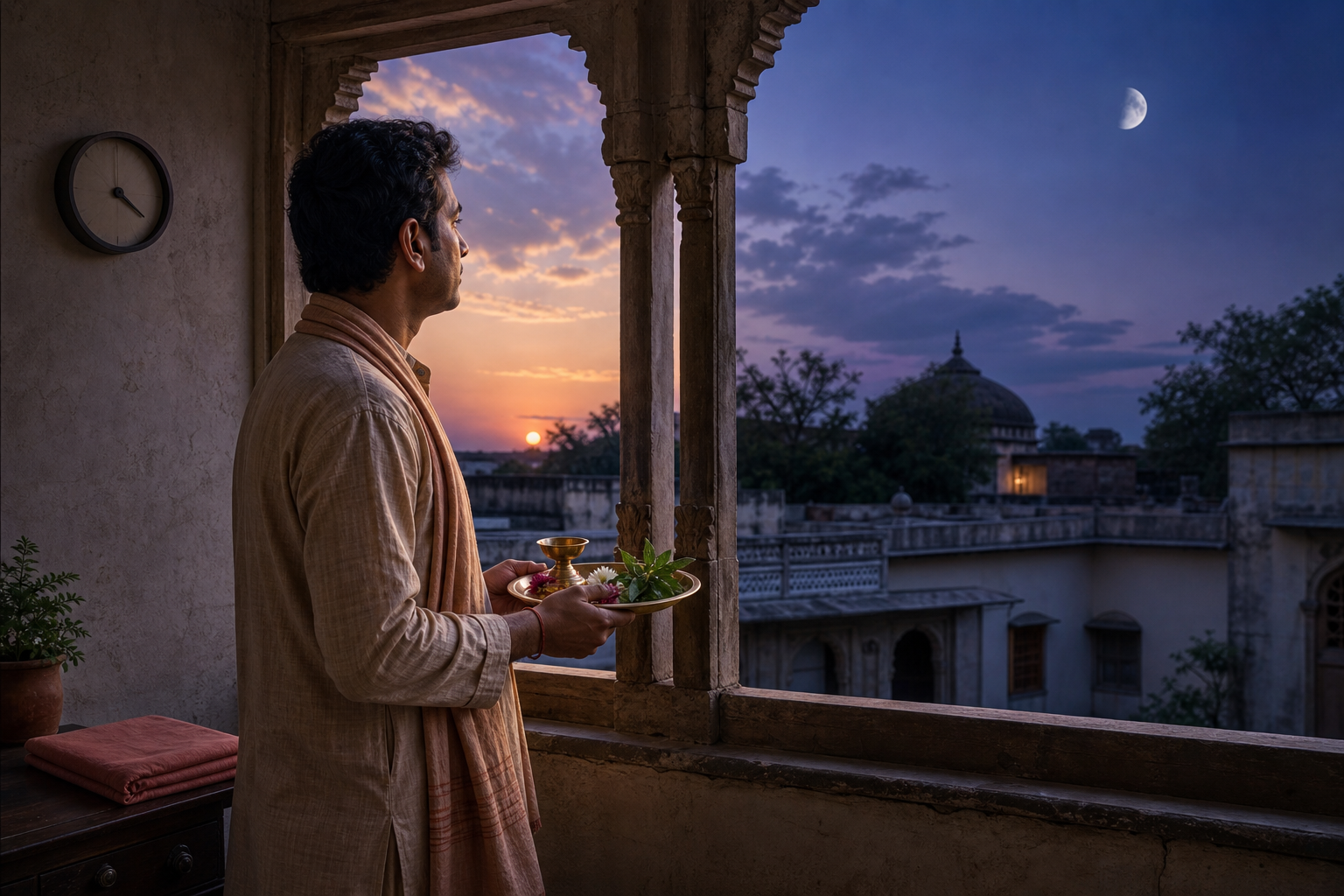
Narasimha Navaratri follows the bright fortnight of Vaishakha, beginning on Shukla Panchami and culminating on Shukla Chaturdashi. In 2026, the observance is scheduled from 22 April through Narasimha Jayanti on 30 April. These are planning dates, not a substitute for a Panchang calculated for the place where you will worship.
| 2026 civil date | Vaishakha observance |
|---|---|
| 22 April | Shukla Panchami; begin the nine-night observance |
| 23 April | Shukla Shashthi |
| 24 April | Shukla Saptami |
| 25 April | Shukla Ashtami |
| 26 April | Shukla Navami |
| 27 April | Shukla Dashami |
| 28 April | Shukla Ekadashi |
| 29 April | Dwadashi or Trayodashi, depending on local tithi timings |
| 30 April | Shukla Chaturdashi; Narasimha Jayanti |
A lunar tithi does not have to begin and end with the local civil day. It can therefore appear differently on calendars prepared for different cities or time zones. Before buying offerings or announcing a family puja time, verify the tithi start and end for your location. If you live outside Bharat, do not simply copy the date and muhurta printed for an Indian city.
The timing of the main Jayanti worship also varies by sampradaya. Some Vaishnava traditions give importance to madhyahna, while others emphasize sandhya or pradosha because Narasimha manifested at the threshold between day and night. The midday and twilight observances both belong to living Vaishnava practice; their coexistence is not a calendrical mistake.
Use a simple order of decision. Follow instructions received from your guru or initiated tradition first. Otherwise, preserve your family parampara. If neither gives a clear answer, align your home puja with a nearby Narasimha temple and a respected regional Panchang. Do not combine several schedules merely because each appears authoritative. Consistency within a valid tradition is more useful than an improvised mixture.
Keep one repeatable home puja from Panchami onward
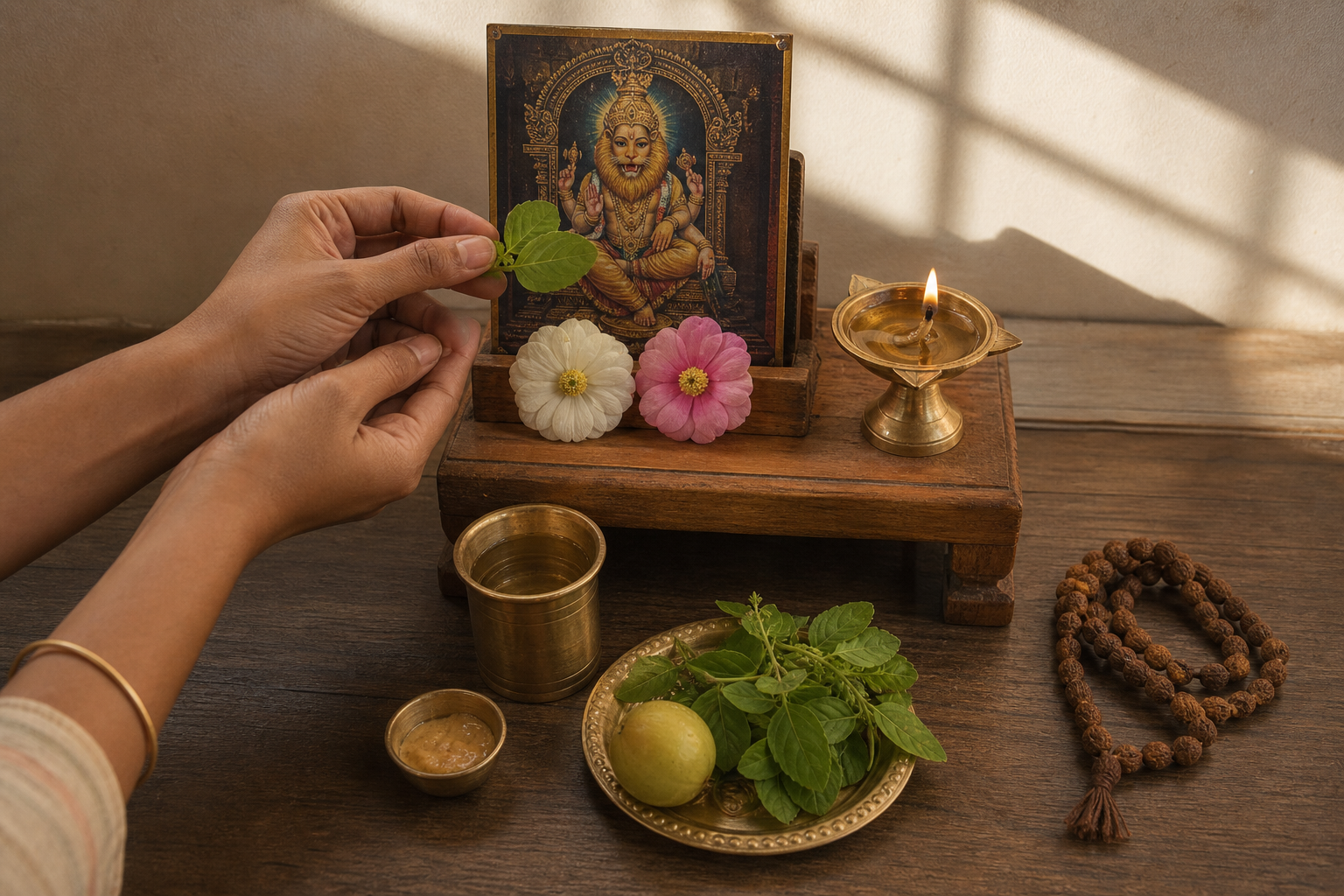
The strongest household observance is usually the one that survives an ordinary workday. Establish a core practice for all nine days, then expand it on Chaturdashi. This prevents the first evening from becoming so elaborate that the vrata quietly disappears by the fourth.
- Prepare yourself and the altar. Bathe, wear clean clothes, and clear the worship space. Place an image or murti of Narasimha or Lakshmi-Narasimha according to your household practice.
- Make the sankalpa. State the place, date, gotra where known, and the purpose of the vrata. A suitable purpose is devotion to Bhagavan, freedom from fear, clarity in dharmic conduct, or the welfare of the family. If you do not know a formal family wording, do not invent ritual details; state your intention plainly and reverently.
- Perform the purification you have learned. Traditional home worship may begin with achamana and prokshana. Kalasha-sthapana with tulasi and Vishnu symbols is optional, not a test of whether your devotion is genuine.
- Offer Panchopachara. Present gandha, flowers, dhupa, dipa, and sattvic naivedya. Tulasi is especially appropriate in Vishnu worship. Keep the offering clean and proportionate to what your household can consume as prasada.
- Recite one stable mantra or stotra. Repetition of a familiar text is better than changing texts every night merely to create variety.
- Read or hear the Prahlada narrative. Use the Prahlada-charitra in Skandha 7 of the Bhagavata Purana as the scriptural centre of the vrata, dividing the reading across the available evenings if necessary.
- Close properly. Offer arati, make kshama-prarthana for errors in the worship, and distribute prasada rather than leaving naivedya unused.
One commonly recited Narasimha mantra is: Om Ugram Viram Mahavishnum Jvalantam Sarvato Mukham, Nrisimham Bhishanam Bhadram Mrityor Mrityum Namamy Aham. Another option is the Narasimha Gayatri: Om Nrisimhaya Vidmahe, Vajranakhaya Dhimahi, Tanno Simhah Prachodayat. The Narasimha Kavacham, Prahlada’s hymns, and Sri Lakshmi-Narasimha Karavalamba Stotra are also established choices. If you have received a mantra under formal guidance, keep to that instruction rather than replacing it with a general selection.
Decide your minimum before Panchami. It might consist of the lamp, Panchopachara, your chosen recitation, a passage from the Prahlada-charitra, and arati. On a less hurried evening, you can add longer parayana. This distinction between a fixed core and an optional expansion protects the continuity of the vrata without reducing worship to a hurried checklist.
Use the nine nights to train courage, not devotional aggression
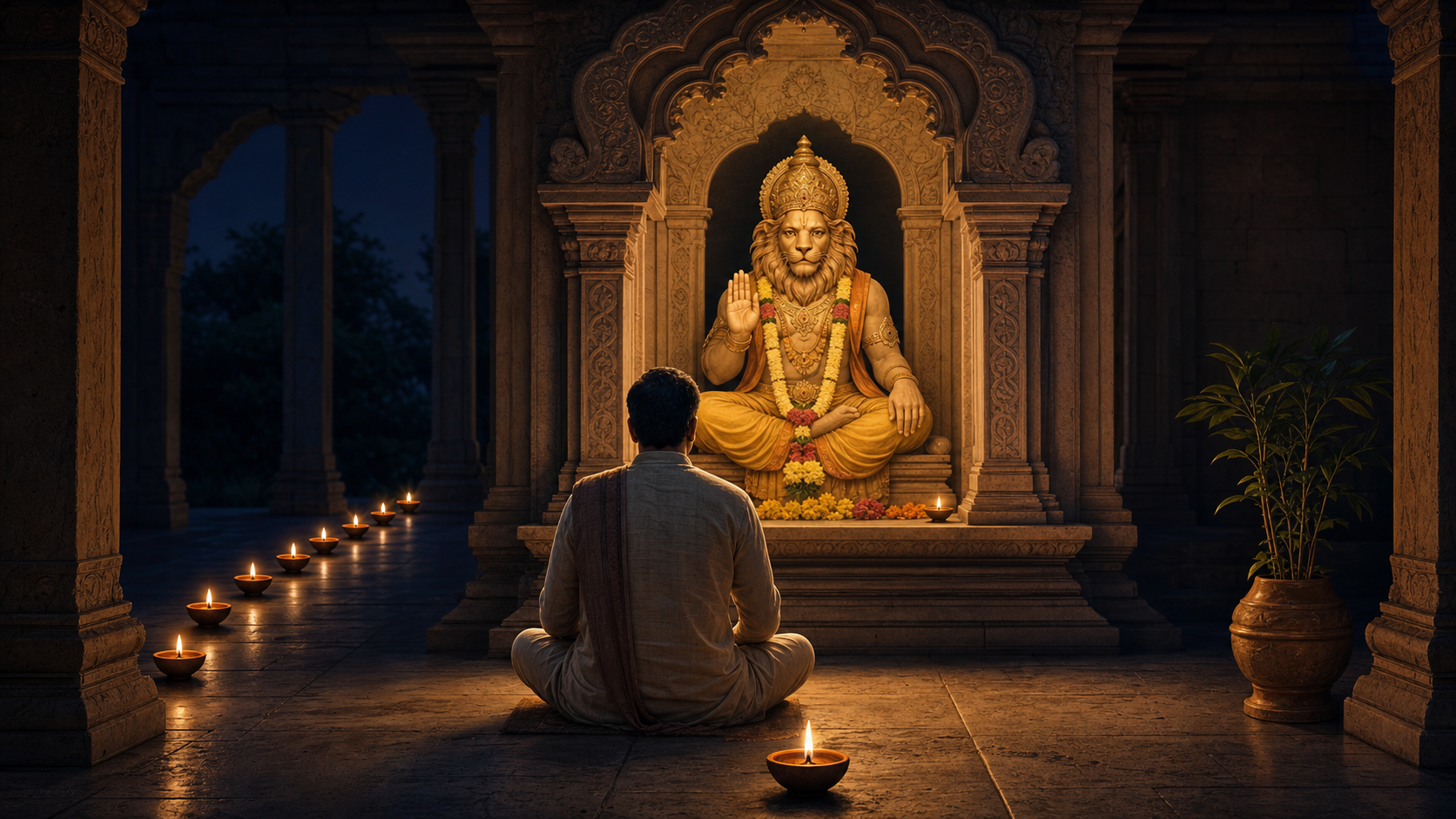
Narasimha resolves a precise dharmic crisis. The Lord appears neither simply as man nor lion, at a time that is neither day nor night, and at a threshold that is neither wholly indoors nor outdoors. The form is fierce, but the fierceness is governed. Dharma is protected without treating power as permission to abandon cosmic order.
That distinction matters when you bring Narasimha worship into daily life. Ugra is not a religious excuse for uncontrolled speech, hatred, humiliation, or vengeance. Before acting in a conflict, ask three questions: What or whom am I duty-bound to protect? Which dharmic boundary must I not cross? What truthful action can I take now without becoming an imitation of the adharma I oppose?
Some devotees contemplate the nine Narasimha forms associated especially with Ahobilam: Jwala, Ahobila or Ugra, Malola, Kroda or Varaha-Narasimha, Karanja, Bhargava, Yogananda, Chatravata, and Pavana. Jwala can direct attention toward protective fire, Ahobila toward righteous strength, Malola toward grace, Yogananda toward inward stillness, and Pavana toward purification.
Do not assume that there is one universal day-by-day assignment for these forms. Regional and lineage mappings can differ. If your temple or guru provides a sequence, follow it. Without that guidance, contemplate the Nava-Narasimha forms as a group and keep the same daily puja rather than presenting a personal arrangement as inherited tradition.
Give the vrata an ethical rule as well as a ritual form. Keep satya by noticing where fear is tempting you to evade an honest answer. Keep ahimsa by refusing to turn devotional intensity into cruelty. Protect someone vulnerable through a concrete, discreet action. Arrange anna-dana or another form of service within your means. These disciplines express the same movement seen in the Prahlada narrative: steadfastness before adharma without surrendering one’s orientation toward Bhagavan.
If children are participating, let them hear Prahlada’s story rather than only watching the mechanics of the puja. Ask what Prahlada refused to surrender, why power could not compel genuine devotion, and why Narasimha’s strength protects rather than terrorizes the innocent. The questions make the vrata a form of dharmic education instead of an annual spectacle.
Let Narasimha Jayanti deepen the practice without causing harm
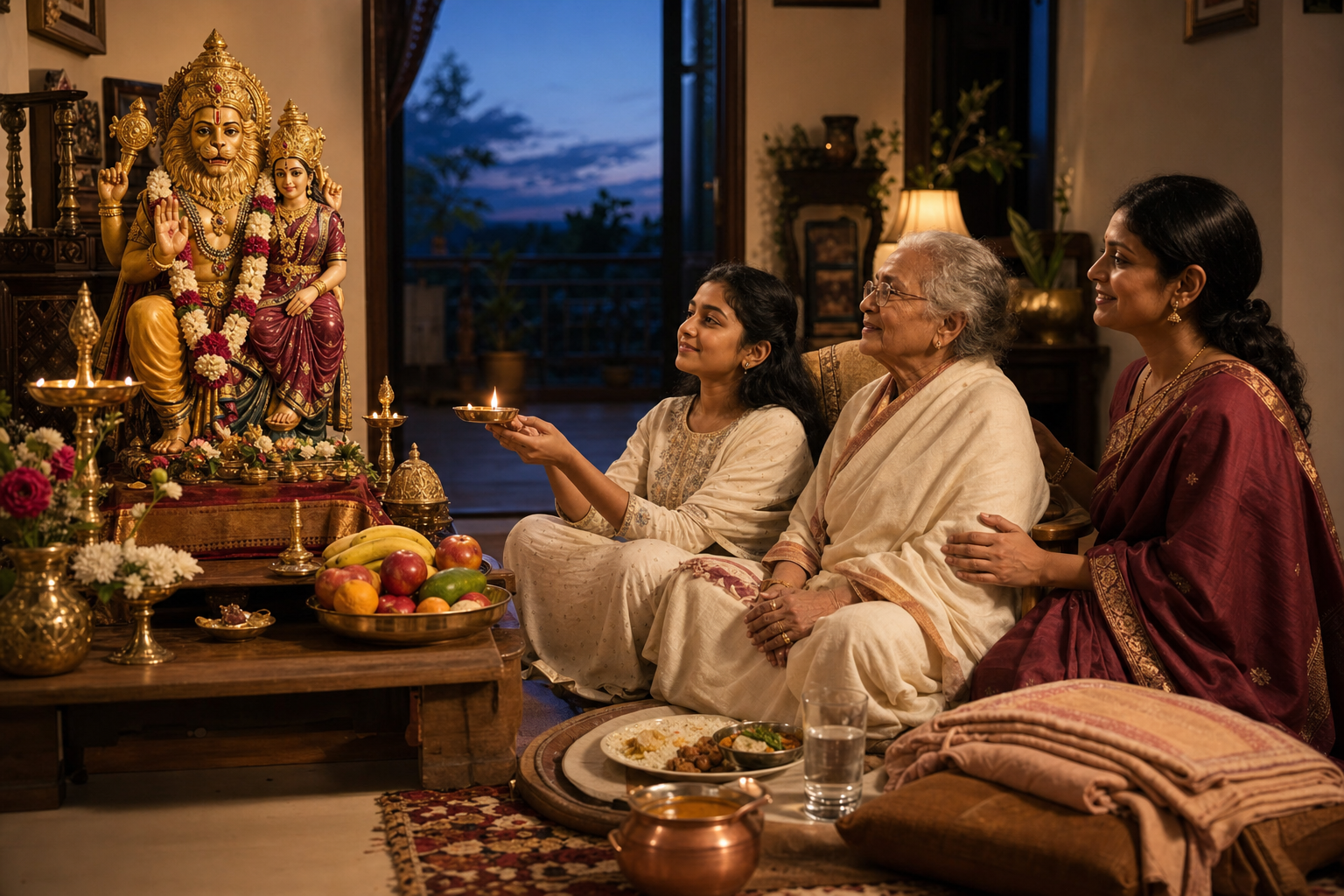
Choose a fast your body can actually sustain
Upavasa on Chaturdashi may range from phalahara, using fruit and milk, to a full-day fast. Parana is made according to the following day’s tithi and the applicable Panchang. Greater deprivation is not automatically greater devotion. Elders, expectant mothers, and people with health conditions should use a moderated fast or a sattvic diet under appropriate guidance rather than risk injury in pursuit of ritual strictness.
Plan the culmination before the day begins. Confirm the Chaturdashi window, the puja period observed by your tradition, and the parana time. Prepare naivedya and puja materials in advance. Set aside food or funds for charity. During the chosen muhurta, perform the fuller form of your established daily worship or attend the temple observance. Afterward, share prasada and complete the intended dana. This sequence keeps the fast connected to worship and service instead of making hunger the entire event.
Carry the cooling lesson of Simhachalam into the home
At Simhachalam, the moola vigraha of Varaha Lakshmi Narasimha is covered with sandalwood paste through the year. On Akshaya Tritiya, the old covering is removed for the rare Nijaroopa Darshanam, abhishekam is performed, and a fresh sandal covering is applied. In the 2026 festival sequence, sandal preparation begins on Gandham Amavasya, 17 April, before Chandanotsavam on 20 April.
Chandan is a cooling and pacifying upachara to Ugra-Narasimha, not merely decoration. That gives your ordinary gandha offering a useful contemplative meaning. As you offer it, identify the heat that needs governing in you: panic, resentment, pride, or the desire to retaliate. The aim is not to cool courage into passivity. It is to keep strength under the direction of dharma.
The same care should govern the physical offerings. Use natural lamps safely, avoid unnecessary plastic, prefer biodegradable flowers, and prepare only as much prasada as can be distributed mindfully. If you plan to visit Simhachalam or another major Narasimha kshetra, check the temple’s current darshan arrangements and arrive prepared for Vaishakha heat and large congregations. Temple archakas following Pancharatra or Vaikhanasa practice may use precise timings for abhishekam, alankara, and utsava; a household need not imitate those specialized rites to participate meaningfully.
Key takeaways
- Use a Panchang calculated for your location; do not import Indian tithi or muhurta times into another time zone.
- Let guru, sampradaya, family parampara, or a trusted local temple settle the choice between madhyahna and pradosha worship.
- Keep one repeatable daily core from Panchami through Chaturdashi, then expand it on Narasimha Jayanti.
- Read the Prahlada-charitra and connect recitation with satya, ahimsa, protection of the vulnerable, and dana.
- Do not present a self-created Nava-Narasimha sequence as universal tradition; follow an inherited mapping where one is available.
- Choose phalahara, a moderated sattvic diet, or a fuller fast according to health and guidance, and confirm the correct parana time in advance.
Begin with two decisions: select the local Panchang you will follow and write down the daily practice you can maintain. When Panchami arrives, keep that promise quietly. Let Chaturdashi find you not only more practiced in puja, but less evasive before difficulty, more disciplined in strength, and readier to protect another person without departing from dharma.
References
- Hindu Pad — Nrusimha Navaratri 2026: Definitive Dates, Daily Puja, Muhurtas, and Narasimha Jayanti Insights
- Hindu Pad — Gandham Amavasya 2026 at Simhachalam: Sacred Sandalwood Rites Before Nijaroopa Darshanam