
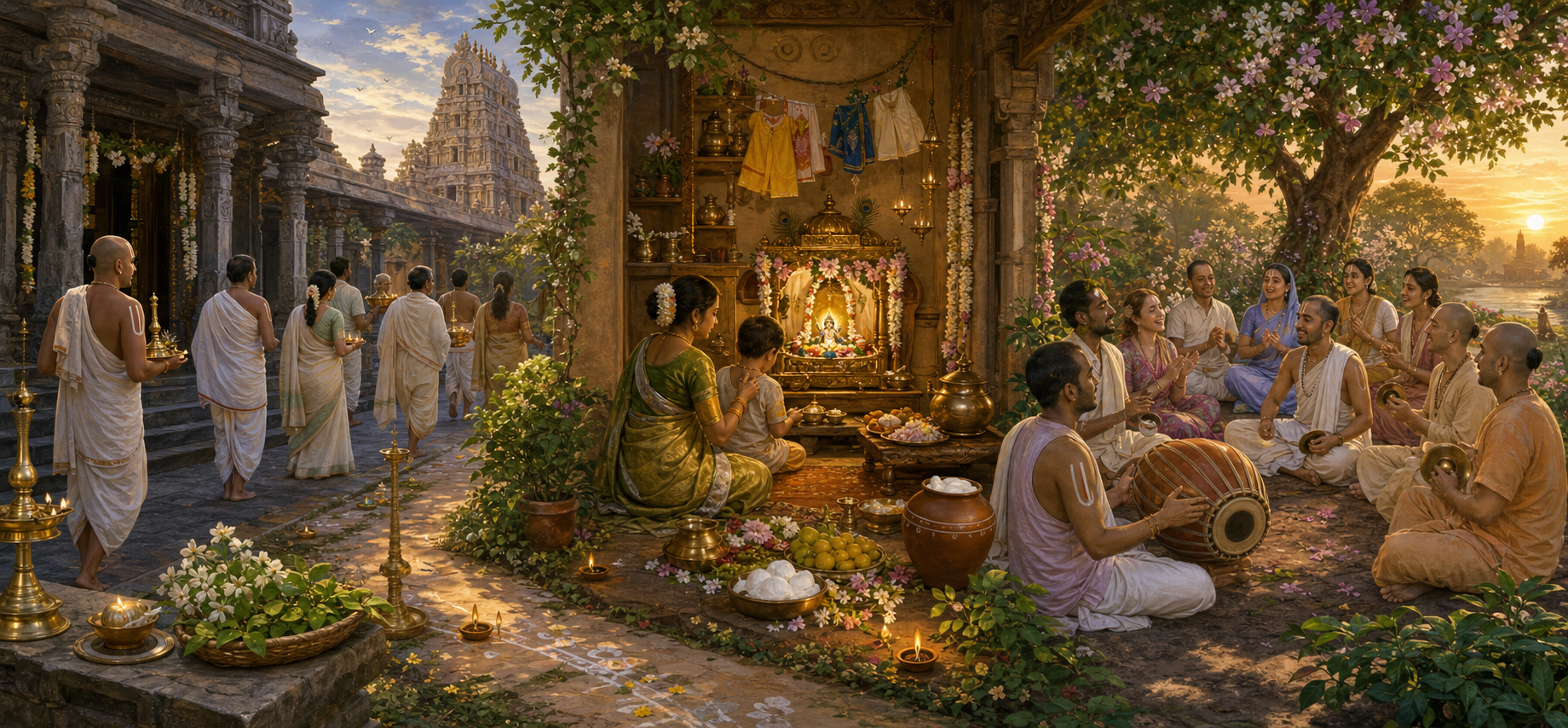
You may leave one Vaishnava temple hearing Om Namo Narayanaya, encounter another community singing about child Krishna in Braj, and then join a kirtan centered on Radha and Krishna. All three settings call themselves bhakti, yet they can feel like different spiritual worlds. What is actually shared, what must remain distinct, and how should you begin without turning living traditions into a devotional mixture?
The useful answer is to look beyond surface differences without ignoring them. Every Vaishnava path gives particular answers to four questions: whom you approach, what relationship you cultivate, how grace is understood, and what discipline carries devotion into ordinary life. Once you can see those four elements, you can enter a temple or satsang with greater understanding and choose a practice with roots.
Key takeaways
- Vaishnava bhakti is a family of disciplined relationships with the Divine, not one uniform ritual style.
- Sri Vaishnava practice places surrender and service within the Vishishtadvaita vision of Narayana, Sri, the individual soul, and the world.
- Surdas and the Pushtimarg setting make Krishna’s Braj lila present through poetry, music, loving attention, and intimate seva.
- Gaudiya Vaishnavism centers the reciprocal love of Radha and Krishna and explains divine intimacy through acintya-bheda-abheda.
- The most reliable test of any devotional practice is its effect on conduct: less contempt, steadier remembrance, truthful speech, compassion, and service without spectacle.
Use four questions to understand any Vaishnava path
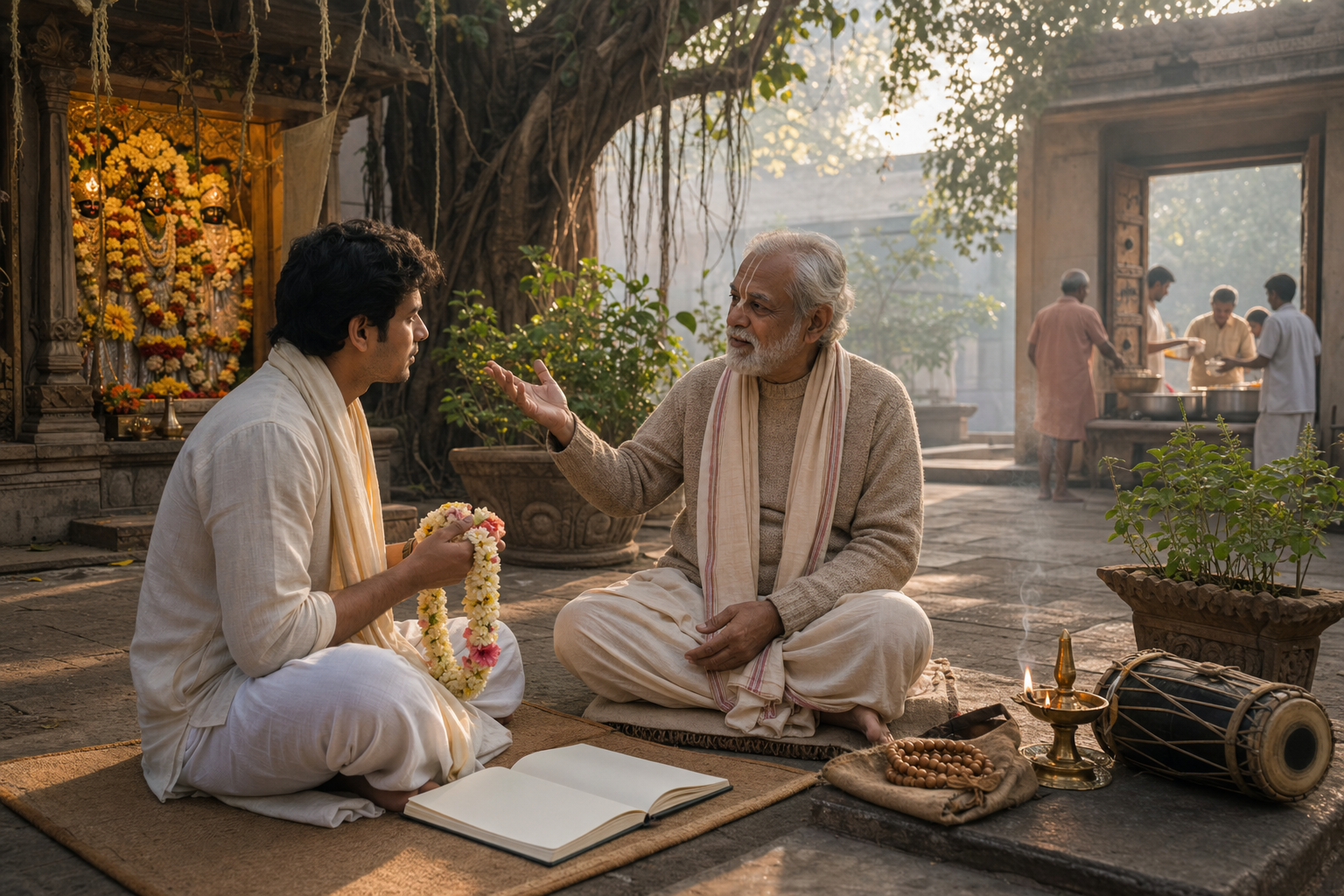
The word bhakti does not erase theology. Two devotees may both sing Krishna’s name while understanding the devotee, the world, divine grace, and even the purpose of singing in different ways. Begin with questions that let a tradition speak in its own vocabulary.
| Question | What to notice | Why it matters in practice |
|---|---|---|
| Who is approached? | Narayana together with Sri, Krishna in Braj, or Radha and Krishna | The answer shapes the names, sacred stories, iconography, and form of worship that organize devotion. |
| Which relationship is cultivated? | Refuge and service, parental affection, friendship, sweetness, or reciprocal divine love | Bhava is not decorative emotion. It trains how the devotee attends, remembers, serves, and surrenders. |
| How is grace received? | Through prapatti, compassionate mediation, intimate seva, or loving reciprocity | The same outward act can function as surrender, hospitality, remembrance, or participation in lila. |
| What sustains the relationship? | Mantra, sacred recitation, temple worship, lila poetry, music, kirtana, remembrance, and service | A tradition becomes intelligible when you see its recurring rhythm, not merely its most dramatic festival. |
Use these questions the next time you visit a temple, haveli, or satsang. Notice the principal form on the altar. Listen for the names in the mantra or song. Ask what the community means by surrender or seva. Observe what happens after the singing: recitation, food offering, teaching, care for guests, or another form of service. You do not need to debate metaphysics at the doorway, but you should understand what the community believes it is doing.
This method prevents two opposite mistakes. The first is sectarianism: assuming that a difference in mantra, language, or ritual makes another Vaishnava path spiritually alien. The second is careless universalism: declaring every path identical before learning what any of them teaches. Respect begins when family resemblance and real difference are both allowed to stand.
Three traditions train three disciplines of relationship
Sri Vaishnava bhakti: surrender becomes kainkaryam
Sri Ramanujacharya, traditionally dated 1017-1137 CE, gave systematic expression to Vishishtadvaita Vedanta while sustaining a devotional world of scripture, temples, teachers, and service. Vishishtadvaita distinguishes Ishvara, chit, and achit while holding sentient beings and insentient reality in an inseparable relation to Narayana. Brahman is one without a second, but this unity does not make the devotee or the world unreal.
That philosophical distinction changes the meaning of surrender. The individual does not vanish into an undifferentiated absolute. The devotee remains real, dependent, loved, and capable of service. Sri, understood as Lakshmi, occupies a compassionate mediating place, while bhakti-yoga and prapatti, or sharanagati, orient the person toward Narayana. Kainkaryam is the practical consequence: surrender finds visible form in service.
If this path attracts you, begin where its philosophy and worship meet. Learn the meaning and pronunciation of Om Namo Narayanaya from a knowledgeable practitioner. Hear a Divya Prabandham hymn in its original language and follow it with a faithful translation. Pay attention to guru-parampara remembrance instead of treating the teacher lineage as a decorative preface. Then accept a modest, dependable form of temple or community service.
For conceptual study, an accessible passage from Vedartha Sangraha can introduce Ramanuja’s larger vision before you attempt the more technical arguments of Sri Bhashya. The Bhagavad Gita Bhashya helps connect philosophical terms to devotional action. The aim is not to collect difficult vocabulary. You should be able to explain why dependence on Narayana produces responsibility rather than passivity.
Prapatti is easily misunderstood when surrender is reduced to waiting for divine intervention. In Sri Vaishnava life, refuge and service belong together. If your idea of surrender excuses neglect, indifference, or contempt for another person, it has become detached from kainkaryam.
Surdas and Pushtimarg: enter Krishna’s lila through song
Surdas brought Krishna bhakti into an intimate Braj register. Common chronologies place him in the late fifteenth to early sixteenth centuries, while details of his early life remain variable in traditional memory. His Braj Bhasha padas draw the listener into the sacred geography of Yamuna, Gokul, Vrindavan, and Govardhan, where Krishna is encountered through Yashoda, Nanda, Radha, the gopas, and the gopis. Vatsalya, sakhya, and madhurya become ways of learning devotion through parental affection, friendship, and sweetness.
The important word here is learning. Bhava is not an excuse to manufacture intense emotion. A Surdas pada gives attention a form: a speaker, a scene, a relationship, a gesture, and a change of feeling. By repeatedly entering that form through recitation or music, the devotee learns to notice Krishna’s presence with greater tenderness and concentration.
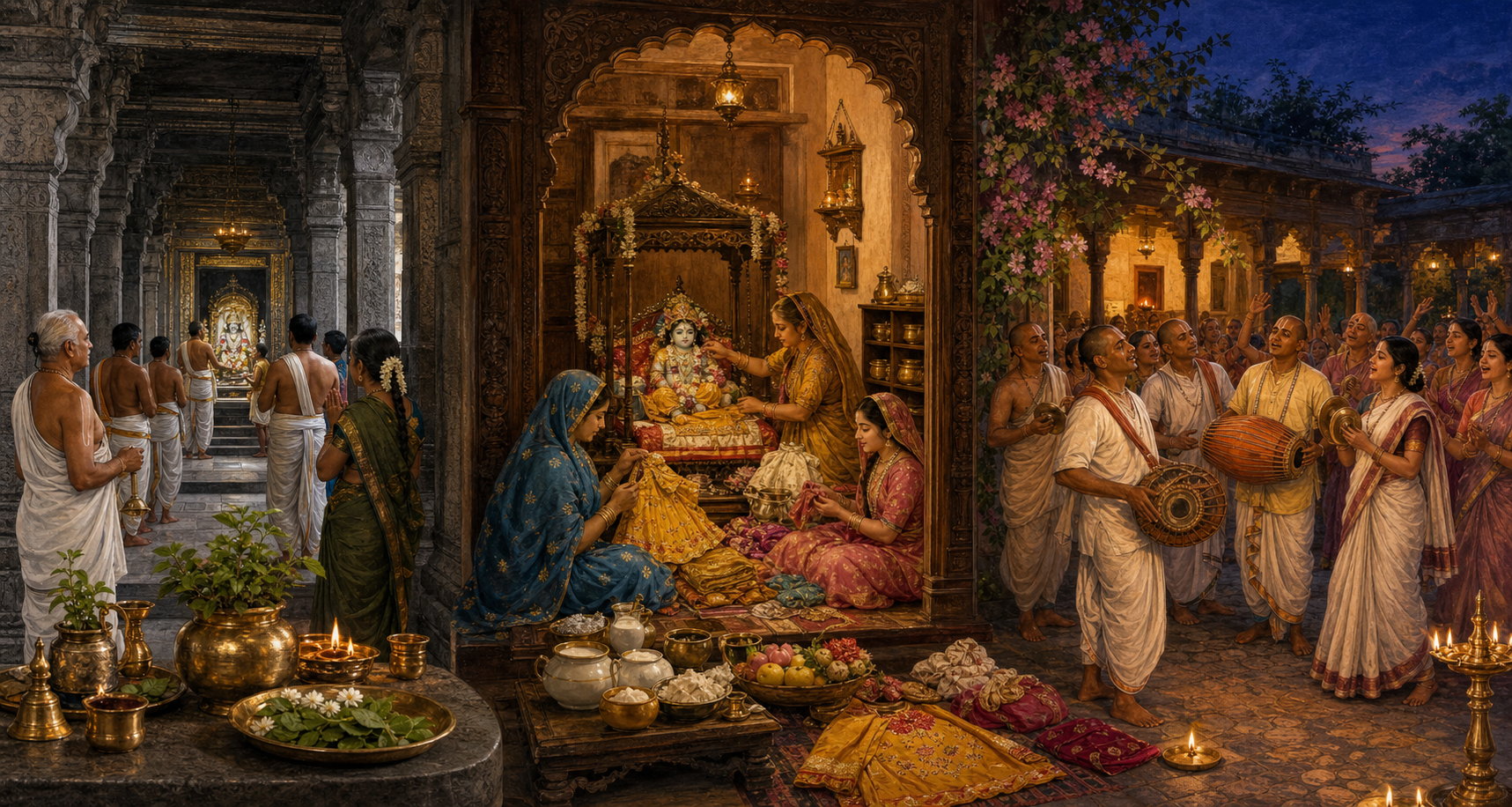
Traditional accounts closely associate Surdas with Vallabhacharya’s Pushtimarg and the Ashtachap circle of poet-musicians. In Pushtimarg havelis, devotional music accompanies the rhythms of seva, so a song is not simply a performance about Krishna. It participates in attending to Krishna. Food, clothing, music, darshan, and the timing of worship belong to a relationship of loving hospitality.
You can use a pada contemplatively without pretending to possess its bhava. First identify who is speaking and to whom. Locate the scene in Braj. Notice whether the governing relationship is maternal, friendly, or marked by devotional sweetness. Recite or hear the composition attentively, then remain quiet long enough to name what it asks you to relinquish: haste, control, indifference, or self-importance. Complete the practice with an act of care that fits the mood you contemplated.
There is also a textual caution worth observing. Sursagar, Sur Saravali, and Sahitya Lahari have passed through diverse manuscripts and editorial histories, so available compilations can differ in contents and sequence. For worship, use the edition and musical lineage trusted by the community in which you are learning. For literary or historical claims, acknowledge variant transmission instead of assuming that every poem in a modern collection has an uncontested attribution.
Gaudiya Vaishnavism: intimacy without erasing difference
Gaudiya Vaishnava theology places the reciprocal love of Radha and Krishna at the center. Krishna is the inexhaustible object and reciprocator of devotion, while Radha embodies the summit of divine love and the delight-giving potency, or hladini-shakti. Acintya-bheda-abheda describes an inconceivable simultaneous oneness and difference between the Divine and the devotee. The teaching safeguards intimacy without collapsing the devotee into Krishna, and transcendence without making Krishna unreachable.
This matters because prema-bhakti is mature devotion, not simply strong religious feeling. A moving kirtan may awaken attention, gratitude, or longing, but intensity during music is not by itself the measure of prema. Bhagavad Gita 10.10 presents divine guidance as reciprocal: loving service receives a response from the Divine. The devotee therefore cultivates availability to grace through sustained remembrance and service.
Hearing, communal chanting, remembrance, worship, prayer, humble service, friendship, and self-offering give this relationship practical form. Each discipline works on a different part of the person. Hearing corrects what the mind assumes. Chanting gathers scattered attention. Remembrance carries devotion beyond the gathering. Service exposes the desire for recognition. Self-offering confronts the instinct to keep the Divine at a safe distance.
When you join kirtan, begin by listening. Follow the leader’s response rather than trying to dominate the sound. Pronounce the Divine Names attentively. Notice when the mind shifts from prayer to performance, comparison, or self-display, and return to the Name. Afterward, carry one remembered Name into a concrete duty. The important transition is not from a quiet chant to a louder one; it is from chanting in the sacred space to remembering Krishna when patience and humility are actually required.
Let shared dharmic ethics clarify rather than flatten
Vaishnava traditions disagree about real philosophical questions. Those disagreements should not be hidden behind the claim that every path is saying exactly the same thing. Yet doctrinal distinction does not require hostility. The Bhagavad Gita places equal vision and compassion inside the discipline of yoga: 5.18 addresses equal regard across social difference, 6.29 sees the Self in all beings, 6.32 asks the yogi to understand others through oneself, and 12.13-14 joins devotion to compassion and forbearance.
Equal vision does not mean pretending that every action is equally dharmic. Nor does forgiveness eliminate accountability. It means that disagreement does not cancel another being’s dignity. A person devoted to Narayana or Krishna should become less willing to dehumanize an opponent, exploit the vulnerable, or use theology as permission for contempt.
This ethical movement places Vaishnava bhakti in a wider dharmic neighborhood. Buddhist metta and karuna cultivate goodwill and compassion. Jain ahimsa and aparigraha discipline harm and possessiveness. Sikh teaching brings Ik Onkar, simran, and seva into a life of remembrance, equality, and service. These are genuine resonances, but they are not interchangeable metaphysical claims. Respect does not require calling anatta, Vishishtadvaita, Jain teachings about the jiva, and devotion to Ik Onkar different words for one doctrine.
If you are organizing a gathering across dharmic traditions, use a simple protocol:
- Let each community name its own practice, Divine referent, and purpose. Do not translate everything into vague language about energy or spirituality.
- State common ground at the ethical level where it is real: non-harm, compassion, truthful conduct, disciplined remembrance, or service.
- Name a difference without ranking the participants. A clear sentence about distinct views builds more trust than a ceremonial claim that everyone believes the same thing.
- Complete the gathering with a shared responsibility. Suitable forms include annadanam, support for learning, care for elders or animals, or environmental work around a local water body.
- Allow each tradition to reflect on that service in its own vocabulary. Cooperation does not require a synthetic theology.
This is where Vasudhaiva Kutumbakam becomes more than a slogan. A family is not composed of identical people, and unity is not produced by suppressing names, histories, or convictions. It is produced by learning how to differ without abandoning responsibility for one another.
Build a practice with roots, rhythm, and service
If you are deciding where to begin, do not start by asking which tradition is best in the abstract. Ask which understanding of divine relationship you are prepared to practice faithfully within a living community. You may learn from several sampradayas, but a daily sadhana needs enough coherence for its words, gestures, and goals to reinforce one another.
- Name your intention. Decide whether you are seeking refuge, learning loving service, cultivating remembrance through lila, or trying to understand a tradition before making any commitment. A clear intention prevents spiritual browsing from masquerading as practice.
- Choose an anchor tradition. Stay with its vocabulary and rhythm until you can explain its central relationship without caricature. Learning broadly remains valuable, but let one lineage teach you how its parts fit together.
- Learn one practice properly. This might be Om Namo Narayanaya in a Sri Vaishnava setting, a Surdas pada taught within its musical and devotional context, or attentive hearing and chanting of Krishna’s Names in a Gaudiya community. If the community treats a practice as requiring initiation or particular guidance, ask rather than improvising.
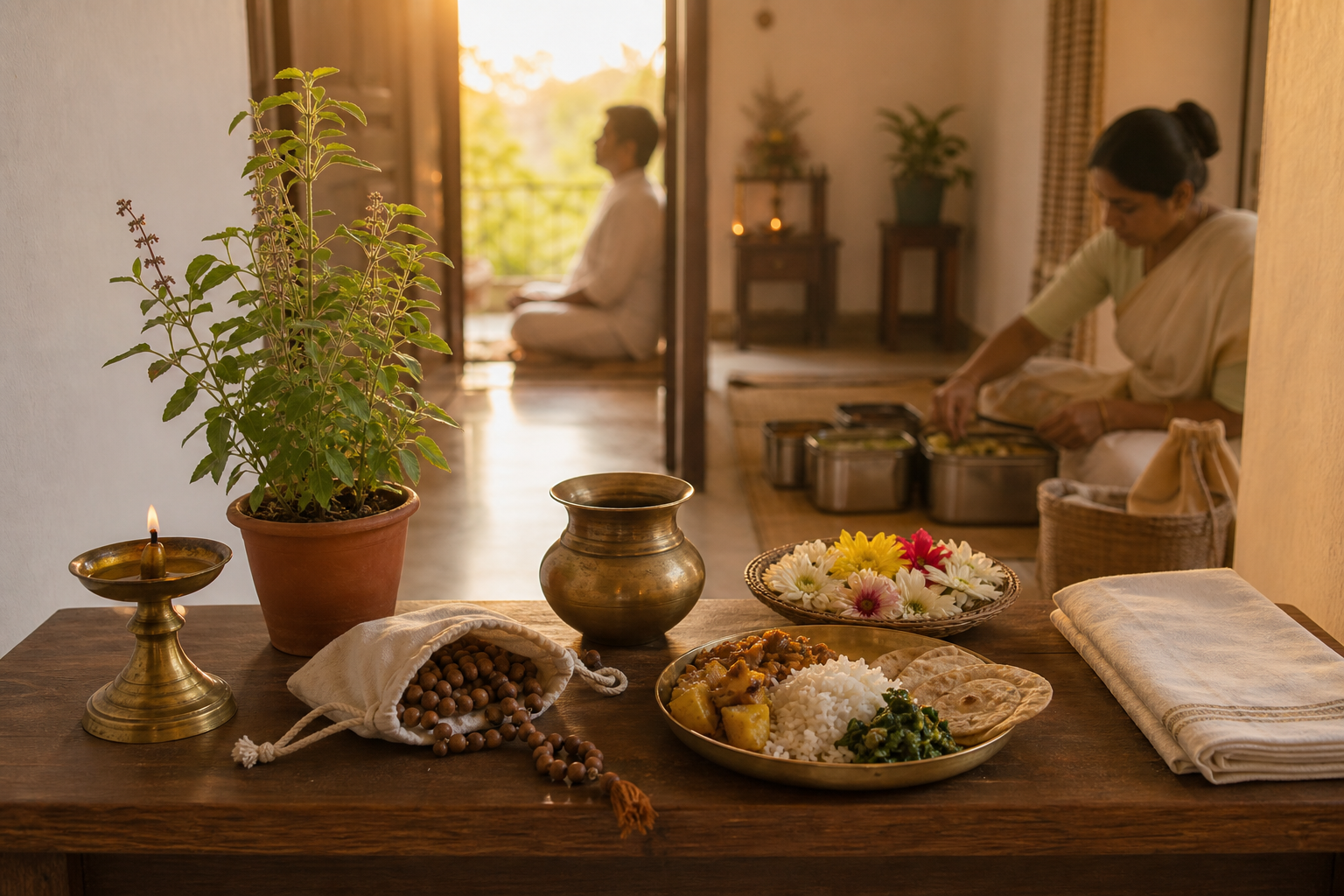
- Give the practice a repeatable place. At a consistent point in your day, begin with a clean space and a deliberate bow, recite or sing what you have learned, read a small connected passage, and sit briefly with its meaning. Consistency matters more than continually adding new material.
- Attach remembrance to service. Choose a duty you can actually fulfill: caring for someone in your household, helping with temple work, sharing food, supporting learning, or serving without public recognition. The service should make your devotional claim answerable to another being’s welfare.
- Review conduct, not mood alone. At the end of the day, ask whether practice reduced contempt, made speech more truthful, strengthened patience, and exposed avoidance of responsibility. A peaceful feeling can be welcome, but it is not a substitute for ethical change.
- Deepen before combining. When another tradition attracts you, first learn how its teachers understand the practice. Do not assume that a familiar word such as grace, surrender, seva, or prema carries exactly the same theological meaning everywhere.
One warning sign is constant expansion: a new mantra, teacher, book, or ritual whenever the current discipline becomes ordinary. Bhakti matures precisely in ordinary repetition. The question is no longer whether the practice feels novel, but whether you can remain attentive, grateful, and service-minded when novelty has disappeared.
Your next move can be small and definite. Visit or contact one living Vaishnava community whose devotional center speaks clearly to you. Ask the four questions, learn one practice in context, and pair it with one dependable act of seva. Judge its depth in your ordinary encounters, not only at the emotional height of a ceremony. Vaishnava traditions do not ask you merely to admire divine love; they train you to become answerable to it.
References
- Dandavats — Love Conquers All: Bhakti’s transforming power, Gita-guided compassion, Dharmic unity
- HinduPad — Sri Ramanujacharya Jayanti 2026: Date, Puja Guide, and the Timeless Vishishtadvaita Legacy
- HinduPad — Surdas Jayanti 2026: Vaishakh Shukla Panchami Date, Puja Traditions, and Bhakti Legacy