
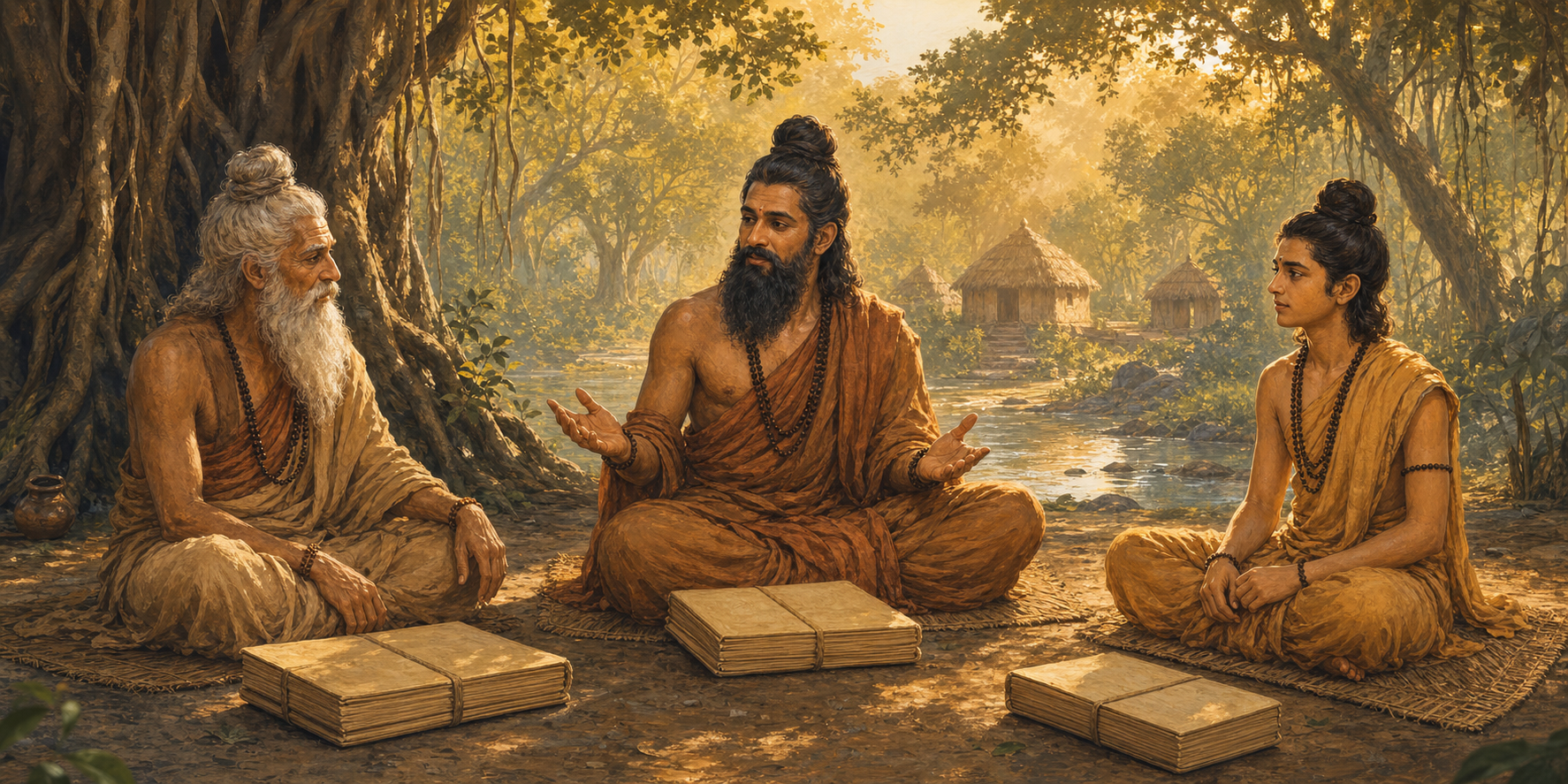
If you are trying to work out how Maharishi Parashara and Muni Shukadeva belong to the same Puranic lineage, one missing name usually causes the confusion: Veda Vyasa. Parashara is Vyasa’s father, while Shukadeva is Vyasa’s son. Parashara is therefore Shukadeva’s grandfather.
That answer is correct, but it is not complete. Puranic lineage runs along two tracks: descent within a family and transmission between a teacher, a listener, and a later narrator. Separate those tracks, and the places of Parashara, Vyasa, Shukadeva, Maitreya, Parikshit, and Suta become much easier to understand.
Start with the five-generation family line
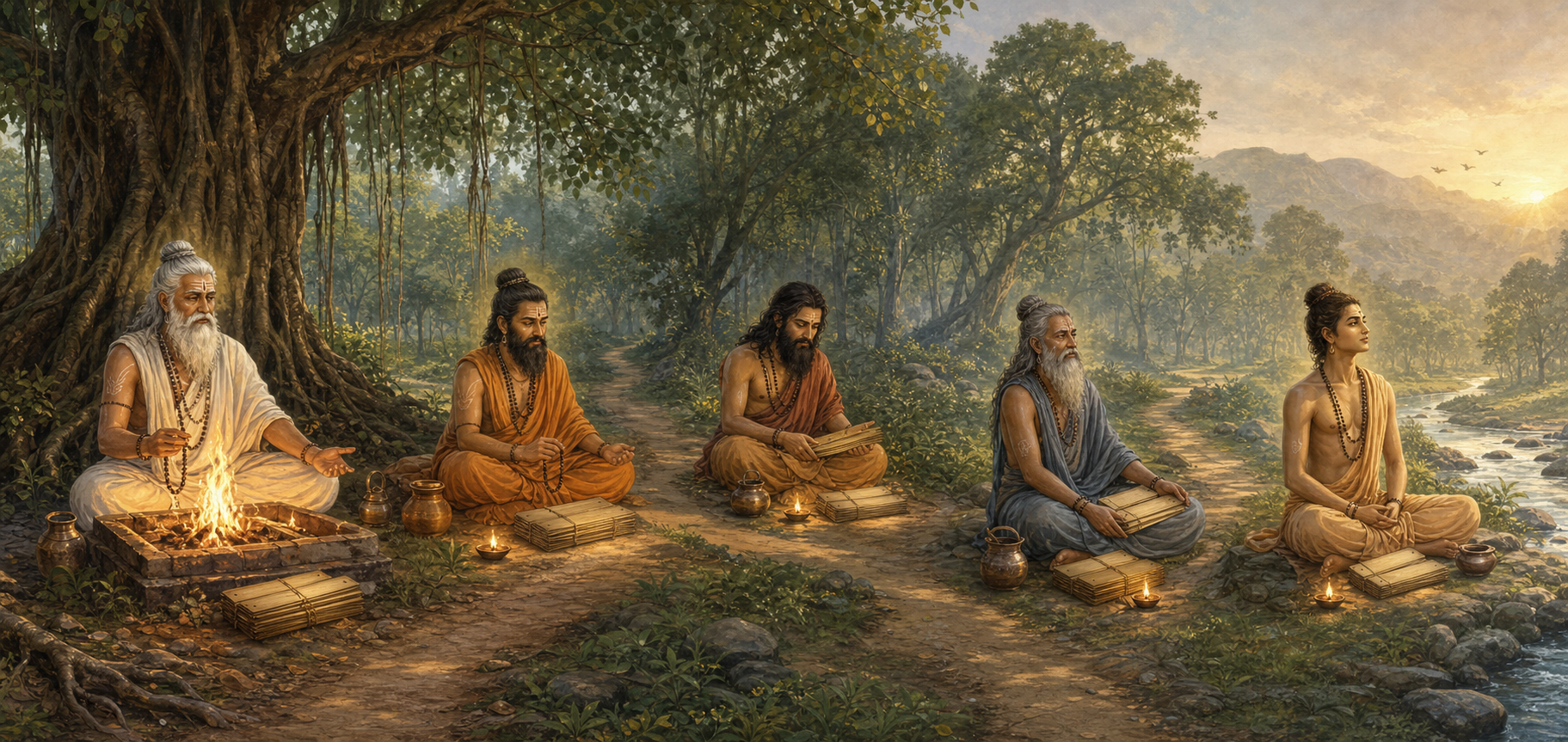
Write the genealogical line first, without adding disciples or audiences:
- Vasistha stands at the ancestral end of this branch of the rishi lineage.
- Shakti is the son of Vasistha and the father of Parashara.
- Parashara is the son of Shakti, the grandson of Vasistha, and the father of Krishna Dvaipayana.
- Krishna Dvaipayana, or Veda Vyasa, is the son of Parashara and the father of Shukadeva.
- Shukadeva is the self-realized son of Vyasa and the grandson of Parashara.
The central relationship is therefore Parashara to Vyasa to Shukadeva. Vasistha and Shakti establish the upstream ancestry. Traditional remembrance places Parashara between Vasistha’s line and Vyasa’s vast scriptural legacy; Shukadeva then carries that inheritance into one of the best-known acts of sacred narration in the Puranic tradition.
Do not place Maitreya, King Parikshit, or Suta into this family tree. They belong to relationships of teaching and narration. Whenever you meet a name in a Purana, ask a precise question: is this connection one of birth, instruction, listening, or retelling? A sage can occupy more than one of those positions, but the positions are not interchangeable.
Two teaching lineages accompany the family lineage
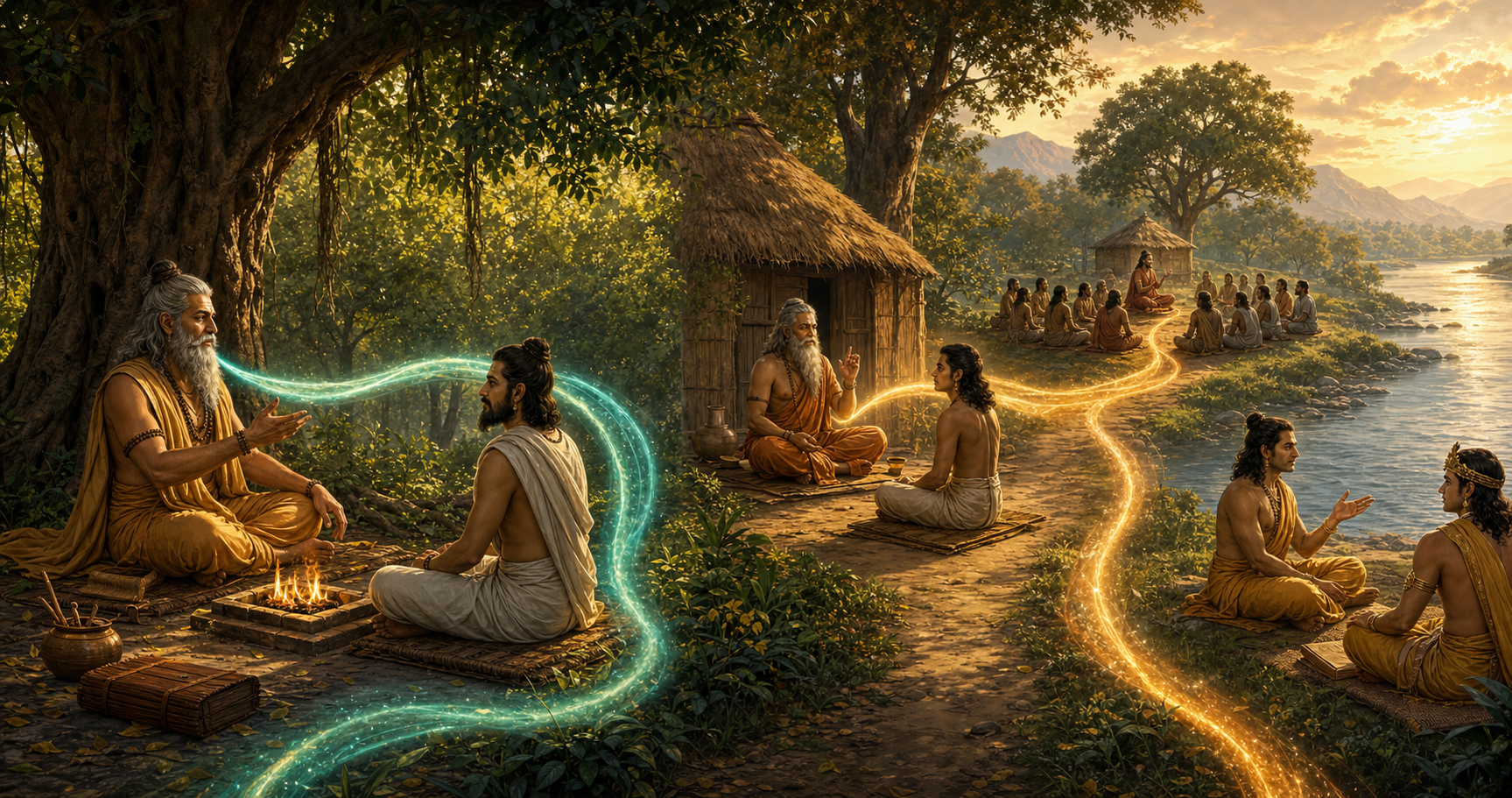
Parashara teaches Maitreya in the Vishnu Purana
The Vishnu Purana presents Parashara as a teacher speaking to his disciple Maitreya. The relevant relationship is therefore Parashara to Maitreya, but this is a guru-shishya connection rather than another step in the family line. Parashara is not merely a relative who prepares the way for Vyasa. He possesses an independent Puranic voice through which cosmology, dharma, devotion, and the ordering of existence are taught.
This distinction matters because Parashara’s name appears across several bodies of knowledge. Along with his dialogue with Maitreya in the Vishnu Purana, tradition associates him with Rigvedic hymnic material, the Parashara Smriti, and the Brihat Parashara Hora Shastra. The same rishi can therefore appear in Vedic, Puranic, dharmashastric, and jyotisha settings. When reading the Vishnu Purana, begin with the role the text gives him there: he is the speaking teacher, and Maitreya is the receiving disciple.
Traditional attribution and modern manuscript history also answer different questions. Parampara remembers Parashara as the originating seer, while surviving works can contain layered redactions, regional recensions, and later additions. You do not have to discard either fact. Honor the traditional attribution without assuming that every surviving line must have been written by one hand at one historical moment.
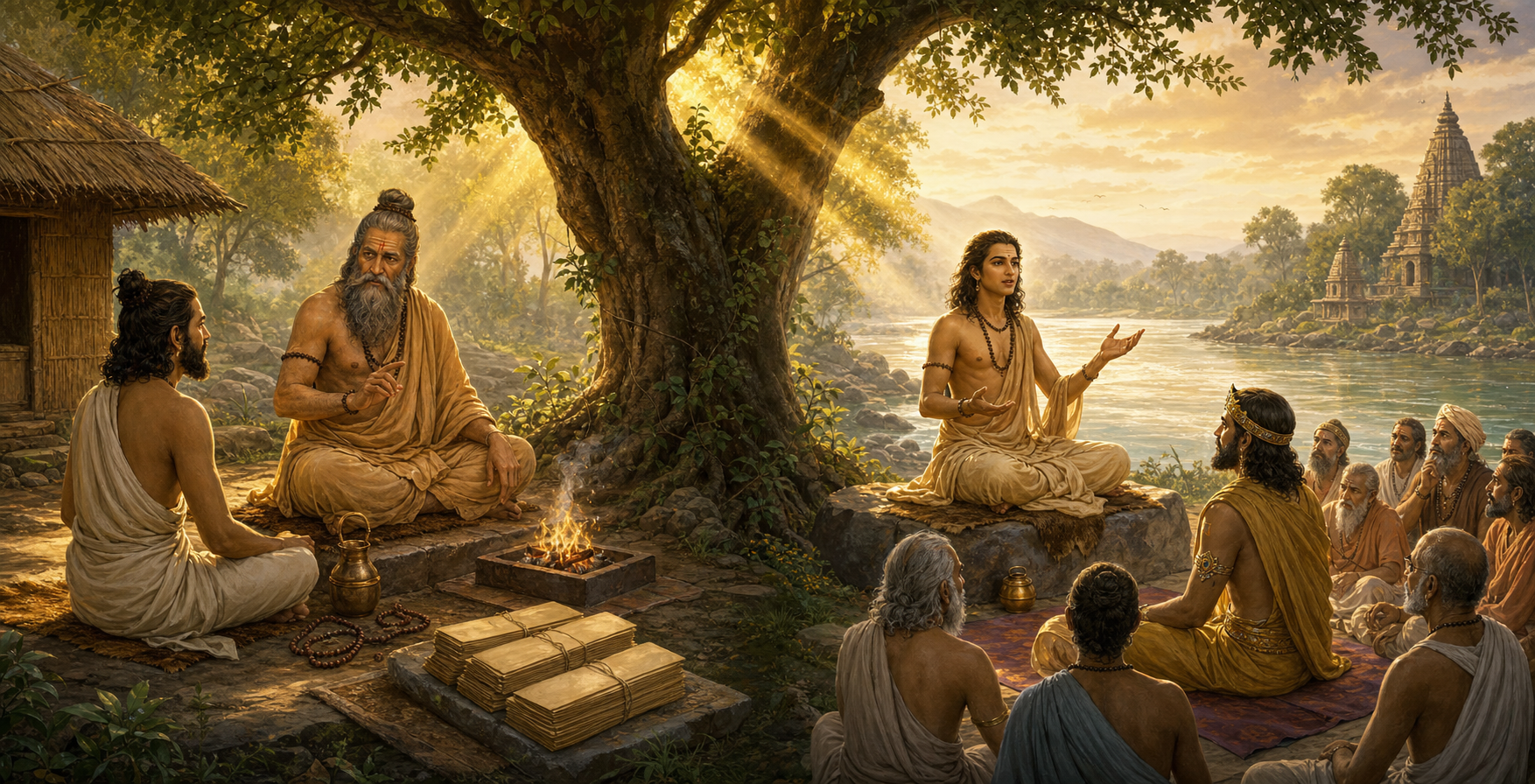
Shukadeva teaches Parikshit within the Bhagavata’s narrative frame
Shukadeva occupies a different Puranic setting. He is the principal narrator of the Bhagavata Purana, delivering its teaching to King Parikshit during a seven-day discourse on the bank of the Ganga. His position in the family tree comes from Vyasa, but his position in the Bhagavata comes from speaking realized wisdom to an attentive listener.
The Bhagavata’s transmission has two narrative levels that should not be collapsed:
- The inner discourse: Shukadeva addresses King Parikshit and brings devotion, knowledge, and dispassion into one teaching.
- The outer retelling: Suta recounts Shukadeva’s discourse at Naimisharanya, carrying it to another gathering of seekers.
This gives you a practical rule for reading the Bhagavata: identify both the immediate speaker and the surrounding narrator. A passage may preserve Shukadeva’s instruction to Parikshit while appearing inside Suta’s retelling. Calling every voice simply “the narrator” erases the architecture through which the teaching reaches successive audiences.
Shukadeva’s celebrated renunciation is also part of that architecture. He is remembered as a parama-hamsa, spontaneously detached from social markers, praise, blame, and ordinary possessiveness. Yet detachment does not leave him silent or indifferent. His inner freedom becomes compassionate teaching. The recluse enters a relationship of responsibility precisely because another person is ready to hear.
What Parashara and Shukadeva contribute to the lineage
Placing the two sages side by side clarifies their roles without turning them into rivals or interchangeable names.
| Question | Parashara | Shukadeva |
|---|---|---|
| Where does he stand in the family? | Son of Shakti, grandson of Vasistha, and father of Vyasa | Son of Vyasa and grandson of Parashara |
| What is his principal Puranic conversation here? | Teacher of Maitreya in the Vishnu Purana | Teacher of Parikshit in the Bhagavata Purana, with the discourse later recounted by Suta |
| What spiritual profile does he represent? | A rishi whose legacy joins revelation, systematic inquiry, dharma, and applied knowledge | A realized renunciant whose narration joins bhakti, jnana, and vairagya |
| What should you notice while reading? | How sacred knowledge is ordered, interpreted, and applied through a teacher-disciple dialogue | How hearing sacred teaching can turn urgency into disciplined devotion and freedom from fear |
The table marks emphasis, not opposition. Parashara should not be reduced to astrology, even though Parashari jyotisha remains an influential part of his legacy. Shukadeva should not be reduced to an eccentric image of an unclothed wanderer, even though radical non-attachment defines his remembered life. The Puranic role of each sage is relational: Parashara teaches Maitreya, and Shukadeva teaches Parikshit.
Nor should Parashara be assigned to reason while Shukadeva is assigned to devotion. Parashara’s inheritance joins inquiry with reverence. Shukadeva’s Bhagavata teaching makes devotion inseparable from discernment and dispassion. Both figures resist the modern habit of choosing between disciplined thought and spiritual commitment.
Key takeaways for reading the lineage correctly
- The genealogical line is Vasistha to Shakti to Parashara to Vyasa to Shukadeva. Parashara is Shukadeva’s grandfather, with Vyasa connecting them.
- The Vishnu Purana follows a teaching relationship: Parashara speaks to his disciple Maitreya. Maitreya belongs in the guru-shishya map, not the family tree.
- The Bhagavata Purana uses layered narration: Shukadeva teaches Parikshit, and Suta later recounts that discourse at Naimisharanya.
- Genealogy does not by itself settle textual authorship. Paramparic attribution identifies an originating authority, while manuscript history can still contain layers and regional recensions.
- Lineage transmits more than ancestry. Its authority is carried through realization, disciplined listening, accurate recollection, and renewed teaching.
Study the lineage with two maps, not one list
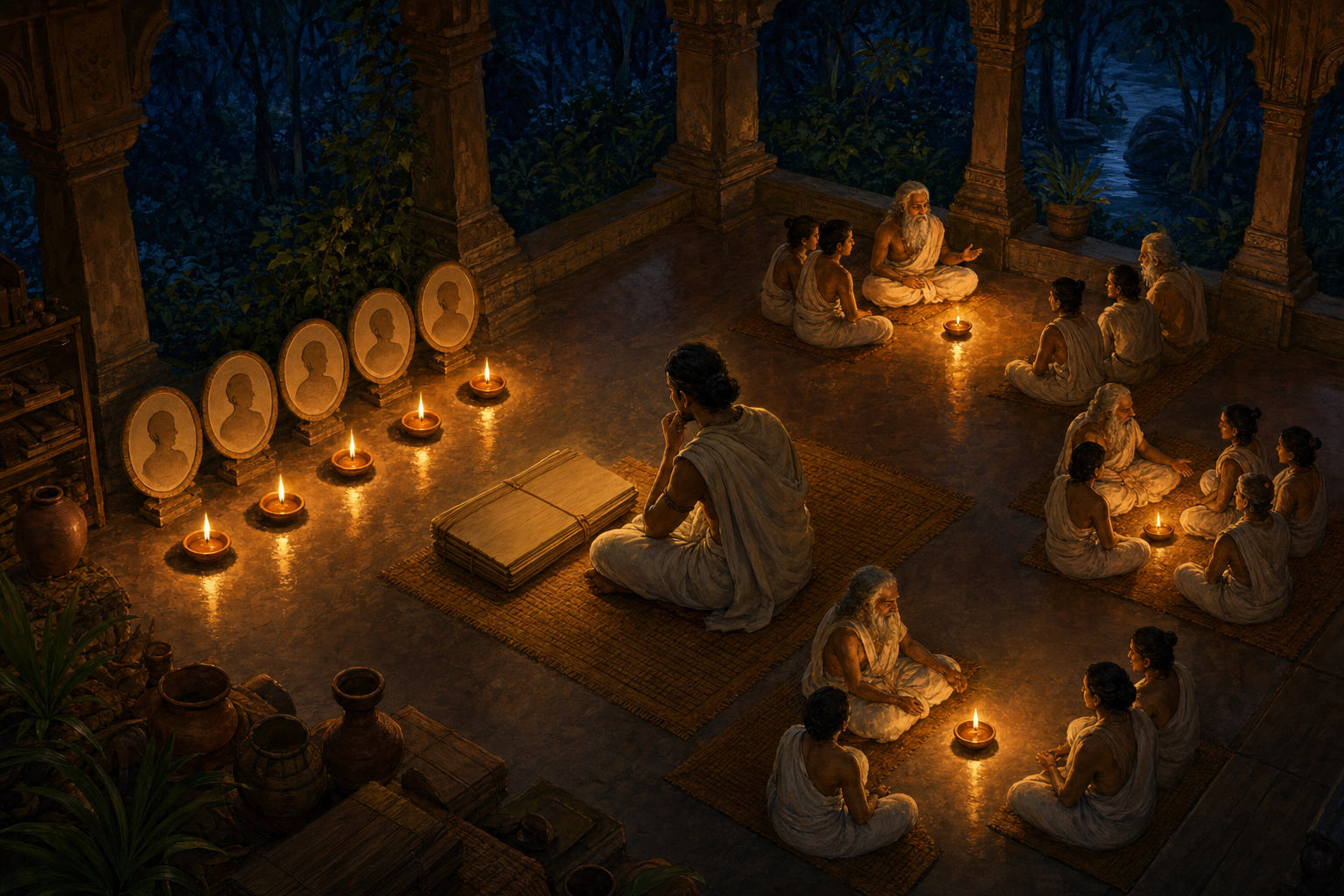
You can turn this structure into a simple study practice the next time you open either Purana:
- Make a family column. Write Vasistha, Shakti, Parashara, Vyasa, and Shukadeva in descending order. Do not add anyone merely because that person appears in the same sacred narrative.
- Make a transmission column. Under the Vishnu Purana, write Parashara as teacher and Maitreya as disciple. Under the Bhagavata, distinguish Shukadeva’s discourse to Parikshit from Suta’s retelling at Naimisharanya.
- Read for the relationship as well as the doctrine. In the Parashara-Maitreya dialogue, notice how questions organize knowledge. In the Shukadeva-Parikshit dialogue, notice how attentive hearing holds bhakti, jnana, and vairagya together.
- Label attribution carefully. When discussing Parashara’s wider textual legacy, distinguish what tradition attributes to the rishi from claims about the formation of surviving manuscripts.
- Record what is being transmitted. Note whether a passage carries cosmology, ethical duty, devotional remembrance, discernment, renunciation, or several of these at once. This keeps parampara from becoming a bare succession of famous names.
Use the consecutive 2026 Jayantis as a study sequence
The 2026 calendar offers an unusually clear way to contemplate both ends of this relationship. Shukadeva Jayanti falls on 17 April 2026, followed by Parashara Jayanti on 18 April 2026.
- On 17 April: read or hear a selected Bhagavata passage, undertake japa of “Om Namo Bhagavate Vasudevaya,” and focus on Shukadeva’s union of realization, renunciation, and service through teaching.
- On 18 April: read from the Vishnu Purana’s Parashara-Maitreya dialogue, undertake japa of “Om Parasharaya Namah,” and reflect on knowledge as a responsibility transmitted through disciplined instruction.
Shukadeva Jayanti is associated with Amavasya, identified as Vaishakh Amavasya in the North Indian Purnimanta system and Chaitra Amavasya in Amavasyant calendars. Parashara Jayanti follows on Vaishakh Shukla Pratipada. Because observance depends on the tithi prevailing at local sunrise rather than civil midnight alone, use a trusted regional panchanga for your location.
At your next Purana reading, draw a family arrow in the margin and a separate teaching arrow beside the speaker. That small discipline will keep every rishi, disciple, king, and narrator in the right relationship. More importantly, it will let you encounter parampara as living transmission: wisdom received with attention, embodied with integrity, and passed onward when another person is ready to hear.
References
- HinduPad — Muni Shukadeva Jayanti 2026: Sacred Date, Ritual Guide, and Timeless Bhagavata Wisdom
- HinduPad — Maharishi Parashara Jayanti 2026: Date, Vedic Legacy, Observance Guide and Dharmic Unity