

You may be asking a blunt question: if dharma declines from one yuga to the next, does the moral law weaken too? And when a person dies, is the karmic account closed?
The useful answer is no on both counts. A yuga changes the conditions under which you choose; it does not suspend cause and consequence. Death changes embodiment; it does not automatically erase the tendencies, intentions, and unfinished momentum associated with the jiva. Once you separate cosmic order, personal duty, karmic causality, and historical time, the doctrine becomes a guide to action rather than a reason for fatalism.
Four ideas that should not be collapsed into one
Many apparent contradictions disappear when four related terms are assigned different jobs. Rta describes the underlying order that makes a coherent cosmos possible. Dharma is right participation in that order under concrete circumstances. Karma is the causal continuity created by action, intention, and cultivated disposition. A yuga is the wider moral and historical environment in which beings act.
| Idea | The question it answers | What it does not mean |
|---|---|---|
| Rta | What makes reality ordered rather than arbitrary? | That nature must conform to personal wishes or preserve every human achievement. |
| Dharma | What is the right way to participate in that order here and now? | That the same outward action is right in every role and circumstance. |
| Karma | What consequences and tendencies follow from willing, acting, and becoming? | That every misfortune can be decoded as a visible punishment. |
| Yuga | What conditions make dharmic perception and action easier or harder? | That a troubled age cancels responsibility or grants permission for adharma. |
The sequence matters. Rta is the encompassing order. Dharma is how you align yourself with it. Karma is what your alignment or misalignment sets in motion. The yuga supplies the surrounding pressure: the habits, institutions, conflicts, and spiritual atmosphere within which you must discern your duty.
This is why the familiar excuse, “These are bad times, so clean conduct is unrealistic,” fails in Dharmic terms. A difficult yuga may make truthfulness costly, restraint unfashionable, or attention fragmented. Those conditions increase the need for discernment; they do not make deception, cruelty, or heedlessness consequence-free. The age affects the test. It does not rewrite the law by which an answer bears fruit.
Death changes the vehicle, not the moral continuity

A common Vedantic account distinguishes the physical body from subtler layers of mind, prana, senses, impressions, and causal potential. At death, the gross body returns to the elements while the subtle and causal bodies accompany the jiva onward. The Bhagavad Gita’s image of changing worn garments conveys the essential point: bodily death is a transition within samsara, not necessarily the destruction of conscious continuity.
The threefold account of karma makes that continuity easier to understand:
- Sanchita karma is the accumulated field of past karmic potential that has not yet fully borne fruit.
- Prarabdha karma is the portion already operative in the present embodiment and its circumstances.
- Agami karma is the new momentum generated by what you choose and cultivate now.
These categories are explanatory, not diagnostic. They help account for continuity across lives, but they do not give you access to another person’s invisible history. You cannot look at illness, poverty, bereavement, persecution, or good fortune and confidently reconstruct a previous birth. Prarabdha is not a warrant for blaming someone who suffers, and karma is not a substitute for compassion, justice, or practical help.
Death also does not make every accumulated consequence arrive at once. Puranic accounts place Yama Dharma and Chitragupta within an imagery of impartial moral reckoning. Svarga and naraka are generally presented as conditioned and temporary experiences in which particular karmic results mature, not as two eternal destinations from which no further movement is possible. When those results are exhausted, rebirth may continue according to remaining momentum and vasanas.
Moksha is therefore more than admission to a pleasant postmortem realm. It is freedom from compelled return. The traditions differ over how that freedom should be described. Advaita Vedanta emphasizes knowledge of nonduality and allows for liberation while living, followed by freedom from rebirth at bodily death. Vishishtadvaita and Dvaita emphasize loving relation with the Divine, surrender, bhakti, and a liberated destination such as Vaikuntha. Smarta practice can integrate knowledge, devotion, disciplined action, and yoga. The shared practical point is that merit can improve conditions within samsara, while liberation ends bondage to the cycle itself.
The final orientation of the mind matters, but it should not be treated as a last-minute password. Antima-smriti is shaped by repeated attention. A mind trained for years in resentment, distraction, or possessiveness cannot safely assume that clarity will appear on command at death. Daily remembrance, mantra, prayer, meditation, seva, and ethical restraint matter because they make a certain direction of consciousness familiar.
What this means when someone dies
When death enters your family, do not turn karma into an accusation or use metaphysics to suppress grief. Perform the duties that actually belong to the living. Antyeshti returns the physical body to the elements with dignity. Shraddha, pinda-dana, tarpana, and observances during Pitru Paksha express continuing gratitude and responsibility toward the departed within the Hindu ritual world.
Exact rites vary by region, lineage, family custom, and the status of the deceased. Follow a knowledgeable acharya or priest rooted in your family’s sampradaya instead of assembling an improvised checklist from unrelated customs. The actionable principle is stable even where procedures differ: accompany the departed with prayer, support the bereaved without judgment, settle duties honestly, and let remembrance deepen the conduct of the living.
The yugas change the pressure, not the standard

Yuga language describes a large-scale change in the visibility and stability of dharma. It explains why righteous action may encounter different degrees of support across cosmic time. It does not imply that Rta periodically stops operating, that karma becomes unreliable, or that everyone born in one age has the same spiritual character.
A yuga is better understood as the moral climate than as an individual verdict. A storm changes what safe navigation requires, but it does not abolish navigation. In the same way, weakened institutions, confused norms, and powerful temptations may require greater vigilance, stronger satsanga, and more deliberate practice. Your surroundings affect what is difficult. They do not choose on your behalf.
Avatara theology sharpens this point. Vaishnava traditions do not ordinarily treat the Supreme as a finite being trapped by personal karma. Yet the avatara acts within the architecture of cosmic order, demonstrating proportion, restraint, reciprocity, and restoration. Bhagavad Gita 4.7-8 places the manifestation of the Divine in relation to the decline of dharma and its re-establishment. Restoration is not portrayed as arbitrary power replacing law; it reveals how rightful power serves order.
What Rama’s ocean and Dvaraka’s ocean actually teach
The maritime episodes at the end of Treta Yuga and Dvapara Yuga make the distinction concrete. Before the passage to Lanka, Sri Rama petitions Samudra and undertakes austerity. When the ocean remains silent, Rama prepares a divine weapon. Samudra then appears, the weapon is redirected, conditions for passage are given, and the causeway is raised. Rightful force is present, but so are petition, self-limitation, and respect for the nature of the element.
At the close of Krishna’s earthly lila, the Yadavas destroy one another and the sea advances over Dvaraka after the city has fulfilled its purpose. The two ocean episodes disclose reciprocity and eventual closure within Rta: nature may cooperate with a dharmic purpose under particular conditions, but no temporary arrangement obliges the cosmos to preserve a city, kingdom, or advantage forever.
It is tempting to turn this arc into a literal debt in which the ocean waited from Treta to Dvapara to collect repayment. That goes further than the narrative warrants. The connection works as a disciplined karmic metaphor, not as a demonstrated transaction between two separate events. Rama’s passage and Dvaraka’s submergence frame a lesson about the lawful use of power, the limits of possession, and the completion of temporal purposes. They do not establish that Dvaraka was punished because the sea once yielded to Rama.
The same discipline should govern historical claims. Marine surveys near Dwarka and Bet Dwarka have documented anchors, masonry, harbor-related remains, and changes in the shoreline across multiple periods. Their dating and relationship to sacred chronology remain debated. Material evidence can illuminate a long relationship between settlement and a changing coast without being forced to prove every detail of an Itihasa narrative.
For you, the immediate lesson is practical. A dharmic project must respect the enduring nature of the field in which it operates. Tapas does not cancel physical limits. Sacred purpose does not justify environmental carelessness. Political power does not make a civilization exempt from consequence. Plan for changing conditions, use force proportionately, and do not mistake temporary cooperation from nature for permanent ownership over it.
Karma should produce responsibility, not victim-blaming
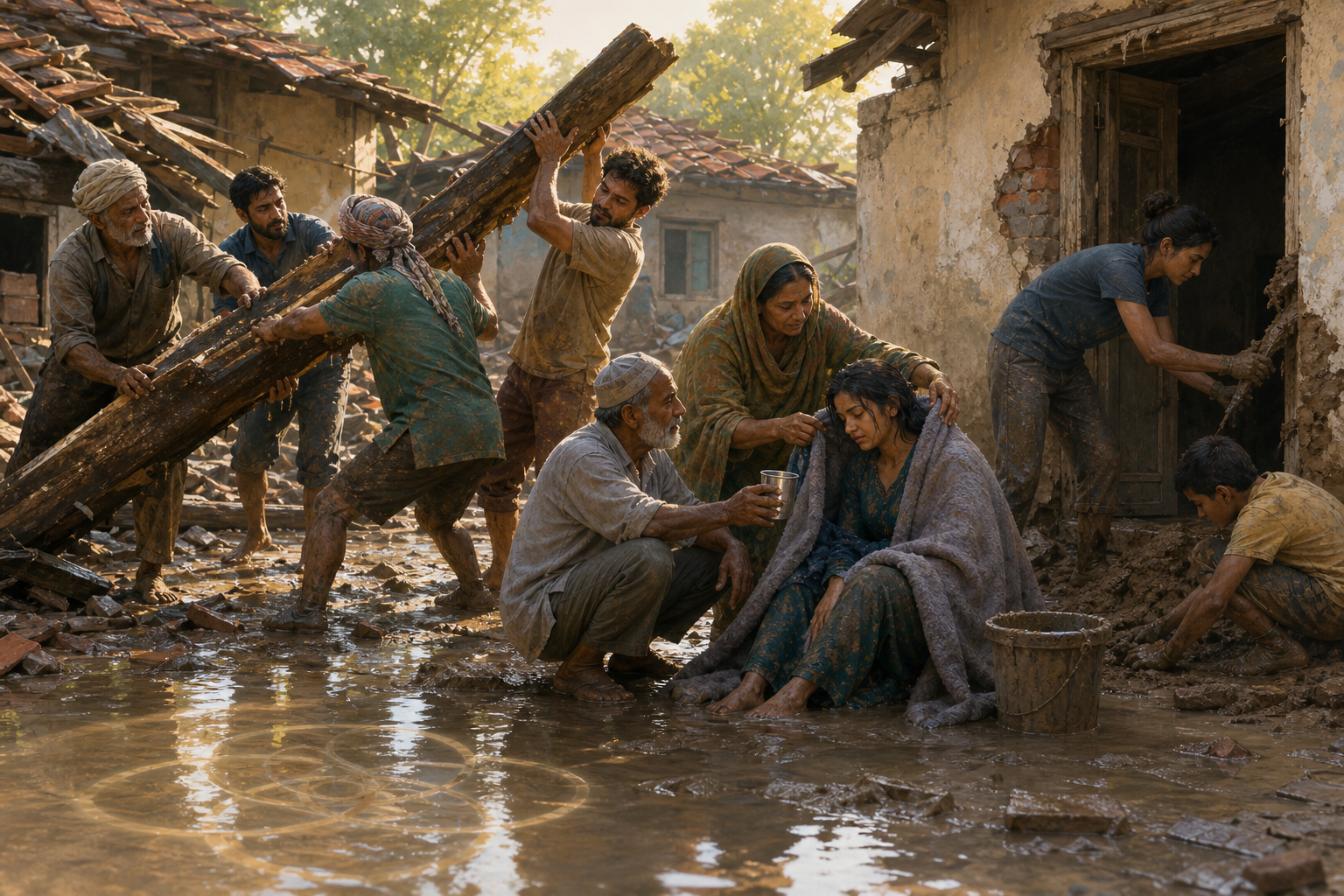
Karma becomes distorted when it is used as a courtroom verdict about someone else’s life. The doctrine asks you to examine your own agency. It does not appoint you as an all-knowing interpreter of another being’s hidden past.
- Do not reason backward from suffering to guilt. An observed result does not reveal the full network of causes behind it. Respond first to the visible duty: protect, feed, comfort, heal, defend, or seek justice.
- Separate visible consequences from metaphysical speculation. If greed produces corruption, pollution, broken trust, or institutional decay, you can identify the causal chain without claiming access to a cosmic ledger.
- Do not use destiny to erase present choice. Prarabdha describes conditions already in motion; agami reminds you that your response is generating new momentum now.
- Treat collective karma with care. Communities clearly inherit the effects of policies, customs, violence, generosity, neglect, and stewardship. That does not justify declaring every disaster a divine punishment or every victory proof of moral superiority.
- Keep doctrinal differences intact. Shared Dharmic vocabulary does not mean every tradition proposes the same metaphysics.
Buddhism affirms karmic causality and rebirth without accepting a permanent atman, placing liberation in nirvana through insight and compassion. Jainism treats karma with a distinctive precision as subtle matter binding the jiva until purification through right faith, knowledge, conduct, ahimsa, and austerity. Sikh thought places human action within hukam and seeks mukti through remembrance of the Divine Name, righteous living, and grace. Their convergence lies in ethical seriousness and the possibility of liberation, not in an interchangeable theory of the soul.
This distinction matters whenever you discuss karma across the Dharmic family. Unity becomes stronger when it is based on accurately understood differences. You can affirm responsibility, restraint, compassion, disciplined consciousness, and liberation as shared commitments without pretending that atman, anatta, karmic matter, and hukam are four names for precisely the same doctrine.
A daily practice for acting within cosmic order

Cosmic time can make personal action feel insignificant. Karma answers that anxiety by bringing the question back to the next intention you strengthen. You do not have to diagnose the yuga before you can practice dharma today.
Before sleep, write one honest sentence under each of these prompts:
- Dharma: What responsibility was actually mine today – a promise, a dependent, a boundary, a professional duty, or a person needing protection?
- Bhava: What intention drove my response? Name fear, vanity, anger, compassion, loyalty, or clarity without disguising it. A good intention does not erase foreseeable harm, but intention still shapes the person you are becoming.
- Effect: What consequence can I already see? Keep this answer observable before speculating about unseen karmic results.
- Vasana: If I repeat this response, what habit will become easier next time? This question catches karma while it is becoming character.
- Correction: What repair belongs to me now? It may be an apology, restitution, fulfilled work, firmer restraint, seva, or dana. Choose a concrete act instead of promising yourself a better personality.
- Orientation: What do I want the mind to remember when control falls away? End with the Divine Name, prayer, mantra, contemplation, or silent awareness appropriate to your path.
This audit joins the scales of the doctrine. The visible consequence belongs to ordinary causality. The strengthened habit becomes a vasana. The corrective act changes agami karma. Remembrance trains the mind whose final orientation will not be manufactured at the last breath. Repeated daily, the practice turns cosmic order from an idea into conduct.
Key takeaways
- A yuga changes the moral environment; it does not switch karma or Rta on and off.
- Death ends the gross body’s present function, but ordinary Hindu accounts place the jiva’s karmic and dispositional continuity beyond that transition.
- Svarga and naraka are conditioned results within samsara; moksha is freedom from compelled rebirth.
- Prarabdha can explain why present conditions are not wholly self-created in this lifetime, but it cannot justify blaming a sufferer.
- Avatara narratives teach action within cosmic order: rightful purpose, proportionate power, restraint, and respect for elemental limits.
- Your safest use of karma is first-person: examine your intention, effect, habit, duty, and needed repair.
Before your next major decision, notice any sentence that begins, “The times are bad, so I have no choice,” or, “Karma will handle it, so I need not act.” Replace it with four questions: What is my duty, what will this choice cause, what habit will it strengthen, and what repair will become harder if I delay? The yuga belongs to the great turning of time. The next karma begins with your response.
References
- DharmaRenaissance Blog – Unveiling the Soul’s Journey: Life After Death in Hinduism, Karma, Yama, Moksha
- DharmaRenaissance Blog – Debt of the Deep: Karma, Rta, and Dvaraka’s Fate from Treta to Dvapara Yugas