
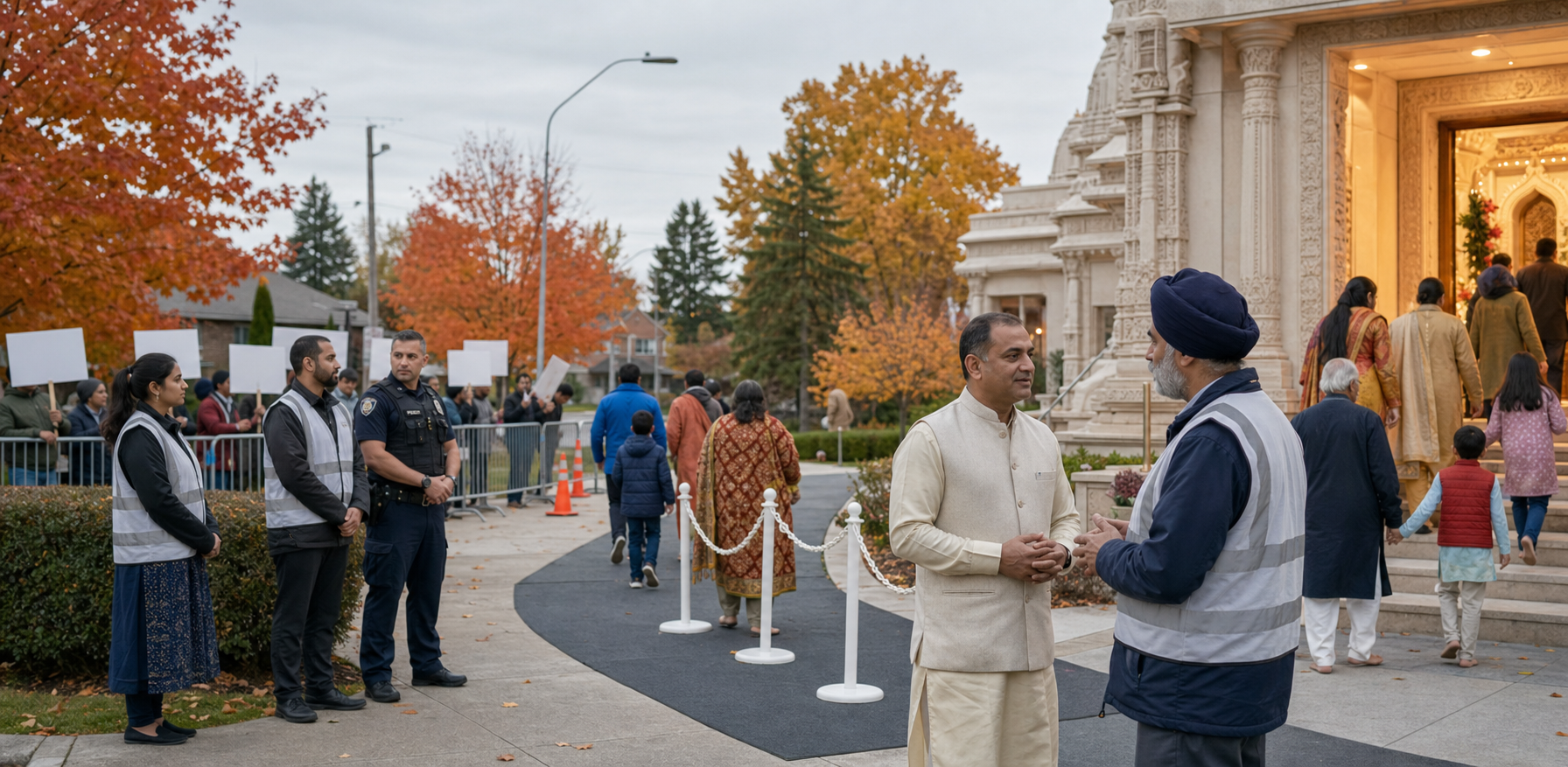
If a protest has been announced outside your mandir, you need two things at once: a credible plan that lets families worship safely, and enough discipline to keep a confrontation with named activists from becoming a conflict between Hindus and Sikhs.
That balance is not a public-relations exercise. It determines whether elders can enter without being surrounded, whether police receive usable evidence, and whether extremists get the communal polarization they came to produce. Here is how temple boards, volunteers, devotees, and Hindu-Sikh community leaders can respond without minimizing the threat or blaming an entire faith.
Read the threat precisely before you respond

On 5 April, coordinated demonstrations involving Khalistan supporters, including people associated with Sikhs for Justice, gathered outside Triveni Mandir in Brampton, Ontario, and Lakshmi Narayan Mandir in Surrey, British Columbia. Although the demonstrations were promoted as protests against the Hindu Canadian Foundation, their placement made mandirs and arriving worshippers the immediate setting of the confrontation.
Police deployed public-order personnel, barricades, controlled access routes, and 100-metre safety buffers. No major injuries were reported during the policing window. That outcome matters because it shows what early coordination can accomplish. It does not mean every protest outside a mandir will receive the same buffer automatically; distance and perimeter decisions depend on the site, expected crowd, access roads, and police assessment.
Your first task is to distinguish disagreement from danger. A political slogan, flag, or criticism of India may be offensive without being a direct threat. Blocking a devotee’s route, surrounding a family, damaging religious property, issuing a threat, pursuing someone to a vehicle, or publishing identifying information alongside hostile instructions creates a different risk. Record the conduct, not merely the viewpoint.
The same precision must govern how you identify the people involved. Sikhs for Justice is proscribed in India under the Unlawful Activities (Prevention) Act, but it is not designated as a terrorist entity in Canada. Its Canadian activities therefore fall under the ordinary rules governing speech, assembly, intimidation, property offences, and public order. Calling every Sikh protester a terrorist is legally careless, factually indefensible, and damaging to the Sikh allies whose support can help protect both mandirs and gurdwaras.
Use the narrowest accurate description: the organization’s name where it is known, the stated purpose of the demonstration, the conduct witnessed, and the location affected. Say “demonstrators blocked the entrance for six minutes” if your records establish that fact. Do not replace evidence with a sweeping label such as “the Sikh community attacked us.” Precision makes a police report stronger and communal retaliation less likely.
Build a layered mandir security plan before the crowd arrives
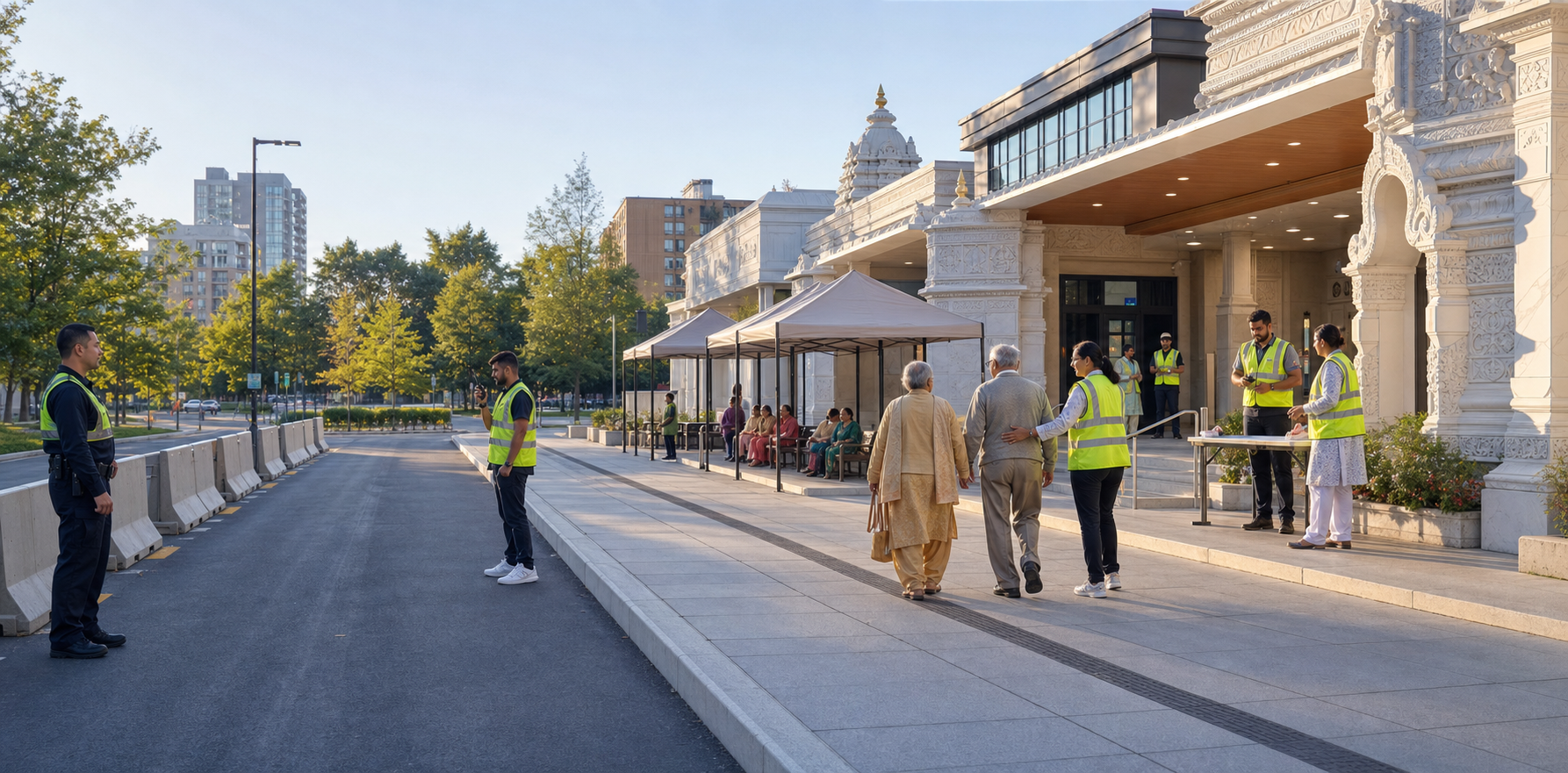
A temple cannot improvise its way through a fast-moving demonstration. As soon as organizers publicly announce one, the board should activate a written plan with three layers: detection, controlled access, and coordinated response. Each layer should still function if another fails.
Detect what is approaching
- Ask police for a named liaison, expected protest boundaries, the planned devotee entrance, and the procedure officers will use if access is obstructed.
- Review camera coverage from the public approach to the building entrance. Check low-light performance, blind corners, recording capacity, the displayed date and time, and whether recordings are duplicated away from the site.
- Monitor public event notices and hashtags for changes in time, location, transport, or declared tactics. Do not ask volunteers to infiltrate private groups or provoke organizers.
- Preserve threats as evidence. Keep the original URL, account name, visible date and time, screenshot, and a short note explaining why the message appeared connected to the temple or event.
- If the temple is considering licence-plate recognition at a vehicle entrance, obtain advice on privacy, retention, signage, and access before deploying it. Collecting more personal data than the temple can lawfully protect creates a second risk.
Delay unauthorized access without trapping worshippers
- Separate the worshipper route from the protest boundary. Mark the entrance clearly enough that a first-time visitor does not wander toward the demonstration.
- Use lighting, open sightlines, visible signage, planters, or properly designed bollards to reduce concealed approach areas and protect pedestrian spaces from vehicles.
- Control doors leading to sanctum, office, nursery, and storage areas while preserving every required emergency exit. Never secure the building in a way that obstructs evacuation.
- Designate a calm interior room for children, elders, and anyone distressed by noise or confrontation. Confirm that the route to it does not cross the public entrance.
- Tell members in advance which door and parking area to use. A short, factual notice is more useful than a dramatic warning that causes families to arrive without understanding the route.
Prepare people to respond
Volunteer marshals are not substitute police officers. Their work is to guide devotees, keep exits clear, observe conditions, relay verified information, and summon professional help. They should not seize signs, debate demonstrators, push people back, or pursue anyone leaving the site.
Assign responsibilities by name before the event: police liaison, marshal coordinator, first-aid lead, family-support lead, evidence custodian, media contact, and board decision-maker. Give every volunteer one reporting channel. Competing message groups create false alarms and make it difficult to distinguish an eyewitness report from a forwarded rumour.
Test the public-address system, radios or phones, exterior lighting, door controls, and camera retrieval process. Place emergency numbers, the police event contact, insurer details, and the temple’s legal contact in the same incident sheet. If an injunction, municipal permit condition, noise restriction, or site-specific exclusion zone may be needed, seek Canadian legal advice early. Do not assume that the 100-metre buffers used in Brampton and Surrey establish an automatic legal entitlement at another property.
On the day, protect access and preserve evidence
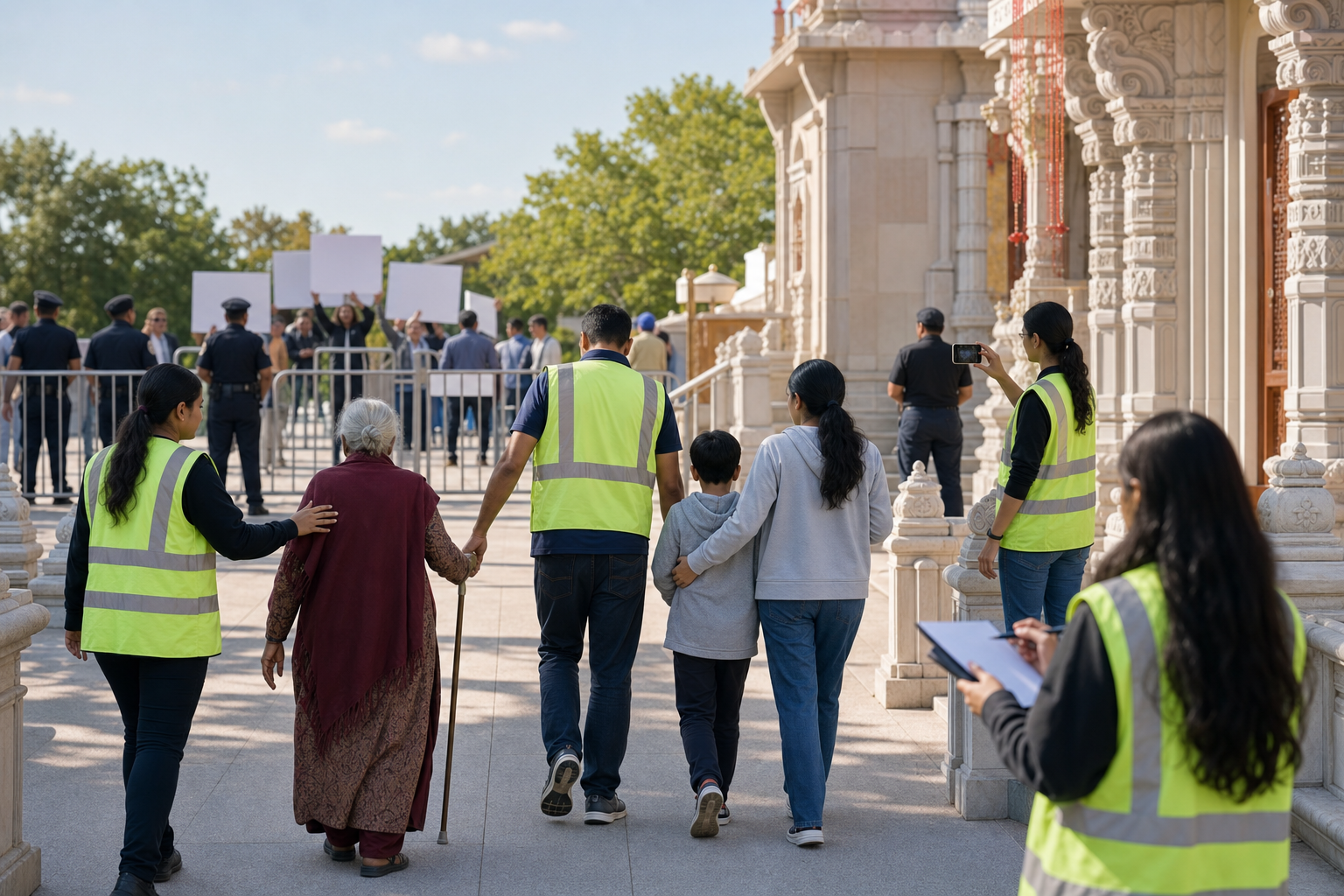
The operational objective is simple: devotees enter and leave safely while lawful demonstrators remain able to express their views within police-imposed conditions. A temple’s plan should make confrontation unnecessary, not help one side win a shouting contest.
- Open the police-agreed entrance before normal footfall begins. Position clearly identified stewards along the whole route, not only at the door.
- Keep children, elders, and mobility-impaired devotees away from the protest-facing edge of the property. Arrange drop-off assistance if the normal parking route has changed.
- Log material events in sequence: time, exact location, conduct observed, people affected, action taken, and the officer or emergency service notified.
- Have one evidence custodian receive original files. Keep unedited recordings, restrict access, and note who copied or transferred them. A viral clip may influence public opinion, but an intact original is more useful to investigators.
- Call emergency services when there is an immediate threat to life or safety. Use the police liaison for developing access, noise, or boundary problems that are serious but not immediate emergencies.
- Issue public updates through one authorized account. State whether worship is continuing, which entrance is open, and what families should do. Do not repeat an unverified threat merely to deny it.
Do not livestream identifiable children, vehicle plates, home addresses, or distressed devotees. Evidence capture and public broadcasting are different jobs. The first preserves information for a legitimate process; the second can expose families to harassment and contaminate a confused situation with incomplete claims.
Volunteers should also know the relevant legal vocabulary without trying to act as lawyers. Canada’s Charter protects expression and peaceful assembly under section 2, while justified limits may be imposed under section 1. Depending on the conduct and evidence, Criminal Code provisions concerning mischief to religious property under section 430, public incitement of hatred under section 319, intimidation under section 423, unlawful assembly under section 63, and hate-propaganda search and seizure under section 320 may become relevant.
Those provisions do not make every hostile slogan or upsetting demonstration a crime. Give police the original words, actions, images, times, and witness details. Let investigators and qualified counsel assess the threshold. Overstating the offence can weaken the temple’s credibility; understating a specific threat can leave people exposed.
After the protest, turn an incident into institutional learning
The crowd’s departure is not the end of the response. Online harassment may continue, frightened families may stop attending, and critical evidence can disappear if no one owns the follow-up.
- Obtain the police occurrence number and provide organized evidence rather than a stream of unrelated screenshots. Identify witnesses who consent to being contacted.
- Ask that the report record the place-of-worship context and any specific indicators of anti-Hindu bias. An accurate classification is important for trend analysis, future security planning, and funding applications.
- Notify the insurer through the required channel, even when visible property damage appears minor. Preserve repair estimates, photographs, invoices, and records of cancelled programs.
- Record operational consequences such as a closed entrance, cancelled class, reduced attendance, volunteer injury, or additional security expense. Do not estimate community-wide harm from impressions when the temple can document its own impact directly.
- Debrief volunteers while memories are fresh. Compare the incident log with video, identify where instructions conflicted, and assign each corrective action to a named board member.
- Review social-media administration. Remove former administrators, enable multi-factor authentication, restrict publishing rights, and preserve threatening messages before blocking or reporting the accounts involved.
Recovery also requires visible human support. Hold a moderated community meeting where the board explains what happened, what remains unverified, how security will change, and where affected devotees can seek counselling or other professional support. Children and adults who experience a hostile crowd at a place of worship may process it as an attack on identity, not just a difficult afternoon. Temple volunteers should listen and refer; they should not attempt to provide mental-health treatment unless professionally qualified.
A public statement should be equally disciplined. Identify the conduct and responsible organization where established, thank those who protected access, request correction of any false claims, and reject reprisals against Sikhs or gurdwaras. This is not softness. It denies extremists the broader communal conflict that gives a local demonstration lasting political value.
Hindu-Sikh unity needs boundaries as well as goodwill
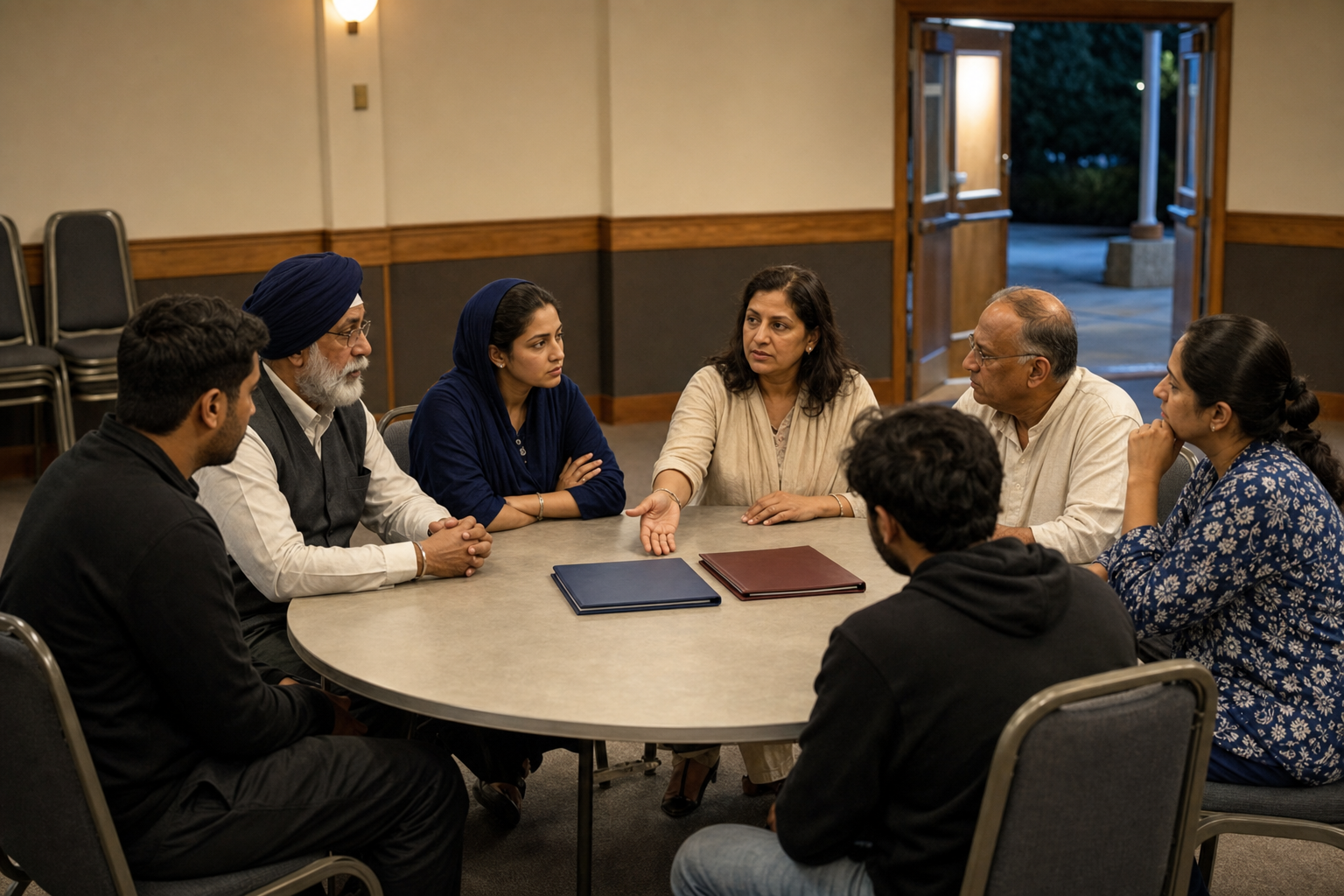
You do not protect Hindu-Sikh relations by pretending intimidation did not happen. You protect them by refusing two false equations: criticism of Khalistani activism is not hostility to Sikhism, and Sikh identity is not evidence of support for Khalistan.
Canada’s Sikh population is religiously, politically, and generationally diverse. Many Sikhs reject threats and violence, while Sikh teachings on seva and sarbat da bhala offer a clear basis for defending every community’s access to worship. Hindu traditions bring the complementary commitments of satya, daya, and ahimsa. Shared Dharmic language becomes useful when it produces shared conduct.
Begin with a narrow agreement that no organization should intimidate worshippers at a mandir or gurdwara. Then make it operational. Hindu and Sikh institutions can name emergency contacts, attend the same worship-site safety training, issue a joint statement when either community is targeted, and arrange reciprocal volunteer support during high-attendance occasions such as Navaratri and Vaisakhi.
The joint statement should not force agreement on Khalistan, the Indian government, or India-Canada relations. Those disputes will not disappear because community leaders share a stage. The useful common ground is local and enforceable: no blocked doors, no threats, no damage to sacred property, no collective blame, and no retaliation against another place of worship.
Media language matters here. If a demonstration is organized by a named group, name it. If affiliations are uncertain, say so. Include Sikh condemnation of intimidation when it is offered, but do not use a ceremonial unity photograph to displace the experience of worshippers who were frightened. Accuracy requires both facts.
Key takeaways
- A protest outside a mandir is not automatically criminal, but obstruction, threats, intimidation, property damage, and unsafe pursuit require immediate documentation and police attention.
- Ask police for a site-specific access and perimeter plan. A 100-metre buffer used elsewhere is a useful precedent for discussion, not a universal entitlement.
- Give volunteers defined safety roles. Do not turn marshals into counter-protesters or amateur law-enforcement officers.
- Preserve original evidence with dates, locations, witness details, and a clear custody record. Keep evidence collection separate from social-media broadcasting.
- Name organizations and conduct precisely. Do not use Sikh identity as shorthand for Khalistani activism.
- Make Hindu-Sikh solidarity practical through reciprocal worship-site support, joint safety training, and the same public standard for protecting mandirs and gurdwaras.
If your mandir faces a credible protest notice, start with one meeting involving the board’s police liaison, security lead, family-support lead, and communications contact. Map the worshipper route, assign the incident roles, and contact a trusted Sikh institution before rumours harden into communal blame. Safety and unity are not competing goals when both are built on truthful naming, firm boundaries, and equal protection for every place of worship.