

Someone in your locality says the youth need to be “ready.” Before you lend a temple hall, a school network, or your child’s time, ask the question that matters: ready to do what?
A prepared young person should make a frightened crowd calmer, summon the right help, stop a dangerous rumour, guide people away from danger, and protect a sacred place without behaving like an unofficial police officer. That is the standard by which you should design, support, or evaluate a Har Ghar Yoddha initiative.
Make “yoddha” mean disciplined service
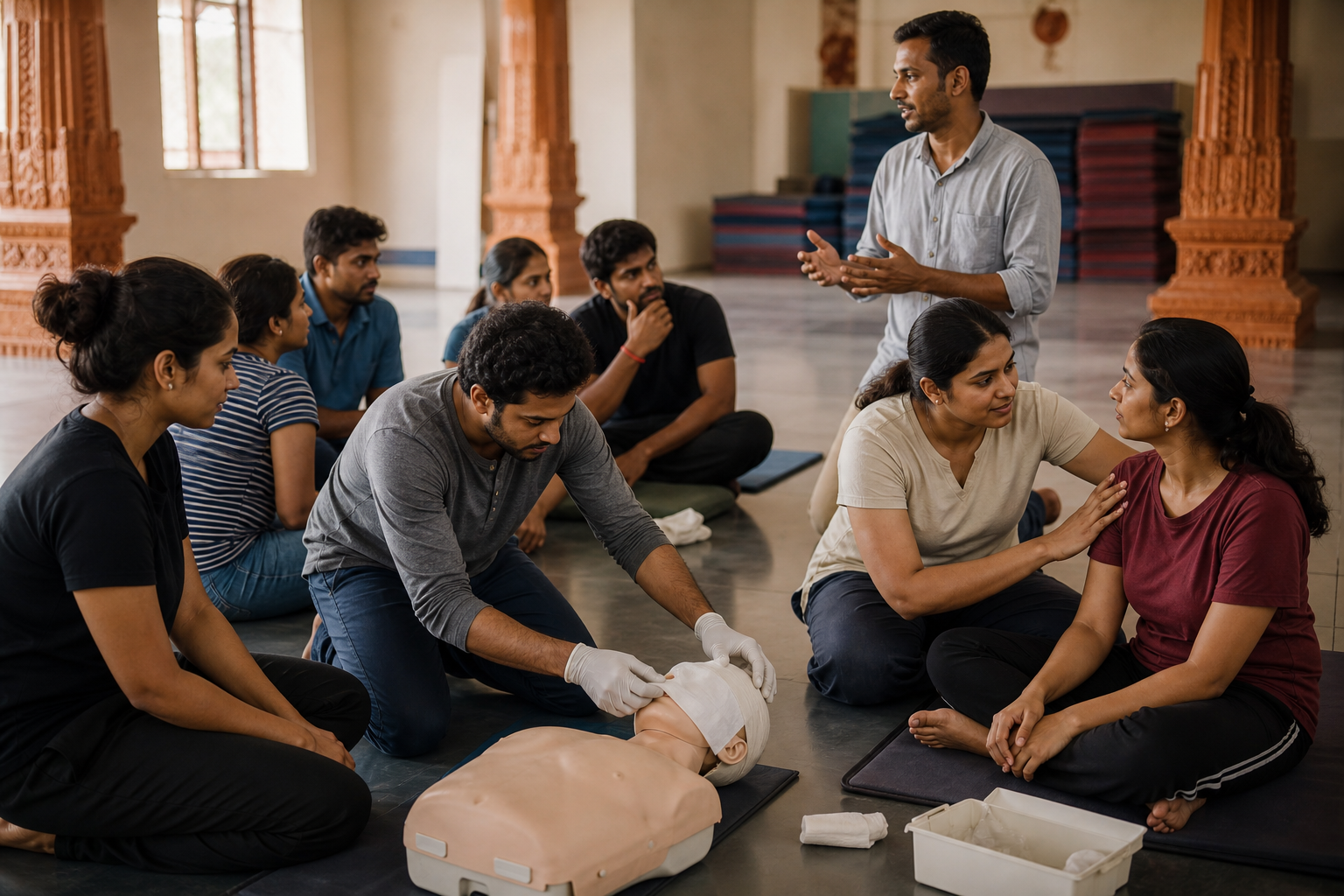
Har Ghar Yoddha literally means “a warrior in every home.” Its constructive meaning is not a fighter looking for an adversary. It is a household member trained to notice danger, prevent escalation, help a vulnerable person, cooperate with authorities, and accept responsibility for the consequences of every action.
This distinction is essential. Youth enthusiasm can become a civic asset when it is governed by restraint. Without restraint, the language of protection can slide into bravado, suspicion, or vigilantism. A credible initiative therefore begins with a written mission and code of conduct, not with physical techniques.
You can adapt the following charter for a local programme: Har Ghar Yoddha prepares youth to protect life, dignity, heritage, and social harmony through prevention, lawful self-defence, first aid, disaster readiness, cyber responsibility, and seva. Volunteers will not punish, intimidate, discriminate, spread unverified claims, obstruct authorities, or act as an unofficial enforcement group.
- Deity should translate into lawful care for temples, sacred objects, pilgrims, and cultural memory.
- Nation should translate into constitutional duty, public safety, cooperation with lawful authorities, and service without discrimination.
- Dharma should translate into truthfulness, compassion, courage, restraint, and responsibility for outcomes.
- Self-defence should mean escaping danger and protecting life, not pursuing, retaliating against, or humiliating another person.
The Dharmic traditions supply a strong ethical grammar for this work. Hindu dharma and daya join duty with compassion. Buddhist metta directs attention towards the welfare of others. Jain ahimsa and aparigraha restrain harm and possessiveness. Sikh seva and sarbat da bhala place service within the good of all. Satya applies just as directly to a forwarded message as it does to spoken testimony. These are not decorative quotations for an opening ceremony; they are standards for decisions made under pressure.
The Pachal initiative in Ratnagiri drew youth and families into practical demonstrations, drills, and locally relevant scenarios. That response points to a useful design principle: young people do not need more abstract exhortation. They need disciplined practice connected to situations they may actually encounter.
Teach the risks youth are likely to face
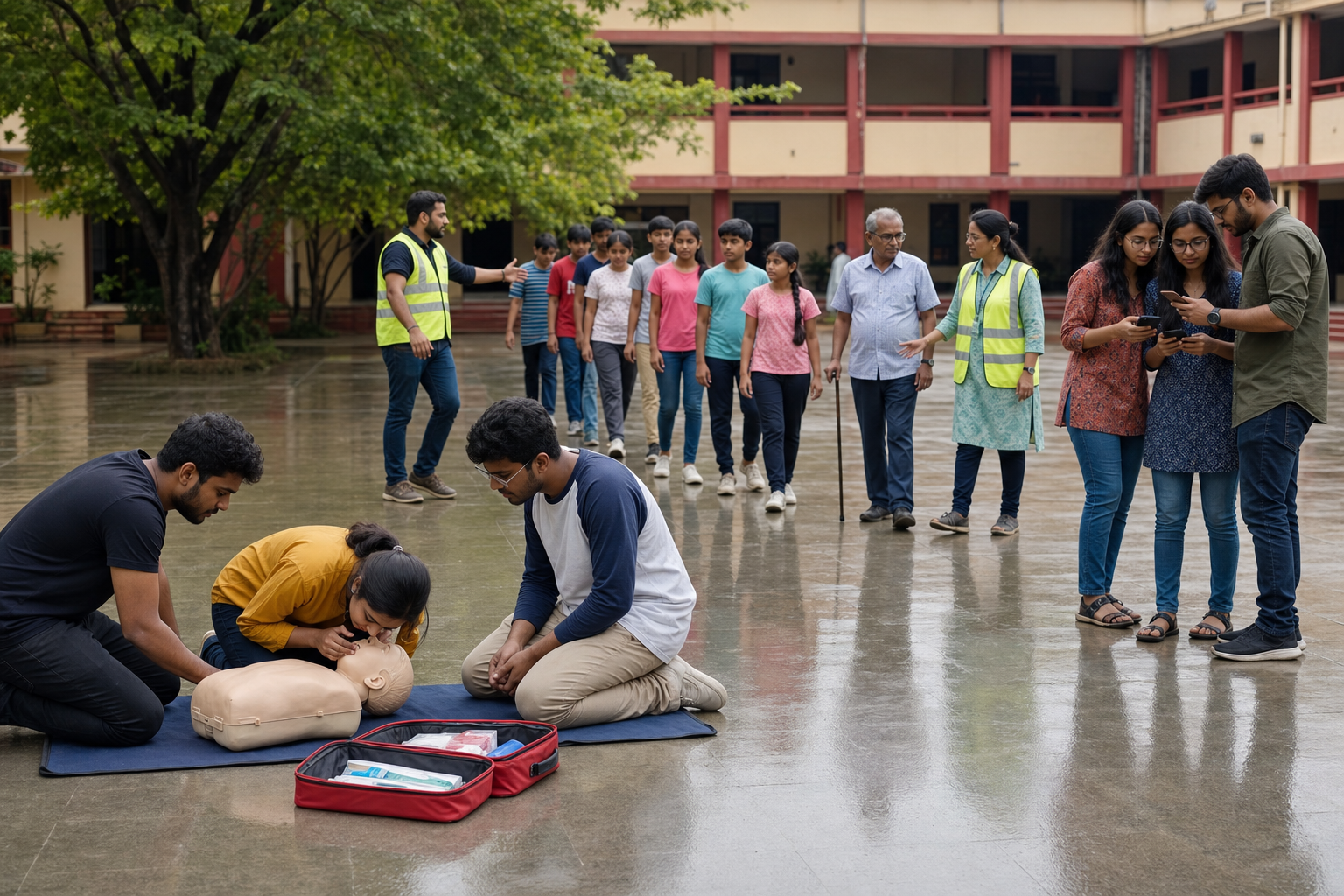
A useful curriculum is modular. Situational awareness, women’s safety, first aid, disaster response, cyber hygiene, and heritage care require different instructors and different safeguards. Do not let confidence in one area masquerade as competence in another.
Situational awareness before physical engagement
Begin with noticing. Cooper’s Color Codes can help participants understand the movement from relaxed awareness towards heightened alertness. The OODA loop gives them a repeatable decision process: Observe, Orient, Decide, Act. Neither framework should be taught as a way to treat ordinary people as threats. Their purpose is to notice meaningful changes early enough to choose a safer response.
Every scenario should reinforce the same priority: identify an exit, create distance, bring other people into awareness, seek help, and de-escalate. Physical engagement belongs at the end of that sequence, only when escape is not immediately possible and action is necessary to meet the threat. Any force must be minimal and calibrated to the danger rather than to fear, anger, or wounded pride.
Indian law recognises private defence only within defined circumstances. The legality of an action depends on the facts, so a training session cannot promise that a particular technique will always be justified. Obtain qualified legal input for the legal module. Teach immediate reporting, accurate documentation, and non-interference with police procedures. Do not train participants to chase, punish, interrogate, or retaliate against a suspected wrongdoer.
Physical drills carry real injury and legal risks. They should be led by a suitably qualified instructor, use controlled contact, and allow every participant to opt out. Weapon-disarming spectacles and aggressive sparring may look impressive, but they undermine a curriculum built around avoidance, exit, and proportionate response.
Women’s safety without transferring blame to women
Women’s safety training should centre consent, dignity, boundary-setting, rapid help-seeking, and collective responsibility. It should never imply that a woman caused an assault by failing to dress, travel, speak, or fight in a prescribed way.
- Practise a clear verbal boundary such as, “Stop. Do not come closer.”
- Practise moving towards a safe exit or visible group while calling for help.
- Teach bystanders to interrupt safely, bring in other people, and direct someone specific to contact the authorities.
- Use scenarios in which a bystander checks privately whether assistance is wanted instead of taking control of the affected person’s decisions.
- Require consent before any contact drill and protect the privacy of anyone who discloses an incident.
A bystander does not have to confront an aggressor physically to be useful. Creating a distraction, accompanying the person to safety, summoning responsible adults or authorities, and preserving relevant information can be safer and more effective. The participant should learn to choose the least escalatory option that still protects the person at risk.
First aid and disaster readiness that support professionals
A basic practice sequence should cover scene safety, calling for professional help, airway-breathing-circulation checks, bleeding control, shock management, and safe positioning. The lesson is not “become the doctor.” It is “avoid becoming another casualty, activate professional help, and provide appropriate support while it is safe to do so.”
These topics require hands-on teaching under a qualified first-aid instructor and alignment with current national guidance. A delayed emergency call, an unsuitable intervention, or careless movement of an injured person can worsen harm. Make those limits explicit at the moment each technique is taught.
Disaster preparation must reflect local hazards. In coastal Ratnagiri, monsoon-related danger and evacuation planning deserve attention. Another community may need a different emphasis. Ask participants to map safe exits, gathering points, communication routes, people who may need assistance, and the authority responsible for each decision. Then rehearse the handoff, because a plan that depends on an improvised chain of command will fail precisely when confusion is highest.
Cyber discipline as a form of social protection
An emotionally charged message can create danger before anyone enters the street. Cyber hygiene therefore belongs beside physical preparedness, not in an optional technology lecture.
- Pause before forwarding content designed to provoke anger or fear.
- Find the original account, statement, image, or recording rather than relying on a cropped repost.
- Check whether the available context supports the allegation.
- Do not turn an unverified name, face, or location into a public accusation.
- Preserve only the information needed for a report and send it through the appropriate channel instead of circulating it for entertainment.
- Report malicious activity while protecting the privacy of victims and bystanders.
Satya requires more than avoiding a deliberate lie. It requires refusing to lend your credibility to something you have not verified. A volunteer who interrupts a rumour may prevent panic, reputational harm, or inter-community tension without ever needing to enter a confrontation.
Put institutions, heritage, and safeguards in the same plan
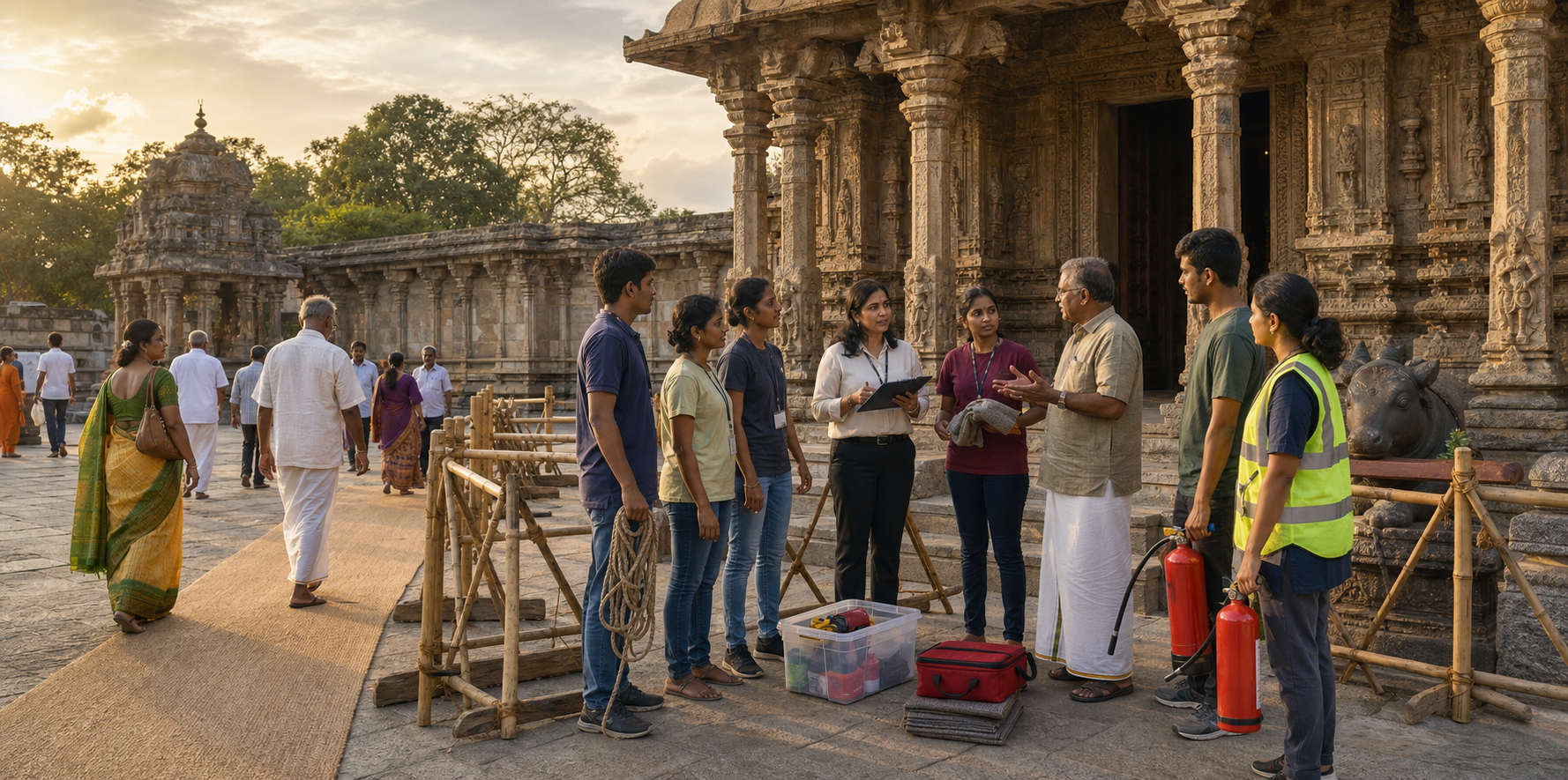
Preparedness groups become risky when they operate around institutions instead of through them. Before any public drill, patrol, festival role, or emergency exercise, bring together the gram panchayat, school representatives, temple committees, gurdwaras, vihars, derasars, local police, and relevant service providers. Not every institution needs to participate in every activity, but every activity needs a recognised owner and a clear authority handoff.
- Agree who contacts the authorities and what information that person should provide.
- Assign limited roles for crowd movement, first-aid support, lost-and-found, hazard reporting, and communication.
- Define which decisions volunteers may make and which must be handed to an official or qualified professional.
- Set a grievance route so residents can report misconduct without confronting a volunteer team directly.
- Record the agreed protocol and make it available to participants, parents, venue managers, and institutional partners.
Heritage protection fits naturally within this framework when “temple defence” is translated into conservation and public safety. Useful work includes volunteer watch-and-ward, orderly crowd movement during festivals, fire-safety preparation, anti-theft precautions, and authorised documentation of artefacts. Volunteers should coordinate with the responsible committee, avoid casually handling sacred or historic objects, and report concerns through the agreed channel.
Courtesy towards other local places of worship does not weaken Hindu stewardship. It demonstrates that protection is grounded in dharma rather than hostility. Offering appropriate cooperation to a gurdwara, vihar, or derasar during a crowded event strengthens the relationships on which neighbourhood resilience depends.
Privacy needs the same seriousness as physical safety. Collect only information necessary for training or coordination. Explain why it is needed, restrict access, and do not turn attendance records, incident details, phone numbers, or images into material for unrestricted group chats. Young participants should never be pressured to publicise a personal safety disclosure as proof that the programme is relevant.
Know when not to lend your support
If you are a parent, teacher, donor, committee member, or prospective participant, treat the following as warning signs:
- The organiser refuses to adopt a written no-vigilantism and no-hate rule.
- A religious, caste, ethnic, or political community is presented as the training target.
- The curriculum begins with retaliation, weapons, or aggressive physical engagement instead of awareness and de-escalation.
- Participants are encouraged to conduct secret surveillance, collect unnecessary personal information, or publish unverified accusations.
- Volunteers are told to bypass, replace, or obstruct police and emergency professionals.
- Contact drills ignore consent, gender dignity, medical limitations, or the right to withdraw.
- Instructors cannot explain the boundary between their competence and the work of legal, medical, or emergency professionals.
Do not lend your name, venue, money, or child’s participation until those problems are corrected. A programme that treats safeguards as weakness is not teaching courage. It is removing accountability.
Launch small, refresh skills, and measure behaviour
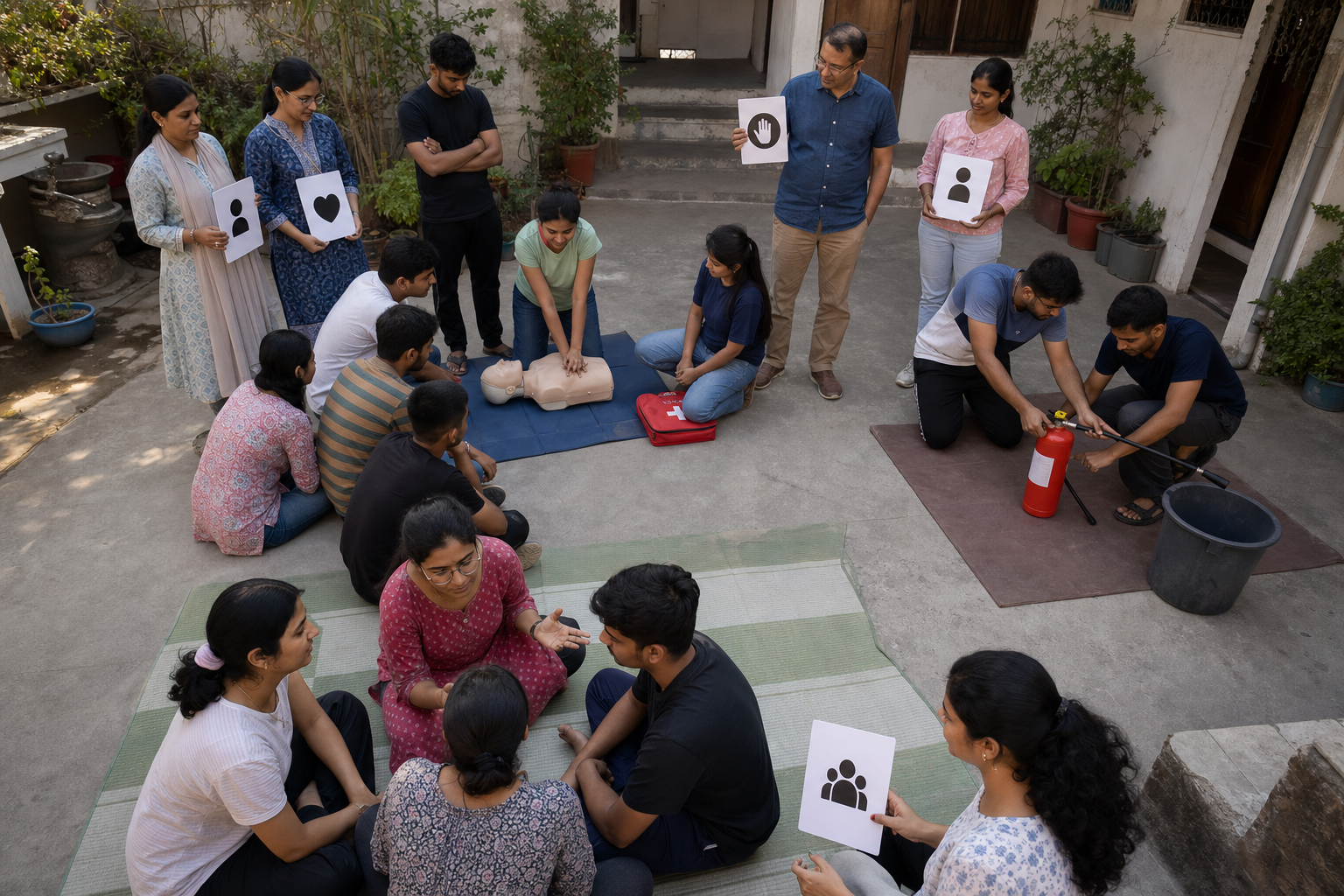
The train-the-trainer model can make Har Ghar Yoddha scalable, but replication should come after quality control. A charismatic participant is not automatically ready to teach. A trainer must be able to demonstrate the skill, explain its limits, stop unsafe behaviour, protect participants’ dignity, and refer questions outside the module to a qualified person.
- Map local needs. Identify realistic safety, disaster, cyber, event, and heritage risks with the institutions responsible for them.
- Adopt the charter. Put lawful service, non-violence, non-discrimination, privacy, and due process in writing before recruitment.
- Choose instructors by module. Legal boundaries, first aid, physical safety, cyber hygiene, and disaster coordination require relevant competence.
- Practise local scenarios. Use the places and decisions participants recognise: a crowded festival entrance, an evacuation route, an injured person, an unwanted approach, or a provocative message.
- Rehearse escalation and handoff. Every participant should know when to stop acting, whom to contact, and what information to provide.
- Schedule refreshers. Short community sessions, demonstrations, and video explainers can reinforce learning, but practical skills still need supervised rechecking.
- Debrief without blame. After a drill or public event, ask what participants noticed, where communication stalled, whether anyone felt unsafe, and which protocol needs revision.
Attendance, uniforms, slogans, and photographs measure visibility, not preparedness. Track evidence that the initiative changes behaviour:
- Can participants still demonstrate the relevant skill during a refresher?
- Are hazards reported promptly to the correct authority?
- Do volunteers contribute useful hours during cultural and community events?
- Do drills produce orderly communication and clean handoffs rather than duplicated commands?
- Do women, parents, elders, and institutional partners report that the programme respects dignity and boundaries?
- Are conduct, privacy, and discrimination complaints documented and addressed through the agreed process?
Use those answers to narrow weak modules, retrain facilitators, and improve protocols. Expansion is justified when retained skills and responsible conduct improve, not merely when enrolment grows.
Key takeaways
- A Har Ghar Yoddha volunteer is a disciplined civic protector, not an unofficial enforcer.
- Awareness, exit, help-seeking, and de-escalation come before any physical response.
- First aid, disaster response, and self-defence require qualified instruction and explicit limits.
- Cyber verification is safety work because unchecked rumours can create real-world harm.
- Temple and heritage care should focus on conservation, crowd safety, fire precautions, and coordination with responsible committees.
- No-vigilantism, no-hate, privacy, consent, due process, and non-discrimination are operating rules, not public-relations language.
- Success means retained skills, timely reporting, useful service, and trustworthy cooperation with authorities.
At your next local meeting, place the charter before the drills and ask every participating institution to agree on roles, limits, and authority handoffs. If restraint, inclusion, and accountability cannot be accepted in writing, the initiative is not ready. If they can, youth have a serious framework through which courage becomes seva and every household becomes a steadier part of the community.