

You may want to live more dharmically but have no room for another elaborate practice. Work is waiting, relatives need attention, messages keep arriving, and even service can begin to feel like one more obligation. The answer is not necessarily a larger project. It is to change how you meet the duties already in front of you.
Daily dharma becomes practical when seva, compassion, and humility operate together. Seva turns your capacity toward another’s welfare. Compassion helps you notice the actual need. Humility prevents the act from becoming a performance, a claim of superiority, or a demand for gratitude. With all three present, an ordinary meal, conversation, handover, apology, or hour of volunteer work can become sadhana.
Use the need-duty-ego test before calling an act seva

Good intentions alone do not make service useful. You can offer help that was never wanted, take over a responsibility someone needs to learn, or give so far beyond your capacity that resentment follows. Before acting, test the situation through three questions.
- What is the real need? Look for the burden that can actually be reduced. The useful response may be food, information, patient listening, transport, a fair introduction, or simply completing your own duty reliably.
- What is mine to do? Your svadharma matters. Help should not become an excuse to neglect a child, an elder, a promise, a professional obligation, or your own legitimate limits.
- What does my ego want from this? Ask whether you would still perform the act if no one knew, no one praised you, and the beneficiary never repaid you.
The Bhagavad Gita’s teaching in 2.47 places your authority in action rather than possession of the result. That is not permission to act carelessly. You still plan, ask whether the help worked, correct mistakes, and learn. What you release is the claim that the result must confirm your goodness or unfold exactly as you imagined.
This distinction protects seva from two common distortions. The first is control disguised as kindness: helping only on the condition that the other person obeys you. The second is self-erasure disguised as humility: accepting abuse, concealing wrongdoing, or exhausting yourself because saying no feels spiritually improper. Compassion does not require either. A clear boundary can prevent further harm, and referring a need to someone better equipped can be more responsible than trying to become indispensable.
Use a simple decision rule. If the help is wanted, within your capacity, consistent with your duties, and likely to preserve the other person’s dignity, act. If one of those conditions is unclear, ask before intervening. If immediate suffering demands a response, do what is safely within your role and then connect the person with appropriate support.
Begin with svadharma before adding a service project
People often imagine seva as an activity performed somewhere special. That can make daily responsibilities seem spiritually secondary. Karma Yoga reverses the order. The Gita’s instruction in 18.46 presents one’s own work as a means of worship. Your first field of service is therefore the place where your choices already affect other lives.
Before seeking a new commitment, examine the recurring points where someone depends on you.
- At home: complete an unglamorous task without keeping score; give someone your full attention before proposing a solution; share food before treating it as a private possession; keep a promise whose importance is greater to the other person than it is to you.
- At work: make a handover clear enough that a colleague does not have to reconstruct your thinking; credit the person who contributed; correct an error before it becomes another person’s emergency; treat support staff with the same respect you show senior people.
- In public: queue fairly, return what is lost, make room for an elder, drive without turning impatience into danger, and greet workers as people rather than as functions.
- Online: verify a claim before forwarding it, refuse mockery as a substitute for argument, and do not turn another person’s mistake into entertainment.
Dharmic memory repeatedly returns to materially small offerings because they expose the quality of intention. Shabari’s hospitality, the squirrel’s contribution to Rama’s bridge, Vidura’s plain meal, and Sudama’s flattened rice carry spiritual weight through sincerity rather than display. These episodes do not romanticize deprivation or make competence irrelevant. They show that the worth of an offering cannot be read from its price, prestige, or visibility.
You can apply that principle with a brief sankalpa before the day’s demands take over:
- Name one duty that must be done well today.
- Name one person whose burden your conduct can lighten.
- Choose one useful act that does not require an audience.
- Perform it attentively, without rushing through the human being in order to finish the task.
- At completion, release the need to be noticed and offer the result to the Divine or to the welfare of the community.
Then measure the act by its effects: Was the real burden reduced? Was dignity preserved? Was your duty fulfilled? Did the act leave less egoic noise behind? These questions are more reliable than asking whether the gesture looked generous.
Make compassion accurate, especially in speech

Compassion is not a permanent tone of softness. It is the ability to meet a being and a situation with the response that reduces needless suffering without abandoning truth. Sometimes that response is comfort. Sometimes it is correction, restraint, patience, protection, or silence.
Yoga Sutra 1.33 offers a useful map for matching the response to the circumstance: friendliness toward happiness, compassion toward suffering, appreciative joy toward virtue, and wise equanimity toward harmful or unwholesome conduct. The four attitudes prevent several errors at once. Friendliness checks envy. Compassion checks indifference. Appreciative joy checks rivalry. Equanimity stops another person’s misconduct from colonizing your mind.
Speech is where this discipline is tested most often. The Gita’s description of verbal tapas in 17.15 joins four qualities: truthfulness, gentleness, benefit, and non-agitation. Before speaking or sending a message, pass it through four gates:
- Is it true? Separate what you know from what you inferred, heard, or merely suspect.
- Is it beneficial? Truth can be used to clarify or to humiliate. Decide which purpose your sentence serves.
- Is its form gentle? Gentleness does not dilute the fact. It removes contempt, mockery, and avoidable cruelty from its delivery.
- Does it avoid needless agitation? Some truths will disturb because the matter is serious. Do not add provocation that contributes nothing to understanding or remedy.
This is particularly important in political and religious disagreement. Defending dharma does not require circulating an unverified claim or insulting an entire community. Precision is stronger than indiscriminate anger. Identify the act, argument, institution, or policy you oppose; state the evidence available to you; and resist language that converts criticism into dehumanization. Satya and ahimsa must discipline advocacy from within.
When your words do cause avoidable harm, repair them while the incident is still clear. Name what you said or did, correct any false claim, acknowledge the effect without forcing the other person to comfort you, and state what you will change. An apology that mainly explains why you should be excused leaves the burden with the injured person. Accountability is seva because it stops your ego from making others carry the cost of your conduct.
Let humility remove status from service
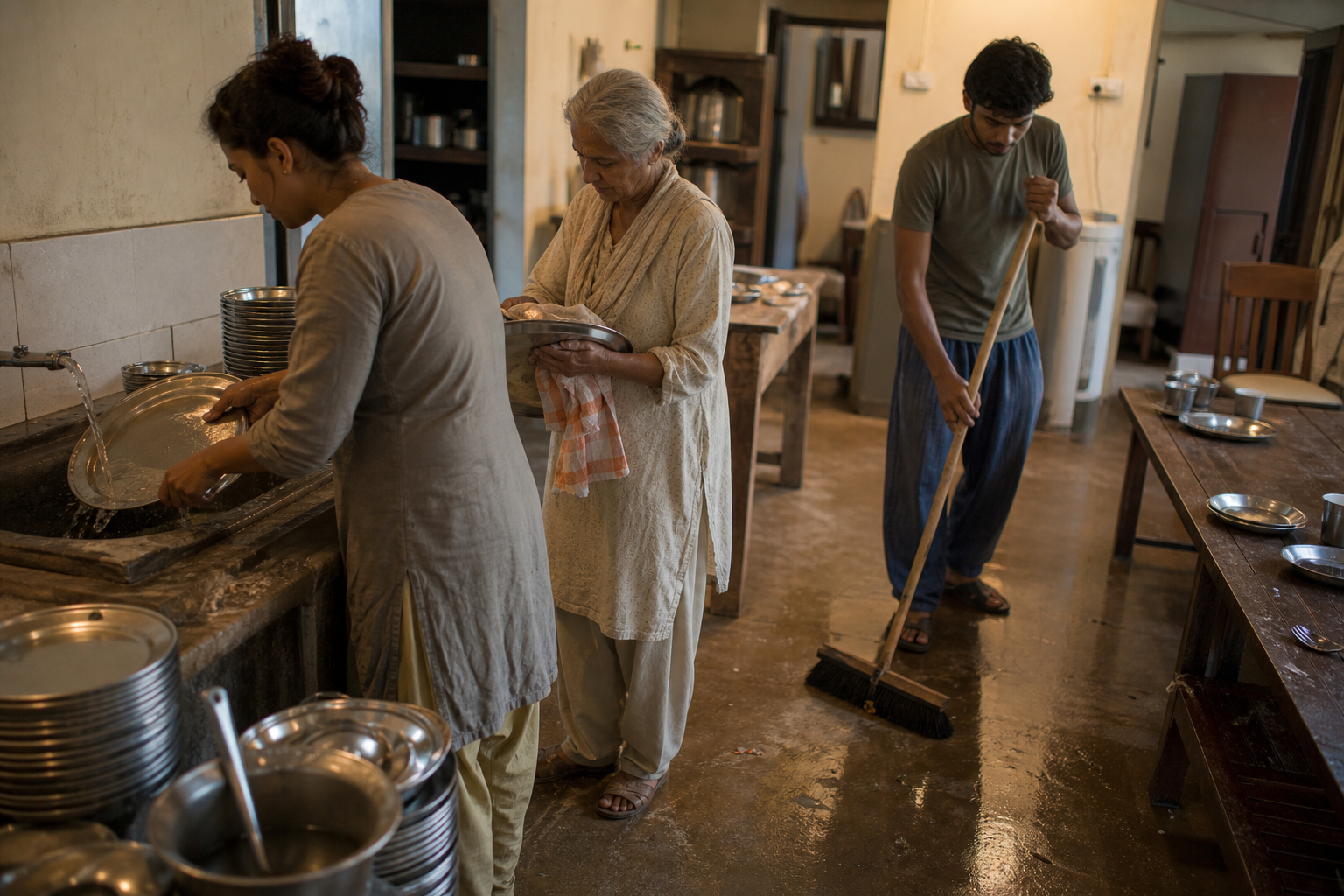
Humility is often confused with speaking badly about yourself. That is still a form of self-absorption. Dharmic humility is clearer and sturdier: you know what you can contribute, but you do not make your importance the center of the act. You can exercise skill, authority, and courage without needing them to establish your superiority.
The Vaishnava ideal of dasa-dasanudasa, servant of the servant, gives this posture theological depth. In the reconciliation at the gates of Vaikuntha, Srimad Bhagavatam 3.16.7 presents the Lord as the servant of His devotees. Divine greatness is revealed through protective love and voluntary service, not insecurity about rank. The same passage joins humility with detachment: fortune remains with the Lord even though He does not grasp after it.
That pattern has direct consequences for leadership. If you manage a household, temple committee, business, classroom, or civic group, humility should be visible in what you do with responsibility.
- Take responsibility for a failure before distributing blame.
- Give credit specifically rather than absorbing collective work into your own reputation.
- Do low-status tasks when they need doing, while still assigning roles fairly.
- Use money, influence, and access as resources held for a purpose, not as proof of personal worth.
- Protect the dignity of the person receiving help. Do not require public gratitude, obedience, or exposure of private hardship as the price of assistance.
- Listen to correction from people with less formal status. Rank can organize responsibility, but it does not make perception infallible.
After any significant act of service, conduct an ego audit. Would you be disappointed if your name were omitted? Are you retelling the event to advertise your goodness? Are you insisting on your preferred solution after the recipient has explained what is actually needed? Do you avoid tasks that seem beneath your position? Has an unspoken expectation of gratitude turned into resentment?
If the answer is yes, do not use the discovery as a reason to stop serving. Correct the offering. Return attention to the need, give away credit, ask rather than assume, and reduce the audience around the act. Humility grows through such corrections, not through a fantasy that the ego disappeared before practice began.
This service-first ethic appears across the dharmic family without making the traditions interchangeable. Hindu Karma Yoga consecrates action and loosens attachment to its fruits. Sikh seva, langar, nimrata, and sarbat da bhala join humility with equality and the welfare of all. Buddhist discipline joins the cultivation of good with purification of mind, while the bodhisattva ideal directs compassion toward all beings. Jain ahiṁsa, aparigraha, and the principle that living beings support one another place careful restraint alongside assistance. The doctrines and paths remain distinct, but each asks you to examine how spiritual conviction changes your treatment of life around you.
Use a daily rule that still works when you are tired

A practice that depends on ideal energy will disappear on difficult days. Make your rule small enough to survive fatigue and concrete enough to expose avoidance. Link it to moments that already occur.
- At the beginning of the day: form one sentence of sankalpa: “May my duties today reduce harm and serve more than my ego.” Then identify the duty in which you are most likely to become impatient.
- Before meals: remember that food is received through many lives and forms of labor. Share where appropriate, avoid waste, and eat with gratitude rather than entitlement.
- Before sending a difficult message: apply the four gates of truthful, beneficial, gentle, and non-agitating speech.
- When irritation appears: ask what response fits the situation: friendliness, compassion, appreciative joy, or equanimity. Do not assume every problem needs the same emotional posture.
- When an unnoticed task appears: do it if it is yours and within your capacity. Let anonymity train the impulse that usually seeks credit.
- At the end of the day: practise svadhyaya by reviewing one act of service, one missed opportunity, one moment of ego, and one repair to make. Keep the review factual; self-condemnation consumes attention without correcting conduct.
Predictable obstacles need specific responses. When you are tired, shrink the act without abandoning the value: listen for a minute with full attention, wash the shared cup, or send the necessary information clearly. When cynicism says small acts do not matter, choose a bounded burden you can genuinely reduce. When you want recognition, make the next act private. When resentment rises, check whether you exceeded your capacity, ignored consent, or secretly expected repayment. When practice becomes irregular, attach it to an existing cue such as waking, eating, opening your inbox, or preparing for sleep.
Do not count spiritual progress mainly by the number of visible good deeds. Notice whether kindness arrives before contempt, whether you recover from irritation sooner, whether you can appreciate another person’s virtue without rivalry, whether correction provokes less defensiveness, and whether service requires less recognition. The Yoga Sutra names clarity and serenity of mind, citta-prasadanam, as the fruit of cultivated attitudes. A quieter need to possess the role of helper is part of that refinement.
Key takeaways
- Test proposed service against real need, your duty, your capacity, consent, dignity, and the ego’s demand for reward.
- Start with recurring responsibilities. Reliable care at home, clean work, disciplined speech, and fair public conduct are fields of seva.
- Treat non-attachment as freedom from ownership of the result, not as indifference to whether your action helped.
- Use compassion accurately. Comfort suffering, appreciate virtue, meet happiness without envy, and apply equanimity where harmful conduct would otherwise capture your mind.
- Let humility remove status from the act. Ask what is needed, share credit, accept correction, and serve without making gratitude a condition.
- Review the day and make repairs. Dharma becomes stable through repeated correction, not occasional moral display.
Begin with the next ordinary demand, not a future version of your life. Choose one burden you can responsibly lighten, perform the act with full attention, and leave your name out of it when you can. Tomorrow, do the same with a little more discernment. That is how seva becomes character, compassion becomes dependable, and humility moves from an admired ideal into daily dharma.
References
- DharmaRenaissance Blog – The Sacred Power of Small Acts: Hindu Scriptures on Daily Compassion and Life Mastery
- Dandavats – Divine Humility and Seva in SB 3.16.7: H.H. Radhanath Swami at ISKCON Chowpatty, Mumbai