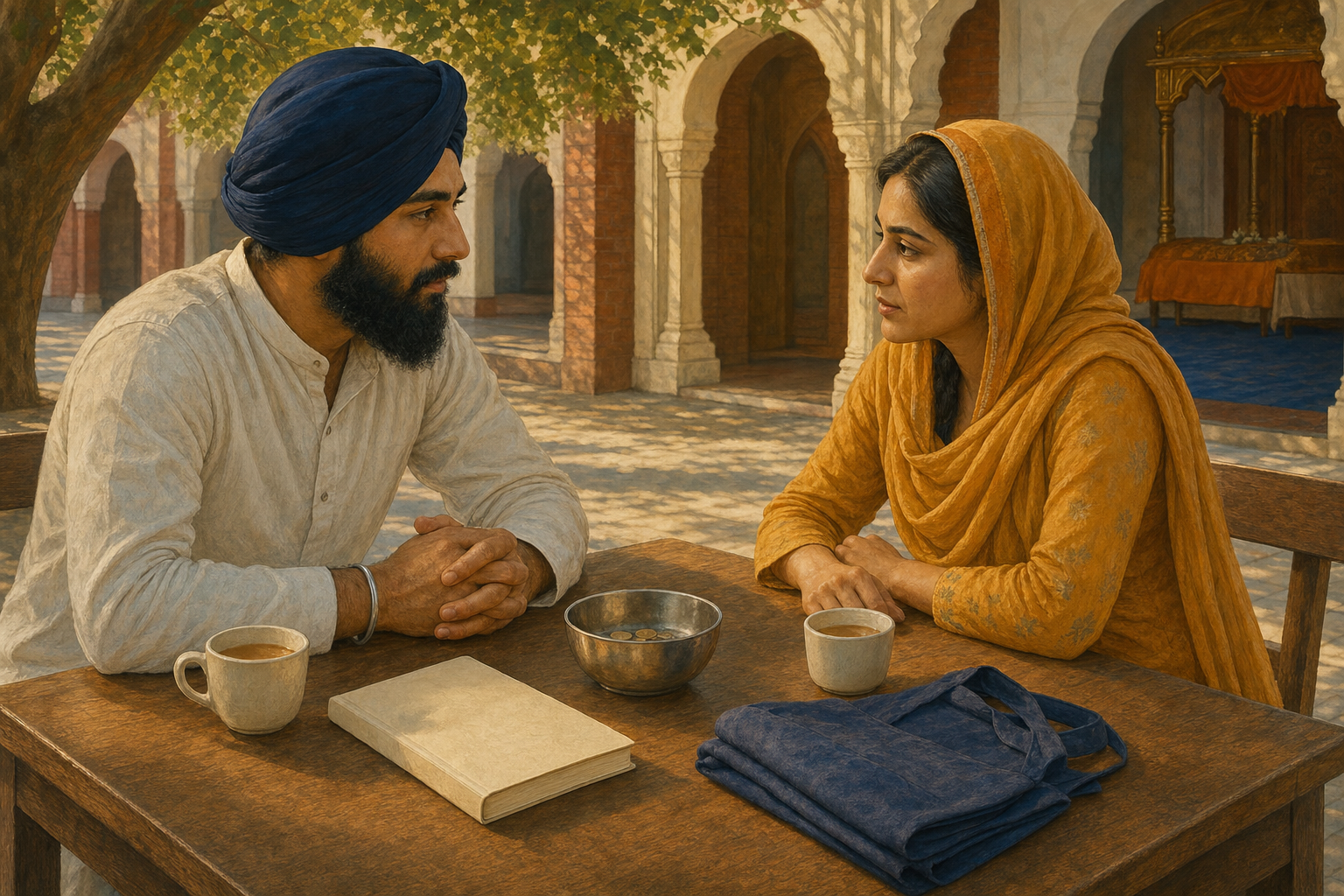
You may be planning an Anand Karaj, explaining it to relatives, or trying to understand why its four rounds matter. The useful question is not only what happens in the Gurdwara. It is what kind of marriage you are agreeing to practise after the wedding clothes are put away and the langar is finished.
Anand Karaj asks two Sikhs to build a household whose centre is the Shabad Guru. The spouse is a lifelong fellow traveller, but Shabad remains the deepest and most dependable companion. That distinction turns the ceremony from a celebration of romantic attachment into the beginning of a shared discipline.
Key takeaways
- Anand Karaj means a blissful union, but its bliss is the fruit of Gurmat-centred living rather than the excitement of the wedding day.
- The couple circles Guru Granth Sahib during four Laavan because divine wisdom, not either spouse or family, is meant to govern the household.
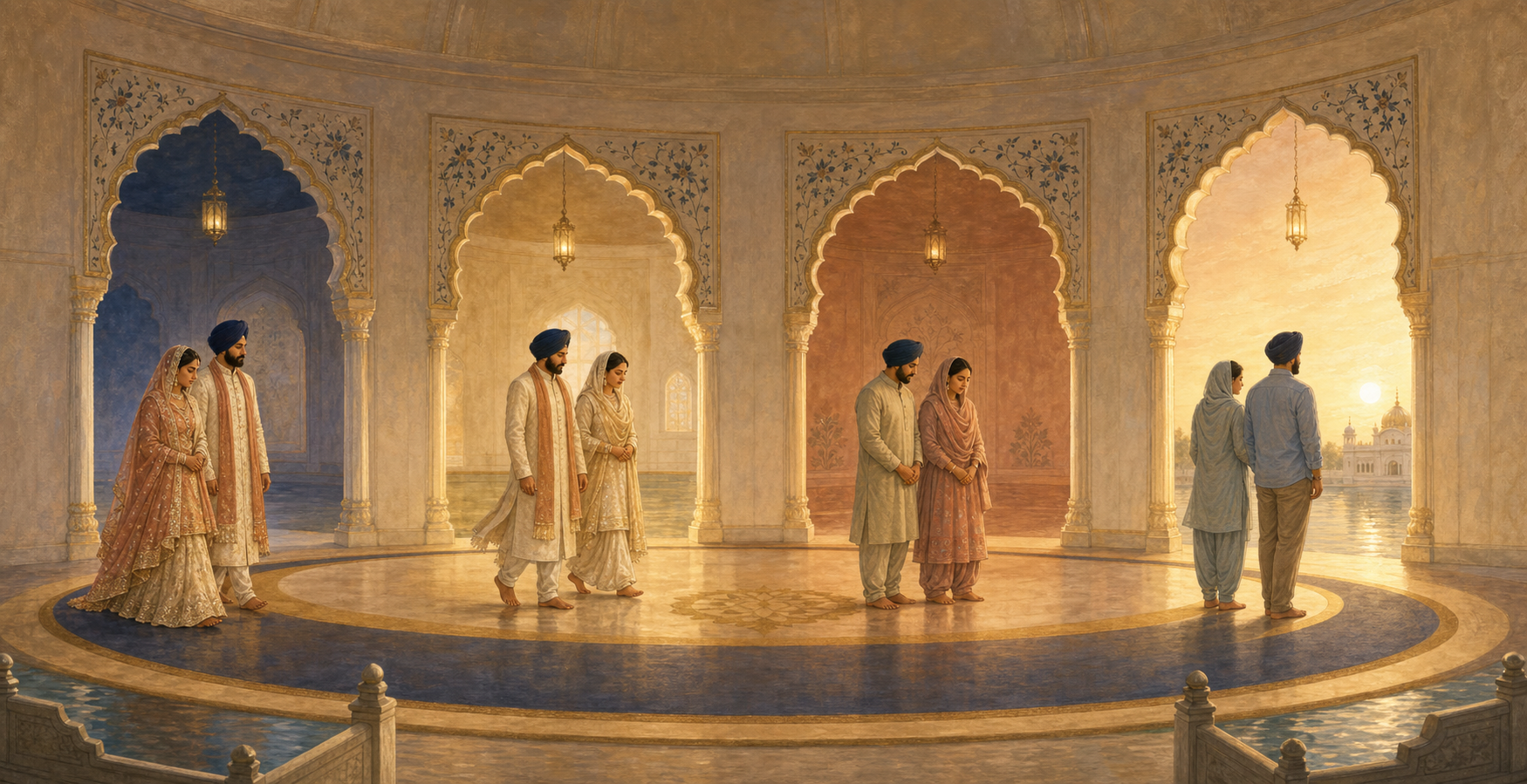
- The Laavan form one developing path: righteous conduct, deeper reliance on the Guru, loving detachment from ego, and the maturation of sahaj and anand.
- The absence of kanyadaan and dowry is not incidental. It expresses a marriage based on equality and reciprocal responsibility rather than transfer or ownership.
- Kirtan, Ardas, hukamnama, Karah Prashad and langar carry the spiritual meaning of the occasion; astrology, competitive display and priestly intermediation do not.
- Interfaith eligibility and civil registration should be settled before invitations are issued, because religious solemnization and legal recognition are distinct questions.
The four rounds commit you to a way of living
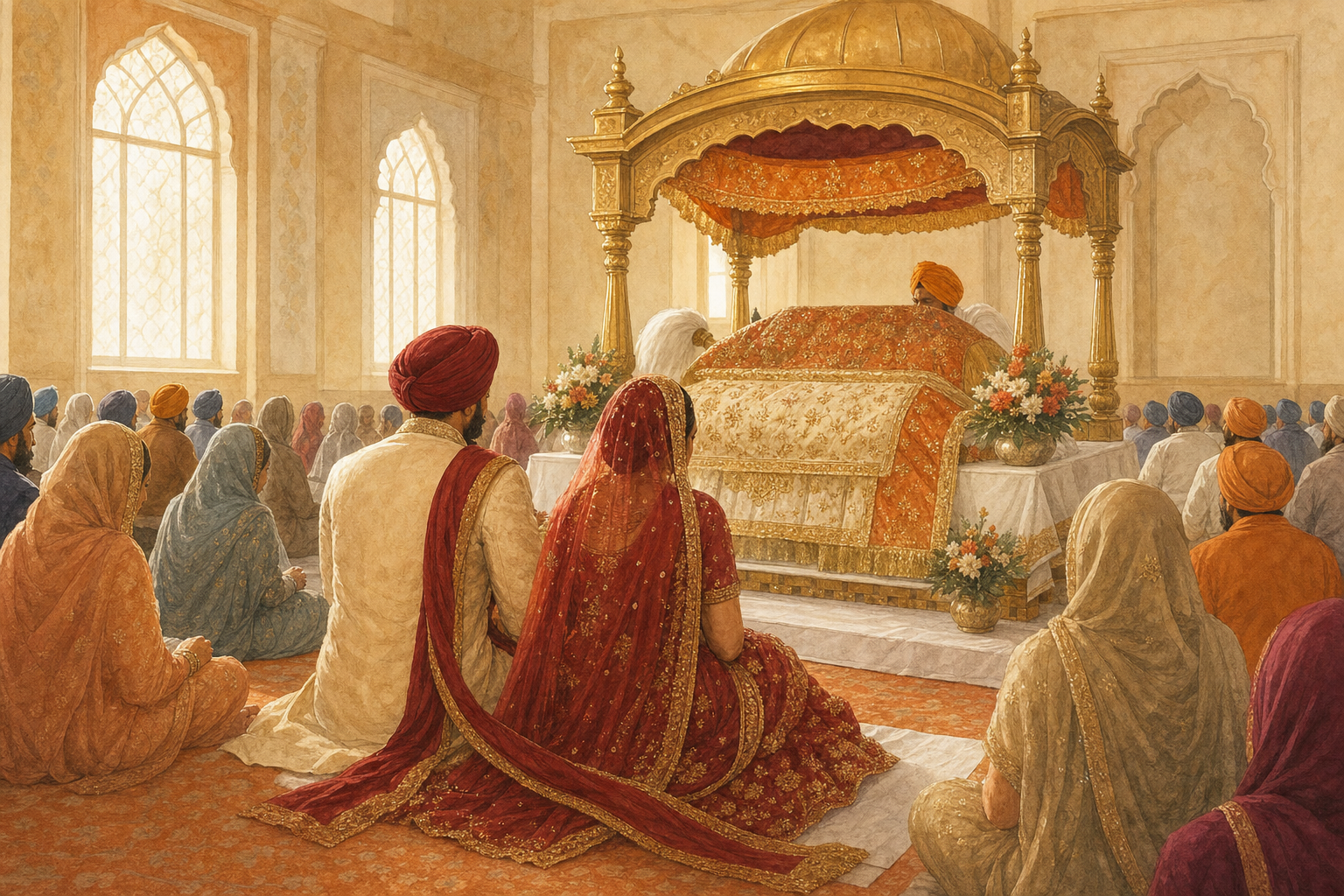
The centre of Anand Karaj is not the bride, the groom or the joining of two family reputations. It is Guru Granth Sahib. The couple moves around the Guru rather than around a fire, publicly placing its shared life within the orbit of revealed wisdom. The sangat is therefore a witness to a spiritual undertaking, not merely an audience for a family occasion.
The palla should be read in the same light. It represents connection and mutual responsibility; it does not transfer a woman from one male guardian to another. There is no kanyadaan in Anand Karaj. The granthi and kirtani facilitate the scriptural order, but they are not priests who manufacture sanctity on the couple’s behalf. Sanctity arises through the Guru’s presence and the truthful participation of the couple and sangat.
The four Laavan of Guru Ram Das are not four unrelated promises. They trace an ascending movement in spiritual life. Read them as a diagnostic for the home you intend to create:
| Laav | Spiritual movement | Marital ethic | Question for the couple |
|---|---|---|---|
| First | Dharam, or righteous conduct | Fidelity, responsible household duties, honest work and the sharing of resources | Will our ordinary choices reflect truthful earning and responsibility? |
| Second | Deeper reliance on the Satguru and hukam | Learning, listening and making decisions through a shared grammar of Gurbani | Can we learn together before either of us insists on winning? |
| Third | Bairaag, or loving detachment | Affection without possession, generosity without display, and reconciliation before pride | Can we love without controlling and give without keeping score? |
| Fourth | Sahaj and anand | Steady joy, balance in success and remembrance during difficulty | Can we meet changing circumstances without making ego the centre of the home? |
Use these questions before the wedding, not only during it. Each partner can name one concrete behaviour under every Laav and then compare answers. Under righteous conduct, for example, you may need to discuss honesty at work, fidelity and financial transparency. Under loving detachment, you may need to discuss jealousy, consumption, obligations to relatives or the urge to control one another’s time. A disagreement here is useful information: it reveals the preparation still required before ceremonial agreement becomes daily conduct.
The fourth Laav does not certify that the couple has already attained effortless harmony. Sahaj and anand are the horizon toward which married life moves. Expecting permanent bliss from the wedding itself creates disappointment; treating the marriage as a continuing apprenticeship gives both partners work they can actually undertake.
Plan a ceremony that expresses the commitment honestly
A Gurmat-centred Anand Karaj is structurally simple. Local sequencing can vary, so confirm the maryada with the Gurdwara, but the recognisable ceremonial flow normally includes:
- The couple and sangat gather in the presence of Guru Granth Sahib, with an opening Ardas.
- A hukamnama is taken as scriptural guidance for the couple and congregation.
- The palla connects the couple as a sign of shared responsibility.
- Each Laav is sung, with the couple completing one circumambulation of Guru Granth Sahib for each hymn.
- Anand Sahib is recited or sung, using selected or complete pauris according to maryada and local custom.
- A concluding Ardas completes the formal sequence.
- Karah Prashad is distributed, followed by the communal fellowship of langar.
Seating on the floor expresses humility and equality before the Guru. That principle should never be turned into a test that excludes an elder or a person with a disability. Suitable seating or mobility accommodations preserve participation without weakening the meaning of equality.
Kirtan is not background music. The Laavan are composed in Raga Suhi, while Anand Sahib is in Raga Ramkali. Their musical rendering helps the sangat receive the teaching through sound, so clarity and devotional attention matter more than theatrical effect. If many guests do not understand the words, arrange a concise explanation before the rounds so that the congregation knows what it is witnessing.
Several popular wedding habits contradict the logic of the rite. Astrology cannot determine the spiritual fitness of the union. Dowry turns relationship into transaction. Ostentation makes family status, rather than the Guru, the emotional centre of the day. A large celebration is not automatically irreligious, but spending that creates debt, rivalry or pressure on relatives should be examined honestly.
Before paying deposits, settle four practical matters with the Gurdwara: the applicable maryada, the couple’s eligibility, accessibility for participants, and the relationship between the religious ceremony and civil registration. Then tell both families plainly that the palla is not a handover, dowry is not part of the rite, and astrology will not govern the date or the marriage. Budget for langar and seva before spending on display. Those decisions will protect the meaning of the day when social expectations become loud.
Carry Anand Karaj into devotion, money and conflict
Build a shared rhythm without turning it into surveillance
A Shabad-centred home needs recurring contact with Gurbani. The traditional daily cadence of Nitnem may include Japji Sahib in the morning, Rehras Sahib in the evening and Sohila at night. Couples may also read together, reflect periodically on Sukhmani Sahib, participate in kirtan, prepare langar or undertake seva with the sangat.
Choose a practice both partners can honour sincerely. Shared devotion should orient the household; it should not become a device for monitoring who appears more religious. If your routines differ, agree on a common point of return and protect it in the household calendar. Consistency matters because the marriage will need a centre precisely when work, illness, caregiving or fatigue disrupts its preferred routine.
Make kirat karni and vand chhakna visible in the budget
Honest work and the sharing of resources remain vague until they shape actual decisions. A couple preparing for Anand Karaj should discuss the ethics of income, spending, saving, generosity and obligations to dependants. Useful questions include:
- Are there forms of earning either of us considers incompatible with truthful conduct?
- Which financial information will always be shared between us?
- How will we make space for generosity, langar and seva without using charity for status?
- What duties do we accept toward children, elders and relatives, and where do healthy boundaries belong?
- Does our desired standard of living reflect restraint, or are we trying to impress people outside the household?
This is where the third Laav becomes practical. Bairaag does not mean neglecting material responsibilities. It means handling possessions without letting possessions, comparison or entitlement rule the relationship.
Use a conflict practice that softens ego without hiding harm
When a disagreement begins to harden, a Shabad-centred response can interrupt the contest for dominance:
- Pause for Ardas so that the first task becomes correcting intention, not defeating the other person.
- Return to the wedding hukamnama or seek scriptural guidance, reading slowly and aloud rather than grabbing a line that appears to support one side.
- Describe what you observed, felt and need in first-person language. Do not convert interpretation into accusation.
- Name the shared Gurmat aim involved, such as truthful conduct, generosity, care for family, time for simran or reconciliation.
- Agree on the next responsible action and a time to revisit it. Spiritual language is not a substitute for following through.
Do not weaponize Gurbani or hukam by using it to silence your spouse. Guidance should interrogate both partners’ assumptions. It is not a shortcut that lets the more forceful person declare divine approval for a preferred outcome.
Reconciliation is a virtue, but it does not require tolerating violence, coercive control or an immediate safety threat. In those circumstances, move to safety and seek qualified local help. Ardas and counsel from the sangat may support a person, but they must not be used to conceal harm or replace appropriate professional and legal protection.
Make equality observable in the household
The rejection of kanyadaan and dowry establishes a clear principle, but equality has to survive the wedding. Look at who controls money, whose career is treated as expendable, who carries care work, whose family receives priority and who is allowed to define the household’s religious life. Reciprocal responsibility is credible only when both partners can speak, decide, serve and be heard.
Resolve interfaith and legal questions before invitations
Sikh Rehat Maryada defines Anand Karaj as the union of two Sikhs. This is not a judgement on the human dignity of a non-Sikh partner. It protects the coherence of vows whose shared reference point is Guru Granth Sahib, Gurbani and the Sikh path. Universal respect does not require treating every sacred rite as interchangeable.
If one partner is not Sikh, treat the matter as a question of truthful commitment rather than a venue dispute. Do not pressure someone into a nominal identity simply to obtain a preferred ceremony. A civil solemnization, together with a Gurdwara-based Ardas or blessings in the presence of the sangat where local practice permits, can honour family and spiritual relationships without misrepresenting Anand Karaj. Confirm the available form directly with the relevant Gurdwara before making public plans.
Religious solemnization and civil recognition must also be checked separately. In India, the Anand Marriage Act of 1909 and its 2012 amendment affirm the distinct status of Sikh marriage. Outside India, civil registration operates under the law of the relevant jurisdiction and may sit alongside the Gurdwara ceremony.
Do not assume that completing Anand Karaj automatically completes every civil requirement where you live. A missed registration step can create serious problems when proof of marriage is needed. Obtain the current checklist from the local civil authority and ask the Gurdwara exactly which part, if any, it performs for legal purposes. Settle who is authorised to solemnize the civil marriage, what documentation is required and how registration will be confirmed before the wedding date.
Before your next wedding decision, sit together with the four Laavan and agree on one shared devotional rhythm, one rule for money, one method for conflict and the correct religious and civil route for your circumstances. If you cannot yet discuss those matters honestly, that is not a reason to decorate the disagreement. It is the clearest indication of where your preparation should begin.