
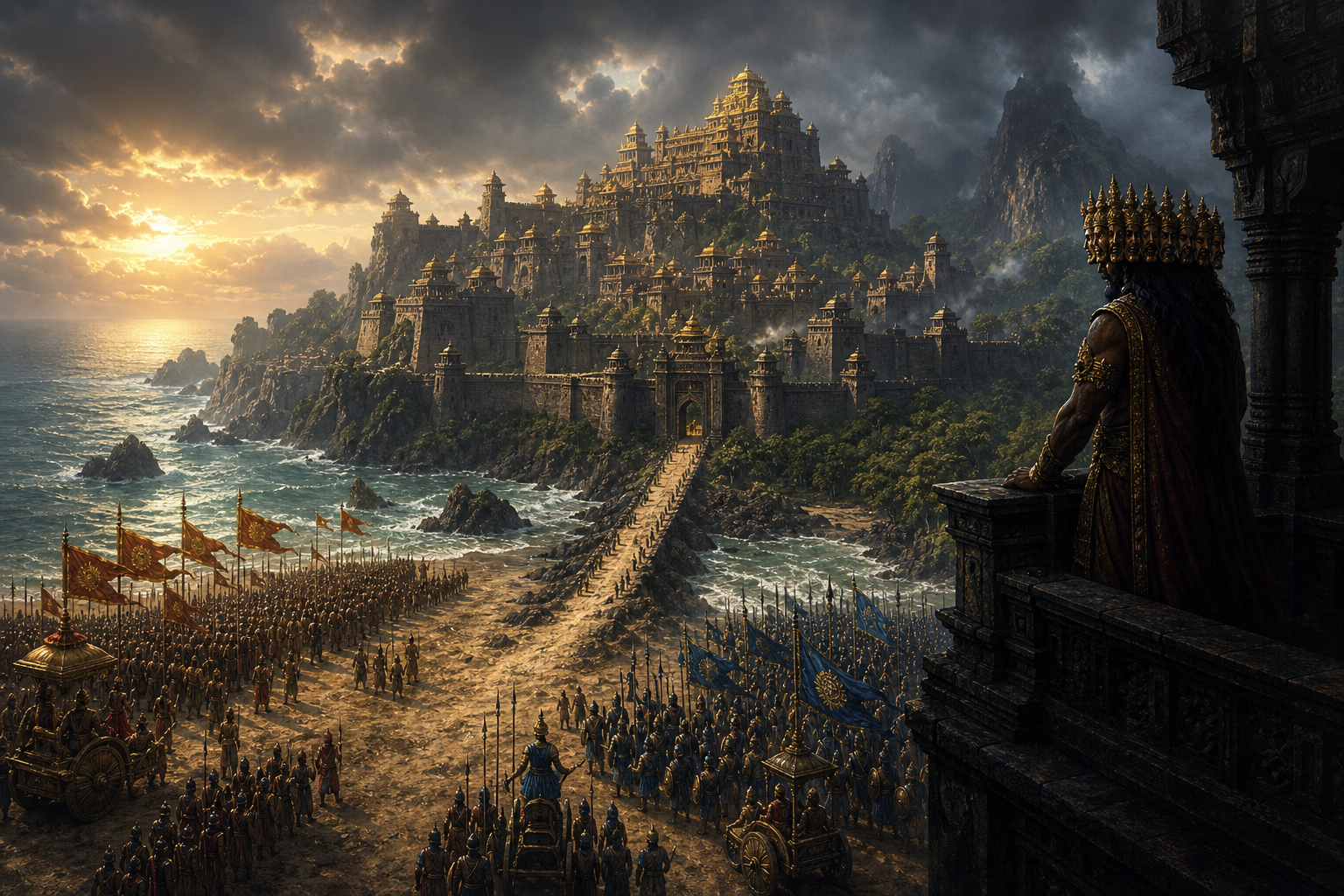
If you are trying to decide whether Lanka lost because Ravana fought too ethically, do not settle for that answer. The stronger reading is more demanding: Ravana accepted the visibility of dharma-yuddha after abandoning dharma in the cause of the war, then failed to adapt Lanka’s strategy to the constraints he had accepted.
You should keep three questions separate. Was the cause just? Were the means permitted? Did the commander build an effective plan within those limits? Lanka failed these tests at different moments. That is why neither moral restraint nor military inferiority, by itself, explains the campaign.
First, separate the treaty claim from the battle pattern
You will not find a clause-by-clause day-one treaty in the Valmiki Ramayana. There is no surviving instrument in which Rama and Ravana sign formal provisions banning night operations, maya, or particular astras. What the Lanka narrative does preserve is a recurring rhythm of visible daytime engagements, pauses after fighting, named warriors meeting in recognizable contests, and moral condemnation when deception crosses an ethical line. Later Sanskrit, vernacular, and oral traditions make that convention more explicit.
This distinction matters because a useful interpretation must not turn a pattern into a quotation. You can reasonably describe the opening campaign as operating under conventions associated with prakasa yuddha, or open warfare. You should not present a reconstructed legal agreement as though its complete wording appears in the primary narrative.
When you evaluate any disputed episode in the Lanka war, work through three layers in order:
- Narrative fact: What actually happens in the episode? Note the time of fighting, the target, the weapon or deception, and the response.
- Ethical judgment: Does the narrative praise, tolerate, condemn, or punish the conduct? Do not assume that every successful tactic receives moral approval.
- Strategic inference: Which side benefits from that mode of fighting, and which capabilities does it suppress? This is where the daylight convention becomes important for Lanka.
That method prevents two common errors. The first is to treat every later elaboration as a verbatim rule from Valmiki. The second is to assume that whatever an epic hero or villain does automatically defines the dharmic norm. Epics frequently teach by showing transgression and consequence, not only by presenting ideal conduct.
Dharma-yuddha sets a moral floor, not a rigid script
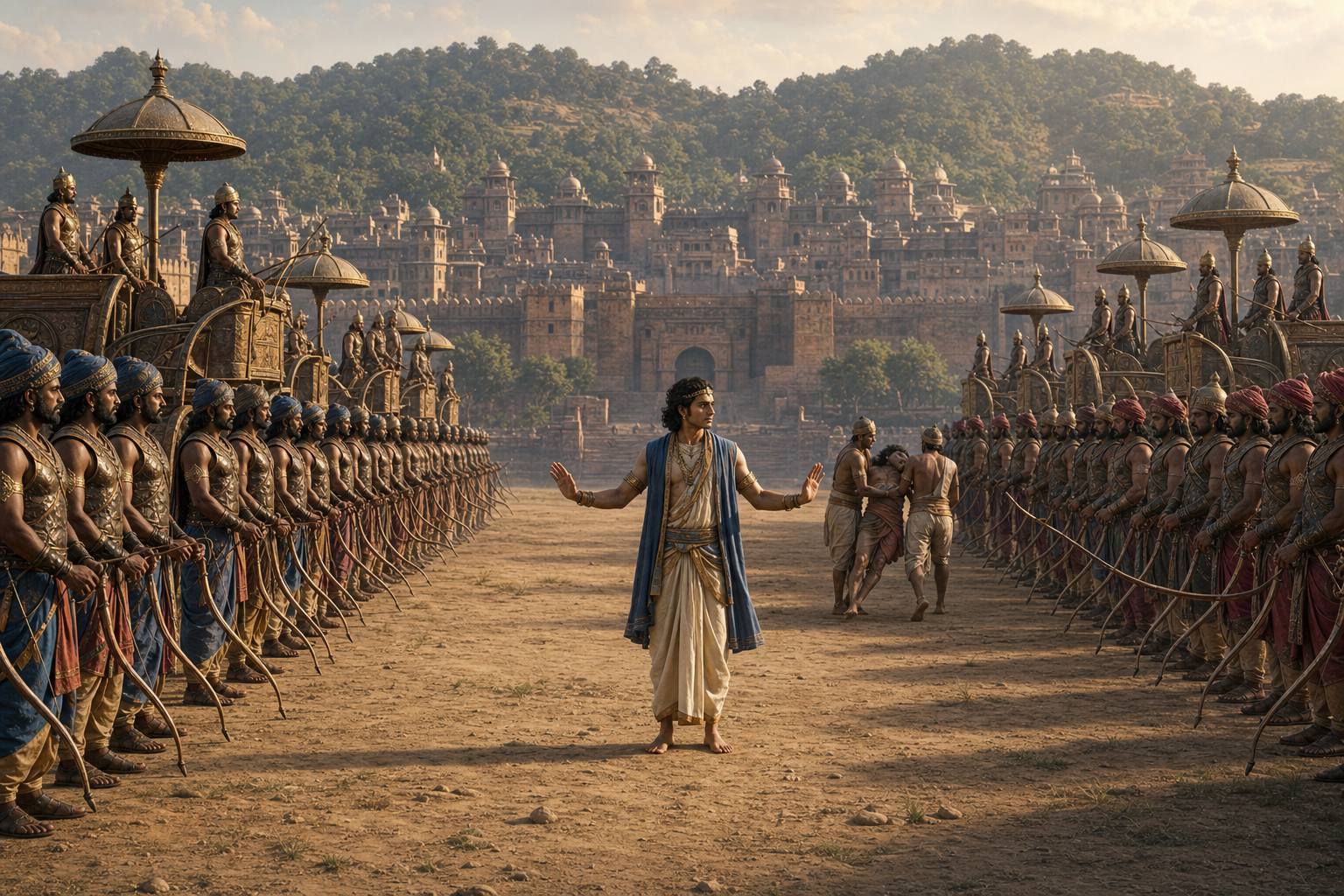
Dharma-yuddha does not require a commander to announce every plan, discard surprise, or fight in the manner most convenient to the enemy. Its central demand is that necessity remain governed by discrimination, proportionality, restraint, and a just purpose. The unarmed, the surrendered, those who flee, and people outside the fighting are not to be treated as convenient extensions of the battlefield. Poisoned weapons, poisoned water, indiscriminate burning, attacks on sleeping camps, and devastation of villages or agriculture fall below the dharmic floor.
| Question | Dharma-yuddha | Limited stratagem | Kutayuddha or Asura Vijaya |
|---|---|---|---|
| What is targeted? | Armed opponents and military capability | A specific military threat or formation | Non-combatants, sustenance, the environment, or society itself |
| What does deception do? | It may conceal timing, position, or intention without erasing protected status | It creates a bounded advantage under necessity and discrimination | It uses perfidy, fabricated terror, or systematic deceit to destroy trust and morale without a moral limit |
| How are vulnerable opponents treated? | The unarmed, surrendered, and fleeing are spared | Exceptional action is confined to the active threat | Helplessness becomes an opportunity for harm |
| What is the stopping rule? | Force ends when its just purpose has been secured | A countermeasure ends when the specific perfidious threat ends | Expediency displaces restraint, so escalation becomes self-justifying |
| What follows victory? | Lenience and restoration of order | Only what is needed to prevent renewed harm | Humiliation, plunder, terror, or domination as ends in themselves |
The practical dividing line is not simply open versus secret. Prakasa yuddha is visible and declared; tusnim yuddha is silent or concealed. Concealment can remain permissible when it is directed at a military objective and bounded by necessity. Kutayuddha begins when secrecy becomes the vehicle for prohibited harm, perfidy, indiscriminate destruction, or the deliberate collapse of civilian life.
Ask one sharp question whenever someone labels a tactic clever: does the deception hide a plan, or does it annihilate the protections on which humane conduct depends? Hiding troop disposition is not morally equivalent to poisoning a water supply. Disrupting an attacking formation is not equivalent to terrorizing its families. The label maya cannot decide the issue; target, purpose, effect, and limit must decide it.
Reciprocity also has a boundary. Kautilya permits defensive countermeasures when an enemy uses illicit methods, but this latitude functions as a shield against the particular threat, not as permission to imitate every atrocity. Once the threat ends, the exception must end. Otherwise the defender allows the enemy to rewrite the defender’s own moral code.
The restraint continues after the fighting. Victory, under some Dharmashastra formulations, does not authorize limitless annexation, mutilation of a defeated ruler, seizure of the treasury, or dishonor toward women. This is strategically important as well as humane: a settlement built on humiliation preserves the causes of another war.
Nor does the Dharmic family speak in one institutional voice. Jain ahimsa places the burden of justification on every use of force. Buddhist right intention and karuna test the motive that accompanies action. Sikh dharam yudh treats force as a last resort for righteous defense, never as an outlet for hatred or an excuse to attack non-combatants. The shared principle is narrower and stronger than a claim of uniformity: force must remain answerable to life, purpose, and restraint.
Lanka gave up advantages it could have used lawfully

Daylight favored Rama’s coalition
Lanka’s rakshasa forces drew unusual value from surprise, shapeshifting, rapid concentration, illusion, and nocturnal movement. Rama and Lakshmana, by contrast, brought archery that benefited from clear lines of sight. The vanara host could swarm, flank, refill gaps, and rally around visible leadership. A daytime rhythm therefore did more than make the war look honorable: it changed which capabilities mattered most.
Ravana effectively converted an asymmetric defense into a series of conspicuous contests. His champions still possessed immense power, but their distinctive advantages were reduced whenever battle became predictable, visible, and centered on recognizable duels. Indrajit’s stealth and illusion could still be introduced later, yet delaying those capabilities gave the invading coalition time to stabilize its command and morale.
The fortress and the Setu should have shaped the campaign
Lanka’s walls, moats, and coastal approaches favored a defender willing to make the attacker spend time, cohesion, and effort. Fighting prominently outside those defenses surrendered part of that leverage. The Setu also concentrated Rama’s movement, resupply, casualty evacuation, and communication along a crucial crossing. A strategy centered on the fortress and on legitimate military interdiction could have imposed friction without turning villages, water, crops, or non-combatants into targets.
This is the strategic distinction you should notice: dharma restricted what Lanka could attack, but it did not require Lanka to ignore terrain, conceal its dispositions, protect its gates passively, or allow enemy military logistics to operate without pressure. Ethical limitation and tactical predictability are not synonyms.
A dharmic asymmetric defense was still available
Within the ethical limits described above, a better-aligned Lanka strategy could have done the following:
- Keep the defense anchored to walls, moats, gates, and coastal approaches instead of repeatedly seeking symmetrical displays of valor outside them.
- Conceal military dispositions and the timing of sorties without using false protected status, indiscriminate terror, or attacks on helpless people.
- Concentrate pressure on attacking formations, combatant leadership, and military movement across the Setu while preserving civilian sustenance.
- Use bheda, or division, against the cohesion of the opposing fighting force only in calibrated ways, rather than spreading fear and social collapse among non-combatants.
- Employ exceptional countermeasures only against an identifiable illicit threat, and withdraw them when that threat stops.
- Maintain a diplomatic exit so that tactical success does not become the only route to regime survival.
Ravana’s mistake, then, was not that he accepted any ethical restraint. It was that he appeared to understand strategy as a choice between public chivalry and unbounded terror. A capable commander searches for advantage inside the moral boundary. Pride made Ravana choose a form of visible combat that advertised courage while muting the very force characteristics on which Lanka depended.
Ravana lost the cause, counsel, and intelligence battle first
Even a flawlessly observed battlefield code could not make Ravana’s underlying cause righteous while Sita remained captive. Right conduct in individual engagements cannot launder the purpose for which a war is continued. This is the first correction to the idea that Ravana simply became a victim of his own chivalry: selective compliance with battlefield etiquette is not the same thing as dharma.
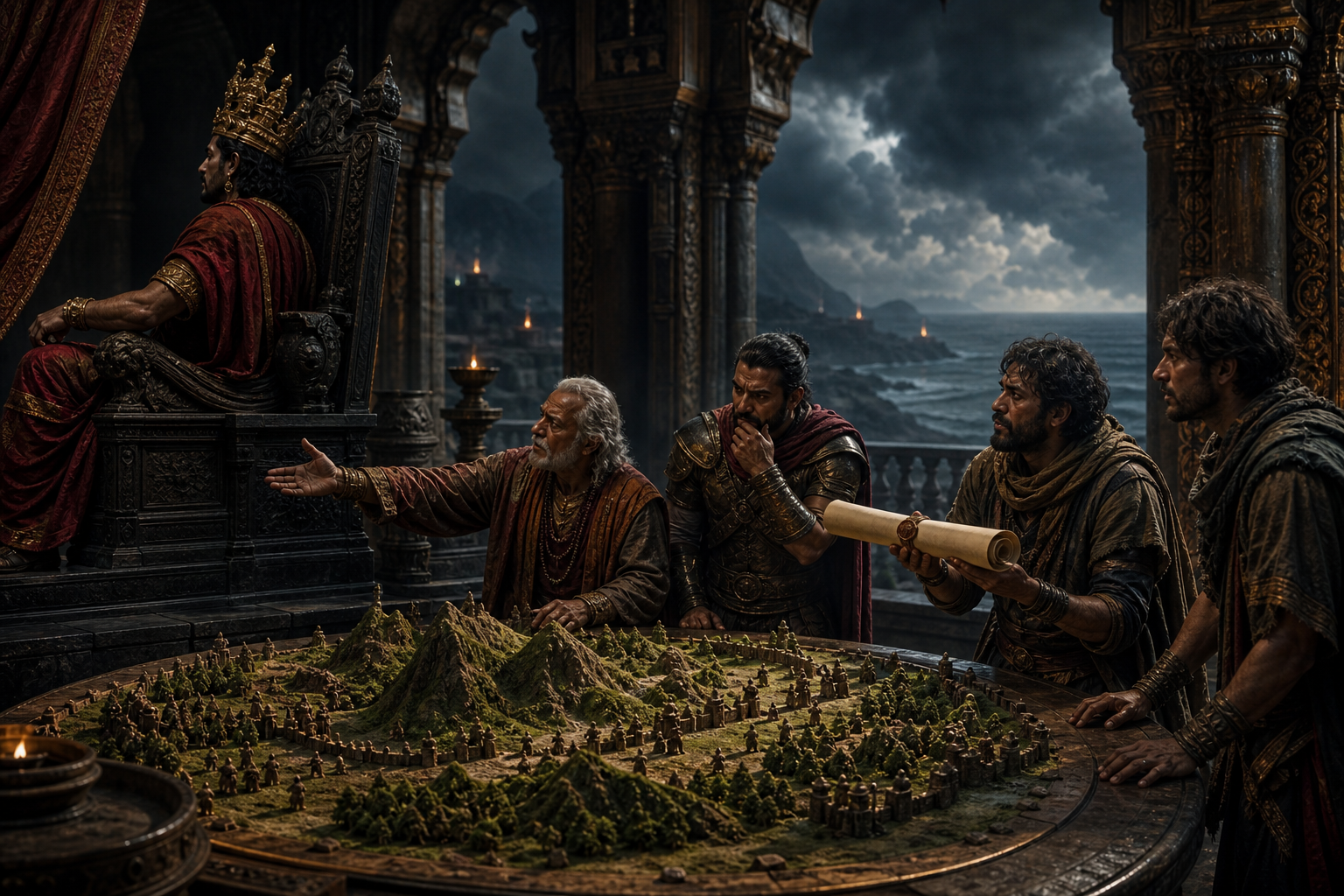
Vibhishana offered the most important strategic option available to Lanka: restore Sita, de-escalate, preserve life, and keep the kingdom from a ruinous war. Ravana rejected that exit and drove a knowledgeable counselor into Rama’s camp. Lanka then lost more than a dissenter. The opposing coalition gained insight into its order of battle, terrain, and operational habits. In practical terms, Ravana converted honest internal counsel into enemy intelligence.
You can use that episode as a leadership test. When someone warns that the objective itself is corrupt or unsustainable, do leaders examine the claim, or redefine disagreement as betrayal? A command structure that punishes inconvenient truth often discovers the same truth later as an external threat.
Indrajit’s illusion of Sita’s killing reveals the other side of the failure. Its purpose was not merely to hide a maneuver. It fabricated the apparent murder of the very person whose rescue gave Rama’s coalition its cause, hoping to produce despair and psychological collapse. That is why the episode stands as an emblem of maya severed from dharmic guardrails. The method sought advantage by manufacturing apparent atrocity, not simply by confusing the enemy about a combat formation.
The contrast is decisive. Operational secrecy protects a plan. Asura Vijaya makes terror and deception first-choice instruments, blurs the line between combatant and non-combatant, and treats the enemy’s moral universe as something to destroy. One conserves the possibility of order after victory; the other consumes it.
Rama’s restraint also operated as combat power in the moral domain. A cause presented as rescue and protection gave a diverse coalition a stable reason to fight. Predictable rules made coordination easier. Ravana’s reliance on fear, rejection of a peaceful exit, and expulsion of Vibhishana weakened the loyalty and informational security on which Lanka depended. Moral legitimacy did not replace weapons or command, but it affected who cooperated, who defected, and which side could sustain trust.
Key takeaways
- No clause-by-clause day-one pact survives in the Valmiki Ramayana; the careful claim is that a recurring convention of open, largely daytime combat shaped the early campaign.
- Dharma-yuddha prohibits perfidy, indiscriminate harm, poisoned means, attacks on the helpless, and destruction of civilian sustenance. It does not prohibit every secret plan or asymmetric method.
- Lanka’s strategic error was force-method misalignment: Ravana accepted a visible battle rhythm that favored Rama’s archery, vanara mass, and increasingly coherent command.
- A stronger defense could still have used fortifications, terrain, military secrecy, calibrated division, and pressure on combatant logistics without crossing the dharmic floor.
- Ravana’s rejection of Vibhishana sacrificed both a diplomatic exit and sensitive knowledge about Lanka’s defenses.
- Indrajit’s false vision of Sita’s death shows the boundary between concealing a military plan and using fabricated atrocity as terror.
- Right cause, permitted means, adaptive competence, and a stopping rule must be judged separately. Success in one category cannot erase failure in another.
The next time you hear that dharma makes a society weak, test the claim through five questions: What is the cause? Who is targeted? What protection does the method preserve or destroy? Where is the limit? What makes the violence stop? Lanka warns against ruthlessness, but it also warns against hollow displays of honor that pride has detached from competent strategy. The task is not to choose between ethics and effectiveness. It is to become effective without surrendering the moral floor that makes victory worth having.
References
- The Dharma Dispatch – Inside Yuddha Dharma: How Hindu War Ethics Contrast Kutayuddha, Asura Vijaya, and Jihad
- DharmaRenaissance Blog – The Day-One Blunder Ravana Signed: A Proud Pact That Crippled Lanka’s Ramayana War Strategy