

Suppose you lead a temple committee, cultural association, family enterprise, or public institution. An old commitment now conflicts with a fair outcome. A loyal colleague has made a serious mistake. People want an immediate display of strength. You need to decide what dharma requires before urgency, loyalty, and reputation decide for you.
Asking what Rama would do is useful only if you go deeper than finding an episode that justifies the action you already prefer. The Ramayana offers something more demanding: a way to identify competing duties, place limits on power, seek capable counsel, act proportionately, and examine who will bear the cost of your decision.
Dharma becomes visible when legitimate duties collide

The easy leadership decision is the one in which honesty, loyalty, compassion, law, and public confidence all point in the same direction. The decisive test comes when each points somewhere different. That is the moral terrain in which Rama is remembered as Maryada Purushottama: the exemplary person whose conduct remains within ethical bounds even when power, affection, and suffering pull against one another.
Rama’s acceptance of fourteen years of exile is not a lesson in passive obedience. Kaikeyi invokes Dasharatha’s boons, Rama relinquishes the throne, and Bharata refuses to convert the injustice into his own kingship. Bharata instead preserves continuity as regent, placing Rama’s sandals on the throne while governing from Nandigrama. The brothers respond differently, yet neither treats the kingdom as personal property. Their conduct places duty, restraint, and legitimate stewardship above possession of office.
This distinction matters in your own institution. A title may be legally yours while the authority attached to it remains a trust. Conversely, surrendering a title can be theatrical if you continue controlling every decision from behind the scenes. The practical question is not simply whether you stay or resign. It is whether your conduct protects the purpose of the office without turning that office into an extension of your ego.
Before choosing a course, write down the claims that actually compete:
- Your duty to the purpose of the role.
- Your duty to promises already made.
- Your duty to the people most exposed to harm.
- Your duty to establish and communicate the truth.
- Your duty to preserve legitimate public confidence.
Do not hide the collision behind a general statement about doing the right thing. Name it precisely: keeping this promise protects continuity but burdens these people; disclosing this failure serves truth but may damage a valuable institution; removing this person limits immediate risk but may deny a fair hearing. Once the conflict is visible, you can reason about dharma. Until then, moral language is likely to conceal preference.
There is also a crucial difference between accepting a cost yourself and assigning it to someone with less power. Rama gives up royal privilege. Bharata gives up the crown he could have claimed. Their renunciation does not prove that every inherited promise must be enforced regardless of consequence. It does show why a leader should ask: am I protecting dharma by bearing a burden, or protecting my image by making someone else bear it?
Devotees approach Sri Rama as Lord and Maryada Purushottama, not merely as a management archetype. A practical leadership reading should therefore deepen reverence rather than reduce bhakti to corporate technique. The Ramayana’s ethical reach across Hindu, Buddhist, Jain, and Sikh settings likewise does not erase their distinct philosophies. It reflects a shared seriousness about duty, ahimsa, inner restraint, service, and responsibility to the community.
Maryada turns good intentions into operating discipline
Maryada is often translated as a boundary, limit, or proper order. For a leader, it is the line you refuse to cross even when crossing it would be convenient. Without such limits, sincerity is not enough. A person can sincerely believe in a cause and still deceive allies, humiliate an opponent, punish a dissenter, or conceal failure in the cause’s name.
The Ramayana repeatedly tests action against truth, compassion, and public trust. It also refuses the idea that a desirable end automatically purifies any means used to reach it. You can turn that ethical architecture into a decision process:
- State the purpose. Complete the sentence: this decision is necessary in order to protect what? Name the actual responsibility, not a slogan such as tradition, unity, or progress.
- Establish the facts. Separate what is known, what has been alleged, what has been inferred, and what remains uncertain. Urgency does not transform an allegation into evidence.
- Map the affected people. Include opponents, dependants, volunteers, employees, families, and people who cannot easily object. Power tends to make invisible those who will pay quietly.
- Declare the boundary. Write down the means you will not use: deception, collective blame, personal vengeance, coerced agreement, or the concealment of relevant facts.
- Invite counsel and dissent. Ask someone competent to argue against your preferred option. If disagreement carries a personal penalty, you are not receiving counsel; you are receiving compliance.
- Choose a proportionate response. Use enough authority to address the wrong, but do not enlarge the action merely to demonstrate dominance.
- Define restoration. Decide how ordinary trust, responsibility, and service can resume after the intervention. A punishment without a path back to order may satisfy anger while leaving the institution weaker.
This process is stricter than asking whether your motive is pure. Motives are difficult to inspect and easy to praise. Boundaries, evidence, affected people, and remedies are visible. They allow others to test whether your conduct matches your stated dharma.
Promises deserve special care. Rama’s exile gives promise-keeping enormous moral weight, but it should not be flattened into mechanical vow worship. A leader must ask what the promise protects, who made it, who is being made to pay for it, and whether fulfilling it now would violate a more fundamental obligation. Faithfulness is a virtue; using an old promise to avoid present moral reasoning is not.
Dharmic authority listens, delegates, and forms principled alliances

Rama does not move through the epic as an isolated ruler who already possesses every answer. Vishvamitra guides the young princes. Forest sages offer counsel and context. Rama and Sugriva form a reciprocal alliance. Sugriva organizes scouts in every direction. Jambavan’s counsel, Sampati’s information, and Hanuman’s capacity turn a broad search into a successful mission. Vibhishana demonstrates that integrity can survive even within an adversarial structure. These relationships show leadership operating through counsel, alliance, intelligence, and trusted service.
The modern failure is easy to recognize. A committee is formally consulted after the chair has already decided. Experts are invited but overruled whenever their findings become inconvenient. The same dependable volunteer receives every difficult assignment until seva becomes exploitation. An ally is valued only while useful. None of these arrangements produces genuine counsel.
For an important decision, make sure four voices are present:
- The keeper of facts, who distinguishes evidence from assumption and corrects errors without protecting status.
- The keeper of human consequences, who identifies burdens that may be invisible to senior people.
- The principled dissenter, who tests the preferred option and can disagree without retaliation.
- The executor, who knows what the decision will require in practice and where implementation is likely to fail.
In a small organization, one person may carry more than one role. What cannot be omitted is independent dissent. Do not assign that responsibility to someone whose position depends entirely on pleasing you.
Hanuman also offers a precise model of delegated authority. He receives a mission, carries Rama’s ring, finds Sita in Ashoka Vatika, gives reassurance, gathers information, and returns with Sita’s chudamani and a usable report. He has room for courage and judgment, but his initiative remains directed toward the mission rather than personal glory. His strength is joined to humility, discernment, seva, and fidelity.
When you delegate, therefore, specify the objective, the moral boundaries, and the information that must come back. Do not prescribe every movement. Afterward, ask three questions: what did you learn, which assumption proved wrong, and what should we do next? Delegation without boundaries invites abuse; delegation without discretion wastes capable people.
Use the same discipline when forming alliances. Clarify the shared objective, each side’s obligation, and what happens after the immediate problem is solved. A principled alliance does not require identical beliefs. It does require enough truth and reciprocity that neither side is merely using the other.
A just victory restores order instead of feeding conquest

Dharmic leadership cannot assume that every conflict will dissolve through goodwill. Ravana’s coercion of Sita leads to a war in which courage and force become necessary. Yet the moral question does not disappear once a cause is judged righteous. It becomes more exacting, because power exercised under the banner of dharma can become difficult to question.
The Ramayana frames legitimate force through clarity of purpose, proportional conduct, counsel, and responsibility for the order that follows. Ravana’s defeat is not followed by Rama seizing Lanka for himself. Vibhishana is crowned, while Rama returns to Ayodhya. Victory culminates in restored governance rather than indefinite possession. This is why the manner of action matters to legitimacy and lasting peace.
The same test applies below the level of warfare. Expelling a member, dismissing an office-holder, imposing sanctions, initiating litigation, or publicly exposing misconduct may sometimes be warranted. Before acting, answer these questions in plain language:
- What exact wrong are we trying to stop?
- What evidence establishes it?
- Does the response distinguish the responsible person from dependants, bystanders, and the wider community?
- What condition will end the intervention?
- Who will restore normal service, trust, and accountability afterward?
If you cannot state the wrong precisely, the action is vulnerable to mission creep. If you cannot name an ending condition, temporary emergency power may become permanent authority. If you have planned the punishment but not the restoration, you have prepared for victory as an emotion rather than governance as a duty.
Do not call an action dharma-yuddha merely because you feel certain of your cause. The label does not remove the obligations of truth, proportionality, restraint, and care for what follows. A righteous purpose should make the leader more accountable for the means used, not less.
Public trust must not become moral outsourcing
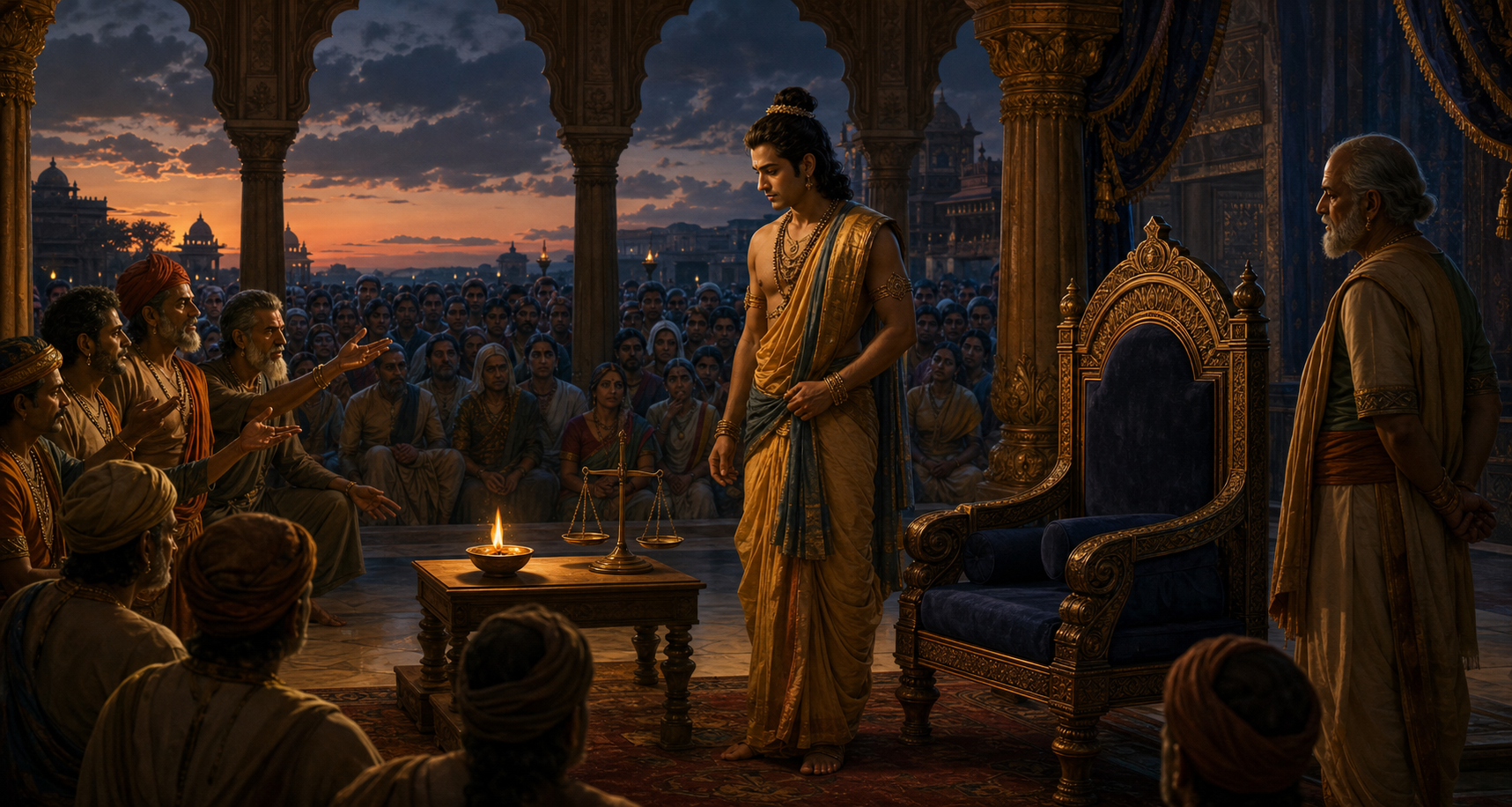
The most difficult leadership reading of the Ramayana appears in Sita’s treatment. After her abduction, she undergoes the agni-pariksha as a public affirmation of chastity. Later, public censure leads Rama to exile the pregnant Sita to Valmiki’s hermitage, where Lava and Kusha are born. Some readers regard the Uttara Kanda as containing later redactional layers, while its centuries of devotional reception remain part of the tradition’s moral life. The episode’s textual and ethical difficulty should be acknowledged rather than smoothed away.
You do not have to force this episode into either an easy defence or an easy dismissal before learning from it. It makes a permanent leadership problem impossible to ignore: what happens when public confidence, institutional reputation, intimate duty, justice, and the dignity of an affected person appear to conflict?
Public trust matters. Public mood is not the same thing. Trust should be grounded in truthful conduct, fair process, and visible responsibility. Rumour, prejudice, or outrage does not become dharma merely because it is widespread. A leader who follows every wave of opinion has outsourced moral judgment while retaining the authority and prestige of office.
Before invoking community confidence to justify a painful action, conduct a burden audit:
- Is the alleged loss of confidence based on verified conduct, or on suspicion and repetition?
- Has the affected person received a meaningful opportunity to be heard?
- Who is choosing the decision, and who will live with its consequences?
- Are people with less status being asked to absorb the cost of protecting institutional reputation?
- What protection, remedy, or path to correction is available if the judgment proves wrong?
- Could you defend the same decision if it brought no praise and damaged your own standing?
A leader’s willingness to suffer personally can be admirable, but it does not settle the question when another person bears a greater involuntary burden. That is especially important in families and religious institutions, where appeals to honour, unity, sacrifice, or tradition can silence the person with the least authority.
Rama Rajya remains compelling as an aspiration for ethical governance because authority is imagined as answerable to dharma and the common good. To pursue that aspiration now, you also need fair hearings, truthful records, protected dissent, and ways to correct error. Without those disciplines, maryada can be reduced to reputation management, and public trust can become a reason to abandon justice rather than uphold it.
Key takeaways
- Dharma is clearest when you name the legitimate duties that conflict instead of hiding them behind a slogan.
- Treat authority as a trust attached to an office, not as personal possession.
- Set moral boundaries before urgency and anger narrow your choices.
- Give counsel real independence, and give capable agents both clear limits and room for judgment.
- Measure force by its purpose, proportionality, ending condition, and plan for restoration.
- Audit who bears the cost whenever public confidence is used to justify harm.
Take one unresolved decision in front of you and reduce it to a single page. Write five lines: the purpose you serve, the duties in conflict, the boundary you will not cross, the dissent you still need to hear, and the repair required afterward. If you cannot name the people who will pay for your choice, you are not ready to announce it. That pause is not weakness. It is where dharmic leadership begins.