
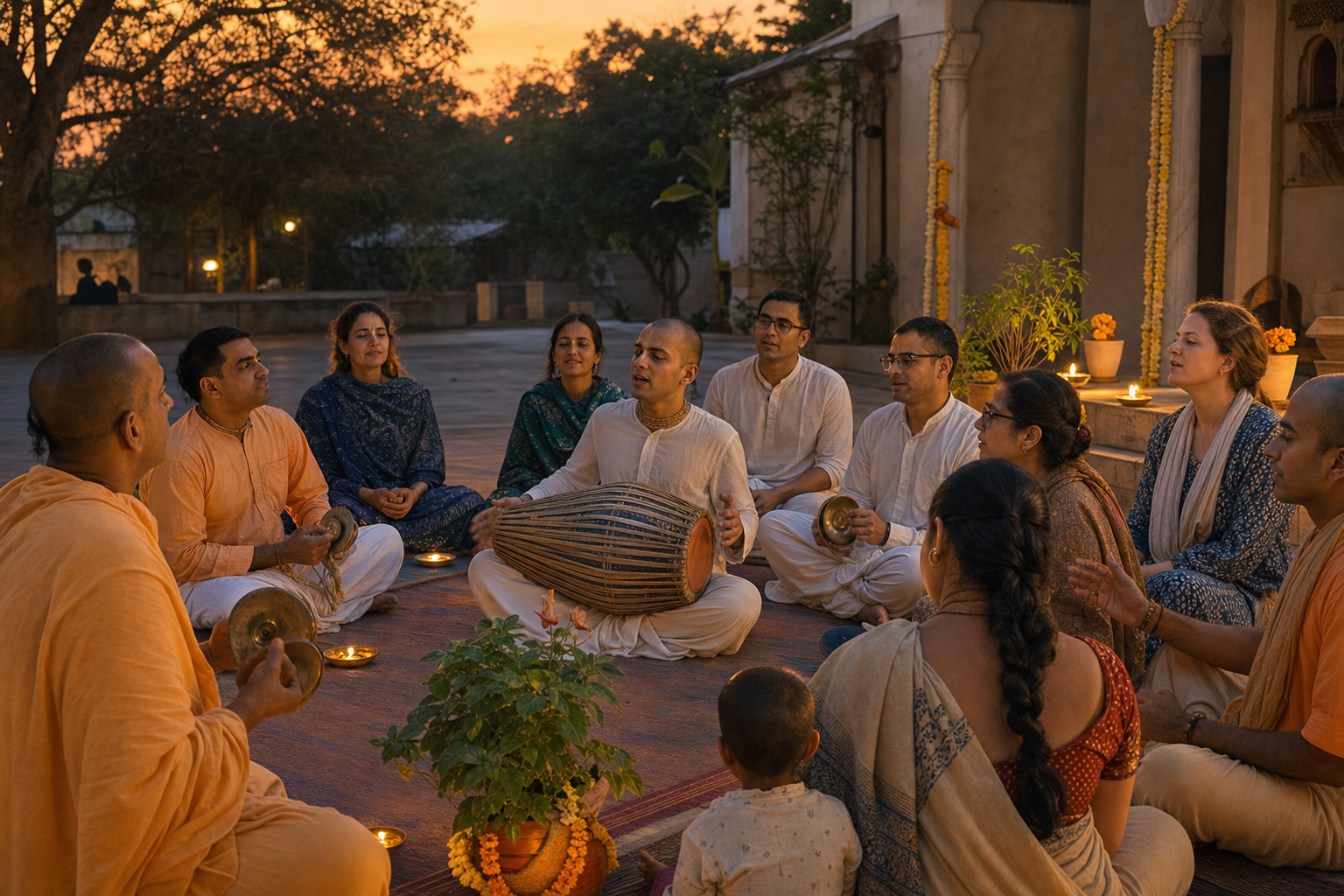
You may have discovered Gaudiya Vaishnavism through a crowded kirtana, only to wonder what remains when the mridanga falls silent. Or you may chant alone and want spiritual company without feeling that you must adopt a social identity before you understand the theology.
A sound community answers both concerns. It lets you practise before you perform belonging, study without treating devotion as intellectually thin, and serve without being pressured into public enthusiasm. Its centre is nama: the divine name heard attentively, repeated faithfully, understood through scripture, and carried into relationships.
Treat the holy name as an encounter, not an atmosphere
Gaudiya Vaishnavism makes a precise theological claim: the holy name, nama, is non-different from the Lord who is named, nami. Chanting is therefore not merely a symbolic reminder of Krishna. Within this tradition, it is direct contact with the self-revealing Absolute through sacred sound.
That claim prevents three common reductions. The maha-mantra is not background music added to create a devotional mood. It is not a cultural badge used to separate insiders from outsiders. Nor is it simply a concentration technique valued only because repetition can settle the mind. Attention, identity, and emotional steadiness may all be affected, but they remain consequences rather than the theological centre of the practice.
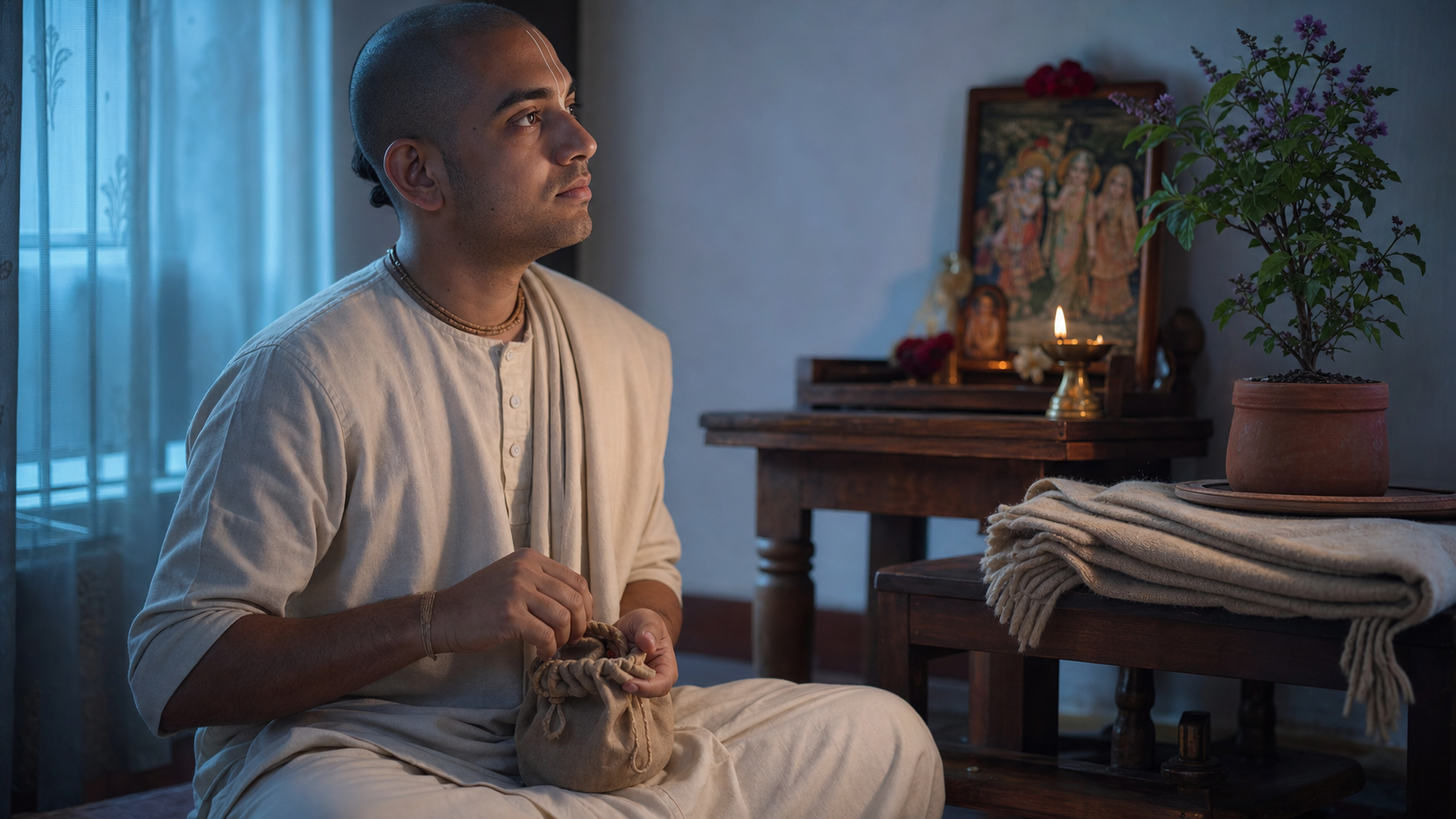
Direct access does not mean casual practice. If the name is understood as Krishna’s presence, listening becomes as important as vocalising. You do not rush through the mantra while mentally living elsewhere. You hear the name you are uttering, notice when attention has wandered, and return to the next audible name without turning distraction into a drama.
Sri Caitanya Mahaprabhu’s encounter with Advaita sannyasis in Kashi also corrects the idea that chanting replaces serious thought. When questioned about giving prominence to public sankirtana rather than remaining exclusively absorbed in Vedantic study, Caitanya began with his guru’s instruction to chant. He then displayed formidable scriptural reasoning, including layered explanations of the Atmarama verse of Srimad-Bhagavatam 1.7.10. The practical lesson is not to choose between devotion and disciplined inquiry. Chanting purifies the orientation of study, while study gives language, discrimination, and depth to devotion.
You can put that relationship into practice with a simple cycle:
- Choose a regular setting in which you can chant without continually negotiating whether to begin.
- Pronounce the mantra clearly enough to hear what you are saying.
- Place attention on the present name rather than judging whether the session feels spiritually intense.
- When the mind wanders, return to the sound now being uttered instead of replaying the distraction.
- Carry one genuine question from your practice into scriptural study or a trusted discussion circle.
This keeps japa from becoming mechanical and study from becoming detached speculation. It also gives you a better measure of progress than emotional excitement: are you becoming more willing to hear, learn, correct yourself, and serve?
Let japa and kirtana do different work
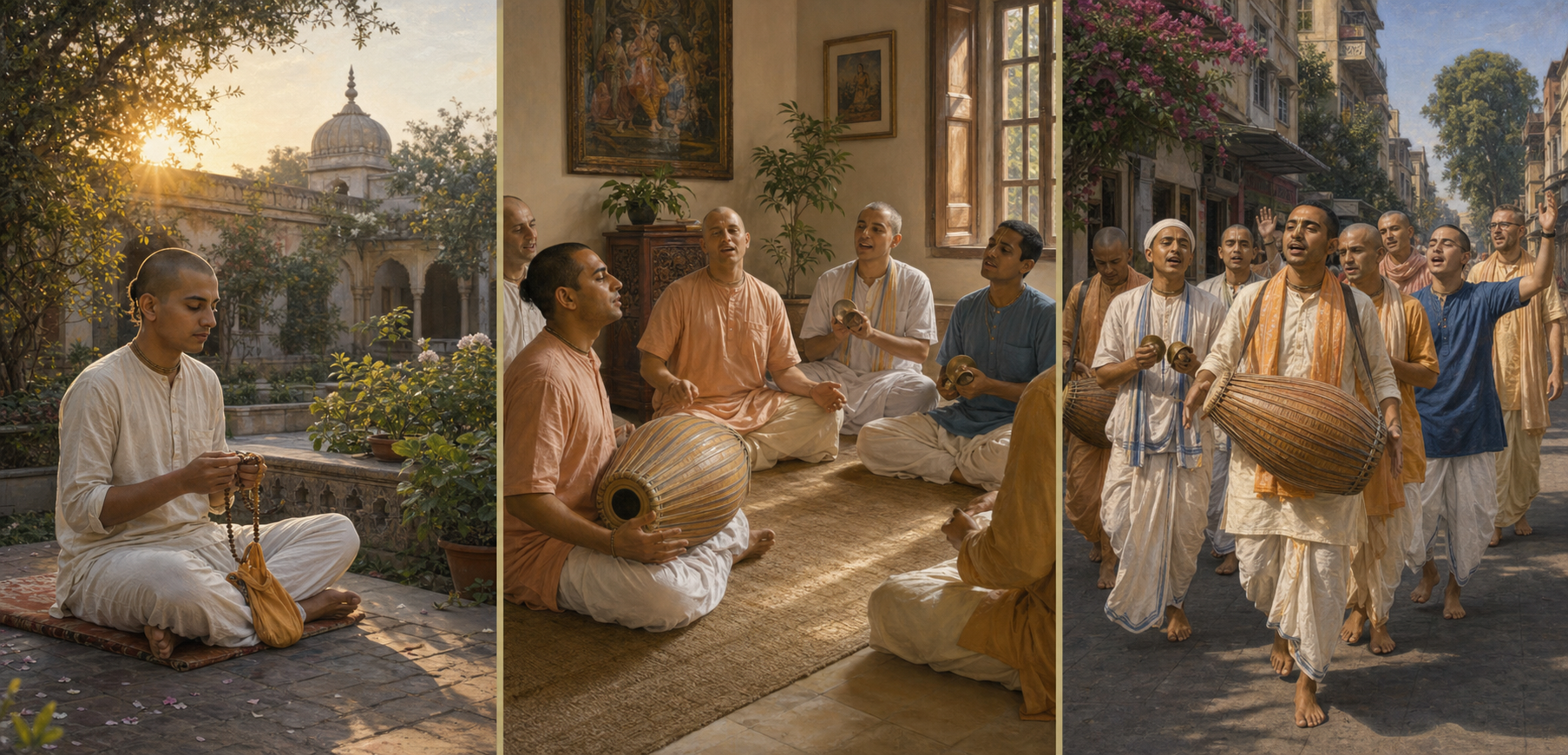
Japa and congregational kirtana belong to the same path, but they expose different parts of you. In solitary repetition, there is no crowd energy to carry your attention. You meet your habits of haste, bargaining, fantasy, and resistance directly. Kirtana places you inside a shared rhythm, where listening, leading, responding, and making room for other voices become part of the discipline.
A well-led kirtana does not require everyone to be a trained singer. Its call-and-response form, repeating refrain, steady pulse, handclaps, and percussion give a newcomer a clear way to enter. You hear the leader, respond with the group, and gradually participate without needing to master a complicated composition first.
The collective lift can be powerful, but it should not become your only test of spiritual value. A fast tempo, a skilled musician, or an expressive crowd can generate intensity. None of those things by itself proves attentive remembrance, mature devotion, or good community. Notice what happens when the music becomes quieter, when a newcomer misses the response, or when someone does not wish to dance. A devotional gathering should still have room for that person.
If you are attending for the first time, you do not need to imitate anyone else’s outward expression. Stand or sit where you can hear. Join the response when you are comfortable. Let the rhythm support the mantra rather than becoming the object of your attention. In a temple, observe the announced expectations concerning modest dress, darshana, arati, and photography. Ask about anything you do not understand; respectful participation does not require pretending to possess knowledge you lack.
Afterward, evaluate the gathering with practical questions:
- Could you hear the mantra distinctly, or did musical display overwhelm it?
- Could a newcomer understand when and how to respond?
- Did the leaders make participation possible without demanding it?
- Was there space to ask what the mantra and rituals mean?
- Was there an ordinary next step, such as japa, study, prasada, or seva?
These questions help you distinguish a memorable event from a community capable of sustaining practice.
Build community around five shared acts
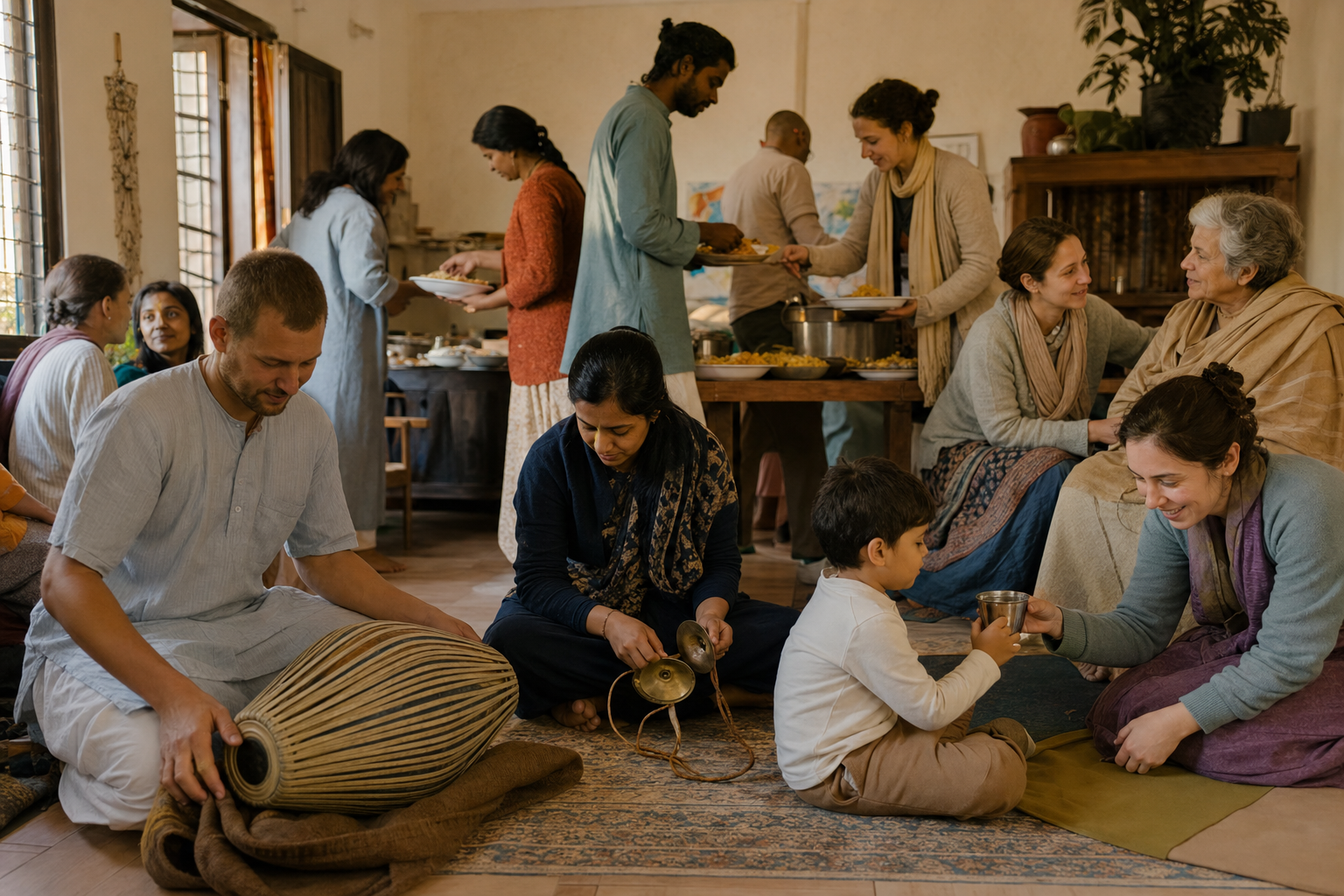
A calendar full of festivals is not necessarily a strong congregation. Community becomes durable when the same people repeatedly chant, worship, learn, eat, and serve together. The familiar arrangement of a kirtana hall, altar, prasada kitchen, classrooms, and spaces for service and cultural education reflects this larger devotional ecology. Each element meets a different human and spiritual need.
- Kirtana makes devotion participatory. The congregation should not be divided permanently into performers and spectators. Leadership matters, but its purpose is to help everyone hear and respond.
- Darshana and arcana place the community before the deity. In Vaishnava worship, the altar is not decoration for a gathering centred on human personalities. Consecrated forms are approached as a living locus of divine presence. That shared orientation reminds leaders and visitors alike that the community is not its own ultimate object.
- Scriptural study gives devotion intellectual accountability. Bhagavad-Gita and Srimad-Bhagavatam study should make room for careful reading and sincere questions. A healthy teacher can explain the lineage’s conclusions without treating every request for clarification as hostility.
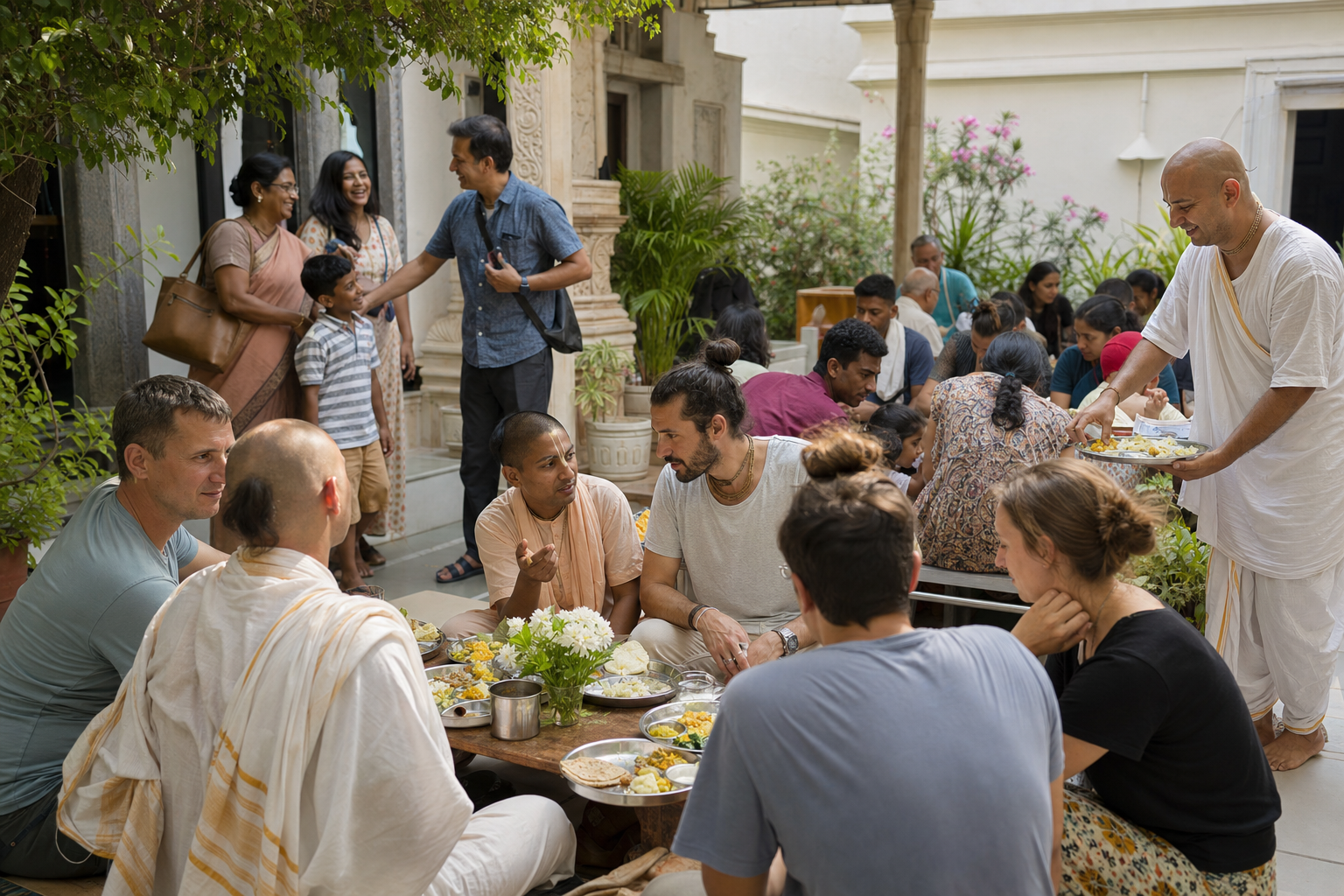
- Prasada turns hospitality into practice. Sanctified food extends worship beyond the formal ritual and creates a natural setting in which people of different ages and levels of experience can meet. The meal is not merely an amenity added after the important programme.
- Seva converts belonging into responsibility. Preparing the hall, serving prasada, teaching, cleaning, welcoming visitors, learning devotional music, or helping with outreach gives affection a practical form. Choose a bounded responsibility you can sustain rather than making an enthusiastic promise that will soon become resentment.
If you are looking for a congregation, return on an ordinary day rather than judging it only by its largest festival. Celebration shows what a community can assemble; routine shows how it treats people. Notice whether volunteers are respected, whether questions receive serious answers, whether children and elders are included, and whether service is shared or concentrated in a small exhausted circle.
If you help organise a gathering, make the next step visible. A person who has just experienced kirtana should be able to discover where to learn japa, when scriptural discussion occurs, how prasada is understood, and whom to approach about seva. Without that bridge, even an uplifting gathering can remain an isolated experience.
Take sankirtana into public life as an invitation
Public harinama can turn an ordinary civic space into a meeting point between devotion and curiosity. During a city-centre harinama in Nottingham, passers-by paused, filmed, smiled, clapped, and sometimes joined the movement. That response illustrates what respectful sacred presence can make possible, but it is not a guarantee that every crowd will react in the same way.
Harinama serves public dharma best when its manner is invitational. Participation must remain optional. The refrain should be easy to follow, but nobody should be treated as an audience member who owes a response. Leaders should remember that attracting attention is not the same as receiving consent, and that visible enthusiasm is not the only respectful reaction. Someone who listens quietly, asks a difficult question, or simply makes space for the procession has also encountered the practice.
Public sankirtana should also lead somewhere more substantial than spectacle. If an interested person approaches, offer a clear explanation and an accessible next step: a temple visit, an introductory discussion, a shared meal, or an opportunity to learn about the mantra. The credibility of public joy increases when the community behind it is also known for learning, hospitality, ethical conduct, and seva.
In a plural Dharmic setting, you can recognise shared patterns without pretending that every tradition teaches the same doctrine. Sikh Naam Simran, the Jain Namokar Mantra, Buddhist mantra recitation and buddhanusmrti, and Gaudiya nama-bhakti all give disciplined sacred remembrance an important place. Yet their theological explanations and spiritual aims should not be flattened into interchangeability.
A precise explanation can be both confident and hospitable: for Gaudiya Vaishnavas, the divine name is understood as non-different from the named Lord; other Dharmic paths also cultivate transformation through sacred recitation while explaining its meaning in their own terms. This avoids two failures at once. You do not conceal Gaudiya siddhanta in the name of harmony, and you do not turn a genuine family resemblance into a claim that other traditions must secretly mean what you mean.
The same discipline applies inside the broader Hindu family. Caitanya’s Kashi dialogue did not require Advaita Vedanta to become Gaudiya theology before respectful engagement was possible. Humility, scriptural seriousness, and confidence in practice allowed disagreement to remain part of a Dharmic conversation rather than becoming a contest for humiliation.
Key takeaways
- Approach the maha-mantra as sacred encounter, not devotional background sound or a technique for manufacturing a mood.
- Use japa to train sustained hearing and kirtana to practise listening, responding, and making room for others.
- Look for a community that joins nama, deity worship, scriptural learning, prasada, and seva into one repeatable way of life.
- Judge a congregation by its ordinary habits as well as its festival energy: how it answers questions, shares work, welcomes newcomers, and treats volunteers.
- Keep public sankirtana invitational, then give interested people a clear route from curiosity to practice and service.
- Recognise sacred sound across the Dharmic family without erasing real differences in doctrine, language, lineage, or spiritual aim.
At your next gathering, do not chase a peak experience. Choose a regular practice of attentive nama, bring one honest question to scriptural study, and accept one manageable act of seva. If you organise the gathering, make sure the person walking in knows how to join, where to ask, and what can come next. Sacred sound sustains community when hearing becomes relationship and relationship becomes service.
References
- Dandavats — Caitanya Mahaprabhu in Kashi: Dialogue with Advaita Sannyasis and the Power of Nama-Bhakti
- Dandavats — Jagannath Arrives in Sahibabad: A Majestic ISKCON Temple and Beacon of Dharmic Unity
- Dandavats — Rise Retreat 2026, Nottingham: Harinam, Bhakti, and Building a Dharmic Community of Love