

You may revere the Ramayana and still hesitate over how to apply it. Rama’s fidelity to duty inspires; Sita’s ordeals trouble; Hanuman’s seva seems clear until your own duties collide. The useful question is not which character you should imitate, but how you should recognize dharma when every available choice carries a cost.
The Ramayana remains a living sacred tradition when it trains judgment, disciplines speech, shapes worship, and changes how a community cares for people and places. You do not preserve it merely by defending it. You preserve it by allowing it to correct you.
Begin with the conflict, not a slogan about dharma
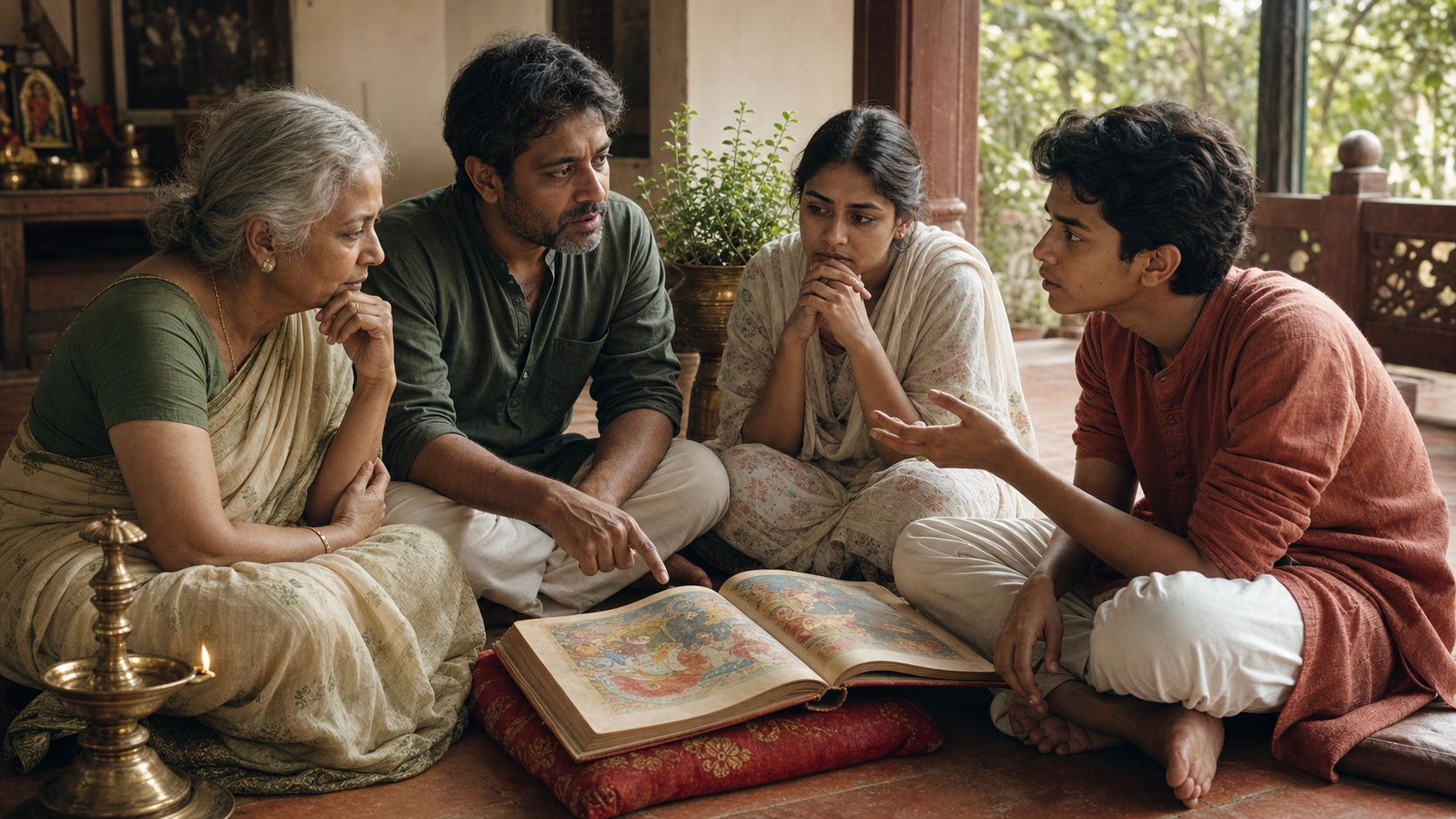
Dharma in the Ramayana is rarely a convenient rule that produces a painless outcome. It arises within relationships: child and parent, ruler and subject, husband and wife, sibling and sibling, warrior and enemy, devotee and Lord. A decision may satisfy one relationship while wounding another.
Rama accepts exile when King Dasaratha’s command places filial duty above succession. Later, after the victory in Lanka, the narrative places private loyalty beside the demands of public kingship. The crisis becomes most severe when pati-dharma, rajadharma, and public expectation no longer point in the same direction. The pain is not incidental to the teaching. It reveals what a simple command such as follow your duty leaves unresolved.
When you use the Ramayana to think through a real decision, examine five lenses separately:
- Truth: What is known, what is inferred, and what is merely repeated?
- Role: Which duties arise because you are acting as a parent, spouse, citizen, leader, friend, or trustee?
- Power: Who can defend themselves, and who will carry a decision made by someone stronger?
- Consequences: What harm is immediate, and what damage will remain after public approval has moved on?
- Repair: If no option is clean, what restitution, protection, or continuing responsibility must accompany the choice?
Write the answers down rather than letting duty remain a grand word. If you cannot separate evidence from reputation, do not call social pressure truth. If the least powerful person must suffer so that the most powerful person can appear blameless, pause before calling the result dharmic. Rajadharma includes public trust, but trust built by sacrificing substantive justice to rumor is already unstable.
The Ramayana’s presence in Hindu, Buddhist, Jain, and Sikh interpretive horizons does not make every telling doctrinally identical. It does allow a disciplined comparison of recurring concerns such as truth, restraint, compassionate rule, personal integrity, and responsibility under pressure. When you read across Dharmic traditions, compare the moral question being asked; do not manufacture sameness where distinct traditions preserve different answers.
Read Sita as a moral agent, not a problem to be solved

Agni Pravesha is often reduced to a verdict about Rama. That reduction obscures Sita. Within the epic’s ritual world, Agni is the witness of vows and a sacred arbiter of truth. Sita invokes that witness, enters the fire, and is returned unscathed; the divine affirmation makes her purity public. Rama then declares that the demonstration was for the world rather than the resolution of a private doubt. Later traditions using the figure of Maya Sita or Chaya Sita alter the theological explanation, but they retain the insistence that Sita’s integrity is inviolable.
None of this turns trial by ordeal into a model for handling modern accusations. The ethical point available to you is sharper: a community must not confuse its demand for spectacle with justice. Sacred symbolism belongs to the ritual universe of the episode. It cannot be used to demand that an innocent person repeatedly prove innocence to satisfy an audience.
The later exile makes that danger unmistakable. Public murmuring, represented by a washerman’s taunt, places royal reputation against Sita’s already affirmed character. Pregnant Sita is taken to the forest, finds shelter in Maharishi Valmiki’s ashrama, and gives birth to Lava and Kusha. When the twins eventually recite the Ramayana before the court, public power is made to hear the human story that public judgment had compressed into suspicion. Sita finally sets the terms of her last vindication and calls upon Bhumi Devi. The Earth receives her. She does not remain available for an endless cycle of accusation and proof.
Carry four boundaries from this episode into contemporary life:
- Do not cite Sita’s ordeal to tell a survivor or accused person that suffering silently is their duty.
- Do not make a vulnerable person carry the burden of protecting an institution’s reputation.
- Do not reopen a settled accusation merely because repetition makes the rumor feel socially important. New scrutiny requires new evidence.
- Do not treat citizens as spectators without duties. Refusing to forward an unverified allegation is also an act of dharma.
The textual history of the Uttara Kanda remains debated. Some readers and scholars understand it as a later textual stratum, while others defend the unity of the Valmiki Ramayana. You need not pretend that this disagreement has been settled. Nor does choosing a textual position erase the episode’s long life in worship, literature, moral debate, and public memory. A mature reading can state the textual question accurately while still confronting the ethical wound the tradition has preserved.
Let place, ritual, and art complete the ethical reading
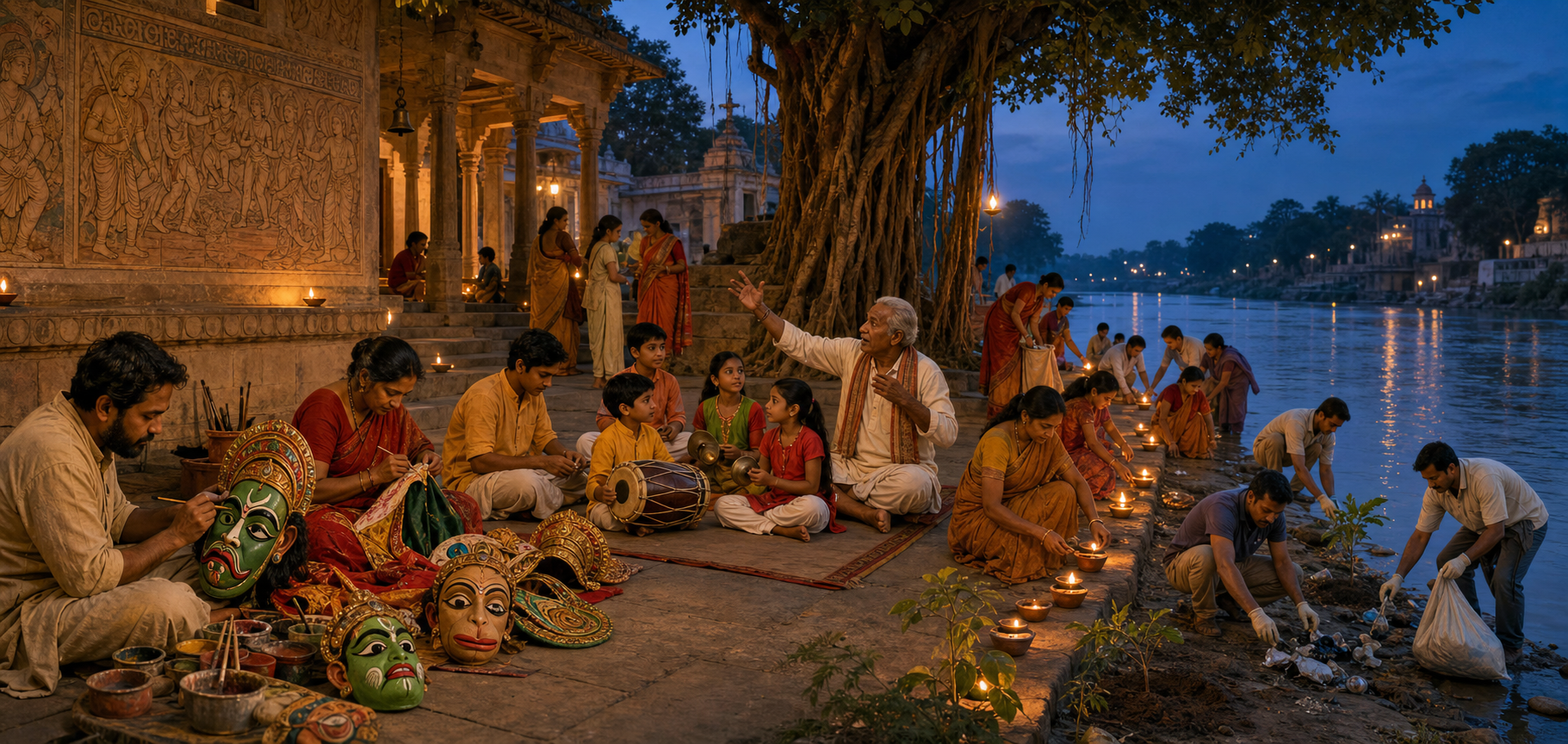
An ethical reading can become sterile if the Ramayana remains only a debate conducted at a distance. Living tradition gives the narrative a body: a river crossed with reverence, a hill approached as sacred, a song learned by memory, a festival shared with neighbors, and a temple sustained for those who will come later.
Bhadrachalam makes this grammar visible. The temple stands by the Godavari within a regional sacred landscape associated with Rama’s vanavasa in Dandakaranya. Local tradition connects nearby Parnasala with the forest dwelling of Rama, Sita, and Lakshmana. Bhadradri itself remembers the tapas of Bhadra, while Pokala Dammakka’s devotional story begins with the discovery and simple worship of the moola vigrahas. These memories allow land, devotee, and deity to participate in one sacred geography.
The kshetra also carries historical and institutional memory. In the 17th century, Kancherla Gopanna, revered as Bhadrachala Ramadasu, became central to the temple’s development and to a musical tradition of Rama bhakti. His remembered imprisonment, release, patronage, and kirtanas combine administrative history with hagiographic meaning. You do not have to collapse those genres into one kind of claim to honor them.
Use three clear phrases when you teach a child, lead a discussion, or describe a pilgrimage: the epic narrates, local tradition remembers, and historical evidence establishes. The distinction does not weaken sacred memory. It protects the integrity of scripture, sthala purana, and documented history by allowing each to speak in its proper register.
Darshan itself can become attentive reading. Bhadrachalam’s Vaikuntha Rama bears shankha and chakra in the upper hands and bow and arrow in the lower hands, joining the transcendent form of Vishnu with Rama as the bearer of royal and martial duty. Sita and Lakshmana complete an iconographic field of conjugal fidelity, shared exile, service, and kinship. Instead of passing quickly before the murti, notice which relationship the image asks you to honor after you leave.
The ritual calendar extends the same instruction through time. The Rama Navami Kalyanam is followed by Pattabhishekam, moving from sacred union to the restoration of righteous public order. You can read that sequence as a practical demand: private vows and public responsibility must support each other. Ramadasu’s kirtanas carry surrender and ethical kingship into collective song, making theology memorable beyond a formal discourse.
Approach a Ramayana kshetra with a four-part discipline:
- Before the yatra: Read the episode associated with the place and identify whether the connection comes from the epic, local sacred memory, or later history.
- During darshan: Observe one iconographic detail, one act of seva, and one relationship embodied by the deities.
- During an utsava: Ask what ethical transition the ritual enacts, such as exile to return, union to responsibility, or disorder to restoration.
- After returning: Choose one obligation that keeps the pilgrimage alive: restrain rumor, support traditional music, serve a temple transparently, or help protect the river and pilgrimage environment.
A sacred river treated as a dumping ground and a sacred story used to humiliate another person reveal the same fracture: reverence has been separated from conduct. Heritage stewardship, responsible pilgrimage, ritual continuity, and care for the Godavari therefore belong to the ethical life of the kshetra, not to a secondary concern called preservation.
Use a five-question Ramayana practice in daily life

You can use the following discipline whenever a family, professional, or community decision is being justified in the language of loyalty, duty, honor, or public trust. It is a modern reflection practice, not a claim that one checklist exhausts dharma.
- What is the actual conflict? State it in one sentence without invoking a revered name. Replace Rama would do this with the precise duties that collide.
- Who occupies which role? List each person’s responsibility on a separate line. Do not assign a duty to someone merely because their sacrifice would make the decision easier for everyone else.
- What kind of knowledge do we possess? Mark each claim as witnessed fact, reasonable inference, inherited interpretation, local tradition, or rumor. Do not let the categories blur.
- Who bears the cost? Circle the person with the least power. Ask whether they have been heard, whether their dignity is protected, and whether a stronger party is transferring its burden to them.
- What keeps responsibility alive afterward? Name the repair, seva, restraint, or continuing obligation that follows the decision. A declaration of dharma without accountability afterward is usually self-protection dressed in sacred language.
In a household discussion, let each person answer all five questions before anyone quotes an episode as authority. In a satsang, assign participants the perspectives of ruler, spouse, citizen, witness, and vulnerable person; the aim is not to put Sita or Rama on trial, but to discover which duty a one-sided reading has hidden. During a yatra, connect the same reflection to one concrete act of seva and decide when you will review whether you actually did it.
This practice also changes how you listen to katha. Stop before the resolution of a difficult episode. Name the information available to each character at that moment, the role each one occupies, and the cost each possible choice would impose. Only then continue. You will begin to notice that the Ramayana does not merely supply answers; it educates the moral attention with which an answer must be sought.
Three questions to carry into your next reading
Does a dharmic reading require calling every painful decision ideal?
No. Reverence does not require moral anesthesia. The epic preserves duty, greatness, conflict, and consequence together. You can honor Rama as Maryada Purushottama while still examining the suffering produced when duties collide. In fact, reverence should make your questions more exacting, not less.
Can public trust override a person’s dignity?
Public trust matters, especially for a ruler or institution, but perception is not identical to truth. If trust is being maintained through rumor, repeated humiliation, or the sacrifice of someone unable to answer back, substantive justice has been separated from procedural legitimacy. The person or institution with power must carry the heavier burden of restoring both.
What is the smallest useful practice to begin now?
At your next recitation, katha, or temple visit, choose one difficult episode and write four words: truth, duty, harmed person, repair. Put one concrete answer beneath each word. Then complete the act of repair or restraint you named. That is enough to move the Ramayana from admiration into conduct.
Let your next encounter with the Ramayana leave one visible consequence: a rumor not repeated, a vulnerable person heard, a vow kept, a song learned, a temple served, or a sacred place treated with greater care. A tradition lives when remembrance becomes responsibility.
References
- DharmaRenaissance Blog — Bhadrachalam Sthala Puranam: Sacred Legends, Living Devotion at Sita Ramachandra Swamy
- DharmaRenaissance Blog — Sita’s Agni Pravesha and Exile: The Contested Ethics of Rajadharma and Public Trust