
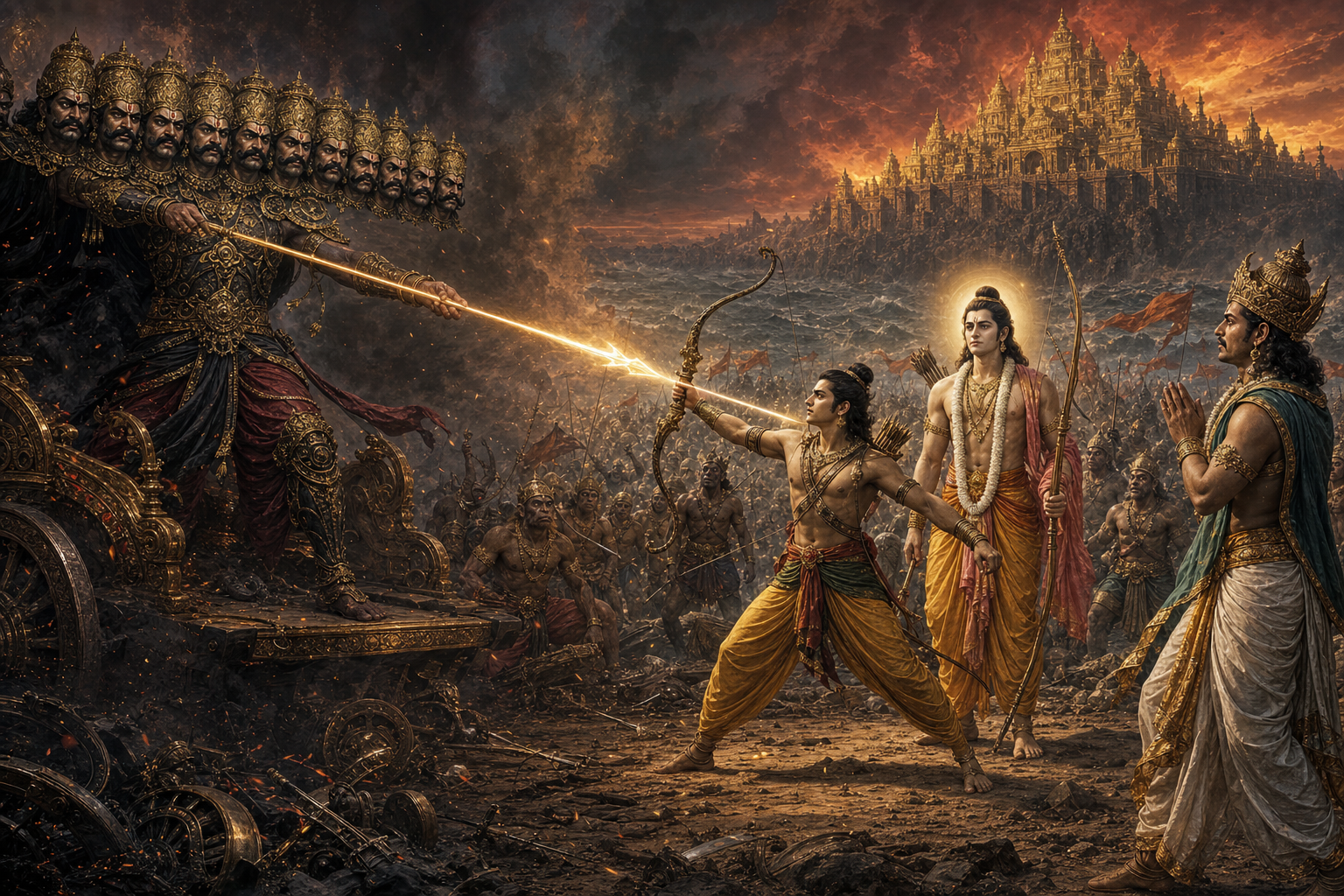
If you are trying to understand why Ravana pursued Vibhishana instead of concentrating only on Rama and the vanara army, the shortest answer is this: Vibhishana threatened Lanka at three levels. He knew how its forces worked, his defection weakened confidence in Ravana, and his presence beside Rama proved that loyalty to dharma could outrank loyalty to family.
That makes the pursuit more than a quarrel between brothers. It is a compact study of intelligence, political legitimacy, wounded leadership, and the duty to protect someone who has sought refuge. It also explains why the familiar description of the hunt as an event of the war’s “third day” should be handled carefully rather than treated as a date accepted by every Ramayana tradition.
Begin with the sequence, not a rigid day number
The safest way to read this episode is to follow its moral and military sequence. Vibhishana first urged Ravana to return Sita and prevent a ruinous war. Ravana rejected that counsel. Vibhishana then left Lanka, sought Rama’s protection, and joined the coalition preparing to fight the kingdom he knew from within.
Once battle began, Lanka suffered serious losses, including the death of the seasoned commander Prahasta. Ravana entered combat personally as the pressure increased. In a common Valmiki-aligned sequence, Rama broke Ravana’s bow, brought down his standard, and compelled him to withdraw. Against that background, Vibhishana became an increasingly important target: he was no longer merely the brother who had contradicted the king in council, but an adviser helping the opposing army understand Lanka’s commanders and methods.
The label “day three” is therefore best treated as a narrative marker for this early phase of the siege. Recensions and regional retellings arrange the engagements with different emphases and timings. Some later narrations make Ravana’s vow against Vibhishana explicit, while the Valmiki tradition conveys much of the vendetta through the consequences of the defection and the mounting pressure on Lanka.
If someone claims that every version places a formally declared hunt on the same numbered day, ask which recension or retelling is being cited. “Vibhishana became a priority early in the war” is a defensible interpretive statement. “Every Ramayana records the same day-three operation” is not. This distinction lets you preserve the force of the episode without creating a false uniformity among living textual traditions such as the Valmiki Ramayana, Kamba’s Ramavataram, and Tulsidas’s Ramcharitmanas.
Vibhishana was valuable because he could make knowledge decisive

Vibhishana’s main value was not that he could overpower Lanka’s greatest warriors by himself. It was that he could help Rama’s coalition recognize what it was facing. He understood the habits of Lanka’s defenders, the strengths of its commanders, and the rakshasa preference for deception, illusion, ambush, speed, and irregular attack.
That kind of knowledge changes a battle before a weapon is raised. An unfamiliar formation becomes readable. A deceptive appearance becomes less convincing. A commander’s apparent weakness can be distinguished from a feint. Vibhishana could help the vanara leaders interpret Lanka’s actions quickly enough to respond rather than merely endure them.
Seen through a modern strategic lens, Vibhishana functioned as a center of gravity even though he was not the coalition’s most visually imposing fighter. A center of gravity need not be the strongest warrior. It can be a person, relationship, or capability whose loss would damage several connected functions at once. Killing Vibhishana promised Ravana three possible gains:
- It could deprive Rama of intelligence about Lanka’s commanders, defenses, illusions, and likely moves.
- It could reassure a shaken rakshasa army that Ravana still controlled events after the loss of Prahasta and other reverses.
- It could warn anyone inside Lanka that defection would bring punishment, even under the protection of Rama.
This is why it is too simple to dismiss Ravana’s decision as irrational rage. There was a recognizable military logic behind the targeting. The failure arose when a limited strategic objective fused with a personal need to erase humiliation. Ravana did not merely want to stop information from reaching the enemy. He wanted to destroy the person whose earlier warning now looked prophetic.
You can detect that change by asking what success would actually accomplish. If removing Vibhishana would disrupt Rama’s decisions, the aim is strategic. If Ravana continues to define victory through punishment even after the opposing army has adapted and protected Vibhishana, the aim has become symbolic. A sound commander changes tactics when the expected gain declines. A wounded ruler may persist because abandoning the hunt would feel like admitting that the dissenter was right.
Rama turned the protection of refuge into battlefield policy
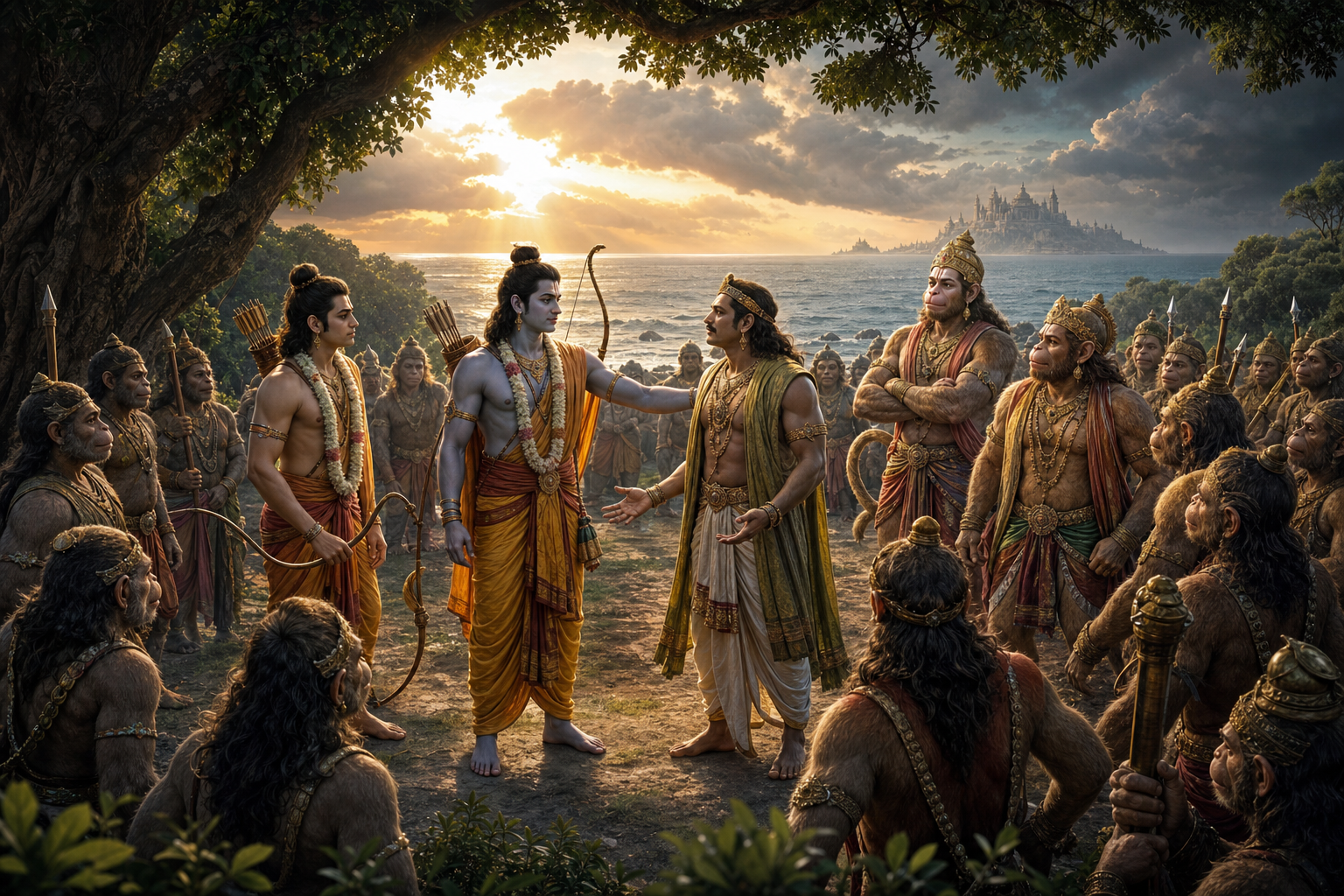
Vibhishana’s arrival forced Rama to make a difficult commitment before its benefits were fully known. A brother of Lanka’s king was asking to cross the lines and enter the opposing camp. Accepting him involved risk. Yet Rama’s response rested on śaraṇāgati-dharma: one who sincerely seeks refuge must be protected.
The importance of that principle appears in what followed. Protection could not remain a noble sentence spoken once. It had to shape guard arrangements, escorts, counter-ambush measures, and the willingness of vanara commanders to interpose themselves when rakshasa forces probed for Vibhishana. Rama’s promise became an operational obligation, even when honoring it made the coalition’s work harder.
This is one of the episode’s sharpest tests of dharma-yuddha. A righteous cause is not enough by itself. The conduct used to pursue that cause also matters. If Rama had accepted Vibhishana for his intelligence but abandoned him once he became inconvenient, refuge would have been reduced to a transaction. Protecting him under pressure showed that the commitment was a rule of conduct rather than a temporary bargain.
That does not mean Vibhishana remained a passive noncombatant. He participated in the campaign and assisted Rama’s side, so Ravana’s attempt to strike him on the battlefield was not simply an attack on an uninvolved civilian. The deeper ethical failure occurred before the fighting: Ravana refused truthful counsel that could have prevented the war, then tried to silence the counselor after the warning began to come true.
When you apply this episode to a conflict over loyalty, use a stricter test than “family versus principle.” Ask whether the person first tried to prevent wrongdoing, whether the authority rejected correction, and whether continued obedience would have supported adharma. Vibhishana’s example does not sanctify every disagreement or defection. It shows that allegiance loses its moral claim when it demands participation in a course already recognized as unjust.
Ravana attacked the witness to his failure instead of correcting it
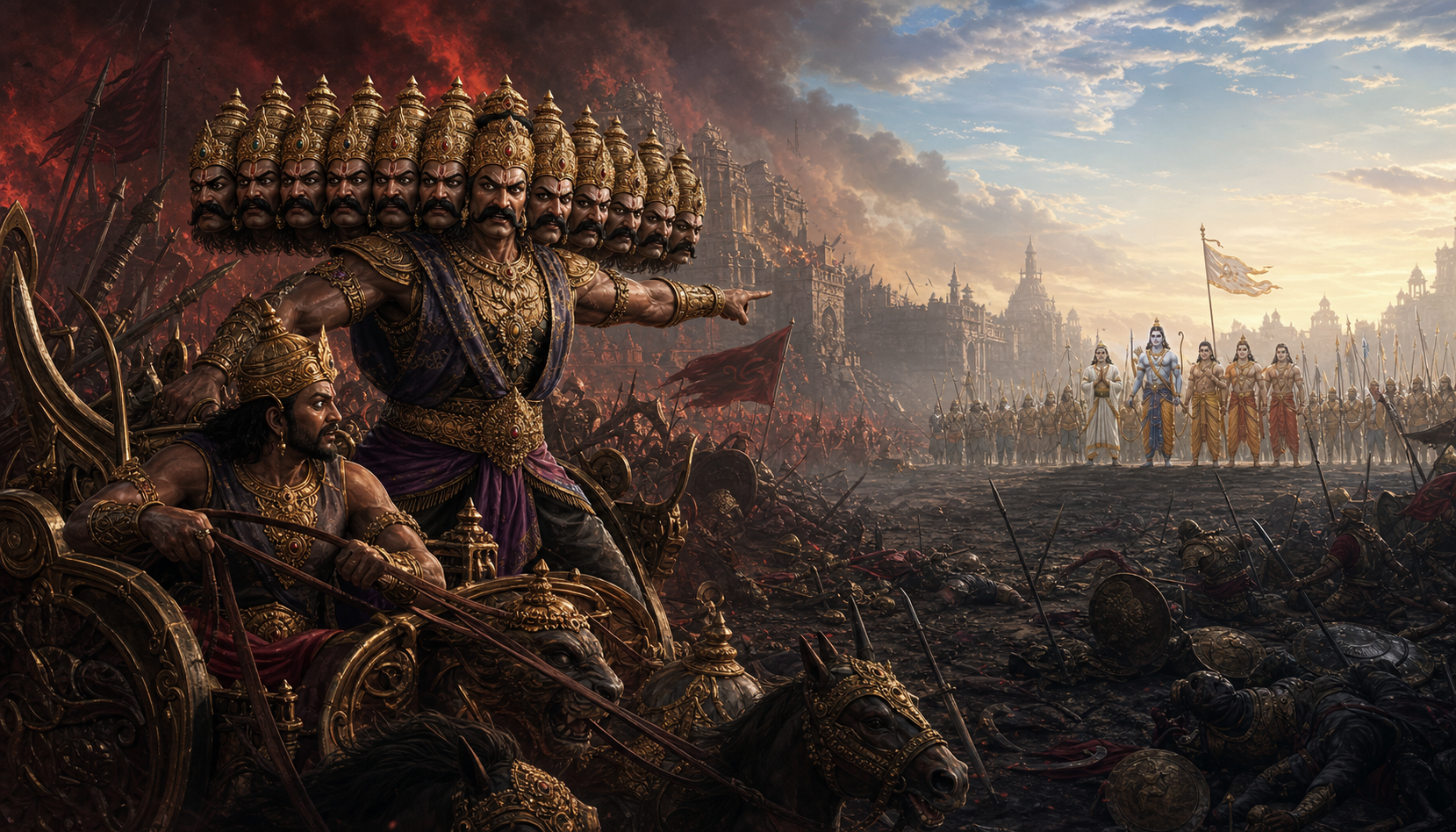
Prahasta’s death damaged Lanka’s military order, but it also damaged the story Ravana told about his own rule. A king identified with grandeur and invincibility had already been contradicted in council. Now the battlefield was validating the warning he had rejected. Vibhishana embodied both injuries: he knew Lanka’s vulnerabilities, and his survival beside Rama made Ravana’s original decision look increasingly indefensible.
This produces a recognizable leadership failure. The bearer of bad news becomes confused with the cause of the bad outcome. Removing that person may provide a brief feeling of control, but it does not repair the weakness the person identified. Ravana could hunt Vibhishana; he could not hunt away the consequences of abducting Sita, refusing correction, and leading Lanka into a war that sound counsel had tried to avert.
The pursuit therefore gives you four practical questions for judging a leader under pressure:
- Does the leader investigate the warning, or immediately question the warning-bearer’s loyalty?
- After a setback, does the leader revise the plan, or choose a person to punish?
- Is a target being pursued for a measurable operational gain, or because the target has become a symbol of humiliation?
- Do promises made in calm conditions still govern conduct when keeping them becomes costly?
These questions clarify the contrast between Ravana and Rama. Ravana treated truthful disagreement as betrayal and converted a military problem into a vendetta. Rama accepted the risk attached to Vibhishana, used his counsel, and continued to honor the protection granted to him. One ruler tried to manufacture unity through fear. The other built trust by making a binding principle visible in action.
Other Dharmic traditions illuminate the same failure without becoming interchangeable with the Ramayana. The Buddhist teaching “na hi verena verāni” warns that hatred does not bring hatred to an end. Jain commitments to satya and ahiṃsā draw attention to the truthful warning offered before violence became unavoidable and to the value of restraint within conflict. Sikh reflection on dharam yudh likewise insists that a struggle is not righteous merely because one side wins; its ethical direction matters. Integrity, restraint, truthful counsel, and protection of the vulnerable converge here as measures of strength, even though each tradition develops those principles in its own theological and historical setting.
Key takeaways
- Ravana pursued Vibhishana because the defector combined insider knowledge, symbolic legitimacy, and practical influence over Rama’s decisions.
- The “day three” label is useful for locating the pursuit in the early war, but it is not a universally standardized timestamp across Ramayana recensions and retellings.
- Ravana’s objective began with military logic but became self-defeating when strategic targeting merged with wounded pride and the urge to punish dissent.
- Rama’s acceptance of Vibhishana mattered because śaraṇāgati was carried from declaration into protection, escorts, and battlefield conduct.
- Vibhishana’s choice places dharma above kinship only after truthful counsel has been offered and rejected; it is not a blanket excuse for disloyalty.
- The episode teaches you to distinguish a leader who learns from unwelcome information from one who tries to eliminate the person who delivered it.
The next time you encounter the claim that Ravana merely hated a traitorous brother, test it against the full sequence: counsel, rejection, refuge, intelligence, protection, and pursuit. That sequence reveals the real conflict. Ravana was not only chasing Vibhishana; he was trying to destroy the living proof that dharma had departed from his court before victory departed from his army.