You complete your japa, open your eyes, and soon find yourself reaching reflexively for the same distraction. The mantra may have quieted the mind for a while, but sight, sound, taste, and habit still seem to pull in their old directions. The useful question is not whether you can silence the senses. It is what you are training them to seek.
Bhakti meditation gives you a practical answer: do not leave the senses vacant and hope that desire disappears. Give them a worthy center. When sound carries the Divine Name, sight rests on a sacred form, taste receives prasada, and the body becomes an instrument of seva, restraint begins to mature into purification.
Stop fighting the senses and retrain their preference
Forceful restraint, or indriya-nigraha, can be necessary at the threshold. You may need to put down the phone, leave an agitating conversation, or decline an indulgence. But restraint only tells a sense where it may not go. It does not necessarily change what the sense finds desirable.
Indriya-suddhi goes further. It purifies a sense by engaging it in its proper relationship with the Divine. The classical bhakti formulation hṛṣīkeṇa hṛṣīkeśa-sevanam defines devotion as serving the Master of the senses through the senses. The eyes, ears, tongue, hands, and mind are not treated as enemies. They are returned to service.
This is why the Bhagavad Gita’s principle of paraṁ dṛṣṭvā, seeing or experiencing something higher, matters so much. A lower attraction does not lose its force merely because you condemn it. Its rank changes when the heart acquires a deeper taste. Bhakti therefore works through replacement: distraction is displaced by remembrance, consumption by offering, and restless novelty by relationship.
In Srimad Bhagavatam 3.28.16, within Kapila’s instruction to Devahuti, the contemplative support is the beautiful personal form of Paramatma. Attention is trained limb by limb, beginning at the lotus feet and moving upward. Beauty here means more than visual attractiveness. Compassion, majesty, sweetness, protection, and auspiciousness give the form spiritual and emotional weight. The mind stays because its object is meaningful and beloved, not merely because the practitioner is exerting pressure.
The familiar yogic progression remains present, but love changes its character. Pratyahara becomes a positive withdrawal from lesser inputs. Dharana holds a chosen form or Name. Dhyana turns repeated attention into a continuous current. Samadhi is the mind resting naturally in the beloved object. What begins as discipline can therefore develop into ruci, a genuine taste for remembrance.
Build a sitting practice that joins sound, form, and feeling
A workable practice needs one stable center. Use a mantra and form recognized by your sampradaya or contemplative tradition rather than collecting sacred sounds whenever novelty fades. Hare Krishna, Om Namo Narayanaya, Om Namah Sivaya, Om Mani Padme Hum, and Waheguru belong to distinct devotional settings. They are not interchangeable mood-setting devices. Fidelity gives a mantra context, guidance, and depth.
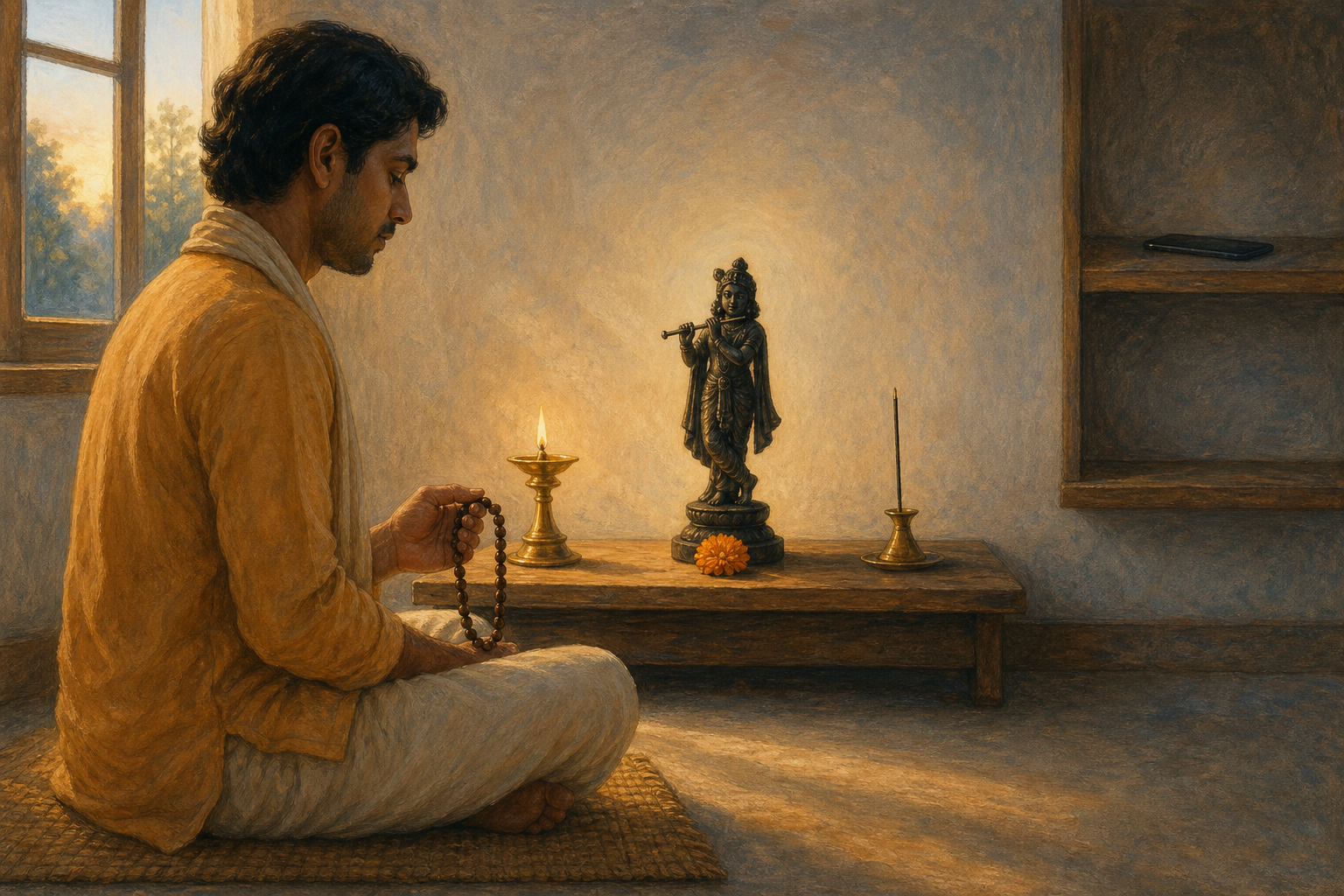
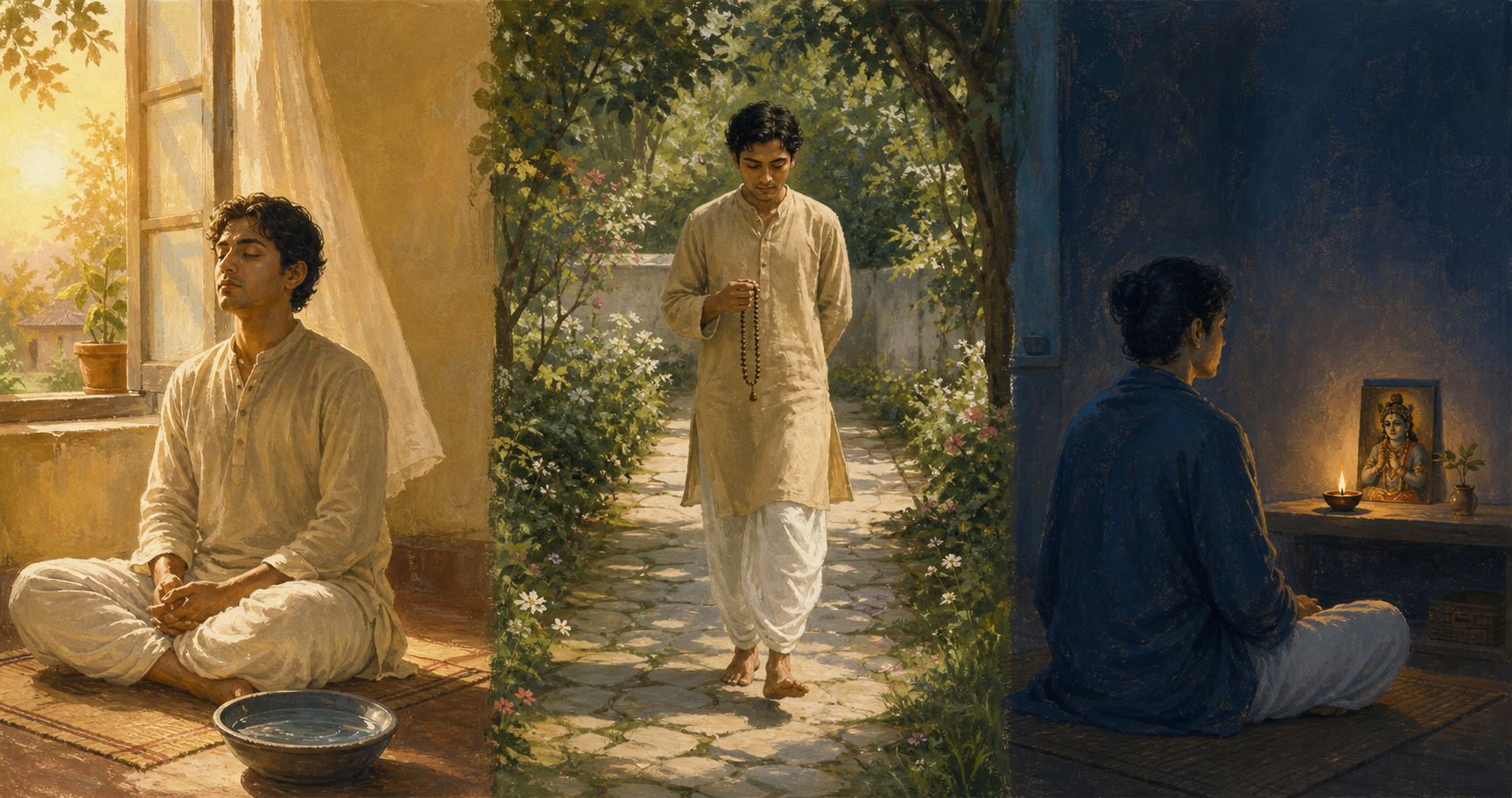
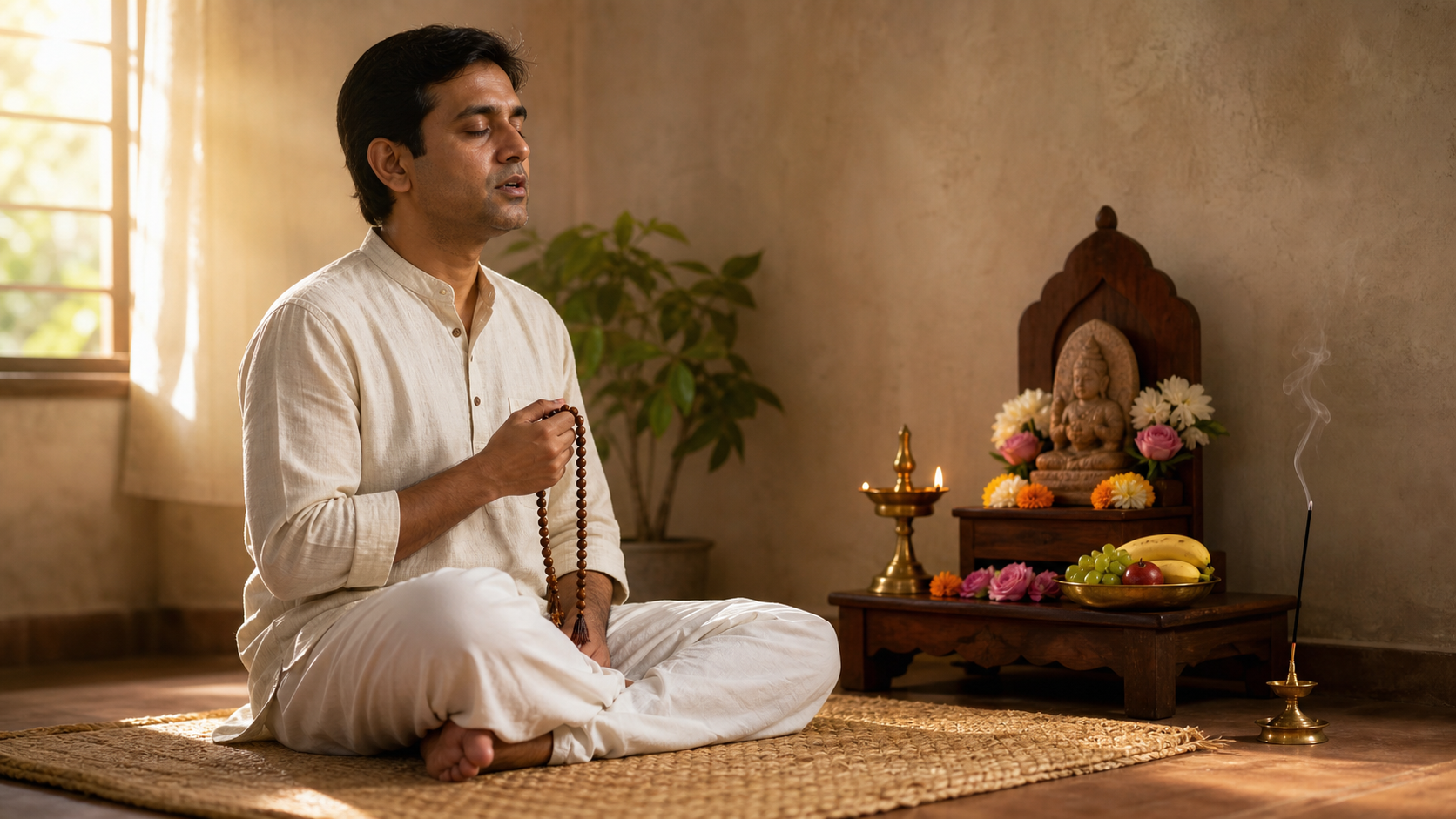
- Prepare a clean, repeatable place. Sit in a stable posture with the spine comfortably upright. A dedicated corner, sacred image, mala, or lamp can tell the senses that ordinary activity has paused. Reduce obvious interruptions before you begin instead of testing your will against them throughout the sitting.
- Let the body settle. Release unnecessary tension in the jaw, shoulders, abdomen, and hands. Allow the breath to become quiet. If lengthened exhalation is comfortable, breathe in for four counts and out for eight for several minutes. Do not strain, hold the breath, or force an eight-count exhalation. If you become light-headed or uncomfortable, return to natural breathing.
- Establish the Name through audible or whispered japa. Hear each repetition instead of trying to finish it. When attention is scattered, clear pronunciation gives the ear something definite to follow. If your schedule is crowded, make ten uninterrupted minutes of japa your minimum viable sitting and protect its regularity.
- Add rupa-dhyana without rushing. In a Vaisnava practice, rest attention at the lotus feet, then move through the ankles, calves, knees, torso, arms, face, and the complete form. Attend to auspicious features and the qualities they express. When the image fades, return gently to the last clear point rather than fabricating a dramatic vision.
- Let sound and form support each other. The mantra can carry attention when imagery is faint. The remembered form can restore meaning when repetition becomes mechanical. As concentration deepens, whispered japa may become mental japa, with Name, form, and devotional feeling occupying one field of attention.
- Close with a concrete act of remembrance. Decide where the practice will reappear in your day: before a meeting, before eating, when entering the home, or at the moment you usually reach for distraction. A one-minute recollection of the form or Name can reconnect ordinary action with the morning sitting.
Do not make visual vividness the test of success. Some practitioners form detailed mental images; others work more steadily through mantra, remembered iconography, and contemplation of divine qualities. The real task is to return attention with reverence. A modest image held faithfully is more useful than an elaborate inner spectacle pursued for excitement.
The emotional dimension also matters. Bhakti aesthetics speaks of an alambana, the central support of devotion; uddipanas, reminders that awaken remembrance; and a durable devotional disposition that can mature into rasa. In daily terms, choose a center, surround yourself with reminders of that center, and approach it as someone to love and serve. Dry concentration often collapses when effort weakens. Relationship gives attention another reason to remain.
Give every sense a devotional task outside meditation
A sitting practice has less leverage when the rest of the day repeatedly trains the opposite preference. Sense purification therefore depends on the environment you build between sittings. This does not require withdrawing from work or family life. It requires deciding what role each sense will play.
- Sight: Keep a sacred image where your attention naturally lands, and pause for darshana rather than treating the image as decoration. Before opening an endless visual feed, notice what you are asking the eyes to carry into the mind.
- Hearing: Use kirtana and sravana during suitable transitions, such as travel or household work. Give priority to mantra, scriptural teaching, and speech that leaves the mind clearer. Hearing is often the easiest bridge back to remembrance because it does not depend on strong visualization.
- Taste: Receive food as prasada in accordance with your tradition. Offering changes the posture from taking to receiving. Eat with enough attention to recognize sufficiency; sanctification should refine appetite, not provide a devotional label for excess.
- Touch and action: Handle the mala attentively, perform murti-seva where appropriate, clean a worship space, prepare an offering, or undertake practical service. The hands learn devotion by doing something useful for another being.
- Smell: Keep the practice space clean and use sacred fragrance according to your tradition. Incense, flowers, or another familiar fragrance can serve as an uddipana, a cue that recalls worship rather than becoming an attraction pursued for its own sake.
This is positive pratyahara. You are not declaring the world impure or becoming frightened of sensory experience. You are becoming selective about what enters, what remains, and what governs the next action. The practical test of an input is its aftermath: does it leave you more capable of remembrance, discernment, and service, or more agitated, grasping, and forgetful?
At the end of the day, identify the input that most strengthened recollection and the one that most fragmented it. Preserve the first and place a boundary before the second. This small audit prevents sense purification from remaining an inspiring idea with no effect on tomorrow’s choices.
Correct the obstacle you actually have, then judge by conduct
Not every difficult sitting has the same cause. Applying more effort indiscriminately can turn meditation into a contest with yourself. Diagnose the pattern first.
When the mind is restless
Viksepa is repeated scattering. Meet it with continuity: the same place, a regular time, and one established support. Keep the mantra audible or whispered until attention becomes steadier. Each return is part of the practice; irritation at distraction only introduces another distraction. Make the return prompt and ordinary.
When the mind is dull
Laya is sinking, heaviness, or loss of alertness. Sit a little more upright, let the eyes remain softly lowered rather than fully closed, brighten the remembered form, or sing a brief devotional song before resuming meditation. The correction is increased clarity, not agitation. Continuing to sit in a fog does not become absorption merely because the body remains still.
When you start chasing the experience
Rasa-svada arises when the pleasure or unusual quality of a state becomes more important than the Divine to whom the practice is directed. Do not build an identity around calmness, imagery, tears, or sweetness. Return the fruit of practice to humility, satsanga, and seva. A devotional experience is being integrated when it makes you easier to correct and more willing to serve.
The test occurs after you stand up
The most reliable markers of sense purification are ordinary. The tradition describes increasing moderation, reduced compulsivity around sense objects, and a warmer ethical presence. Look for these changes in conduct:
- You can decline an unnecessary input with less inner argument.
- An interrupted desire loses force instead of dominating the rest of the day.
- You notice excess earlier, whether it involves food, entertainment, speech, or attention.
- You return from distraction without self-contempt or aggression.
- Remembrance makes you more patient, truthful, non-injurious, and available for service.
If meditation produces private serenity while your speech becomes harsher or your obligations are neglected, the senses are not yet being purified in the bhakti sense. A pleasant state can coexist with self-absorption. Devotion must eventually reorganize preference and action.
The wider Dharmic family provides parallel diagnostics without erasing theological differences. Buddhist samatha and guarding of the faculties train stability and non-reactivity. Jain teaching distinguishes agitated arta and raudra dhyana from purifying dharma and shukla dhyana. Sikh Naam Simran, Kirtan, and seva direct remembrance toward sahaj, a natural equipoise. These disciplines are not synonyms, and you do not need to assemble them into a hybrid routine. They share a practical insistence that trained attention must lessen grasping, aversion, and harm.
Key takeaways
- When an old attraction returns after meditation, do not respond only with more force. Replace the input and give the same sense a sacred function.
- Choose one lineage-rooted mantra or contemplative support and let regularity deepen it. Constantly changing methods keeps attention dependent on novelty.
- Use sound when visual attention is weak, and use sacred form and divine qualities when mantra repetition becomes mechanical.
- Extend practice through sight, hearing, taste, touch, and smell. Your daily sensory environment is part of meditation, not merely what happens before or after it.
- Judge progress by moderation, ethical warmth, and readiness for seva. Unusual inner experiences are secondary.
Tomorrow, prepare one clean place, choose one recognized mantra, and give it ten uninterrupted minutes. Then carry a one-minute recollection into the point where your attention usually fragments. Do not wait for dramatic stillness. Keep giving the senses a better object until remembrance begins to feel less like an interruption and more like home.