
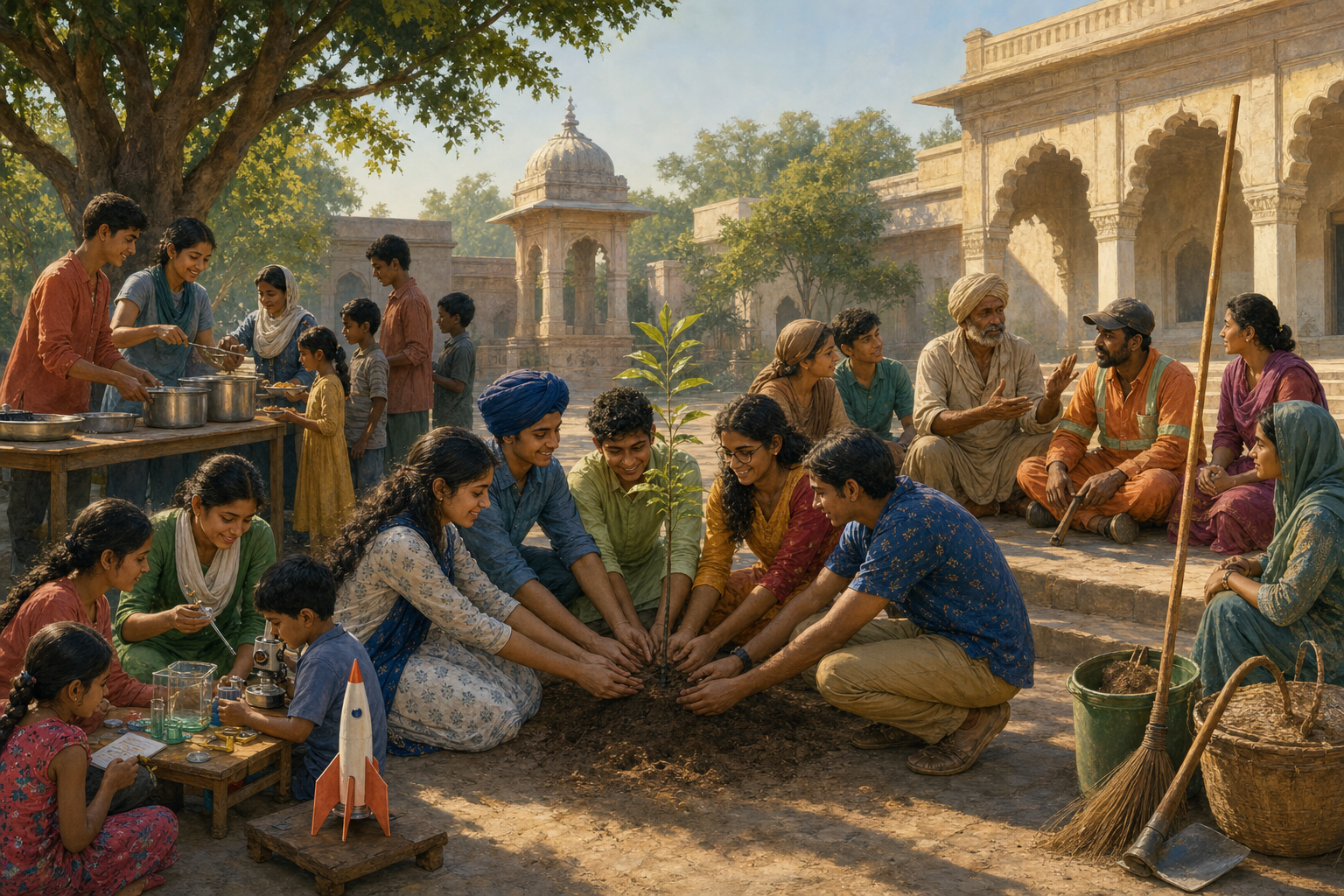
If you are choosing an exemplar for a youth class, community programme, or public commemoration, finding an admirable life is the easy part. The harder task is preventing the tribute from ending when the speeches, photographs, and garlands do.
Use three tests before placing any personality at the centre of your programme: What need will service meet? What unfairness will justice confront? How will unity bring people together without erasing their convictions? Dr A.P.J. Abdul Kalam and Baba Banda Singh Bahadur illuminate different parts of that test. They should not be made interchangeable, but their lives can help you turn remembrance into disciplined public action.
Begin with the problem, not the portrait
A worthy exemplar is more than a person whose name attracts a crowd. The person’s life should change what your group does, whom it includes, and how it measures success. That requires distinguishing three ideas that are often bundled together.
- Service responds to a concrete need while preserving the recipient’s dignity. It asks, “What can we provide, teach, repair, or make accessible?”
- Justice examines the rule, institution, or concentration of power behind the need. It asks, “Why does this burden keep falling on the same people, and what must change?”
- Unity enables people with distinct identities and convictions to cooperate for a common good. It asks, “What can we undertake together without asking anyone to misrepresent a tradition?”
Each corrects a weakness in the others. Service without attention to justice can repeatedly treat a wound while leaving its cause untouched. Justice without service can become a vocabulary that never reaches the person who needs help. Unity without honest difference becomes ceremonial agreement; unity without moral limits can become pressure to conform.
Before approving an event, ask the organising group to complete three sentences: “The need we will meet is…”; “The barrier we will challenge is…”; and “The differences we will respect are….” If the answers are vague, the programme is not ready, however impressive its guest list may be.
Key takeaways
- Choose exemplars for the conduct they can teach, not merely the recognition their names command.
- Make service observable: identify the beneficiary, the need, the responsible team, and the evidence of benefit.
- Make justice accountable: name the unfair barrier, the legitimate means of challenging it, and the restraints on those exercising power.
- Make unity honest: coordinate distinct communities around a shared civic outcome without inventing a blended theology.
- Judge a commemoration by what continues after it, not by the size of the audience on the day.
Kalam shows how knowledge becomes seva
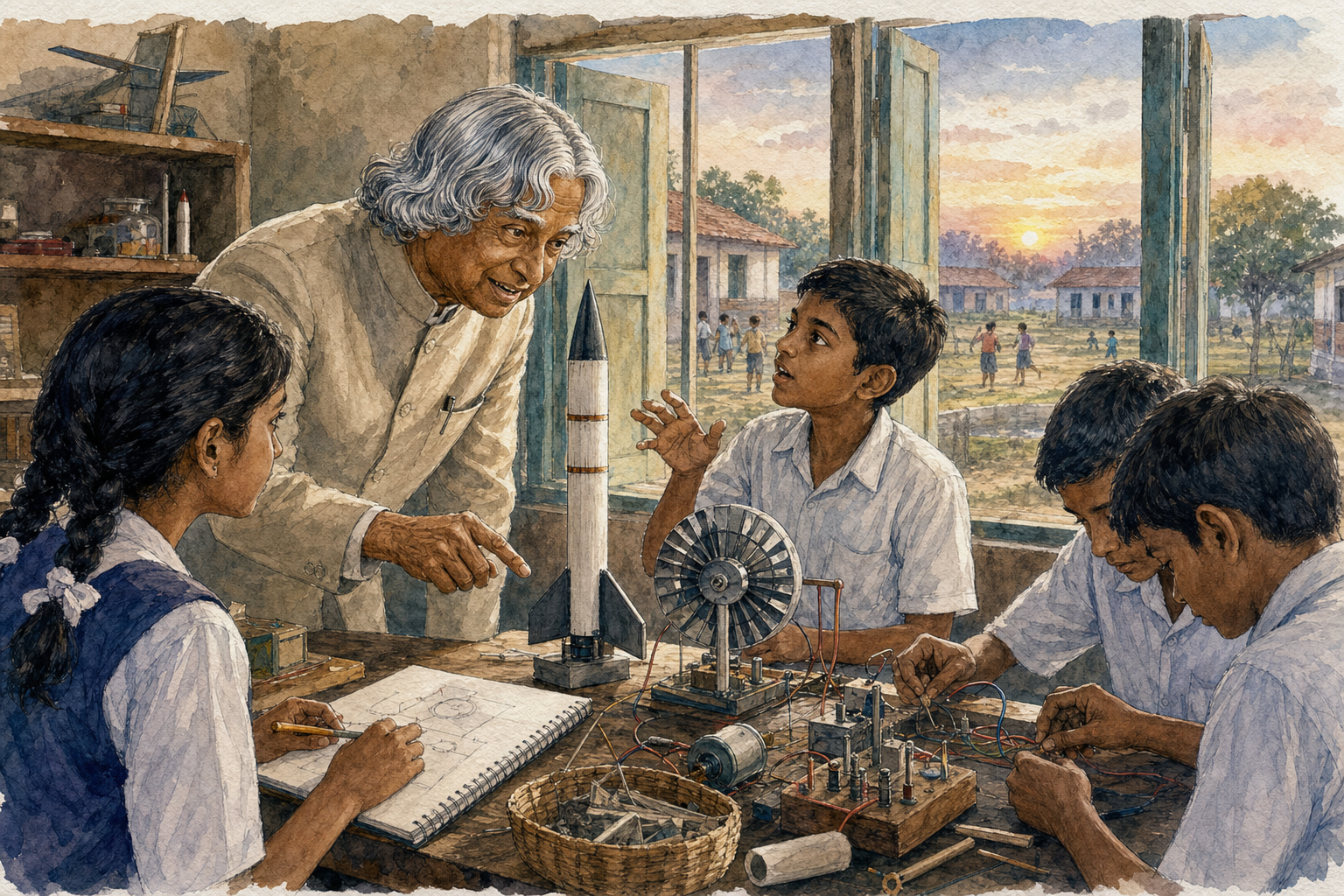
Kalam’s public life joined technical excellence to human development. His path through aerospace engineering, DRDO, ISRO, the SLV-3 programme that placed Rohini into orbit in 1980, the presidency from 2002 to 2007, and later teaching made learning part of a national and intergenerational mission. The lesson is not that every young person must enter science. It is that competence becomes service when it is directed toward a need larger than personal advancement.
This is a useful standard for any educational activity carrying Kalam’s name. A lecture about ambition is not enough. Participants should gain an opportunity to practise, receive feedback, and apply a skill to a public problem. His insistence that talent may be hidden on the last bench also changes recruitment: do not reserve the programme for students who already possess the highest marks, strongest English, or greatest confidence.
A Kalam-inspired learning programme can be designed with the following checks:
- Recruit for curiosity and commitment as well as prior attainment. Give quieter or unconventional learners a clear route to participate.
- Replace passive listening with a task: build a simple prototype, explain a scientific idea, map a local problem, or teach a newly learned skill to someone else.
- Schedule feedback before the final presentation, so revision is part of learning rather than a punishment for failure.
- Ask every participant to identify who could benefit from the work and how the same knowledge could be distorted or misused.
- Pair skill with character. Accuracy, honesty about uncertainty, cooperation, and responsibility should be assessed alongside the technical result.
- Create continuity by preparing participants to mentor the next group instead of treating each event as an isolated achievement.
This approach reflects Kalam’s conviction that education should form good human beings with both expertise and character. It also prevents a common mistake in community programming: celebrating excellence as an individual possession. In a dharmic frame, disciplined effort resembles tapas only when it refines conduct rather than inflating the ego. Knowledge becomes seva when another person can live, learn, or act more capably because it was shared.
Kalam was not a member of Hinduism, Buddhism, Jainism, or Sikhism, and honouring him within a Dharmic civic discussion should never relabel his religious identity. The responsible claim is narrower and stronger: his educational service, scientific integrity, accessibility, and concern for future generations exemplify virtues that Dharmic communities can recognise and practise. A civilisational outlook proves its confidence by recognising ethical kinship without appropriating the person.
Banda Singh Bahadur shows why service needs justice
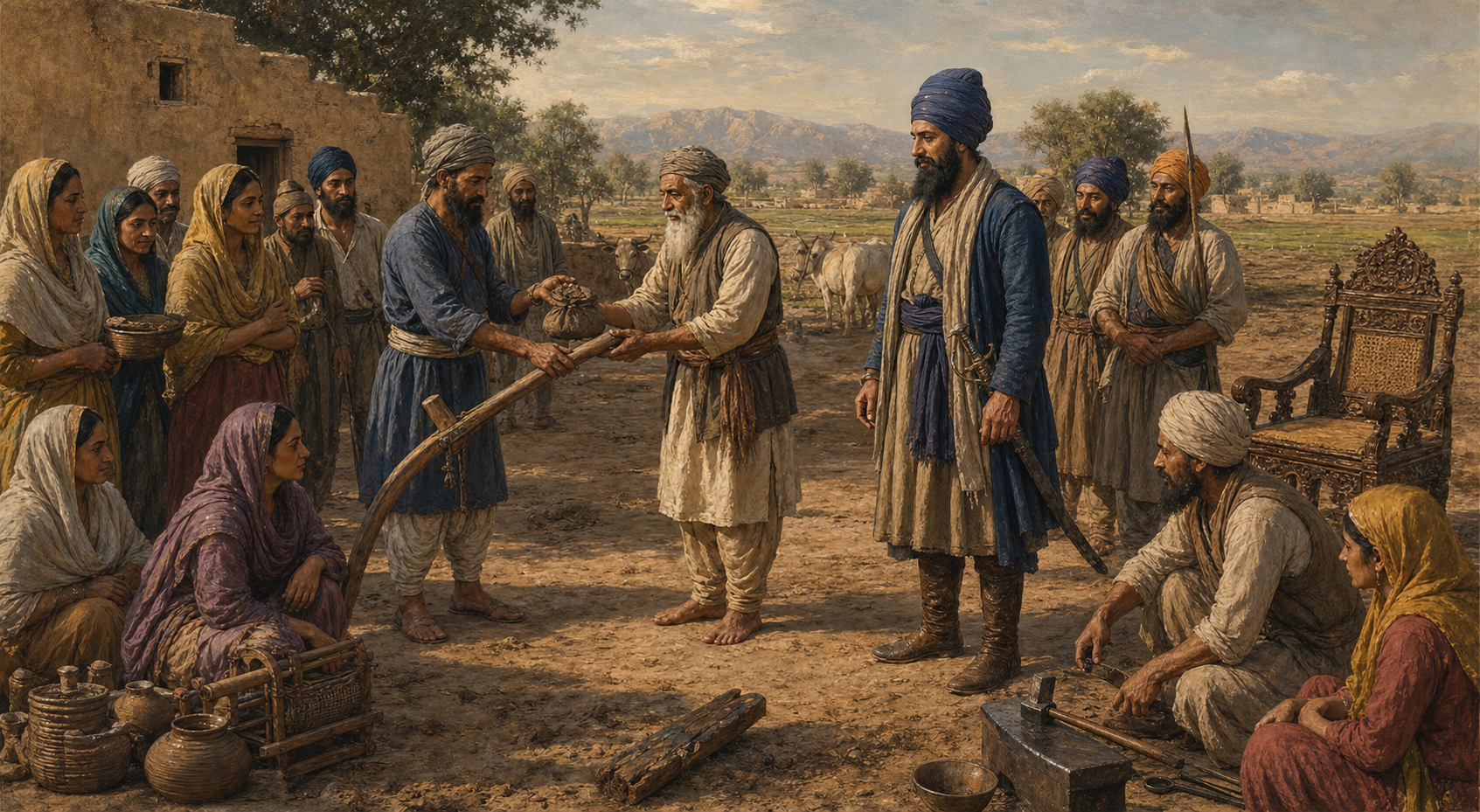
Service answers an immediate need. Justice becomes necessary when suffering is protected by an abusive structure. Baba Banda Singh Bahadur’s life addresses that harder responsibility. After meeting Guru Gobind Singh at Nanded in 1708, he was entrusted with leadership of the Khalsa in a period of severe conflict. His forces captured Sirhind in 1710, and accounts of the territories briefly governed under him point to measures that challenged feudal extraction and increased the dignity of cultivators.
The most useful moral symbol from this history is the pairing of deg and tegh: provision and protection. A just order must be capable of feeding people and defending them. Nourishment without protection leaves the vulnerable exposed; force without nourishment forgets what protection is for.
This does not give a community permission to turn martial memory into anger, intimidation, or romanticised violence. The Khalsa ideal places courage inside a moral discipline concerned with the defence of the vulnerable, restraint, and the welfare of all. Banda Singh Bahadur’s remembrance culminates not in domination but in steadfastness and sarbat da bhala, the welfare of everyone.
When your group invokes justice, apply a protection test before acting:
- Name the vulnerable person or protected freedom. Do not substitute a slogan for an identifiable harm.
- Separate defence from retaliation. Ask whether the proposed action prevents harm or merely expresses collective anger after the fact.
- Use the least coercive means capable of protecting the person at risk. A petition, documented complaint, legal challenge, public education effort, or protective presence serves a different purpose from aggression.
- Place limits on authority. Decide who may act in the group’s name, what conduct is forbidden, and how mistakes will be acknowledged.
- Keep deg beside tegh. Budget for food, transport, education, relief, or another constructive provision alongside advocacy.
- Apply the rule universally. If a protection would be denied to a disliked neighbour, it is group privilege rather than justice.
The Dharmic traditions do not offer one identical teaching about force, and a serious programme should not pretend otherwise. If ahimsa, self-defence, or the Khalsa’s temporal responsibility is discussed, identify which tradition is speaking and let qualified members of that tradition explain its boundaries. Agreement on protecting dignity does not require erasing real doctrinal differences.
Public remembrance should preserve the same discipline. A statue, portrait, or martyrdom programme needs more than heroic language. Add a concise chronology, distinguish established events from later interpretation, explain unfamiliar symbols, and show visitors where they can examine the evidence. The Banda Singh Bahadur memorial at Guru Nanak Darbar Gurdwara in Gravesend demonstrates how commemoration can become a gateway to Sikh history, ethical reflection, and civic education. Your local equivalent might be a bilingual display, a guided youth session, or a service pledge linked to the values being honoured.
Unity must preserve difference to remain credible
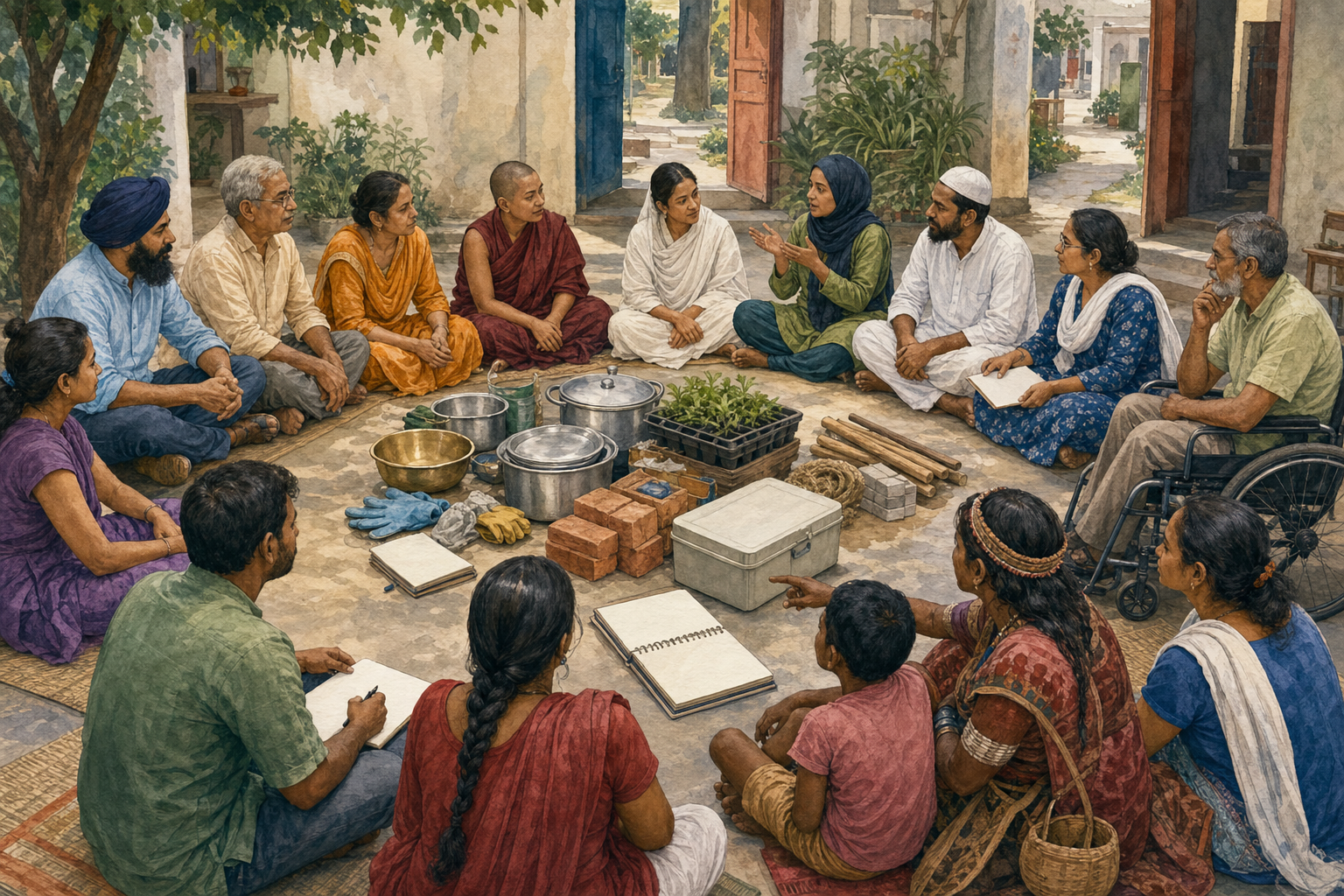
Dharmic unity is strongest when it works as a shared civic grammar rather than a claim that Hinduism, Buddhism, Jainism, and Sikhism are identical. These traditions can meet around truthfulness, disciplined conduct, compassionate action, freedom of conscience, service, and concern for the common good. They still retain distinct texts, teachers, institutions, practices, histories, and understandings of liberation.
This distinction matters when you organise a multi-community programme. A shallow event asks representatives to produce interchangeable statements about peace. A useful event gives each community room to speak in its own vocabulary and then asks what common work can follow.
- Let each participating tradition describe its own teaching. Do not ask one speaker to define another community’s beliefs.
- Choose a common civic outcome, such as mentoring learners, supporting a food programme, preserving a heritage site, or improving public understanding of Dharmic traditions.
- Keep shared action distinct from shared worship. No participant should have to affirm a composite ritual or diluted creed in order to serve.
- Agree on beneficiary criteria in advance. Assistance should depend on need, not religious affiliation or willingness to attend devotional activity.
- Rotate visible responsibilities. Hosting, speaking, logistics, teaching, and review should not remain permanently concentrated in the largest community.
- Name disagreement calmly when it matters. Honest difference is safer than a unity that collapses as soon as a difficult question appears.
Respect also governs how one community learns from another. The openness of langar can inspire universal service, but a partner organisation should support a gurdwara’s langar under the gurdwara’s guidance rather than stripping the practice of its Sikh setting and relabelling it as a generic idea. The same rule applies across Dharmic traditions: learn, cooperate, and credit; do not absorb every practice into an undefined common culture.
Kalam adds another important dimension. Unity need not stop at the formal boundary of the Dharmic religions. A Dharmic public ethic can cooperate with people of other faiths and none when the work protects dignity and advances the common good. Vasudhaiva Kutumbakam loses its meaning if it becomes an inward-looking badge. Its practical test is whether the circle of responsibility grows.
Turn admiration into a repeatable action cycle
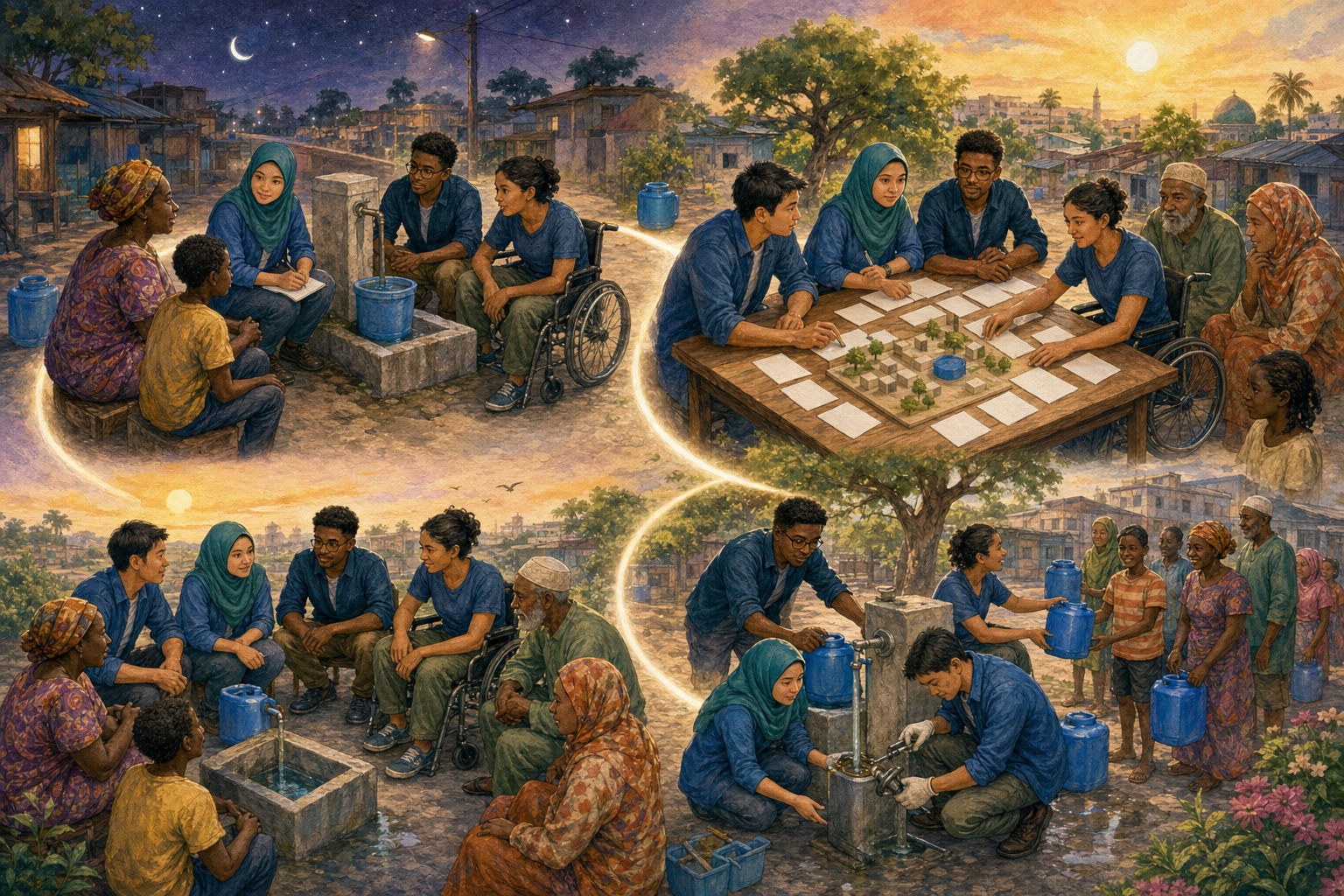
You do not need a large institution to apply these lessons. You need a complete line from value to action to review. Use this cycle for the next jayanti, youth programme, memorial lecture, heritage exhibition, or inter-community gathering.
- Choose the need. Write it in terms of a person and an obstacle: learners lacking access to guidance, neighbours unable to reach a meal service, or visitors unable to understand a local Dharmic history.
- Select the exemplar for the conduct required. Choose Kalam when the work depends on learning, disciplined experimentation, mentorship, or ethical competence. Choose Banda Singh Bahadur when the central issue is protection, structural injustice, courage under pressure, or accountable power.
- Define the service. State exactly what the team will teach, provide, preserve, or make accessible. Assign responsibility rather than leaving the work to whoever volunteers at the last moment.
- Add the justice check. Identify the barrier that produces the need and one legitimate step toward changing it. A tutoring session may help a learner now; widening access to mentors addresses the exclusion that made tutoring necessary.
- Write a unity covenant. Record how partners will represent their own traditions, share responsibilities, choose beneficiaries, and handle disagreement.
- Choose observable evidence. For a learning programme, look for completed work, useful feedback, renewed participation, and learners who can teach the idea onward. For a heritage event, look for accurate interpretation, accessible material, trained volunteers, and a scheduled follow-up action.
- Review conduct as well as output. Ask whether the project preserved dignity, told the truth, restrained power, included overlooked people, and left someone capable of continuing the work.
A simple commitment statement keeps the cycle honest: “By the review date, this team will deliver this service for this group, challenge this barrier, and use this evidence to judge the result.” If the blanks cannot be filled without words such as “awareness,” “empowerment,” or “unity” standing alone, the plan still needs work. Replace the abstraction with something a participant can experience and an organiser can verify.
The decisive change is small but demanding. At your next observance, replace one ceremonial speech with one public commitment: a named need, a responsible team, a protected principle, and a review date. Reverence then becomes practice, and the exemplar returns to public life through the conduct of the people who remember.
References
- DharmaRenaissance Blog – 18 Timeless Dr A.P.J. Abdul Kalam Quotes to Ignite Purpose, Learning, and Dharmic Unity
- SikhNet – Banda Singh Bahadur Immortalized: Historic Statue Unveiled at Guru Nanak Darbar, Gravesend