
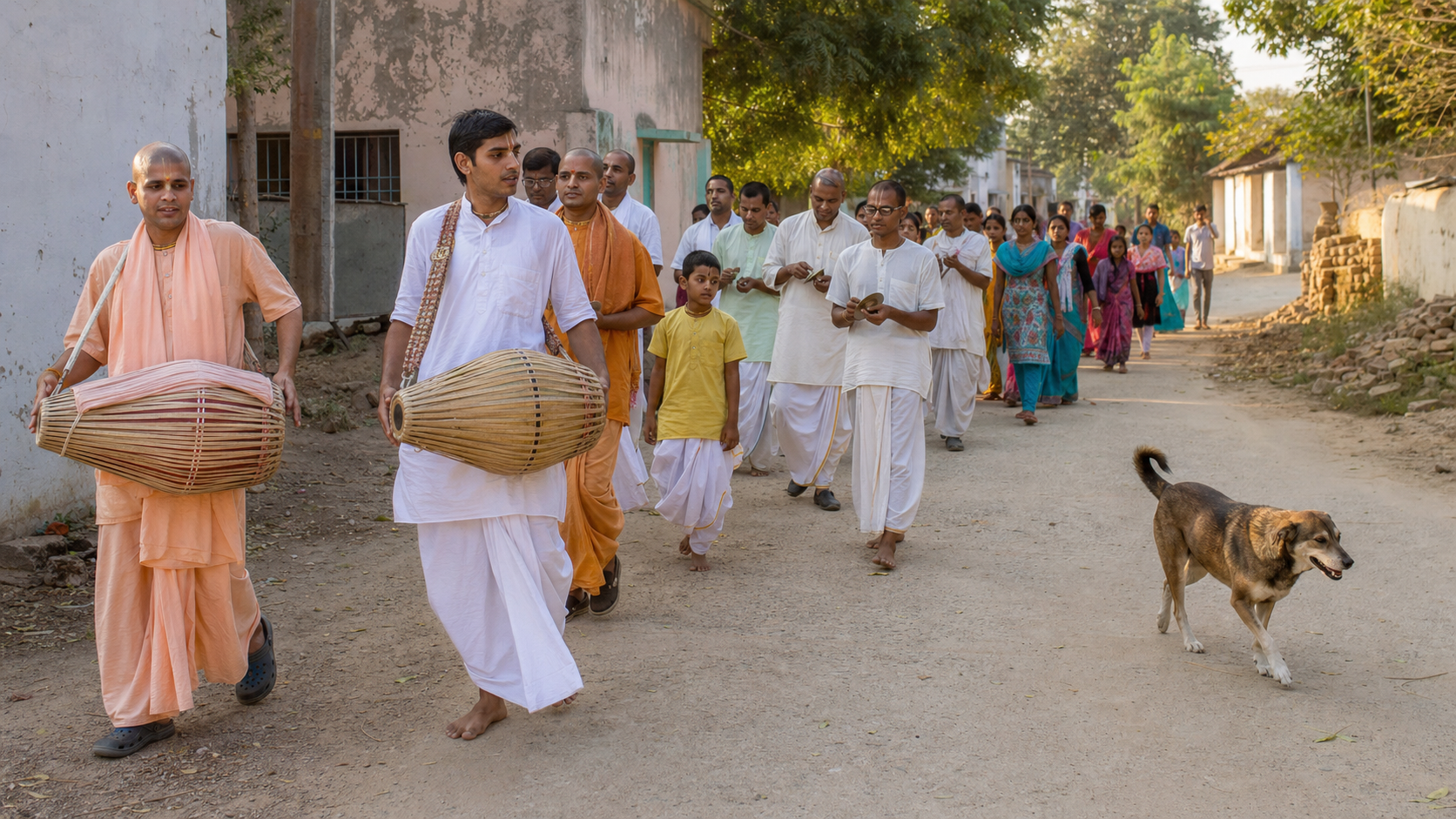
You are halfway through a village kirtan when a street dog slips beside the mridanga line. One devotee reaches down to pet it, a child offers food, someone raises a phone for a closer video, and another person worries about a bite. In that small moment, your theology becomes crowd management.
The dharmic response is neither to chase the animal away nor to make it an unwilling mascot. Keep the procession predictable, give the animal room, stop people from feeding or touching it in motion, and let it leave whenever it chooses. That is how daya becomes visible rather than merely spoken.
An animal reads the procession before it reads your intention
Public bhakti changes a street through sound, movement, and human conduct. Repeated rhythm coordinates footsteps and attention. A cohesive group moving at a steady pace can create a temporary zone of order within an otherwise unpredictable public space. Free-ranging dogs may follow such groups because the regular pace, continuous lower tones, and non-threatening posture suggest relatively low immediate risk.
This behavioural explanation does not diminish the devotional meaning of the encounter. It clarifies how an inner discipline becomes legible outside the human circle. An animal cannot assess the procession’s theology, but it can respond to restraint, distance, sudden movement, noise, and whether an escape remains open.
During an overnight village halt on the ISKCON Maharashtra Padayatra, a dog quietly began walking with the evening nagar sankirtan. The devotees did not crowd or compel it. They allowed it to accompany the procession at its own pace. That restraint matters more than any sentimental interpretation placed upon the event.
A calm animal is not proof that every animal enjoys drums, chanting, or crowds. Following is not consent to be touched. Nor does an animal’s presence need to be treated as an omen. The useful lesson is more demanding: a devotional gathering should be safe enough that vulnerable beings are not frightened, cornered, exploited, or treated as obstructions.
The vocabulary differs across Dharmic traditions, but the public test is recognisable. Hindu practice speaks of daya and ahimsa. Buddhist traditions cultivate karuna and maitri. Jain discipline places ahimsa at the centre of ethical life. Sikh seva and sarbat da bhala widen concern beyond one’s immediate group. These traditions are not interchangeable, yet each challenges you to make goodwill concrete in conduct.
Put daya into the route plan, not only the sermon
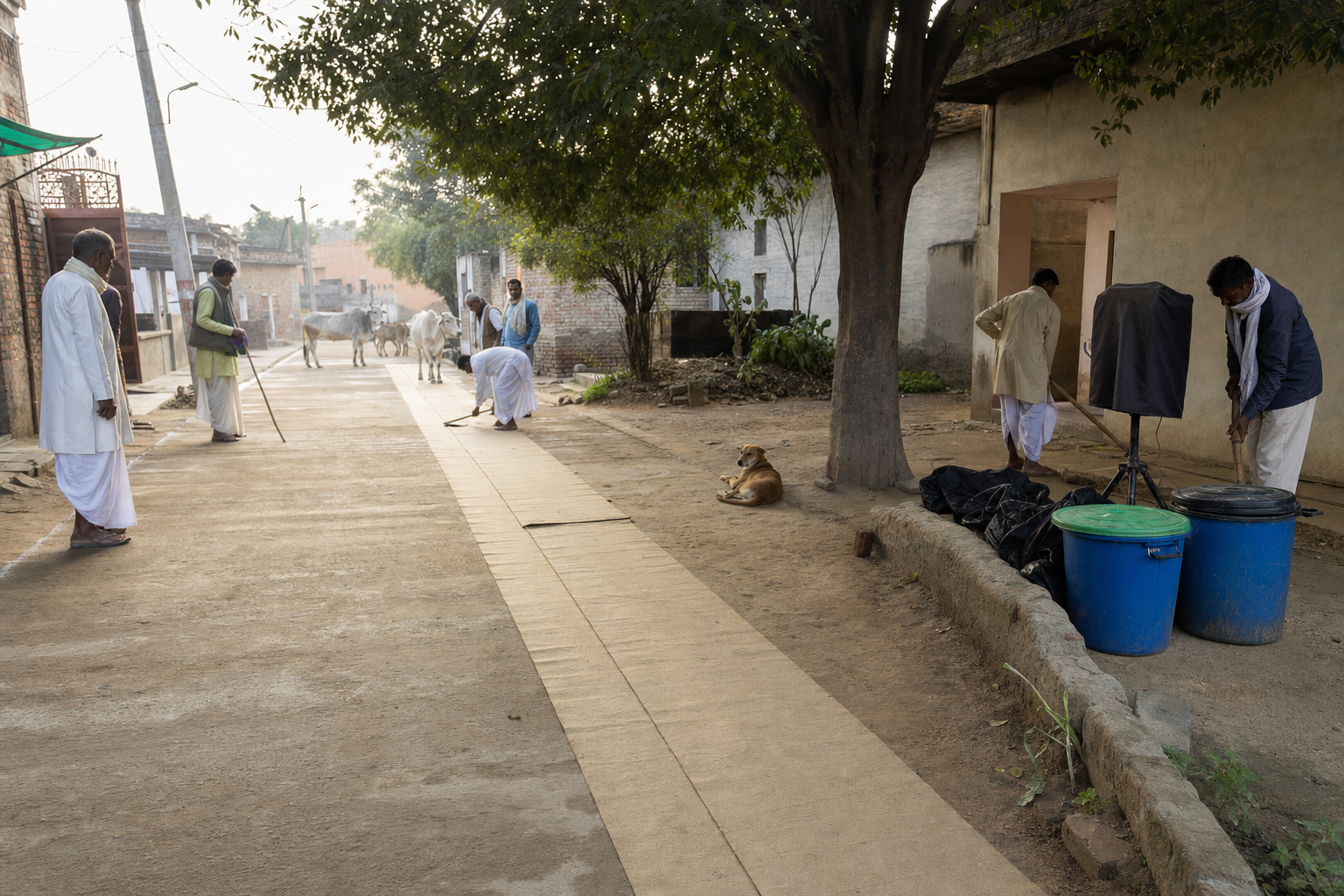
If your temple, yatra team, or sangat regularly enters public space, animal safety belongs in the procession briefing. Waiting until a dog, cow, or other animal appears leaves every participant to improvise. Some will reach for food, some will shout, and others may close around the animal while trying to help.
Use a simple plan before the first cymbal sounds:
- Choose one animal-safety lead. This should be a calm adult positioned where the edge of the formation can be seen. Give that person authority to slow the group, open space, and contact local help.
- Give everyone the same three rules. Do not chase an animal. Do not touch it unless safety is clear. Do not feed it while the procession is moving.
- Keep the formation permeable. A procession should not become a moving wall around an animal. Leave a lateral path through which it can step away from people, instruments, or traffic.
- Notice predictable pressure points. Narrow lanes, road crossings, food-distribution areas, accumulated waste, and places where children gather require closer attention because movement can become compressed.
- Identify local partners. Ask village caregivers, council representatives, or animal-welfare volunteers whom to call about an injured or distressed animal. Vaccination and sterilisation require competent local coordination, not an improvised intervention by travelling devotees.
- Prepare a public-health response. Keep the appropriate local medical and public-health contacts available. Participants should know whom to inform after a bite, scratch, or other possible rabies exposure.
Children need a clear instruction before the route begins: seeing a friendly-looking dog does not make petting safe. An adult should gently intercept a child who approaches rather than shouting across the procession. The same principle applies to adults trying to take close photographs. Compassion protects the animal from being surrounded and protects people from preventable contact.
Sound discipline matters as well. Predictability is more useful than volume for its own sake. A steady procession may be easier for an animal to read than one that repeatedly surges, stops, accelerates its instruments, and breaks formation. If an animal comes close, do not intensify the performance to capture a dramatic moment.
When an animal approaches, use a calm sequence
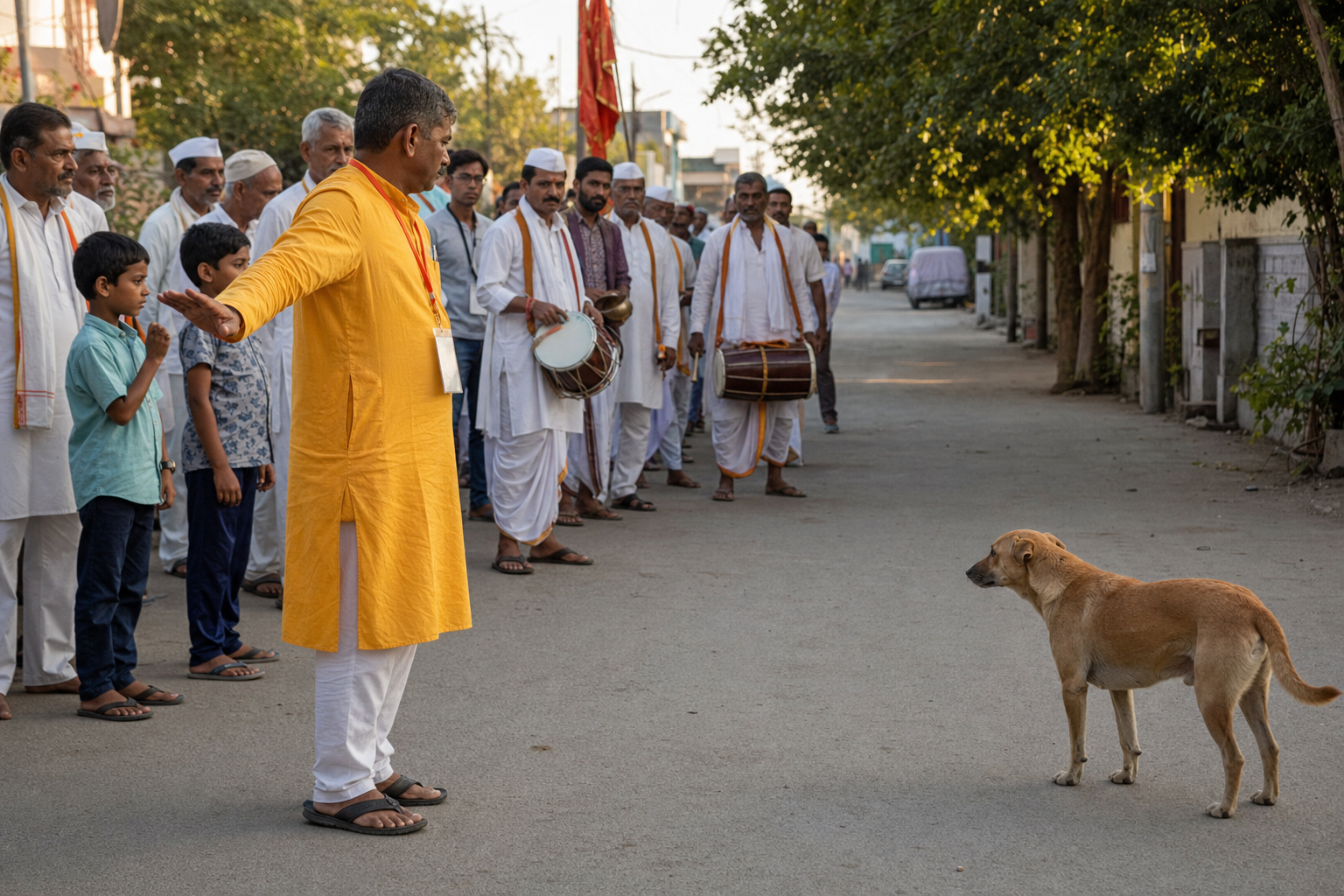
The first few reactions shape everything that follows. Your team does not need to diagnose the animal’s temperament. It needs a shared sequence that reduces crowding and preserves a safe exit.
- Alert the safety lead without alarm. A quiet indication such as animal on the left is enough. Shouting, pointing, or several people turning at once can change a calm situation.
- Relax the nearest edge of the formation. Increase the gap between people. Do not form a circle around the animal or place bodies between it and every route of departure.
- Keep movement predictable if the animal remains calm. Avoid sudden gestures or an abrupt rush toward it. If it appears distressed, widen the distance and slow or pause the relevant part of the procession.
- Keep hands and food away. Do not use prasada to coax the animal farther into the formation. Feeding while walking can draw more animals into a moving crowd and create competition around people’s feet.
- Protect both the animal and nearby children. One adult can create a buffer without touching the animal. Watch the road as well as the procession so that companionship does not lead it into traffic.
- Allow voluntary departure. Do not call the animal back, follow it for a photograph, or treat its leaving as a rejection. Its freedom to disengage is part of compassionate treatment.
- Escalate through experienced local help. If the animal is injured, trapped, persistently distressed, growling, snapping, or moving dangerously through the crowd, move people away. Do not attempt an untrained capture.
Distance can be an expression of compassion. Daya does not require physical contact, and ahimsa does not mean pretending that risk is absent. It means choosing the least harmful response available while respecting the limits of your knowledge.
A bite, scratch, or other possible rabies exposure requires prompt professional assessment under local public-health guidance. Do not wait for symptoms, conceal the incident to protect the procession’s reputation, or substitute prayer for appropriate care. Devotion may accompany responsible treatment; it should never delay it.
Leave the village safer than you found it
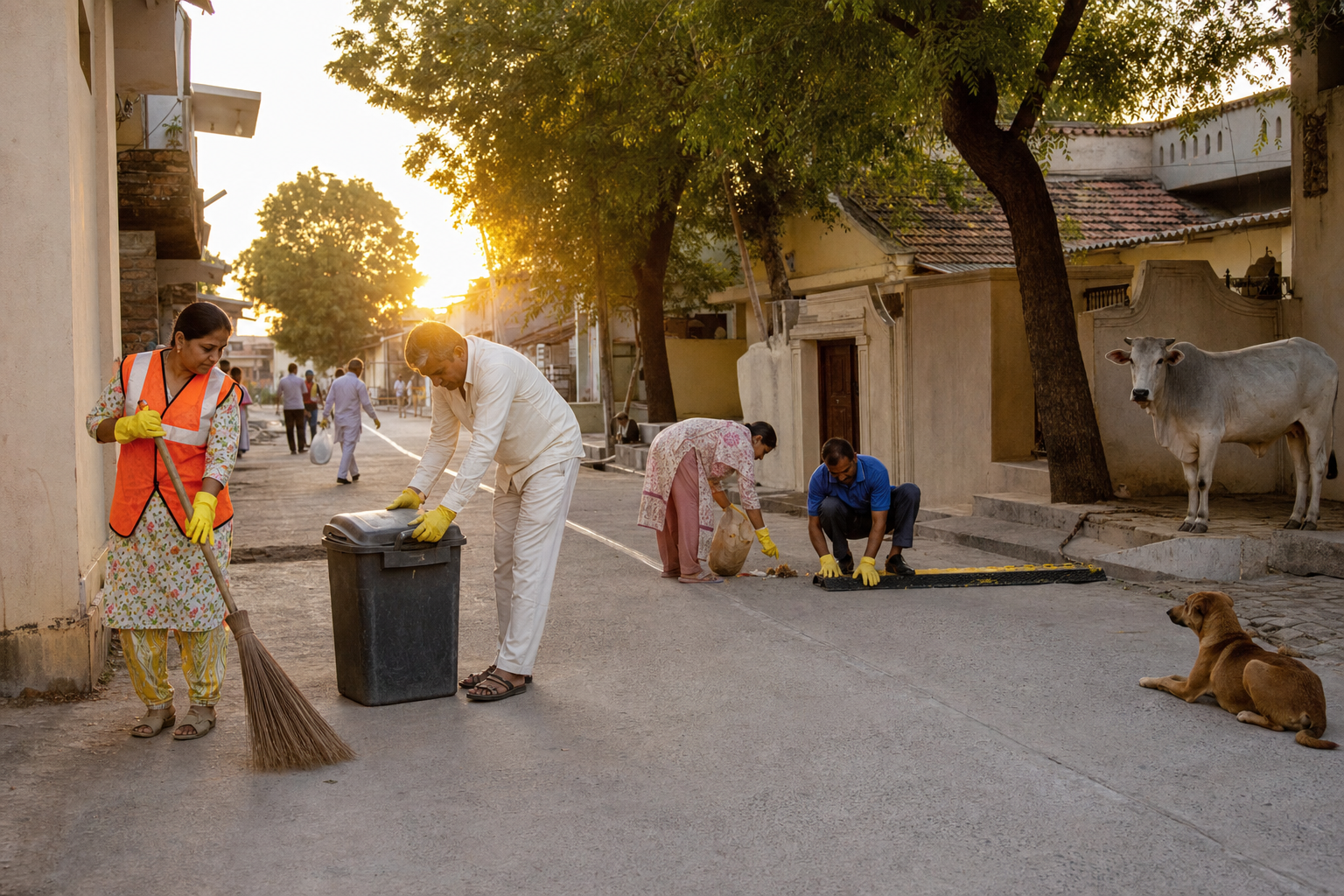
A gentle encounter during kirtan is a beginning, not the full measure of seva. The stronger test comes after the instruments are packed away. Did the team leave scattered food that will draw animals into conflict? Did anyone tell residents where to seek help after a possible rabies exposure? Did the procession build a relationship with people already caring for local animals?
Several modest actions can turn a passing display of kindness into responsible community practice:
- Secure food and clean the route. Respectful waste management reduces the chance that scavenging animals will gather around traffic, crowds, or competing food sources.
- Coordinate water rather than abandoning a container. In hot seasons, ask a local caregiver where a clean water bowl would be useful and who can refill and clean it. A neglected bowl is not a durable act of care.
- Support local vaccination and sterilisation work. Connect village councils and animal-welfare volunteers rather than asking untrained pilgrims to handle animals themselves.
- Share accurate rabies-prevention information. Use guidance supplied by appropriate public-health or animal-welfare professionals. Avoid improvised medical claims in announcements or social posts.
- Debrief practical problems. Note where animals gathered, where the formation became tight, whether food attracted crowding, and whether the safety lead could act quickly. Adjust the next route and briefing accordingly.
- Tell the story without turning the animal into a prop. Emphasise the restraint shown by participants and the local people who continue the work. The ethical centre is conduct, not a dramatic image.
Village processions are moving classrooms. Children observe whether adults practise the gentleness they praise. Households notice whether a devotional group leaves disorder or contributes to public wellbeing. A peaceful cross-species encounter can remain in local memory because it gives people a small, concrete picture of the values proclaimed in song.
This is where public bhakti can become a public good. Nagar sankirtan or Nagar Kirtan does not serve society merely by occupying a street with sacred sound. It serves when the people carrying that sound display self-control, attend to vulnerable life, cooperate with local caregivers, and accept public-health responsibility. Compassion then becomes credible across religious and social boundaries.
Key takeaways
- An animal that follows a procession has not consented to touching, feeding, crowding, or photography at close range.
- A steady pace, non-threatening posture, and open space can make a moving group easier for an animal to read; they do not guarantee that every animal feels safe.
- Brief participants before departure: no chasing, no unnecessary touching, and no feeding while in motion.
- Assign one calm adult to watch the edge of the formation, protect an exit path, and coordinate any pause or local handoff.
- Move people away and contact experienced local help when an animal is injured, trapped, aggressive, or persistently distressed.
- Treat any bite, scratch, or possible rabies exposure as a public-health matter requiring prompt professional guidance.
- Extend seva through clean water in hot seasons, responsible waste management, and local vaccination and sterilisation partnerships.
- Judge the procession by its conduct and what it leaves behind, not by whether an animal creates a memorable photograph.
Before your next public kirtan, add one sentence to the participant briefing: if an animal approaches, stay calm, do not feed or touch it, leave an exit, and alert the safety lead. Then arrange the local contact who can help if the situation exceeds your team’s competence.
That small discipline turns ahimsa from a sentiment into a habit. If an animal chooses to walk beside the holy names, let your response show what the names have taught you: protect it, do not possess it, and keep it free to leave.