
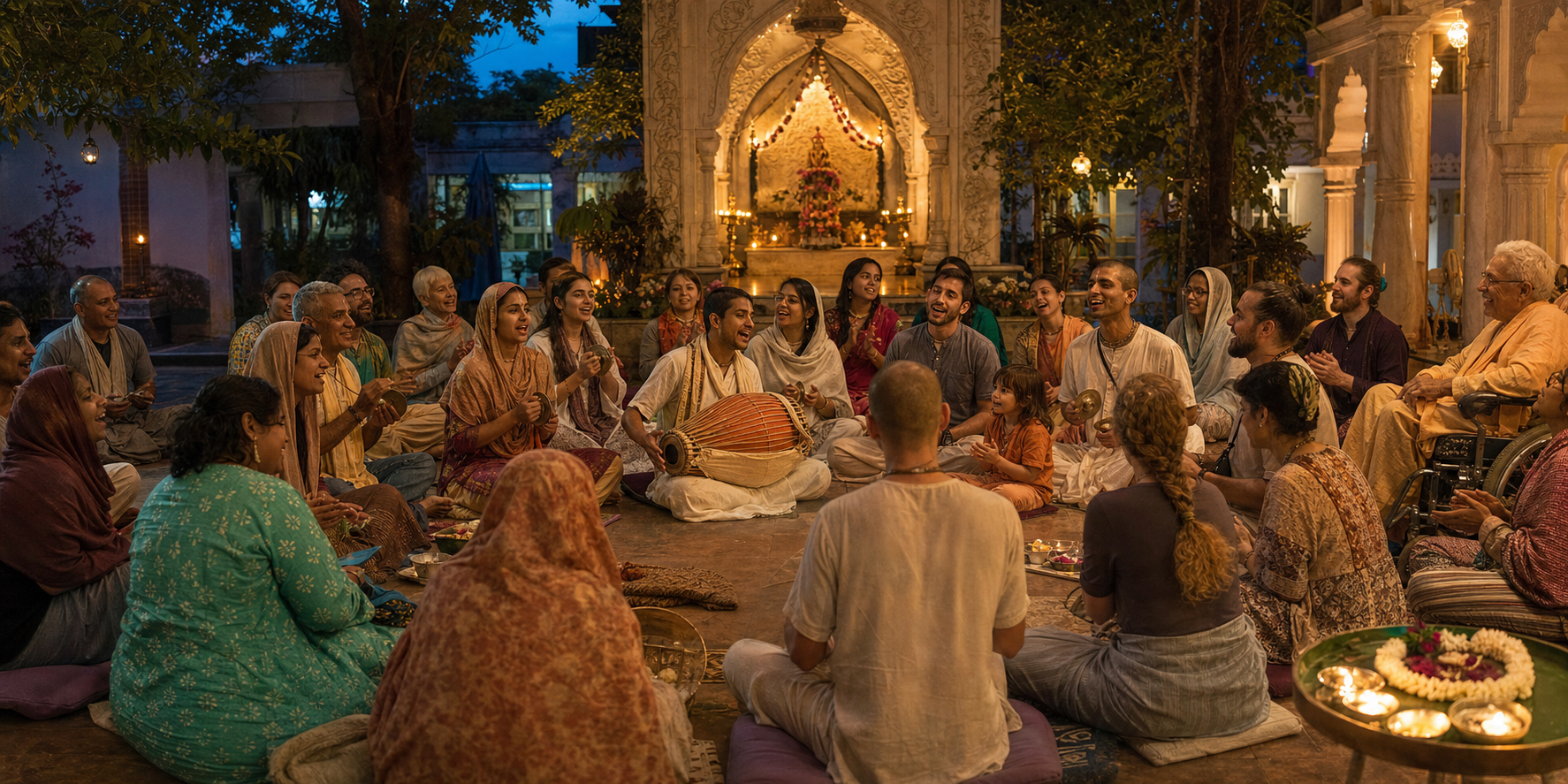
Your temple, nama-hatta, campus group, or household may have sincere devotees and still struggle with uneven participation, personality clashes, or newcomers who never quite become part of the community. The question isn’t whether bhakti has power. It is whether your shared practices are arranged so that devotion becomes shared responsibility rather than private intensity.
You don’t need to erase differences in temperament, generation, culture, or devotional style. You need a dependable rhythm: hear together, chant together, serve together, share prasadam, and carry wisdom beyond the gathering. Each practice does a different kind of work. Unity becomes durable when no single practice is expected to do all of it.
Build unity around a shared center, not forced agreement
Gaudiya unity begins with a shared orientation toward Krishna. Within Gaudiya Vaishnavism, the holy name is understood to be non-different from the Divine, so congregational chanting is direct devotional engagement, not merely religious entertainment. When people remember this, kirtan stops being a stage on which musicians, organizers, or factions compete for attention.
That shared center does not require uniformity. Two devotees can prefer different melodies, tempos, instruments, teachers, or forms of service while remaining aligned in nama, seva, and respect for Vaishnavas. Trouble begins when a preference is quietly promoted into a test of spiritual worth. A slow melody is not automatically deeper than a lively one. Public visibility is not proof of greater surrender. A quiet volunteer is not less devoted than the person holding the microphone.
When friction appears, don’t begin by asking who is more devotional. Use four narrower questions:
- What principle is actually at stake? Separate a theological or ethical requirement from a preference about presentation, schedule, or personality.
- What concrete effect occurred? Name the interrupted service, inaccessible arrangement, disrespectful exchange, excessive sound, or unclear responsibility instead of judging another person’s inner motive.
- Who needs to be heard? Include the people carrying the practical consequence, especially volunteers, newcomers, families, elders, and those responsible for safety or access.
- What conduct will change? Agree on an observable action: a clearer rotation, a sound limit, a written service assignment, a separate time for discussion, or a more respectful way to answer questions.
Do not use kirtan to suppress a necessary conversation. Chanting can soften the heart, but it should not become spiritual pressure to pretend that a practical problem has disappeared. Discuss the issue calmly, decide what will change, and then return to shared practice without turning the disagreement into a permanent identity.
Leadership must carry the same discipline. The service of King Prataparudra surrounding Sri Chaitanya Mahaprabhu’s Ratha-yatra pastimes presents a demanding Gaudiya standard: responsibility is expressed through hospitality, organization, and care for devotees, not through prestige. Authority strengthens unity when people can see it taking responsibility for ordinary service.
Use a five-part gathering that gives everyone a place
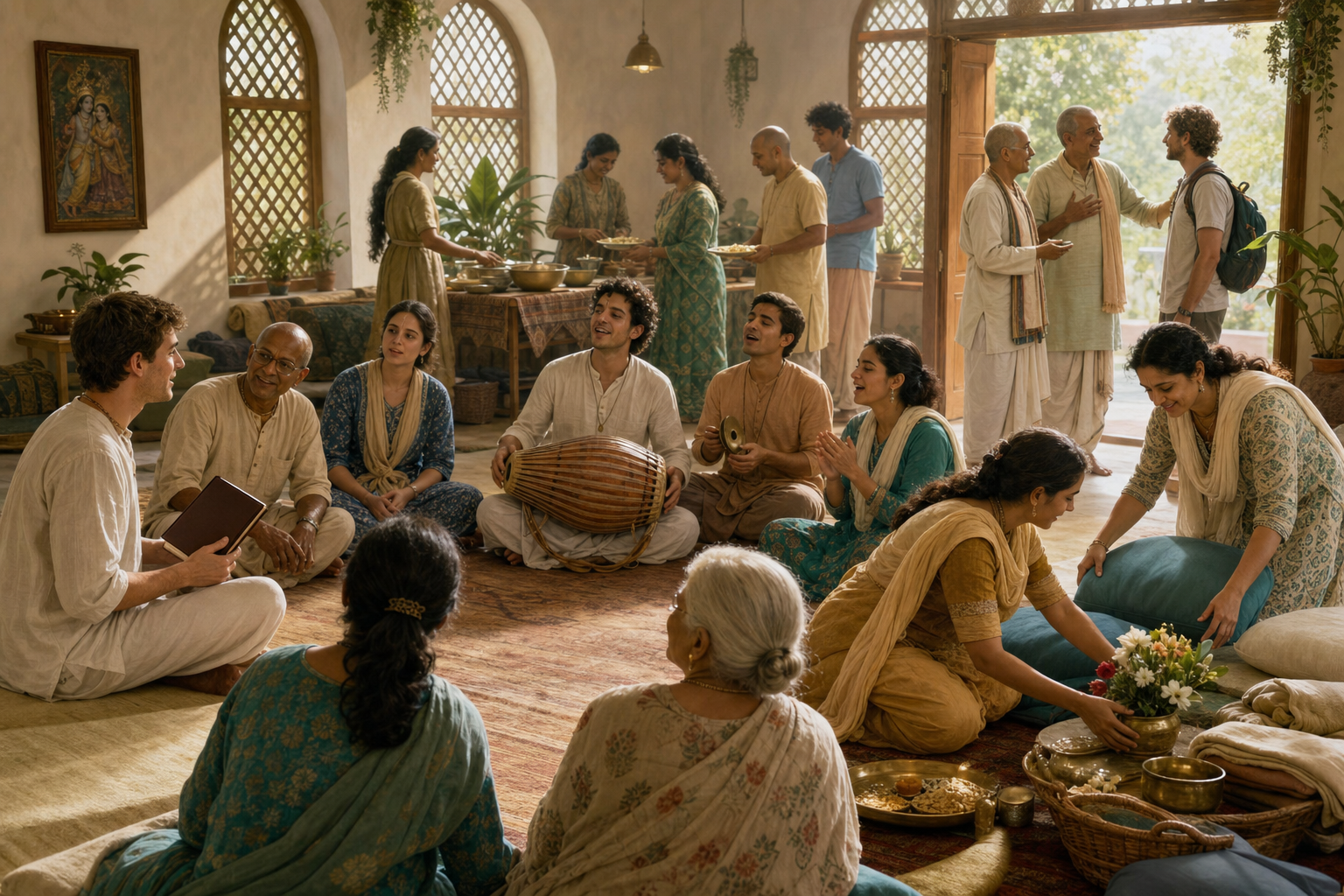
A community gathering is easier to enter when its movement is intelligible. People should know why they are there, how to participate, and what happens after the singing ends. The following sequence works for a home program, a temple gathering, or a small public event because it joins inward practice to outward care.
- Offer a brief orientation. Explain in plain language that the gathering centers on remembrance of Krishna through sacred sound, hearing, service, and sanctified food. Tell newcomers that participation is invited, not compelled. One clear explanation prevents the maha-mantra from feeling like an unexplained performance.
- Lead accessible kirtan. Begin with a steady call-and-response that people can follow. Balance voices and instruments so the mantra remains audible. Train new leaders before rotating facilitation, and make room for qualified women, younger devotees, families, and less-visible members to contribute without treating inclusion as tokenism.
- Hear one focused teaching. Read a verse or short passage from the Bhagavad-gita or another relevant Gaudiya text, give enough context to avoid proof-texting, and ask one practical question: What can we carry into the coming days? A short reading that becomes conduct is more unifying than a long discourse that leaves no shared application.
- Turn the teaching into seva. Give people concrete ways to help: arranging seats, welcoming guests, caring for instruments, keeping paths clear, serving water, cleaning, managing books, or preparing and distributing prasadam. Publish or announce responsibilities so service does not repeatedly fall on the same dependable few.
- Share prasadam with equal respect. Let the gathering conclude in hospitality rather than dispersal. The meal creates space for unhurried conversation, newcomers to ask questions, and people who served in different roles to meet one another without the hierarchy of the platform.
The sequence matters. Kirtan establishes a common devotional center. Hearing gives that emotion direction. Seva prevents spirituality from becoming passive consumption. Prasadam makes welcome tangible. A gathering that omits one of these functions may still be joyful, but it has fewer ways to turn joy into belonging.
For a standard Gaudiya home offering, the practical method can remain simple: prepare clean vegetarian food without onion or garlic, set aside a portion before the altar or sacred image, offer it sincerely with the Hare Krishna maha-mantra or a prayer, pause in remembrance, and then distribute it as prasadam. The heart of the practice is not culinary display. Bhagavad-gita 9.26 places the emphasis on devotion in the offering, while prasadam joins that devotion to hospitality and communal care.
Before calling the gathering successful, view it from the newcomer’s position. Could the person understand the purpose in one sentence? Could they follow the response without already knowing Sanskrit? Was there a low-pressure way to serve? Could they receive prasadam without being cornered into a debate, donation, or commitment? If the answer to any of these is no, the obstacle is probably in the design rather than in the newcomer’s sincerity.
Make public sankirtana a school of humility
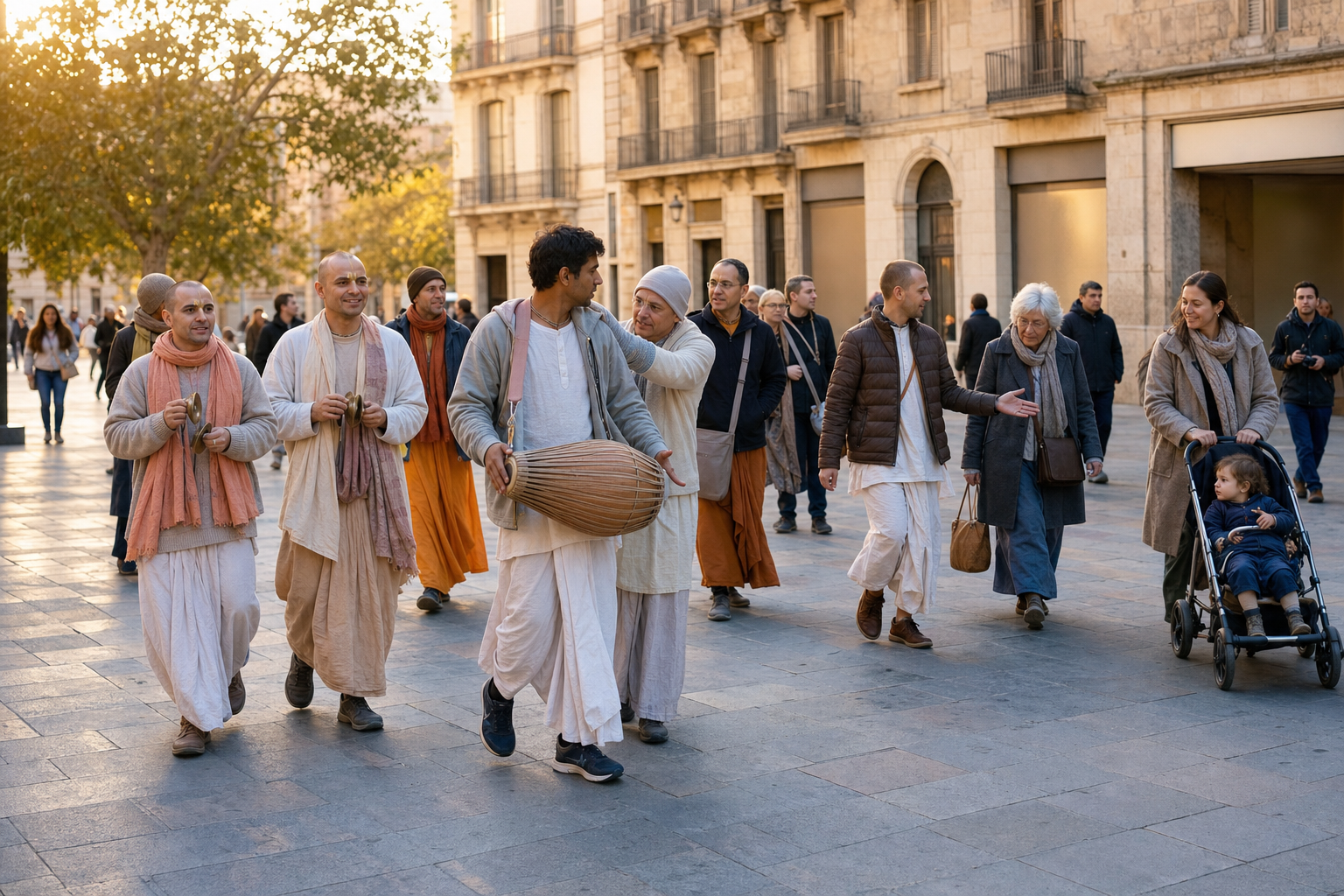
Public harinama reveals whether a community can carry an intense devotional conviction with civic gentleness. The street is shared space. Shopkeepers, residents, workers, parents, and passersby did not all choose to attend your program, so the quality of your sankirtana is measured partly by how carefully you treat them.
Before setting out, use a practical readiness check:
- Confirm local requirements. Check the relevant permissions, route conditions, time windows, sound rules, and public-order expectations. Devotional intention does not cancel a civic obligation.
- Protect movement through the space. Keep footpaths, entrances, crossings, and emergency access clear. Assign identifiable marshals rather than assuming every participant will notice a developing obstruction.
- Design the sound for listeners as well as musicians. Prefer balance over sheer volume. The voices and mantra should not disappear beneath kartals, mridangas, or amplification.
- Explain without pressuring. A small placard, occasional spoken introduction, or QR code can tell people what is being sung and why. Let curiosity initiate further conversation. Avoid aggressive leafleting and street-corner argument.
- Plan for actual bodies. Consider children, elders, people with disabilities, rest points, water, shade, and multilingual information appropriate to the neighborhood.
- Prepare for misunderstanding. Give stewards a calm response protocol and basic first-aid readiness. One designated civic liaison is more useful than several participants trying to answer an official at once.
- Leave the place better than you found it. Minimize disposable material, collect litter, and check the route after the procession. Environmental care makes ahimsa visible.
These disciplines do not reduce harinama to event management. They protect its devotional purpose. Thoughtful public sankirtana combines sadhana, inclusion, safety, and respect for local communities. When the logistics are careless, bystanders remember disruption. When they are handled well, people can encounter the sacred sound without feeling overrun by it.
Public practice can also strengthen unity across the wider Dharmic family, provided cooperation does not erase distinction. Sikh naam simran and Nagar Kirtan, Jain recitation of the Namokar Mantra, and Buddhist recitation or metta chanting each arise from their own theology and discipline. A joint civic program can use sequential devotional segments, rotating facilitators, and a shared logistics team while allowing every tradition to name its practice accurately.
The useful formula is shared ethical ground with distinct devotional integrity. Ahimsa, hospitality, disciplined remembrance, and service offer real points of cooperation. Mixing every mantra into an indistinct spiritual product does not. Unity is stronger when participants know what they share and what they respectfully do not claim to share.
Afterward, ask residents, shopkeepers, organizers, and participants a few plain questions. Was movement kept clear? Was the sound comfortable? Did the explanation make sense? Did anyone feel pressured or excluded? Record recurring answers and change the next event accordingly. Feedback is seva when it helps the community become a better neighbor.
Let books, prasadam, and seva carry the bond forward
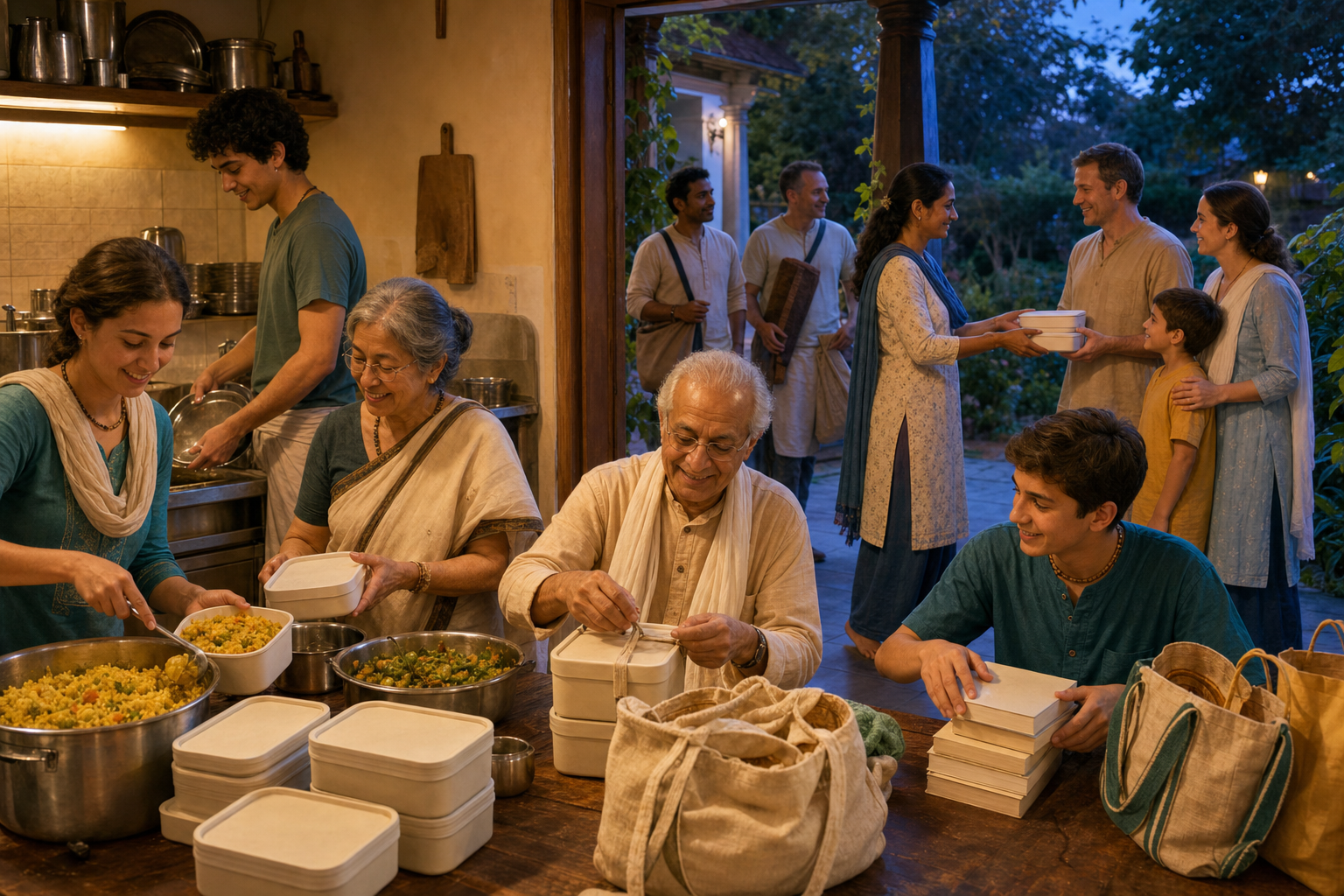
Put each sacred book into a relationship
A physical book can continue serving after the music has ended and the hall has emptied. It can be browsed privately, revisited during a difficult period, passed through a family, placed in a library, or found again after years on a shelf. Its influence cannot be measured only by the first recipient.
Kadamba Kanana Swami’s devotional turn began when a friend read a Bhagavad-gita and passed it to him. The original copy eventually disappeared from his own account, but the hand-to-hand encounter helped redirect an entire life. That is the right scale on which to understand book distribution: not as inventory moved, but as wisdom entrusted to a person.
- Ask permission before offering a book; don’t make acceptance the price of a friendly interaction.
- Introduce one verse that genuinely matters to the reader’s question instead of giving a rehearsed sales speech.
- Add a brief personal note explaining where the person might begin, while leaving room for their own reading.
- Invite the recipient to keep, lend, return, or pass the copy onward. Circulation is not failure.
- Place introductory editions in local libraries, student spaces, reading circles, and community shelves where unhurried discovery is possible.
- Offer a follow-up conversation without chasing the reader for a devotional result.
A reading circle should follow the same ethic. Give the passage context, distinguish the text from a participant’s interpretation, and ask how the teaching might shape conduct. The purpose is not to make the most confident speaker the group’s unofficial authority. It is to help everyone hear more carefully and practice more honestly.
Treat prasadam as sacred hospitality, not catering
Prasadam becomes unifying when the theology is visible in the manner of distribution. The same food should be offered with the same respect across differences of status, wealth, ethnicity, age, or familiarity with the community. Label ingredients and common allergens clearly, maintain clean serving practices, and arrange the space so that people with mobility needs can participate without embarrassment.
Keep the invitation free of hidden conditions. A person should be able to accept prasadam without attending a lecture, joining a list, or defending a belief. This is especially important when food is served publicly or to people in need. Hospitality ceases to feel like grace when a vulnerable guest suspects that nourishment is being used as leverage.
The kitchen and cleanup area are also tests of leadership. If respected organizers take responsibility for repetitive, unseen work, service becomes the community’s common language. If the same people are always left to cook, carry, wash, and restore the space while others receive recognition, the meal may be sanctified but the service culture still needs repair.
Measure practical care without turning bhakti into a score
Attendance alone cannot tell you whether unity is deepening. Look for observable signs: newcomers returning without being chased, volunteers moving into new responsibilities, service being shared more evenly, questions being received without defensiveness, public complaints being addressed, books continuing to circulate, and prasadam being distributed with dignity.
Review one or two of these signs after each gathering. Keep the conversation factual. What was confusing? What task lacked an owner? Who could not access the program? What did neighbors notice? What should be trained before the next event? This turns reflection into improvement without pretending that the spiritual value of sankirtana can be reduced to a dashboard.
Key takeaways
- Build unity around Krishna, nama, seva, and respect for Vaishnavas; don’t demand identical tastes or personalities.
- Separate spiritual principles from preferences about melody, schedule, instruments, speaking style, or visibility.
- Give gatherings a repeatable movement from orientation and kirtan to hearing, service, and prasadam.
- Judge public sankirtana partly by its civic care: lawful planning, balanced sound, clear access, calm communication, and clean shared space.
- Cooperate with other Dharmic traditions through shared service and ethical commitments without flattening their distinctive teachings.
- Distribute books through permission and relationship, serve prasadam without hidden conditions, and treat ordinary work as a field of leadership.
At your next gathering, choose one repair that people can see: make the kirtan easier to follow, give an overlooked volunteer a defined role, place one Bhagavad-gita into a genuine relationship, or serve prasadam with greater accessibility and care. Repeat that improvement until it becomes community culture. Unity grows when devotion is given a reliable form in which everyone can serve.
References
- Dandavats – The Power of One Book: How a Bhagavad-gita Sparked Lifelong Devotion and Dharmic Unity
- Dandavats – Harinama Sankirtana in Public Spaces: 11 Evidence-Based Actions for Peaceful, United Communities
- Dandavats – Prasadam’s Transformative Grace: Gaudiya Insights on CC Madhya 14.36 for Daily Life and Unity