
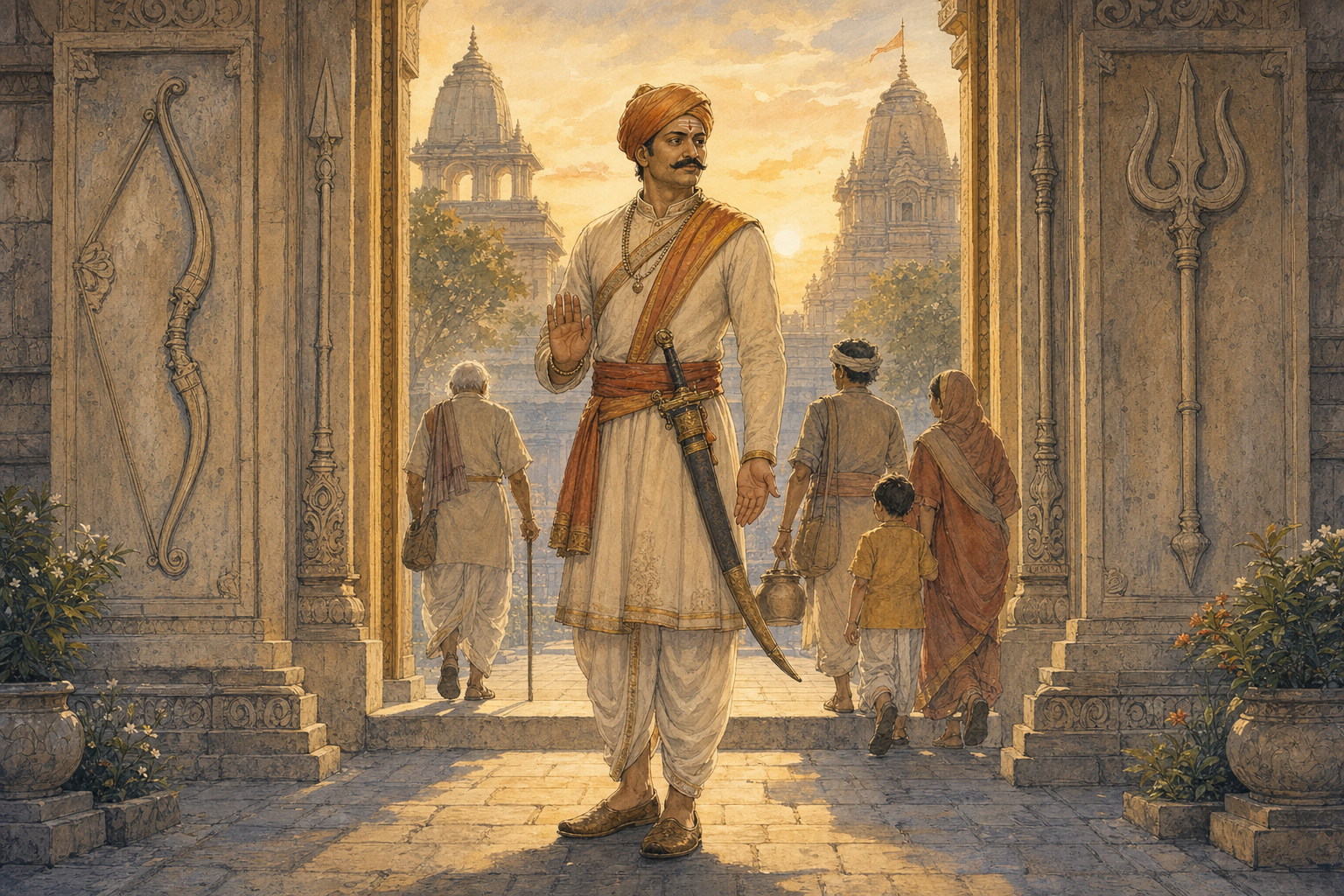
If a sword, spear, or trident in a temple leaves you wondering whether dharmic tradition sanctifies violence, do not judge the symbol in isolation. Read the weapon with its bearer, posture, gestures, purpose, and restraints. That fuller reading turns a troubling image into a practical lesson about how power should be governed.
The central distinction is simple: capacity without command of the self is force, not kshatra. Disciplined kshatra protects the vulnerable, uses no more power than duty requires, stops when protection has been secured, and remains answerable for the consequences. You can use those standards in temple darshana, public leadership, family boundaries, and any situation in which courage must not become cruelty.
Read the weapon as a moral sentence, not an isolated object
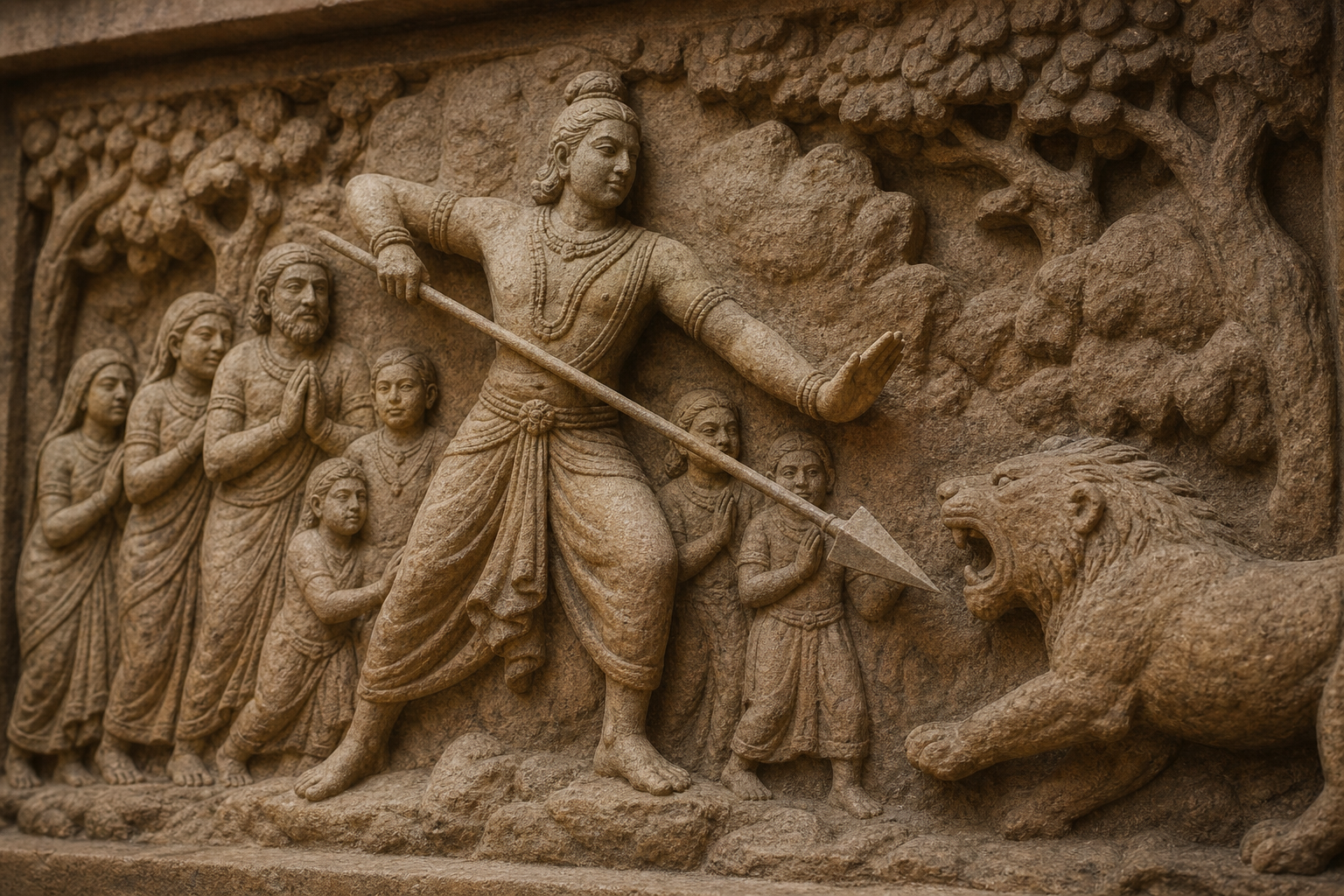
A sacred weapon, or ayudha, first tells you that a deity possesses the capacity to confront disorder. It does not, by itself, tell you how or when that capacity may be exercised. The rest of the icon supplies the ethical grammar: a calm or fierce gaze, a seated or standing posture, a protective gesture, a blessing hand, a mount under control, or another object held in balance.
Veera Shasta makes this grammar especially clear. His heroic form may stand ready or appear with a bow, arrow, sword, shield, staff, horse, or tiger. Yet readiness is accompanied by the assurance of abhaya and the generosity of varada. The result is not an image of uncontrolled combat. It is an image of strength trained to protect, govern, and reassure.
The name Shasta itself comes from the Sanskrit root shas, associated with instruction and governance. That matters. The warrior is also a teacher and custodian of order. The weapon cannot be separated from the discipline that qualifies its bearer to hold it.
Use this five-part reading whenever you encounter armed sacred iconography:
- Identify the bearer. A trident held by Shiva, a vel held by Murugan, and a bow held by Veera Shasta belong to distinct theological settings.
- Identify the form accurately. Count the points, notice the blade, and distinguish a spear from a trident before assigning a meaning.
- Read the whole posture. Stillness, readiness, movement, and mastery of a mount communicate different relationships to power.
- Look for the ethical counterweight. Abhaya, varada, a shield, yogic composure, or a blessing hand may tell you what the weapon is meant to serve.
- Turn the symbol into a discipline. Ask what you must foresee, restrain, discern, protect, or do decisively in your own situation.
This method prevents two opposite mistakes. One is to reduce every weapon to literal violence. The other is to turn every weapon into a vague symbol of positive energy. Sacred iconography is more demanding than either reading. It joins real capacity to definite moral obligations.
Distinguish the forms before interpreting their lessons
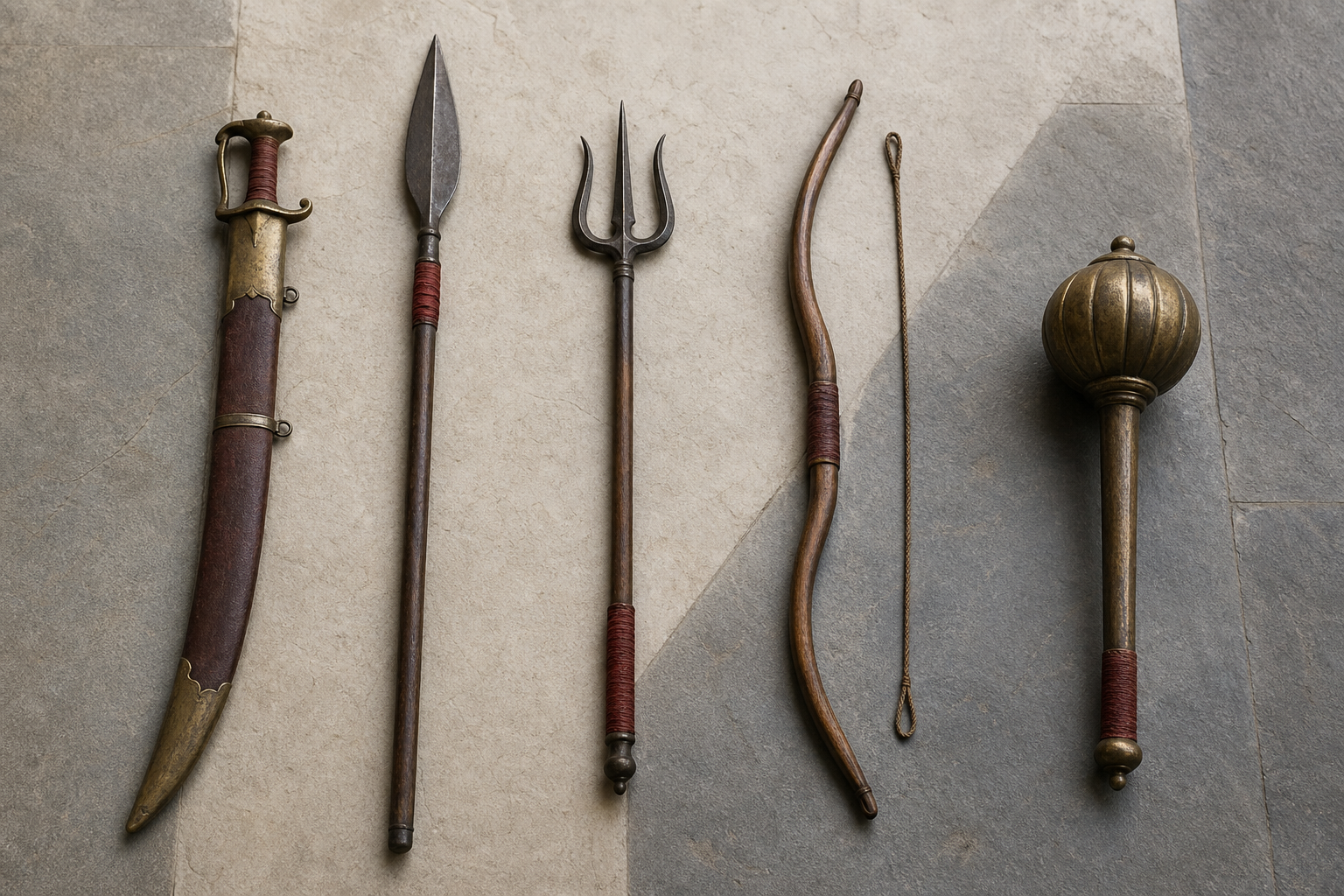
Similar-looking implements do not always make the same statement. The most common confusion is between the shoola and the trishul. A shoola is a single-pointed spear or lance. A trishul has three distinct tips, normally with a longer central point and two shorter flanking points. Murugan’s vel is also a single spear, not a trident.
| Form | What to notice | Discipline it can teach | Question to ask yourself |
|---|---|---|---|
| Shoola or vel | One point or one blade on a shaft | One-pointed attention, clear resolve, and penetration of confusion | What is the one duty that must not be obscured by distraction? |
| Trishul | Three distinct points, with the central point usually longest | Integration of will, knowledge, and action; mastery rather than fragmentation | Do my intention, understanding, and chosen action actually agree? |
| Bow | A weapon that requires preparation, aim, and controlled tension | Foresight and disciplined intention | What consequence should I anticipate before releasing words or action? |
| Arrow | A directed implement released toward a defined aim | Decisive but proportionate action | What single action would address the real problem without widening the conflict? |
| Sword | A cutting blade held for close, deliberate action | Viveka, the discrimination that separates truth from confusion | Which fact, motive, or assumption must be separated from the rest? |
| Shield | A defensive surface carried with an offensive implement | Fortitude, self-protection, and a boundary against harm | What must be protected before confrontation is even considered? |
The trishul’s three points support several complementary contemplations. They can signify iccha-shakti, jnana-shakti, and kriya-shakti: will, knowledge, and action. They can also signify the three gunas, the three dimensions of time, or the yogic relationship among ida, pingala, and sushumna. These are not interchangeable labels to recite mechanically. Each interpretation asks whether multiple powers have been brought into a governed centre.
The single spear teaches a different lesson. Its one-pointed form emphasizes focus and directed clarity. If the trishul asks whether your powers have been integrated, the spear asks whether your purpose has become precise enough to act without diffusion.
Regional vocabulary can still complicate identification. Tamil usage commonly employs sulam for a trident, while vel identifies Murugan’s spear. In much of North Indian speech, trishul clearly means the three-pronged emblem, while other terms may be used for a spear. Do not build a theological argument from a shop label or colloquial name alone. Count the points and examine the icon.
Kshatra begins where anger loses command

Dharma-yuddha is sometimes romanticized as righteous combat. Its ethical value lies in the opposite direction: it restricts the use of force. The Mahabharata and Bhagavad Gita place action inside duty, consequence, self-command, and moral responsibility. They do not convert anger, wounded pride, or group loyalty into automatic permission.
Ahimsa remains the baseline. Kshatra becomes relevant when life, dignity, a legitimate boundary, or social order genuinely requires protection. Even then, power must pass through demanding gates:
- Protection: Name the person, community, duty, or just boundary being protected. If the honest answer is merely your status or pride, the kshatra claim fails at the first gate.
- Right intention: Seek safety and restoration, not humiliation, revenge, or the pleasure of defeating an opponent.
- Necessity: Treat coercion or force as a last measure, not as the first proof of seriousness. Use a less harmful effective means when one is available.
- Proportion: Do no more than the protective purpose requires. The existence of a real wrong does not justify an unlimited response.
- Clarity: Establish what is true before acting. Rumour, collective blame, and rage destroy the discrimination symbolized by the sword.
- A stopping point: Decide what restoration looks like before escalation begins. When the threat has ended or the boundary is secure, continued punishment becomes retribution.
- Accountability: Be willing to explain the decision, face its consequences, repair avoidable harm, and accept penance where conduct has crossed a line.
This test is useful well beyond a battlefield. Suppose a colleague is being intimidated. A disciplined response begins by establishing the facts, giving the targeted person immediate support, stating the boundary clearly, and escalating through the smallest effective step. The goal is a safe and truthful process. Publicly humiliating the wrongdoer after the danger has passed would serve anger, not protection.
The same distinction applies in cultural and political advocacy. Firmly answering a falsehood can be dharmic. Inventing facts, dehumanizing a population, or treating every disagreement as existential combat cannot be made righteous by attaching sacred vocabulary to it. A cause concerned with truth cannot be defended through untruth.
Sacred symbolism is also not authorization for vigilantism. When an immediate physical danger exists, the first duty is to move people toward safety and involve the appropriate emergency or lawful authorities. The icon gives you an ethic of responsibility; it does not exempt you from legal limits, competence, or the risk of making a dangerous situation worse.
Train restraint before you need courage
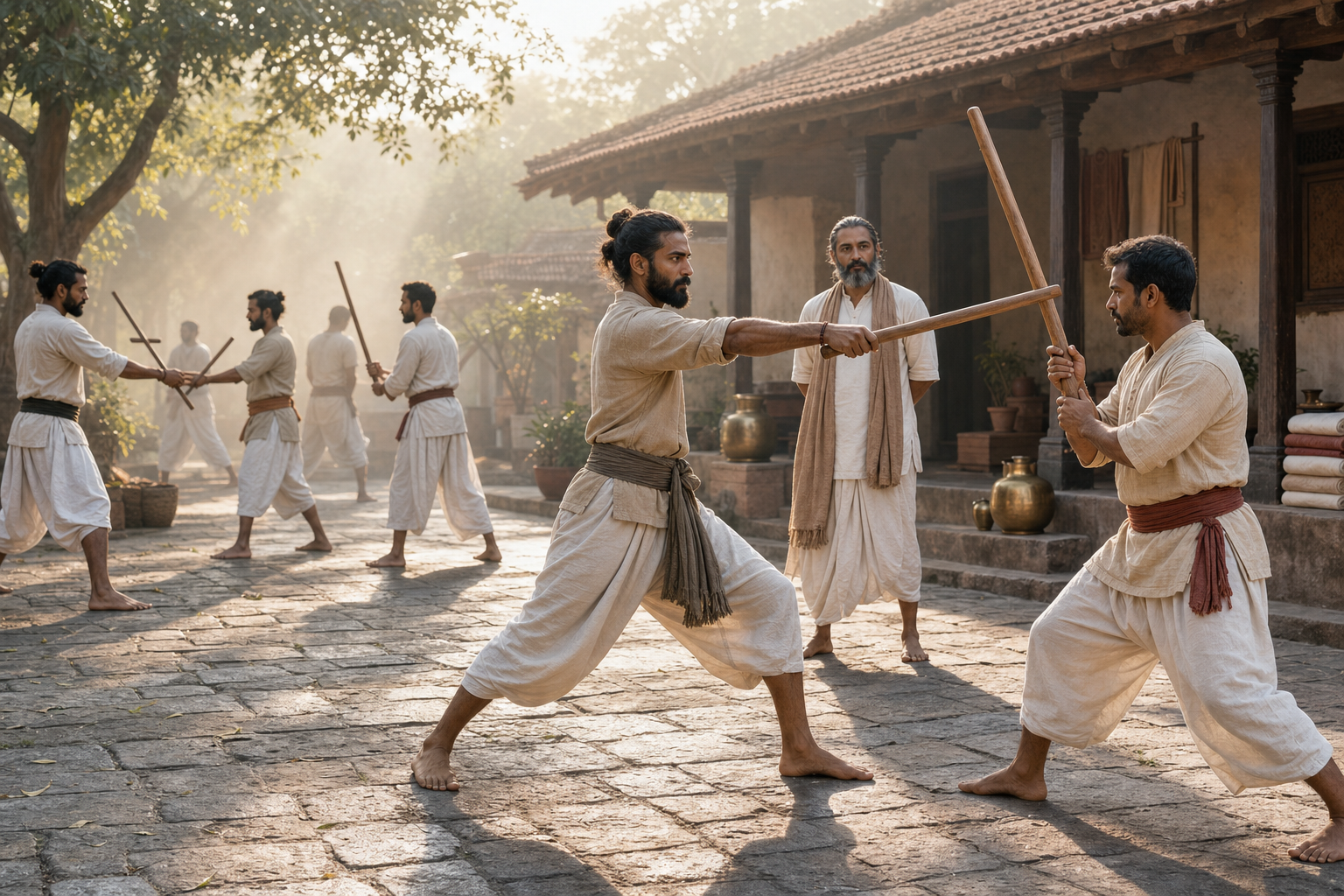
A crisis is a poor time to discover whether you can govern your speech, fear, appetite, and anger. That is why the heroic current around Ayyappa is inseparable from vrata. Simplicity, truthfulness, non-injury, self-control, equality, and service are not decorative preliminaries to courage. They are the training that keeps courage from collapsing into aggression.
You can translate that training into a decision protocol without pretending that every disagreement is a battle:
- Settle your speech before making the first move. If you cannot state the problem without insults or exaggeration, you are not yet ready to act clearly.
- Name your duty and its beneficiary. Write a sentence beginning, “The person or principle I am responsible for protecting is…” This exposes ego-driven motives quickly.
- Separate facts from interpretations. List what you directly know, what you infer, and what remains uncertain.
- Define the restored condition. It might be a person made safe, a false statement corrected, a boundary respected, or a fair process resumed.
- Choose the least harmful action that can realistically reach that condition. A restrained response must still be effective; passivity that abandons the vulnerable is not ahimsa.
- Set the stopping rule in advance. Decide what evidence will show that protection has been achieved and escalation should end.
- Review the aftermath. Ask whom your action protected, whom it harmed, whether the harm was necessary, and what repair is now owed.
The weapons of Veera Shasta can serve as a compact sequence for this protocol. Use the bow before a difficult conversation: consider the long-range consequence. Use the shield next: state the boundary that prevents further harm. Use the sword: cut irrelevant accusations away from the decisive fact. Use the arrow only then: make one clear request, report, refusal, or intervention. Finally, remember abhaya and varada: reassure the person at risk and offer practical help.
A shield-like boundary can be as direct as, “I will continue this discussion when threats stop.” An arrow-like action may be one documented report to the responsible authority rather than a sprawling campaign of accusation. The symbolism becomes useful when it changes the scale, timing, and aim of what you actually do.
This also explains why the controlled horse and tiger matter in heroic iconography. Speed and instinct have not been destroyed; they have been trained and placed in service. The question is not whether you possess anger, urgency, or strength. It is whether they carry dharma or drag it behind them.
Recognize a shared ethic without erasing real differences
Disciplined protection appears across the dharmic family, but it does not appear in identical theological forms. Hindu traditions present armed deities such as Shiva, Devi, Murugan, Bhairava, and Veera Shasta. Sikh teaching brings devotion and defence together through the Sant-Sipahi ideal and the miri-piri relationship between spiritual depth and temporal responsibility. Buddhist traditions employ Dharmapalas and the compassionate firmness of the Bodhisattva path. Jain traditions hold ahimsa with exceptional strictness while still confronting questions of royal responsibility and social order.
The shared ethical floor is easier to state than a shared theology: power should protect truth, life, ethical space, and those at risk rather than serve domination. Beyond that floor, differences in doctrine, practice, and the permitted use of force remain important. Respectful synthesis does not require turning a trishul, kirpan, Dharmapala implement, and guardian’s spear into interchangeable symbols.
Aiyanar’s mounted guardianship at village boundaries adds another practical insight. Protection often begins as boundary work: noticing where ordinary order ends, where vulnerability increases, and where someone must remain vigilant. The continuum between local guardianship and the wider ideal of dharma-protection keeps kshatra grounded in service to an actual community.
When a teacher, organization, or movement invokes sacred weapons, test the invocation by its fruits. Does it train restraint before confrontation? Does it specify whom power must protect? Does it distinguish restoration from revenge? Does it accept truth, limits, and accountability? Does it honour service and self-command as much as martial display? If those disciplines are absent, the symbolism has been detached from the ethics that make it sacred.
Key takeaways
- Identify the implement before interpreting it: one point indicates a spear or vel, while three indicate a trishul.
- Read the entire icon. Posture, gaze, mount, abhaya, varada, and defensive objects determine how power is framed.
- No sacred weapon grants a blank cheque for aggression. Ahimsa, necessity, proportion, restoration, and accountability remain the governing limits.
- Kshatra protects a person, principle, or legitimate boundary; it does not baptize wounded pride as duty.
- Vrata disciplines such as truthfulness, simplicity, non-injury, self-control, and service prepare you to act without becoming ruled by anger.
- A successful intervention ends when safety and order are restored, then turns toward reassurance, review, and repair.
The next time you stand before a sacred weapon, choose one concrete discipline instead of collecting several symbolic meanings. Let the bow change what you anticipate, the shield change the boundary you set, the sword change how carefully you separate fact from impulse, or the trishul change how you align intention, understanding, and action. Kshatra becomes dharmic when the symbol governs the bearer before the bearer tries to govern anyone else.
References
- DharmaRenaissance Blog – Veera Shasta of Ayyappa: Heroic Power, Sacred Symbolism, and Dharma-Yuddha Ethics
- DharmaRenaissance Blog – Shoola vs Trishul: Decoding Sacred Weapons, Iconography, and the Timeless Power of Dharma