
If you are arranging puja, starting a course, signing an important document, or choosing a time for another new beginning on May 4, the first question is not whether the whole day is auspicious. The useful question is narrower: which Panchang factors govern your activity, and which local clock times satisfy them?
For India, the central answer is clear. Monday, May 4, 2026 is observed as Krishna Paksha Tritiya by Udaya Tithi. Krishna Paksha Dwitiya ends at 12:57 AM IST, well before sunrise, and Tritiya governs the rest of the civil day. That settles ordinary sunrise-based worship. It does not, by itself, settle the muhurta for a wedding, griha pravesh, major agreement, or another consequential ceremony.
Read May 4 by sunrise, not by the midnight label
A tithi does not begin at midnight. It changes whenever the angular separation between the Moon and Sun crosses the next 12-degree boundary. Dwitiya covers the 12-degree to 24-degree interval; Tritiya covers 24 degrees to 36 degrees. On May 4, that separation crosses 24 degrees at 12:57 AM IST, so Tritiya begins at that astronomical instant.
| Panchang point | Status for May 4 in India | What it means for you |
|---|---|---|
| Vara | Somavara, or Monday | The weekday supports a Shiva-centered devotional observance. |
| Tithi before 12:57 AM IST | Krishna Paksha Dwitiya | This brief interval belongs to the preceding tithi. |
| Tithi from 12:57 AM IST | Krishna Paksha Tritiya | Tritiya operates through the remainder of the Indian civil day. |
| Udaya Tithi | Krishna Paksha Tritiya | Use Tritiya as the day’s tithi for most sunrise-based puja and routine observances. |
The distinction matters because the civil date and the ritual day answer different questions. Midnight determines the date printed on the clock. Udaya Tithi identifies the tithi present at local sunrise and ordinarily gives the ritual identity of the day. A vrata or rite expressly tied to madhyahna, pradosha, nishita, or another prescribed period must instead use the tithi present during that required period.
Also keep the paksha in view. This is Krishna Paksha Tritiya, the third lunar day of the waning fortnight. It should not be treated as interchangeable with Shukla Paksha Tritiya or with Akshaya Tritiya. The shared number does not erase the difference between the waxing and waning phases.
Calculate Monday’s usable windows from local daylight
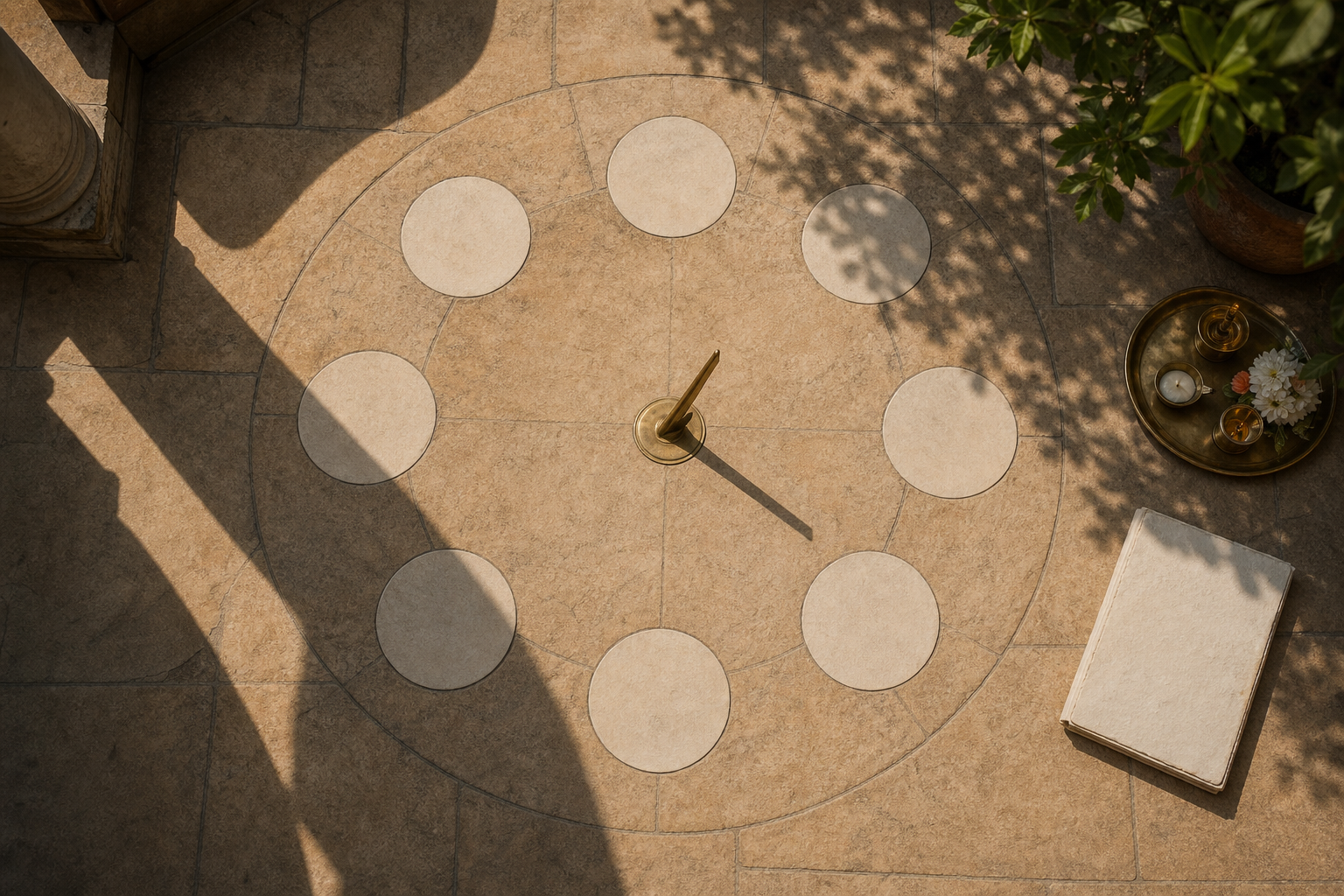
There is no single worldwide Rahu Kaal clock time for May 4. Rahu Kaal, Yamaganda, and Gulika Kaal are portions of the interval between local sunrise and local sunset. Copying timings prepared for Delhi, Toronto, London, Singapore, or another city can shift your result because the daylight interval changes with location.
You can calculate Monday’s intervals with four pieces of arithmetic:
- Find the actual sunrise and sunset for May 4 at the place where the activity will begin.
- Subtract sunrise from sunset to obtain the total daylight duration.
- Divide that duration by eight. Call the result one daylight segment.
- Count forward from sunrise. On Monday, Rahu Kaal is segment 2, Yamaganda is segment 4, and Gulika Kaal is segment 6.
| Monday interval | Start measured from sunrise | End measured from sunrise |
|---|---|---|
| Rahu Kaal | After 1 daylight segment | After 2 daylight segments |
| Yamaganda | After 3 daylight segments | After 4 daylight segments |
| Gulika Kaal | After 5 daylight segments | After 6 daylight segments |
Suppose, only as a simple illustration, that sunrise is 6:00 AM and sunset is 6:00 PM. The 12 hours of daylight produce eight segments of 90 minutes each. The resulting Monday caution periods are Rahu Kaal from 7:30 AM to 9:00 AM, Yamaganda from 10:30 AM to noon, and Gulika Kaal from 1:30 PM to 3:00 PM. These are not ready-made timings for your city; they show how the segment rule works.
For a modest beginning, Abhijit Muhurta offers a practical positive window near local solar noon. It lasts roughly 48 minutes, extending about 24 minutes to either side of true noon. Do not automatically substitute 12:00 PM on the civil clock. Use the locally calculated Abhijit interval supplied by a dependable Panchang, or calculate around the local solar-noon point rather than assuming every place reaches it at twelve.
On Monday, Abhijit can partly overlap Yamaganda. In the 6:00 AM to 6:00 PM illustration, approximate Abhijit runs from 11:36 AM to 12:24 PM, while Yamaganda ends at noon. If your custom avoids Yamaganda even when another favorable interval is operating, the usable overlap-free portion begins after noon and ends around 12:24 PM. Apply that intersection method to your actual local times: first mark the favorable window, then remove any caution period your tradition observes.
Abhijit is best treated here as a workable choice for a brief sankalpa, beginning study, sending meaningful correspondence, or initiating another ordinary task. It is not a universal override that makes every ceremony suitable regardless of tithi, nakshatra, yoga, karana, family tradition, or the participants’ horoscopes.
Use Somavara and Krishna Tritiya for the right kind of practice
Krishna Paksha Tritiya is context-sensitive. Unlike the broad auspicious reputation often attached to Shukla Tritiya, it should not be stamped either wholly favorable or wholly unfavorable. For routine work, you can often find a sound beginning by avoiding the locally calculated caution periods and confirming that no required nakshatra, yoga, or karana condition is being violated.
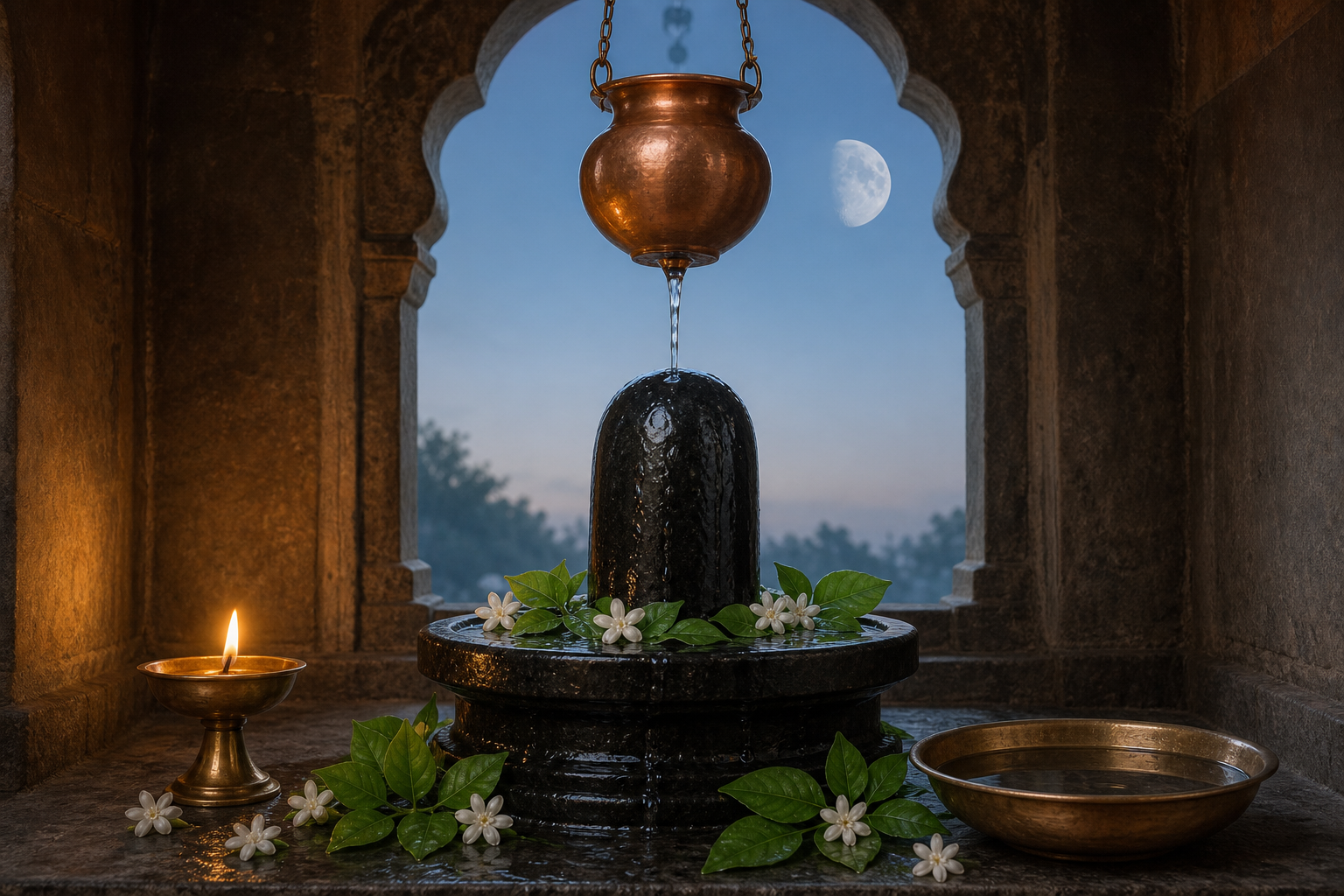
Somavara gives the day a natural devotional center. If your household follows Shiva worship, keep the observance simple and deliberate:
- Prepare the worship space before the chosen period so setup does not consume the muhurta.
- State a brief sankalpa naming the practice you are undertaking.
- Perform a simple abhishekam or offer bilva leaves according to your family custom.
- Set aside an uninterrupted period for quiet japa.
- Carry the steadiness of the practice into one concrete act of patience, restraint, or service during the day.
The same disciplined rhythm can be expressed across the wider dharmic family without pretending that all traditions use an identical ritual calendar. A Jain practitioner may reserve time for samayik or pratikraman. A Buddhist may undertake a period of uposatha-inspired reflection. A Sikh may deepen simran and connect it with seva. The forms remain distinct; the practical thread is a consciously protected interval for recollection and ethical action.
Do not let the search for a perfect minute become a reason to abandon daily sadhana. Muhurta is especially relevant to a commencement. A regular practice already undertaken as a discipline need not be postponed merely because its normal time falls outside Abhijit. Reserve the more elaborate electional work for actions whose beginning is genuinely being chosen.
For diaspora and major ceremonies, verify the full Panchang
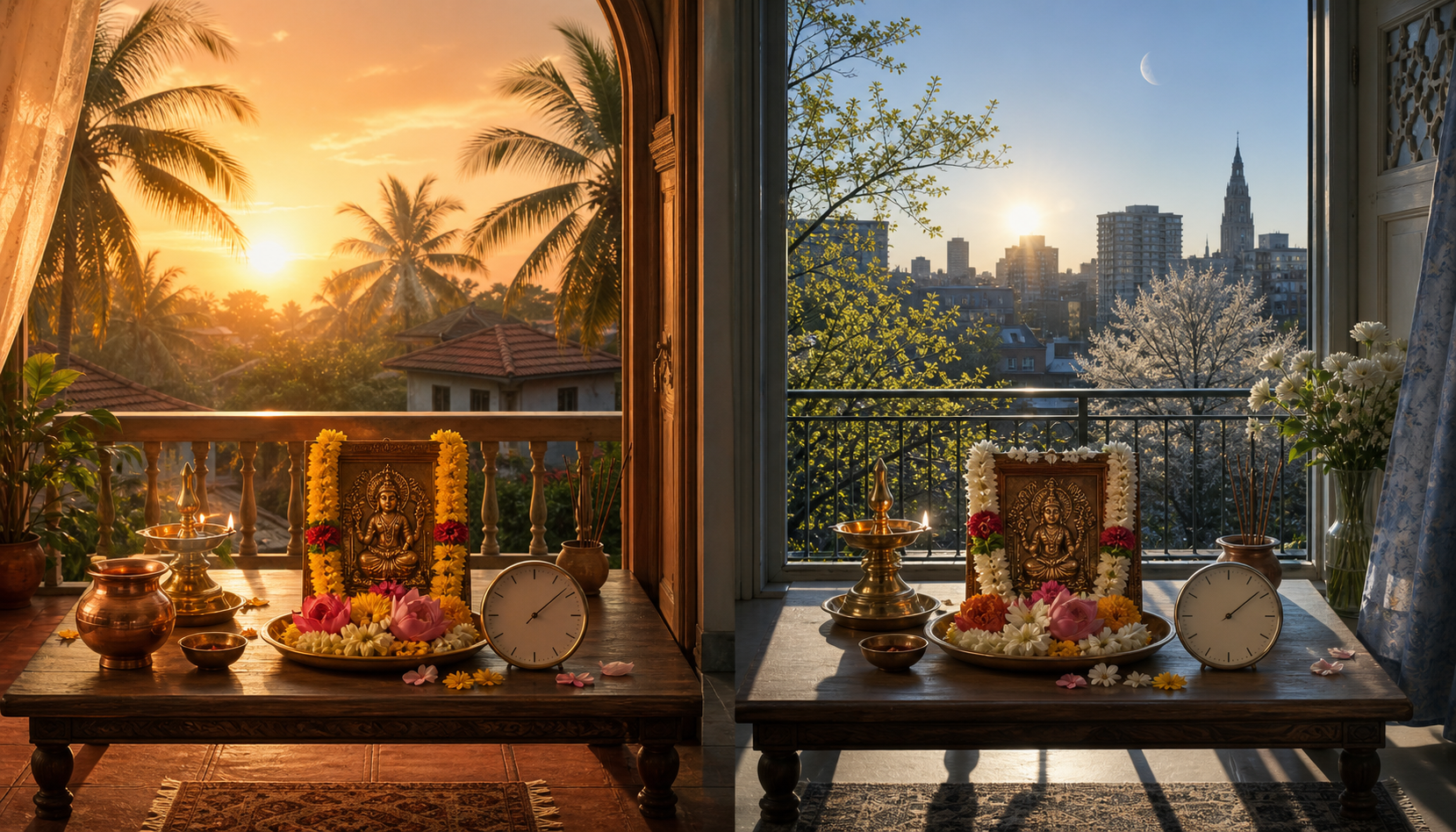
The Dwitiya-to-Tritiya change occurs at one astronomical instant worldwide, but local calendars display that instant on different civil dates. The 12:57 AM IST transition on May 4 corresponds to approximately 7:27 PM UTC on May 3, 3:27 PM on May 3 in New York under EDT, and 12:27 PM on May 3 in Los Angeles under PDT.
If you live outside India, convert the transition to understand the astronomy, but do not stop there. Apply the ritual rule to your local sunrise and the place where the rite will actually occur. An Indian Panchang’s clock times are not portable to North America, Europe, or another region, even though the underlying tithi boundary is the same instant.
A complete Panchang assessment uses five limbs: vara, tithi, nakshatra, yoga, and karana. Chandra Rashi is also frequently consulted in practical muhurta work. Only the weekday and tithi can be fixed from the information above without inventing a location-specific result. Nakshatra and Chandra Rashi depend on the Moon’s sidereal longitude and may change within a civil day. Yoga derives from the combined longitudes of the Sun and Moon, while karana measures half of a tithi.
For a wedding, griha pravesh, major community rite, or consequential contract, use this checklist before approving a time:
- Fix the exact city and time zone of the event. Do not calculate from the host’s home city if the ceremony occurs elsewhere.
- Identify the event’s decisive starting act. The relevant instant may be the sankalpa or another ritually prescribed act, not the guests’ arrival time.
- Confirm the tithi at that instant, especially if the event approaches the next tithi boundary.
- Check the operative nakshatra and Chandra Rashi rather than assigning one value to the entire day.
- Check yoga and karana. If Vishti, also called Bhadra, operates at the intended start and your rite excludes it, shift the beginning to a permissible interval.
- Remove local Rahu Kaal and Yamaganda, and account for Gulika according to the practice you follow.
- Apply any sampradaya, family, regional, or participant-specific requirements after the daily Panchang screen.
This distinction prevents a common planning error: treating a favorable tithi as a complete muhurta. Tithi is one input, not the final verdict. For a legal or financial commitment, electional timing also does not replace ordinary review of the terms, obligations, costs, and consequences. Choose the ceremonial start carefully, but make the underlying decision on its practical merits.
Key takeaways for your May 4 plan
- Observe May 4, 2026 in India as Somavara and Krishna Paksha Tritiya by Udaya Tithi.
- Dwitiya ends at 12:57 AM IST; Tritiya begins immediately and governs the Indian sunrise.
- Calculate Rahu Kaal, Yamaganda, and Gulika from the event location’s actual sunrise and sunset. Monday uses daylight segments 2, 4, and 6 respectively.
- Use locally calculated Abhijit Muhurta near solar noon for modest beginnings, then remove any overlap with a caution period observed by your tradition.
- Do not infer nakshatra, Chandra Rashi, yoga, or karana from the tithi. Verify them for the intended location and start time.
- Do not approve a wedding, griha pravesh, major contract, or comparable undertaking from Krishna Tritiya alone; obtain a complete muhurta assessment.
To prepare now, write down three things: the event city, its May 4 sunrise and sunset, and the exact act whose beginning you want to time. That is enough to calculate Monday’s caution periods and test a modest Abhijit window. If the undertaking is consequential or textually conditioned, carry those details to your local Panchang or trusted ritual adviser and complete the remaining checks before invitations, bookings, or signatures make the timing difficult to change.