
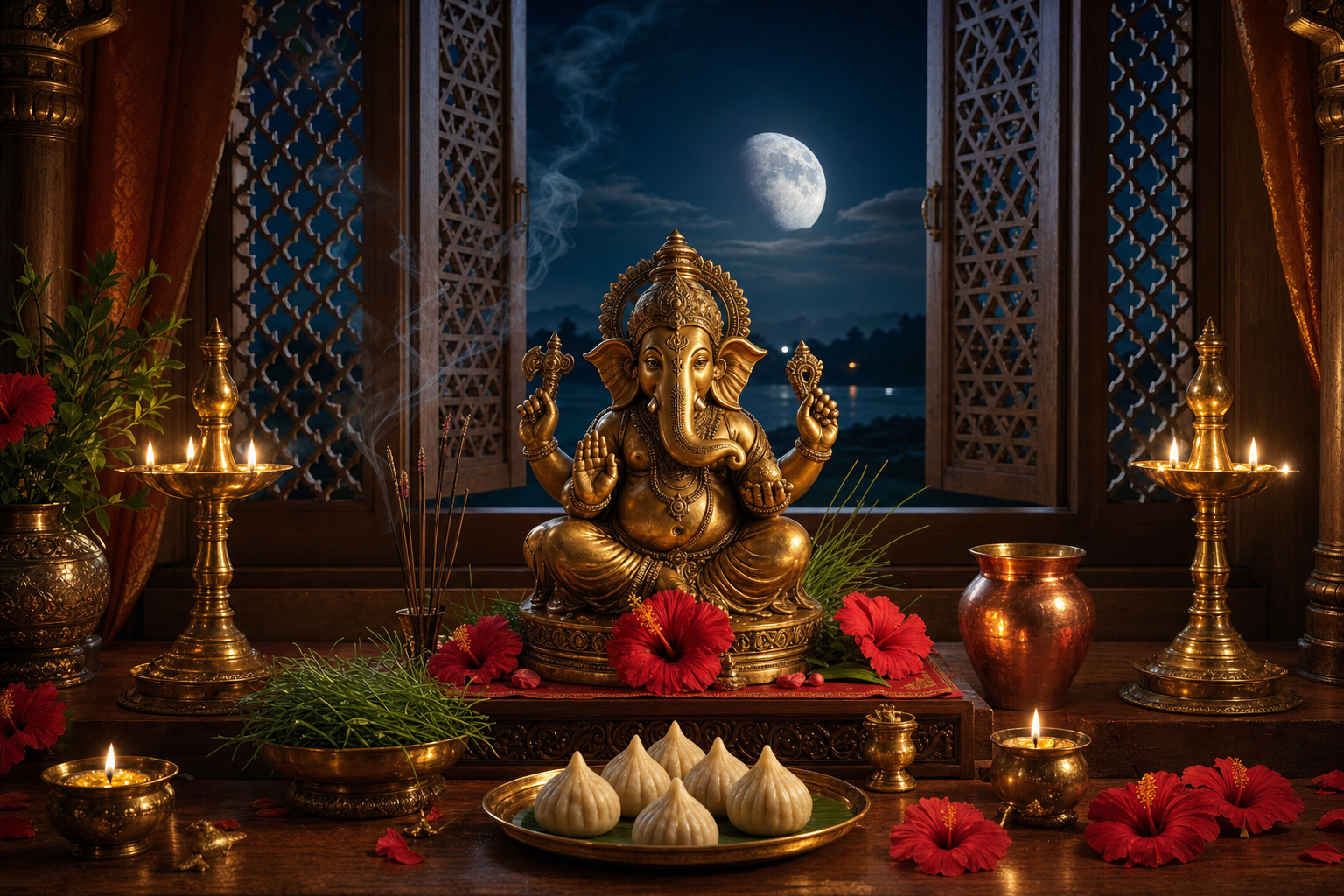
If you plan to observe Sankashti on May 5, the most important detail is easy to miss: sunset does not end this fast. You conclude the vrata only after the Moon has risen in your location, you have had Chandra darshana, and the prescribed worship is complete.
May 5, 2026 is a Tuesday on which Krishna Paksha Chaturthi prevails after the early-morning tithi transition. That makes it Angaraki Sankashti Chaturthi, an especially auspicious occasion for Sri Ganesha upasana, disciplined prayer, and work directed at removing obstacles.
Key takeaways for May 5, 2026
- The baseline Panchang sequence places Krishna Paksha Tritiya until 2:59 AM and Chaturthi afterward.
- Because Chaturthi prevails on Tuesday after sunrise and through the evening in most regions, the date is observed as Angaraki Sankashti Chaturthi.
- Do not break the vrata at sunset. Wait for your city’s moonrise, perform Chandra darshana and arghya, complete the Ganesha worship, and only then conclude the fast.
- Moonrise, sunrise-based muhurtas, Choghadiya, Rahu Kalam, Nakshatra transitions, and the Moon’s Rashi must be checked for your location.
- Brahma Muhurta, Abhijit Muhurat, Vijay Muhurat, and favorable Choghadiya can help you plan prayer or a new undertaking, but none should be copied as a universal clock time.
- The month name may differ between Purnimanta and Amanta calendars. That regional difference does not change the Chaturthi or the vrata rule.
Confirm the two times that govern the vrata
You need two local checks before arranging the day: whether Chaturthi covers the relevant part of the civil date, and when the Moon rises where you are. The first establishes the vrata alignment. The second tells you when the concluding worship can begin or be completed according to your tradition.
A tithi is not a midnight-to-midnight date. It is an astronomical interval determined by the changing angular relationship between the Sun and Moon, with each tithi spanning 12 degrees of relative movement. A tithi can therefore begin at 2:59 AM, in the afternoon, or at another point within a civil date. This is why the weekday printed on a wall calendar is not enough to determine an observance.
For May 5, Tritiya ends at 2:59 AM in the stated Panchang baseline, after which Krishna Paksha Chaturthi continues across the day and evening. That creates a straightforward Angaraki Sankashti alignment for most Indian observances. If you live outside the location or time zone used by that Panchang, do not transfer 2:59 AM directly to your clock. Verify the boundary in a city-specific Panchang.
Moonrise requires the same care. It changes by city, so a time listed for Delhi, Mumbai, Toronto, London, or another location cannot be treated as interchangeable. Search your trusted Panchang by city, confirm that the date displayed is May 5, and record the local moonrise before you begin the fast. If a temple community is leading the vrata, use the schedule issued for that temple rather than combining times from unrelated calendars.
- Select your actual city or the nearest supported location in a trusted Panchang.
- Confirm that Krishna Paksha Chaturthi prevails after the local sunrise and through the local moonrise period.
- Write down the local moonrise time separately from sunset; they are not the same event.
- If you are also choosing a time for travel, a contract, or a new undertaking, note any Nakshatra, Yoga, Karana, or Rashi transition that occurs during your proposed window.
- Use one consistent city setting for sunrise, moonrise, Choghadiya, and the avoidance periods. Mixing locations makes the final schedule internally inconsistent.
Observe Angaraki Sankashti in a workable sequence
The central discipline is simple: dedicate the day to Sri Ganesha, maintain the vrata according to your established practice, conduct the evening worship, honor Chandra at moonrise, and conclude only when the observance is complete. You do not need to turn it into a contest of complexity.
- Make your sankalpa. State that you are observing Angaraki Sankashti Chaturthi for Sri Ganesha. Name the obstacle or area of life in which you seek clarity, but keep the intention dharmic and specific.
- Use the pre-sunrise period for inward practice if possible. Brahma Muhurta, approximately one and a half hours before local sunrise, is suited to mantra, meditation, and sankalpa. Calculate it from your local sunrise rather than assuming a fixed time such as 4:30 AM.
- Maintain the daytime vrata. Follow the form of fasting taught in your household, sampradaya, or temple. The Panchang establishes the timing of the observance; it does not by itself settle every rule about food or water.
- Keep the day connected to its purpose. Chant Om Gam Ganapataye Namah, recite the Sankata Nashana Ganapati Stotram, or reserve a quiet period for Ganesha dhyana. The point is sustained discipline, not merely waiting for the evening meal.
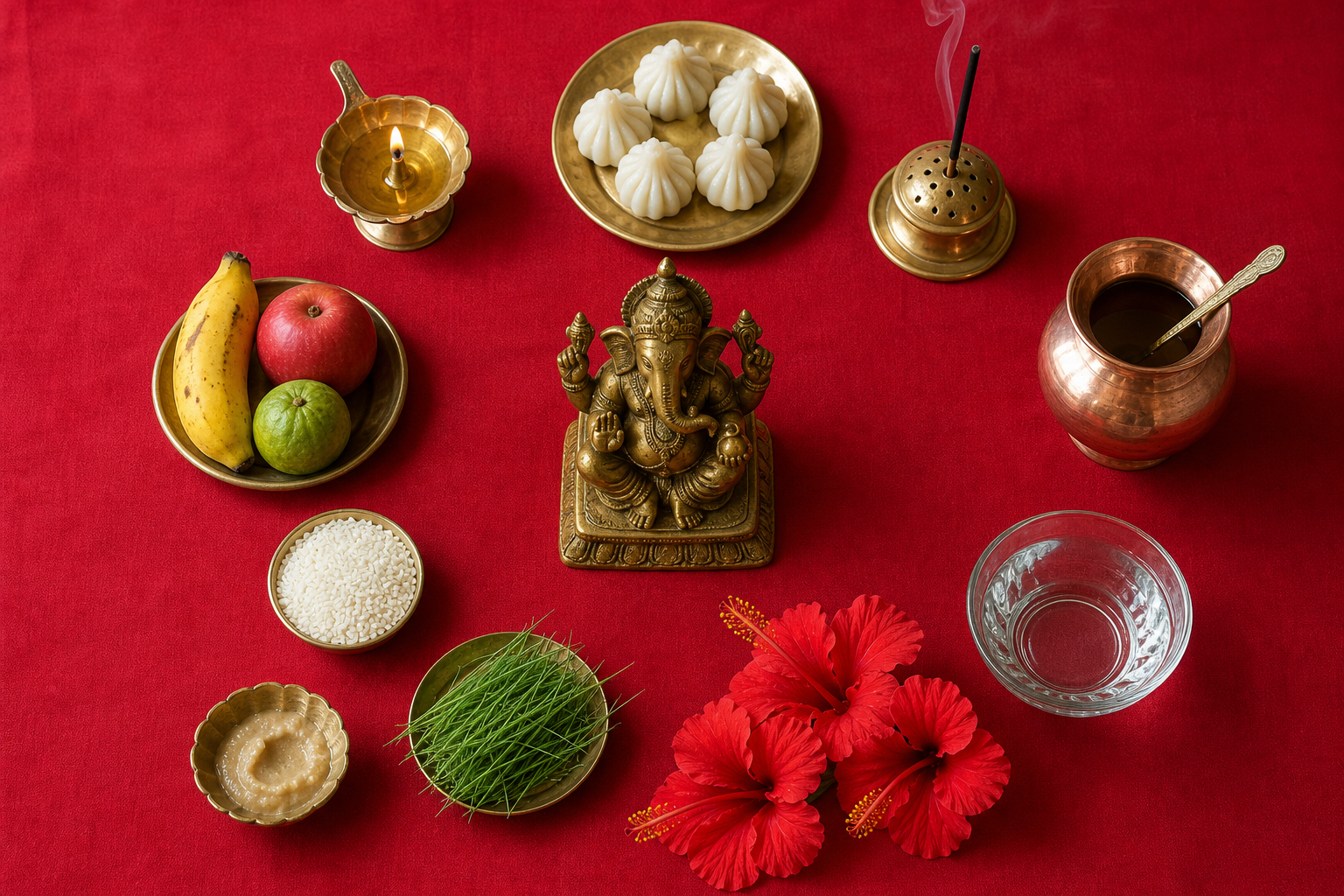
- Prepare the evening offerings before moonrise. Common offerings include durva grass, modaka, or seasonal fruit. Arrange water for arghya to Chandra so that you are not searching for ritual items after the Moon has risen.
- Perform Ganesha puja. Use Panchopachara or Shodashopachara according to your tradition and capacity. Read or listen to the Sankashti Vrat Katha as part of the observance.
- Honor Chandra at the verified local moonrise. Undertake Chandra darshana and offer arghya as prescribed in your tradition.
- Conclude the vrata only afterward. Moonrise is the required turning point, but the fast is not complete until the darshana, arghya, and Ganesha worship associated with the conclusion have been performed.
The most common scheduling mistake is to treat sunset as permission to eat. Sankashti is moonrise-governed. Another mistake is to wait until moonrise to begin preparing the shrine and offerings. Record the time first, then have the puja arrangement ready before that window arrives.
If you cannot perform an elaborate Shodashopachara, do not confuse ritual scale with sincerity. Use the form already accepted in your tradition, offer what you have prepared respectfully, and preserve the elements that define this vrata: Ganesha upasana, self-restraint, Chandra darshana, and completion after moonrise.
Choose a useful muhurta without copying another city’s clock
Angaraki Sankashti is well aligned with remediation rather than display. It is a fitting day for disciplined study, restarting a neglected sadhana, addressing debt or unfinished obligations, and taking a concrete step against a persistent obstacle. The symbolism becomes useful when the prayer and the practical action face the same problem.
Different time-selection tools answer different questions. Use the one suited to the action you are planning:
- Brahma Muhurta: use the pre-sunrise period for mantra, meditation, and sankalpa. It is approximately one and a half hours before local sunrise, not a universal wall-clock interval.
- Abhijit Muhurat: consider this for a generally auspicious beginning when no specially elected muhurta is available. It is centered on local solar noon, the midpoint between sunrise and sunset.
- Vijay Muhurat: consider the later-afternoon window for an undertaking that calls for resolve, forward motion, or decisive execution. Obtain its exact span from the local Panchang.
- Choghadiya: use it for shorter-horizon choices, especially travel and commercial activity. Amrit, Shubh, and Labh are the favored classifications; Rog, Kaal, and Udveg are avoided for launches.
- Rahu Kalam, Yamaganda, and Gulika Kalam: treat these as avoidance periods for starting a new undertaking. Their clock times depend on the division of local daylight from sunrise to sunset.
A copied Rahu Kalam chart can be wrong for your location because the calculation depends on the length of that day’s daylight. The same warning applies to Choghadiya and sunrise-based muhurtas. A generic example is useful for learning the method, but it is not an election for May 5 in your city.
For a practical election, first define the action. Then choose a locally calculated favorable window, remove any portion overlapping an avoidance period, and finally check whether a Nakshatra, Karana, Yoga, or Moon-sign transition cuts through it. If the undertaking is personally important, Tarabalam and Chandrabalam add information that a date-wide label cannot provide.
- Write down exactly what you are beginning: puja, study, travel, a contract, debt resolution, or another task.
- Find a suitable local window such as Abhijit, Vijay, or a favorable Choghadiya.
- Exclude Rahu Kalam, Yamaganda, and Gulika when the question is the start of a new undertaking.
- Check the Nakshatra and Moon’s Rashi if Tarabalam or Chandrabalam matters to the decision.
- Confirm that no relevant Yoga or Karana change occurs halfway through the selected period.
Read the Panchang layers in the right order

The Panchang is not a single label saying that an entire date is good or bad. Its components describe different dimensions of time, and some can change within the same civil day. Read them as layers rather than allowing one favorable factor to erase every other consideration.
| Layer | What matters on May 5 | What you should do |
|---|---|---|
| Vara | Tuesday supplies the Angaraki element. | Recognize the Tuesday-Chaturthi combination as the basis of the special observance. |
| Tithi | Krishna Paksha Chaturthi follows Tritiya after 2:59 AM in the baseline timing. | Confirm the tithi boundary for your location and use Chaturthi to establish the vrata. |
| Nakshatra | The Moon’s lunar mansion gives a more specific qualitative tone and may change during the date. | Check the local transition time, especially for travel, ceremonies, or a consequential beginning; use it with Tarabalam when relevant. |
| Moon’s Rashi | The lunar sign is used when assessing Chandrabalam and personal alignment. | Do not infer it from the tithi. Verify the Moon’s local date-specific position and any transition. |
| Yoga | Yoga is calculated from the combined longitudes of the Sun and Moon. | Check it as an additional quality of the proposed action window. |
| Karana | A Karana is half a tithi, so more than one can occur during one civil date. | Check the actual Karana covering the selected time, particularly for contracts, journeys, or ritual work. |
This order also explains why a universal answer for Nakshatra, Rashi, or Chandrabalam can be misleading. Tithi establishes the vrata, but Nakshatra and Rashi require the Moon’s precise position. Tarabalam is assessed in relation to a person’s birth Nakshatra, while Chandrabalam concerns the relationship between the day’s Moon sign and the person’s natal alignment. Neither can be reduced to the claim that May 5 is equally favorable for every person and every undertaking.
Regional month names do not create different Chaturthis
In the Purnimanta system common across much of North India, this observance is identified as Vaishakha Krishna Paksha Chaturthi. Amanta calendars, prevalent in parts of South and West India, name the lunar month according to the cycle beginning after Amavasya. Two calendars may therefore print different month labels while pointing to the same astronomical tithi and the same Angaraki Sankashti observance.
When relatives or temple calendars use different names, compare the date, tithi boundary, weekday, and local moonrise before assuming there is a disagreement. The operative combination remains Tuesday plus Krishna Paksha Chaturthi; the vrata still concludes after the required moonrise observances.
Let your sankalpa name one real obstacle, then pair it with one disciplined action. If the concern is study, establish the next study period. If it is an unfinished obligation, identify the next step required to resolve it. If it is irregular sadhana, set the time at which practice will resume. Ganesha upasana does not remove the need for effort; it gives that effort a dharmic center.
Before May 5, save your city’s moonrise and tithi details, choose the level of puja you can perform faithfully, and prepare the durva, offering, arghya water, mantra, and Katha in advance. Then the evening can remain an observance rather than becoming a last-minute search for timings.