
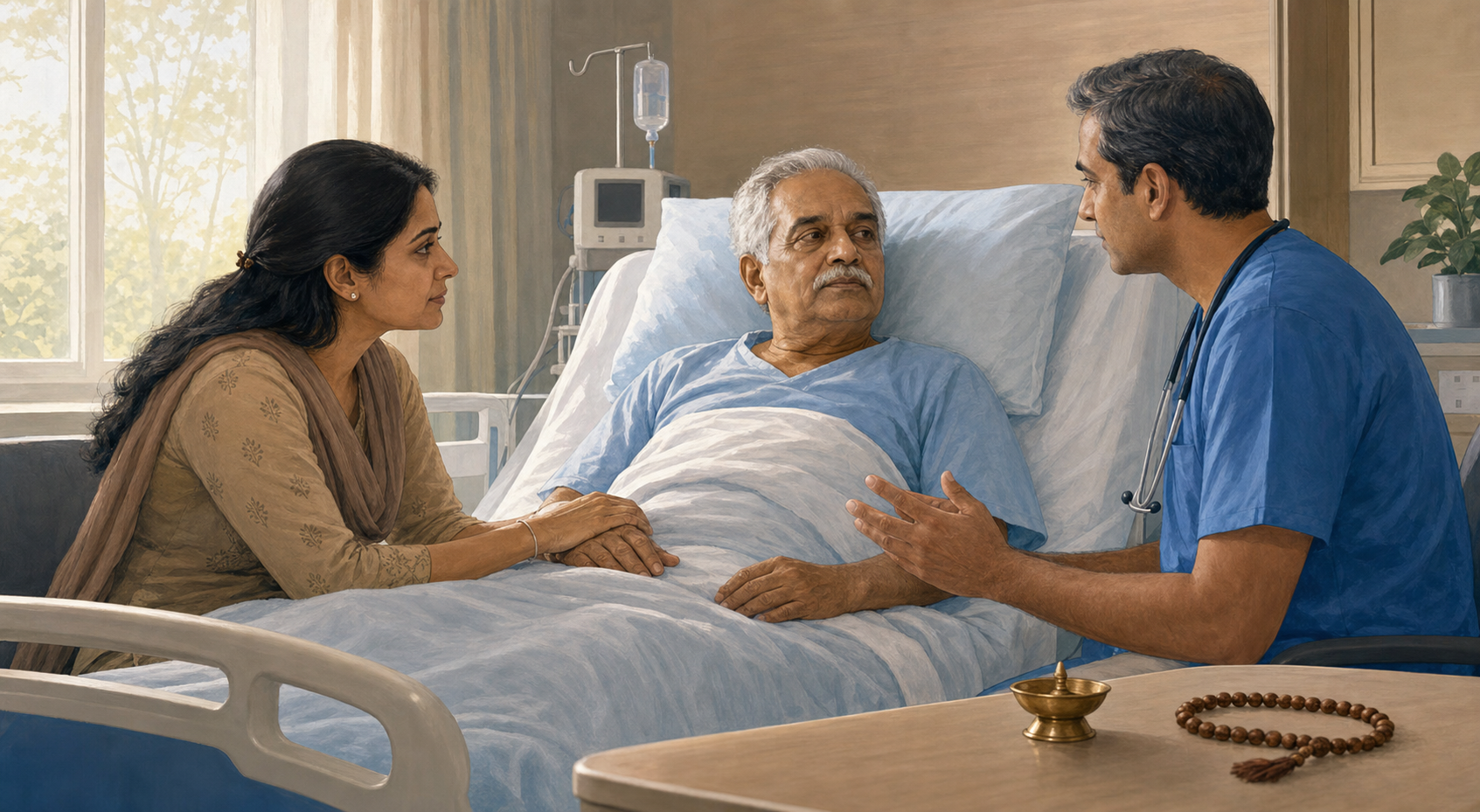
If you are reading because someone has sudden symptoms or a stroke is only suspected, stop and contact local emergency medical services now. Stroke treatment can be time-sensitive, and neither a community discussion nor an online page can determine the type of stroke or the person’s eligibility for treatment.
Once the person is in hospital, the questions can change quickly. You may need to understand why a treatment is or is not possible, protect the patient’s dignity, make decisions about comfort, and channel a worried sangha’s goodwill into useful seva. The way through is to keep medical facts, the patient’s own values, and spiritual support in their proper places.
Treat a suspected stroke as an emergency, not a diagnosis
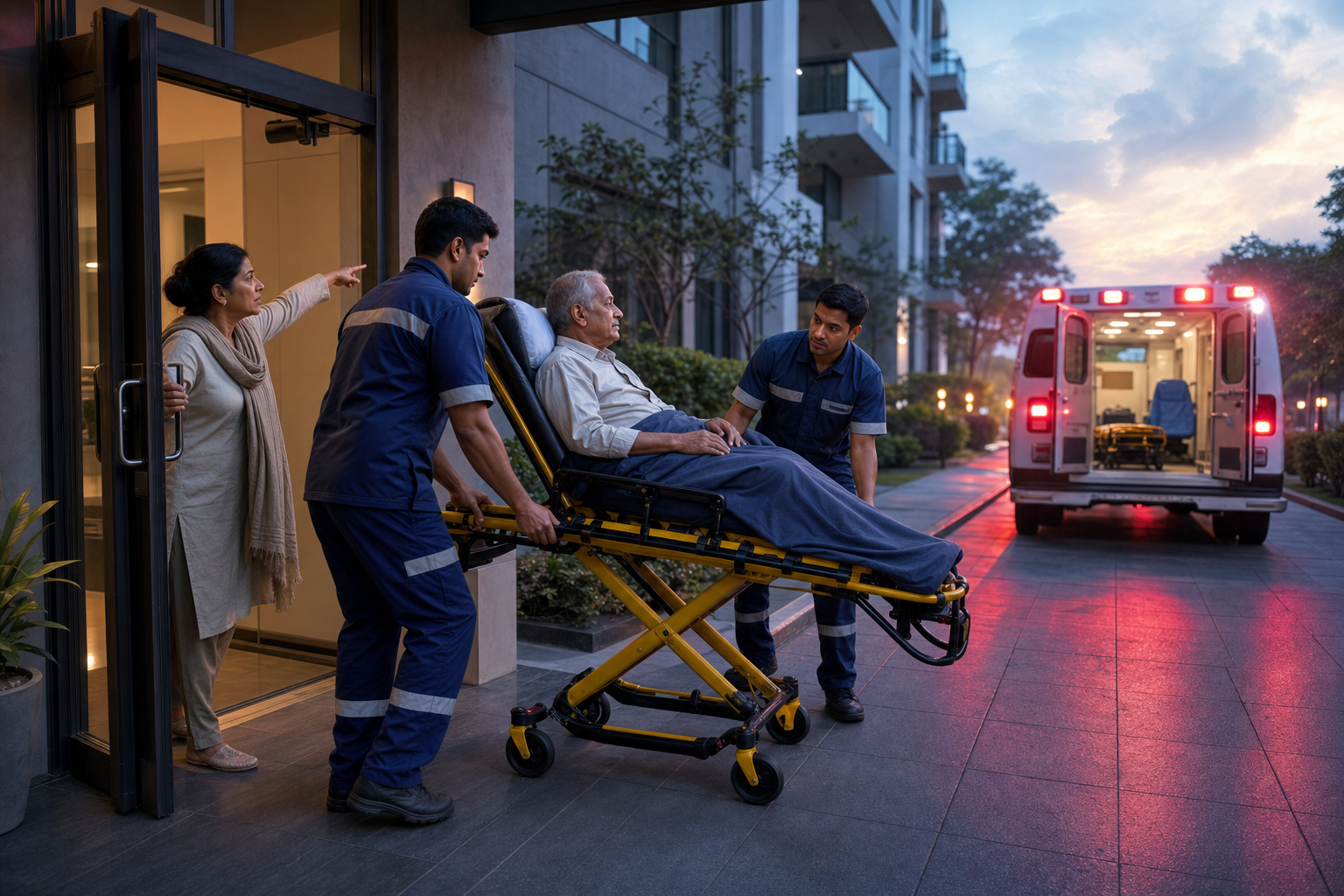
A stroke may be ischemic, caused by a blocked artery, or hemorrhagic, caused by bleeding in or around the brain. The distinction cannot be made from outward appearance alone. It requires urgent clinical assessment and brain imaging, because the treatments are different.
For eligible patients with an ischemic stroke, intravenous thrombolysis is commonly considered within 4.5 hours of symptom onset, while selected large-vessel blockages may qualify for mechanical thrombectomy as late as 24 hours under stringent criteria. These are clinical selection windows, not promises that every person within them can receive treatment. A hemorrhagic stroke may instead require blood-pressure management, reversal of anticoagulation when feasible, or surgery in selected cases.
Do not spend those hours trying to decide at home which type it might be. When speaking with emergency personnel or the hospital, give the most accurate time the person was last known to be well, along with the medication list, known use of blood thinners, allergies, major conditions, and any advance-care documents you can locate.
- Do not give food, water, tablets, herbal preparations, charanamrita, or other liquids by mouth unless the clinical team has confirmed that swallowing is safe. A severe stroke can create an aspiration risk.
- Do not delay emergency assessment for prayer, a remote consultation, or the arrival of a preferred relative. Spiritual practice can accompany medical care; it must not postpone it.
- Choose one family contact early. This gives clinicians a reliable communication route and reduces conflicting messages among relatives.
- Write down what each clinician says, including the stroke type, treatment considered, present goal of care, and next planned discussion. Families under stress often remember different fragments of the same conversation.
When treatment goals change, ask what care continues
After a very severe stroke, clinicians may conclude that no additional intervention can reverse the neurological injury or meaningfully alter its course. Timing, the location and extent of injury, bleeding, anatomical factors, and the person’s overall medical condition can all affect that judgment. Unresponsiveness together with no voluntary movement in the limbs often points to extensive neurological damage, but family members should not infer an exact prognosis from those signs alone.
A change to comfort-focused care is not an announcement that care has stopped. It is a change in its purpose. Palliative care actively addresses pain, agitation, difficulty breathing, secretions, skin protection, repositioning, aspiration precautions, and emotional or spiritual distress. Breathing or circulation support may still be used when it fits the agreed goals. Careful nursing remains essential.
Ask for a planned family meeting rather than gathering crucial information through hurried bedside exchanges. When possible, include neurology, the primary or critical-care team, nursing, and palliative medicine. A chaplain or spiritual-care professional can help translate religious values into questions, but should not replace the clinician who explains medical facts.
- What kind of stroke occurred, and what areas of the brain were affected?
- Which treatment options were considered, and why is each one unavailable or no longer indicated?
- What is medically known about the likely course, what remains uncertain, and what finding could change the plan?
- How will the team recognize pain, agitation, breathlessness, or other distress if the patient cannot speak?
- Which supportive treatments are continuing, and what is the purpose of each one?
- Are decisions about feeding, hydration, sedation, or another intervention approaching? When must they be made?
- Who is the clinical point of contact, and when will the next formal update occur?
If the explanation remains unclear, repeat it back in your own words: We understand that this treatment is not being offered because of these reasons, and that the present goal is this. Ask the clinician to correct you. This is not confrontation. It is a simple way to prevent a grave decision from resting on misunderstood language.
Make difficult decisions through the patient’s values

Feeding, hydration, sedation, and the degree of medical support are not questions for a social-media poll or a congregation-wide vote. Their expected benefits and burdens depend on the person’s neurological injury, prognosis, other illnesses, and goals. These decisions must be individualized and guided by clinical evidence, previously expressed wishes, and any valid advance directive.
Start with the patient’s voice. Look for a written directive, a legally recognized substitute decision-maker, or clear prior statements about severe disability, life-prolonging treatment, consciousness, and comfort. If the person left no explicit instruction, the appropriate decision-maker should try to represent the patient’s values rather than choose according to the loudest relative’s fear, hope, or theology.
- Ask what problem the proposed intervention is intended to solve.
- Ask what benefit is realistically expected for this patient, not for an average patient.
- Ask about burdens, complications, and uncertainty, including what may happen if the intervention is not used.
- Ask how the team will judge whether it is helping and whether the decision can be reviewed.
- Record the decision, its reasoning, and who participated so absent relatives do not reopen it from incomplete information.
Dharmic language can clarify the moral task, but it should not be used as a shortcut around the facts. Ahimsa asks us to examine avoidable harm; it does not automatically declare that every available procedure must be continued or refused. Karuna and daya direct attention to suffering. Seva asks what genuinely serves this person. Truthfulness requires the family to hear an unwelcome prognosis without turning uncertainty into a promise.
When relatives disagree, ask the palliative-care clinician to restate the medical choices and bring the discussion back to the patient’s known values. A trusted spiritual adviser may help, especially when the family wants guidance from a particular sampradaya or tradition. The adviser should understand the actual clinical options before offering a religious judgment.
Bring Dharmic practice to the bedside without imposing it
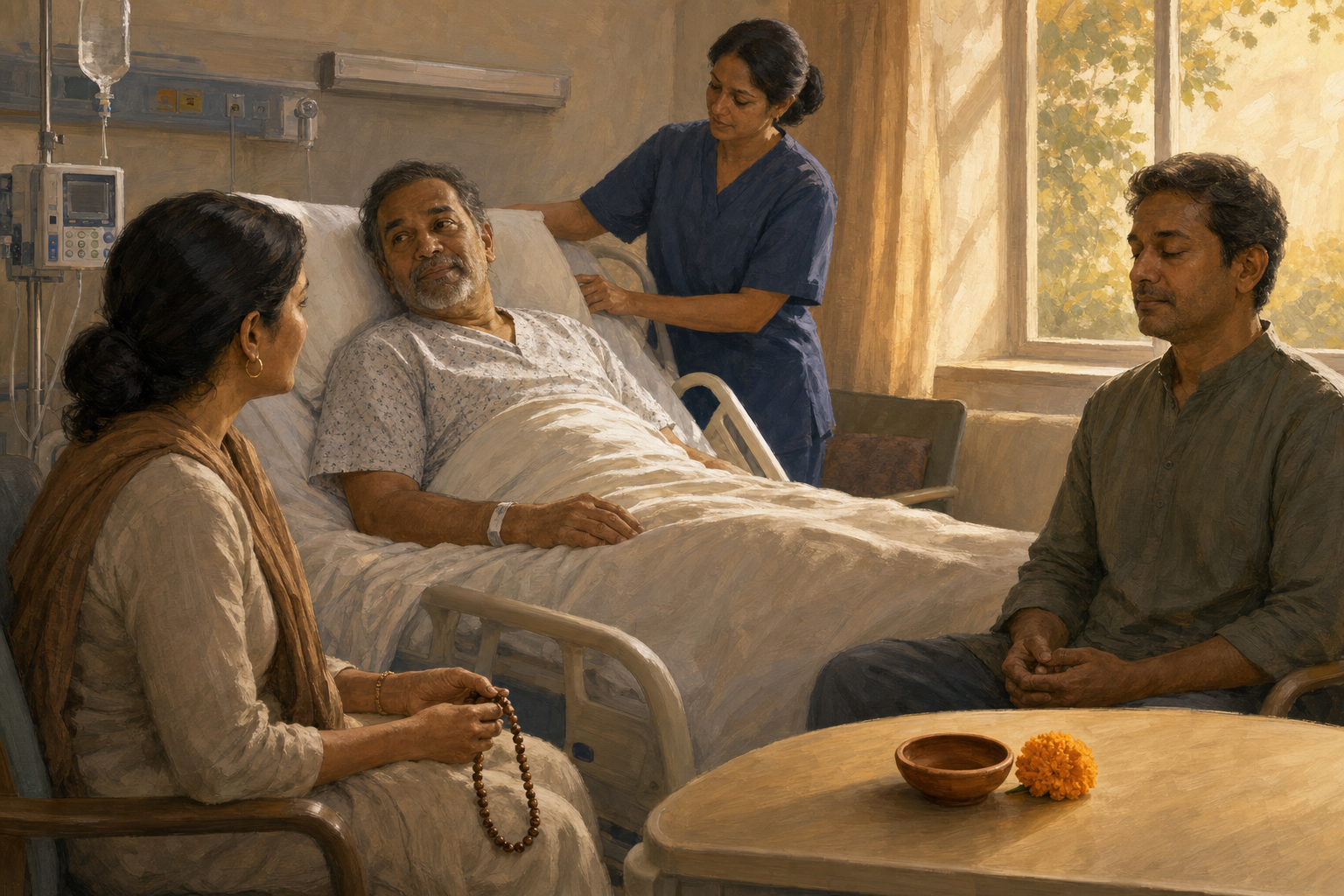
There is no single bedside practice shared by every Hindu, Buddhist, Jain, and Sikh, and no seniority in a community gives others permission to choose for the patient. Begin with the person’s own commitments. If those are unknown, ask the family or authorized decision-maker and keep any observance gentle, reversible, and compatible with hospital rules.
- A Hindu or Vaishnava may value japa, gentle kirtan, a familiar sacred reading, or remembrance of the Divine and guru.
- A Buddhist may prefer quiet mindfulness or metta offered aloud, softly, or silently.
- A Jain may value samayika, equanimity, forgiveness, or kshamapana.
- A Sikh may ask for simran, paath, or the presence of shabad.
These forms differ, but each can express compassionate presence without pressure. Their purpose at the bedside is devotional and relational. They should never be presented as a guaranteed way to reverse brain injury, establish awareness, or replace medical treatment.
- Confirm the patient’s preference, or obtain guidance from the authorized family decision-maker.
- Ask the nurse when recitation is appropriate, what volume is acceptable, and whether a procedure or rest period is approaching.
- Keep voices calm and avoid several groups conducting competing practices in the room.
- Do not touch lines, monitors, oxygen equipment, dressings, or the patient’s position.
- Do not place substances on the body or give food, medicine, sacred water, or herbal remedies without explicit clinical permission.
- Pause immediately when staff need access or when the clinical team identifies signs of distress.
- Do not assume that an unresponsive person can or cannot hear. Speak respectfully, avoid arguments over the bed, and do not discuss frightening predictions as though the patient were absent.
Sometimes silence is the most faithful practice. Sitting quietly, maintaining a composed atmosphere, or offering prayer outside the room may serve the patient better than continuous sound. Presence is not measured by volume or by the number of visitors.
Turn sangha concern into coordinated, privacy-respecting seva

A serious illness can produce more offers of help than a family has strength to manage. Appoint a community coordinator who is not the principal medical decision-maker. That person can maintain a task list, collect questions, organize approved spiritual support, and prevent the patient’s closest relatives from answering the same message throughout the day.
- Offer a specific task: deliver a meal, provide transport, care for children or elders, handle an approved household errand, or cover an existing community duty.
- Ask before visiting. Do not call the ward, arrive as a group, or treat access to a respected teacher or elder as a community entitlement.
- Use one approved update channel. Publish only facts the family has authorized and identify when another update can reasonably be expected.
- Keep names, images, diagnoses, bedside details, and family disagreements out of public messages unless explicit permission has been given.
- Do not circulate unverified prognoses, screenshots, recordings, miracle-cure claims, or interpretations of monitor readings.
- Do not start fundraising, collect personal data, or speak on behalf of the family without clear authorization.
- Include caregivers in the seva plan. A meal, a ride home, or protected time to sleep may be more useful than another request for news.
A privacy-respecting update you can adapt
Shared with the family’s permission: [Name] is receiving [acute or comfort-focused] care after a stroke. The family requests [named prayer or practice] and would welcome help with [specific tasks]. Please do not visit, call the hospital, forward images, or speculate about the prognosis. Verified updates will come through [contact or channel].
This format tells the community what it may know, what it can do, and what boundaries it must observe. It also lets the family express hope without making medical claims. Hope may mean recovery, relief from distress, a peaceful atmosphere, reconciliation, or the strength to make a faithful decision; it need not be reduced to one clinical outcome.
Key takeaways
- A suspected stroke requires immediate professional assessment; do not delay for spiritual or informal remedies.
- Treatment windows describe possible eligibility, not a treatment guarantee.
- Comfort-focused palliative care is active care directed toward symptoms, nursing needs, dignity, and family communication.
- Feeding, hydration, sedation, and supportive treatment should be decided from the patient’s clinical situation and values.
- Dharmic bedside practices should be chosen by preference, offered gently, and coordinated with staff.
- A sangha helps most when one coordinator turns concern into specific tasks and protects the family from repeated demands.
- Share only verified, authorized information; privacy is part of ahimsa and seva.
Before the next clinical meeting, write down the patient’s known wishes, choose one family spokesperson, and bring the seven care questions above. Before the next community update, name one coordinator and one practical need. Those small acts give compassion a form that the patient, family, clinicians, and sangha can all use.