
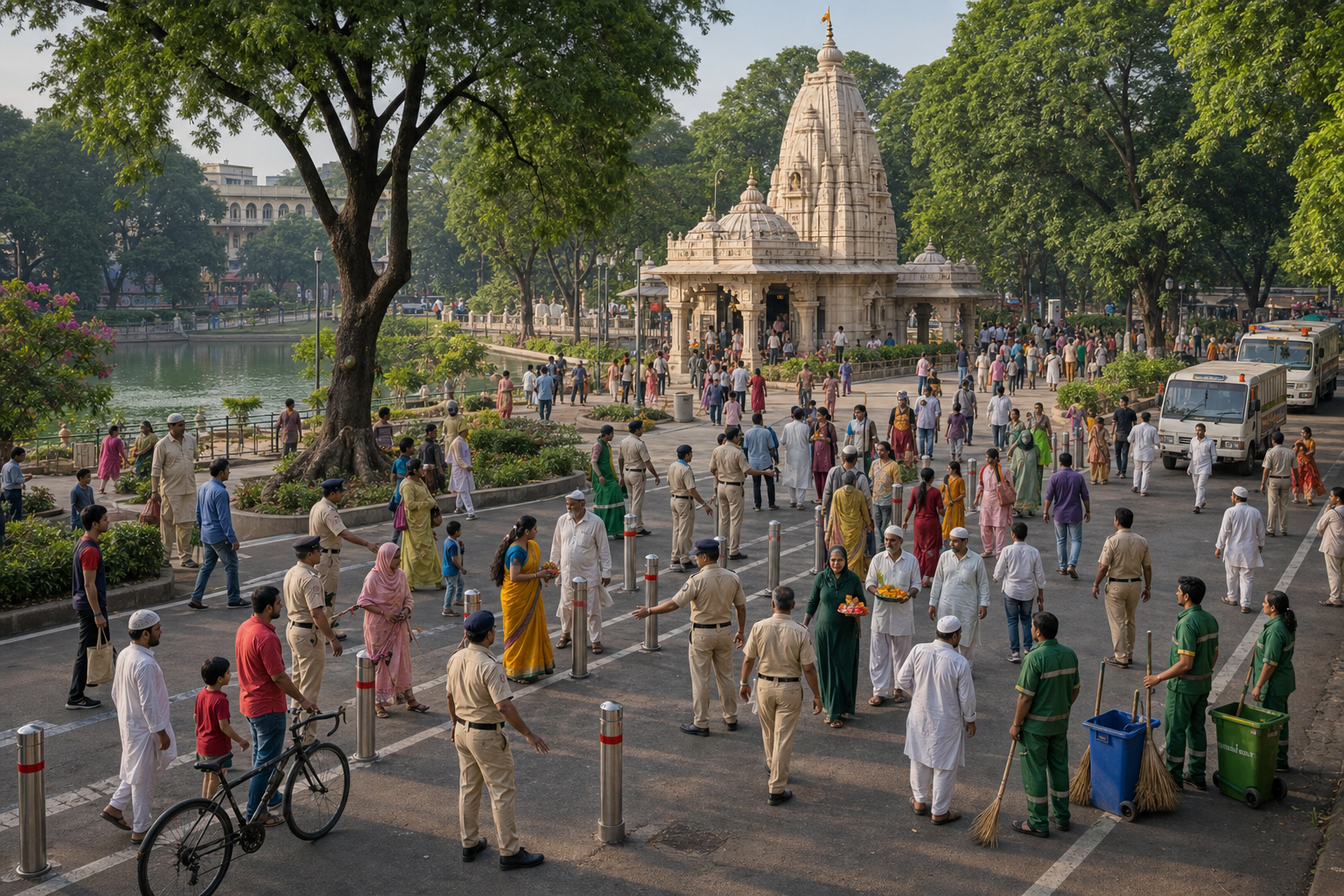
If you worship at Sarasbaug Ganpati Mandir, live nearby, run a shop on an approach road, or plan to observe Eid, you need more than an appeal to “maintain peace.” You need to know which routes will remain open, what conduct is prohibited, who will enforce the rules, and when ordinary use of the area will resume.
With Hindu Janajagruti Samiti and other civil-society organisations seeking curbs around Sarasbaug, Pune’s best answer is neither a vague assurance nor a sweeping communal restriction. It is a narrow, enforceable plan that protects temple access, redirects disruptive traffic, enforces animal and noise laws, and gives every resident predictable recourse.
Key takeaways
- Pune should regulate conduct, routes, hours and locations rather than restrict a community as a whole.
- The immediate Sarasbaug temple precinct should remain free of livestock staging, unauthorised slaughter, obstructive parking and blocked emergency access.
- Animal sacrifice, where legally permitted, belongs only in licensed facilities handling eligible animals under the required health, sanitation and welfare controls.
- One official notice should publish the regulated area, peak-hour diversions, delivery windows, complaint channel, enforcement responsibilities and expiry time.
- Devotees and residents should report specific violations through official channels, avoid physical confrontation and refuse to amplify unverified claims.
The right standard is equal freedom under specific rules
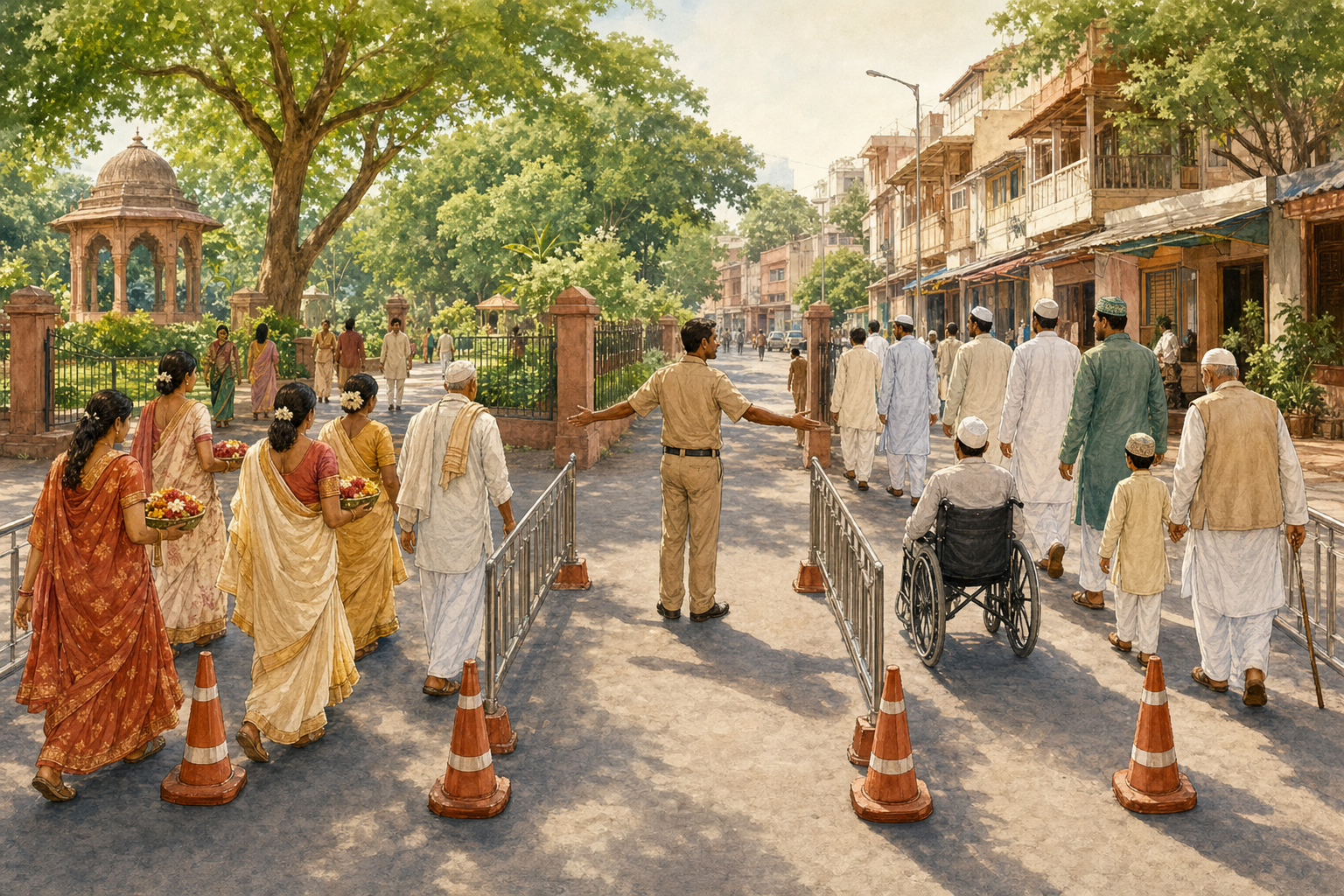
Sarasbaug is not merely an empty patch of public land. It is at once a garden, a busy civic commons, an approach to a historic Ganpati shrine and part of the daily routine of families, elders, vendors and commuters. A festival plan must recognise all of those uses. Treating the area only as a traffic junction would miss its devotional character; treating it only as a temple perimeter would ignore the lawful civic movement around it.
Article 25 protects freedom of conscience and religious practice, but that protection operates subject to public order, morality, health and other fundamental rights. This means a Muslim resident’s lawful prayer and charitable activity deserve protection. It also means religious freedom does not create a right to obstruct temple access, exceed binding noise limits, move prohibited animals, mistreat livestock or conduct unauthorised slaughter in a street or public space.
A Hindu civic response does not have to surrender legitimate concerns in order to demonstrate fairness. It should insist on measurable protections: continuous darshan access, an unobstructed emergency lane, no public slaughter, no livestock loading or staging beside the temple, humane transport enforcement, predictable quiet periods and prompt sanitation. Those demands become stronger when they identify conduct that authorities can verify instead of assigning guilt by religious identity.
The Maharashtra Police Act, 1951 permits local regulation of assemblies, processions and vehicle movement when public order requires it. Narrow controls under Section 37 can therefore address a defined place and period without turning the whole locality into a general exclusion zone. Any order for Sarasbaug should pass four tests:
- Identified risk: The order should name the problem it addresses, such as a blocked temple approach, livestock congestion, unsafe crowd crossing, excessive noise or an obstructed emergency route.
- Geographic fit: The regulated boundary should be shown on a map. “Near Sarasbaug” is too uncertain for residents, traders or police personnel to apply consistently.
- Time limit: Every diversion, access control and delivery restriction should have a start time, an end time and a clearly identified festival window.
- Equal enforcement: The same rules on obstruction, provocation, noise, sanitation and public safety should apply regardless of the offender’s community.
This distinction matters. A temporary restriction on livestock vehicles using a congested temple approach during notified peak hours can be justified by location and risk. An undefined demand to keep an entire religious community away cannot be administered fairly and is unlikely to solve the operational problem.
A workable Sarasbaug order needs routes, zones and named duties

Publish one complete order at least a week in advance
Residents should not have to assemble the rules from press remarks, forwarded messages and barricades encountered on the morning of the festival. Pune Municipal Corporation and Pune City Police should release one multilingual notice at least a week before the regulated period. Physical notices around Sarasbaug must match the online version.
The notice should contain:
- A map marking the temple precinct, regulated approach roads, pedestrian entries, vehicle diversions and the emergency corridor.
- The exact hours during which each control applies, including any quieter interval near the Ganpati Mandir.
- Routes for buses, ordinary private vehicles, heavy vehicles and vehicles carrying livestock.
- Short delivery windows through which local shops and vendors can receive essential supplies without defeating the traffic plan.
- The authority responsible for traffic, animal-transport checks, crowd control, sanitation, noise complaints and medical response.
- A single grievance channel with a reference-number system, plus the method for escalating an unresolved obstruction or safety complaint.
- The time at which temporary barricades, monitoring equipment and exceptional controls will be removed.
A QR-code map can help commuters, but it cannot replace street signs. Elderly devotees, occasional visitors and people without reliable mobile access must be able to follow the plan from visible boards and instructions given by trained personnel.
Operate three zones instead of treating every road alike
A zone model keeps the strictest controls where the risks are greatest and prevents unnecessary disruption elsewhere.
- Temple and garden precinct: Keep pedestrian access to darshan open, preserve a marked emergency lane and prevent livestock loading, unloading or staging. Public or street-side slaughter should not be allowed. Soft barricades can separate queues from through-movement without making the garden inaccessible.
- Approach-road zone: Redirect heavy and livestock-carrying vehicles during the notified peak period. Joint police, municipal and Animal Husbandry check-posts can verify certificates, species eligibility and transport conditions before a non-compliant vehicle reaches the most sensitive streets.
- Licensed-facility network: Direct legally permissible slaughter to authorised facilities equipped for sanitation, drainage, waste handling and disinfection. The city should publish how residents and transporters can confirm that a facility is licensed instead of leaving them to rely on informal claims.
No radius should be improvised at a checkpoint. If a road is restricted, the map should show it. If access is limited only during a peak window, officers should restore it when that window ends. Predictability reduces both hardship and arguments at the barricade.
Check legality and welfare before vehicles reach Sarasbaug
The Maharashtra Animal Preservation Act, 1976, as amended, regulates species-specific slaughter and certification. The Prevention of Cruelty to Animals Act, 1960 and the Transport of Animals Rules, 1978 also require humane transport. Those are operational obligations, not matters to be negotiated after a vehicle becomes stuck beside the temple.
Check-post personnel should inspect the relevant health and transport documents and look for adequate space, shade and water. They should record the result, direct compliant traffic onto the designated route and take lawful action on non-compliance. Screening on ingress roads is safer than allowing residents or rival groups to stop vehicles themselves.
The city must state plainly that visible animal transport is not, by itself, proof of an offence. The enforceable questions concern species eligibility, certification, vehicle conditions, route compliance and destination. Precision protects animals and the temple precinct while reducing the risk that rumour becomes street confrontation.
Design the crowd plan around crossing points and escape routes
The National Disaster Management Authority’s 2014 crowd-management principles provide a practical foundation: assess the risk beforehand, separate entry and exit flows, monitor conditions as they change and keep emergency egress open. At Sarasbaug, that should become a one-way pedestrian loop where feasible, separate queue and transit lanes, and a clearly protected path for ambulances and fire services.
Token-based queues at the shrine can distribute darshan demand across the busiest period. Trained volunteers should assist elders, families and visitors who cannot interpret a diversion quickly. Women volunteers can make the system more approachable and help surface crowding or safety concerns that might otherwise go unreported.
Officials should define crowd triggers before the event. When entry counters or personnel indicate that a published safe operating threshold has been reached, inward movement can pause while exit continues. A threshold that nobody knows, applied only after visible distress, is not a crowd plan.
Shade, potable water and first-aid points belong near the managed queues rather than inside the emergency corridor. These simple placements lower health risk without creating a second obstruction.
Treat noise and sanitation as enforceable services
The Noise Pollution (Regulation and Control) Rules, 2000 establish a night-time window from 10 p.m. to 6 a.m. States can notify limited exemptions for no more than 15 days in a year, but an exemption must actually be notified. Residents should not be expected to infer one merely because a festival is taking place.
The public notice should therefore identify any valid exemption and the conditions attached to it. Monitoring should concentrate on sensitive locations such as the temple precinct, hospitals and schools. Complaints need a time and location so an enforcement team can verify the alleged breach while it is occurring.
Licensed facilities must also have a plan for animal by-products, effluent, drainage and disinfection. PMC should schedule sanitation sweeps, vector control and safe drinking-water support as named tasks with responsible teams. Waste left to accumulate after the main gathering is not an unavoidable religious consequence; it is a failure of licensing and municipal execution.
What you can do before and during the festival window
Your most useful contribution is to make every concern specific enough to verify. That protects Sarasbaug more effectively than a broad allegation and makes it harder for a genuine complaint to be dismissed as communal rhetoric.
- Check the final official notice: Save the map and applicable times rather than relying on an earlier demand, a political statement or a forwarded image. If no complete notice has appeared a week before the event, ask PMC and Pune City Police to publish one.
- Plan access by time and route: Devotees should use the marked pedestrian entrance and avoid arriving through a vehicle-diversion corridor. Traders should schedule deliveries inside the stated micro-delivery window.
- Report conduct, not identity: Give the exact location, time and observed problem: a blocked darshan route, an obstructed emergency lane, suspected street slaughter, unsafe animal transport, waste discharge or a noise breach. Do not report lawful prayer or the mere presence of an animal-carrying vehicle as an offence.
- Preserve evidence safely: Note the time, direction of travel and visible conduct. If an image is necessary and lawful, capture only what helps officials identify the incident. Do not endanger yourself, invade a private space or provoke people for a clearer recording.
- Do not enforce the law yourself: Physically blocking a vehicle, opening it, seizing an animal or confronting a crowd can cause injury and destroy the controlled route plan. Send the information to the designated authority. Use emergency services when there is an immediate threat to life or safety.
- Stop rumours at your own phone: Do not forward an undated clip or allegation merely because it carries a Sarasbaug label. Submit uncertain material to the official rumour-control or grievance channel and wait for verification.
- Use one liaison per organisation: Temple representatives, resident associations, market groups and participating religious organisations should each nominate a reachable contact. A shared liaison group can resolve a stalled vehicle or confusing barricade before a street argument forms around it.
If you are asked to move from a supposedly restricted area, request the applicable order and check its boundary and operating time. Remain calm and comply with lawful safety directions; a disputed citation, seizure or denial of access should be addressed through the grievance process and, where necessary, qualified legal counsel rather than settled at the checkpoint.
Peace committees should include Hindu, Muslim, Buddhist, Jain and Sikh representatives, along with residents and traders. Their job is not to bargain away a statute or excuse a violation. It is to carry accurate instructions, identify emerging congestion and connect the right official to a problem while it is still small.
Judge the city by the record it publishes afterward
A festival that ends without a major confrontation can still conceal preventable failures. Pune should conduct an open review after temporary controls end and publish enough operational information for residents to judge whether the restrictions were necessary and proportionate.
The review should cover:
- Whether access to Sarasbaug Ganpati Mandir remained continuously available during the published hours.
- How often the emergency corridor or pedestrian approaches were obstructed, why it happened and how quickly they were cleared.
- The number and type of transport checks, documented non-compliance and enforcement actions, without using communal identity as a substitute for the violation.
- When crowd thresholds were reached and whether inward-flow pauses followed the announced trigger.
- Noise complaints, verified exceedances and any notified exemption that affected enforcement.
- Sanitation completion, waste handling, effluent problems and the time required to restore ordinary public use.
- Complaints received by category, response time and unresolved cases requiring follow-up.
Temporary cameras or counters should collect only what the operating plan needs. Once the event ends, exceptional monitoring should be decommissioned and any retained information handled under a disclosed retention rule. Festival security must not quietly become permanent surveillance.
This is the practical test for Pune: can it protect a Hindu sacred precinct without collective punishment, and facilitate a lawful Eid observance without relaxing public-order, animal-welfare or sanitation duties? A mapped order, early notice and visible enforcement can do both. If you live, worship or work near Sarasbaug, ask for those concrete protections now, while the routes and responsibilities can still be fixed.