
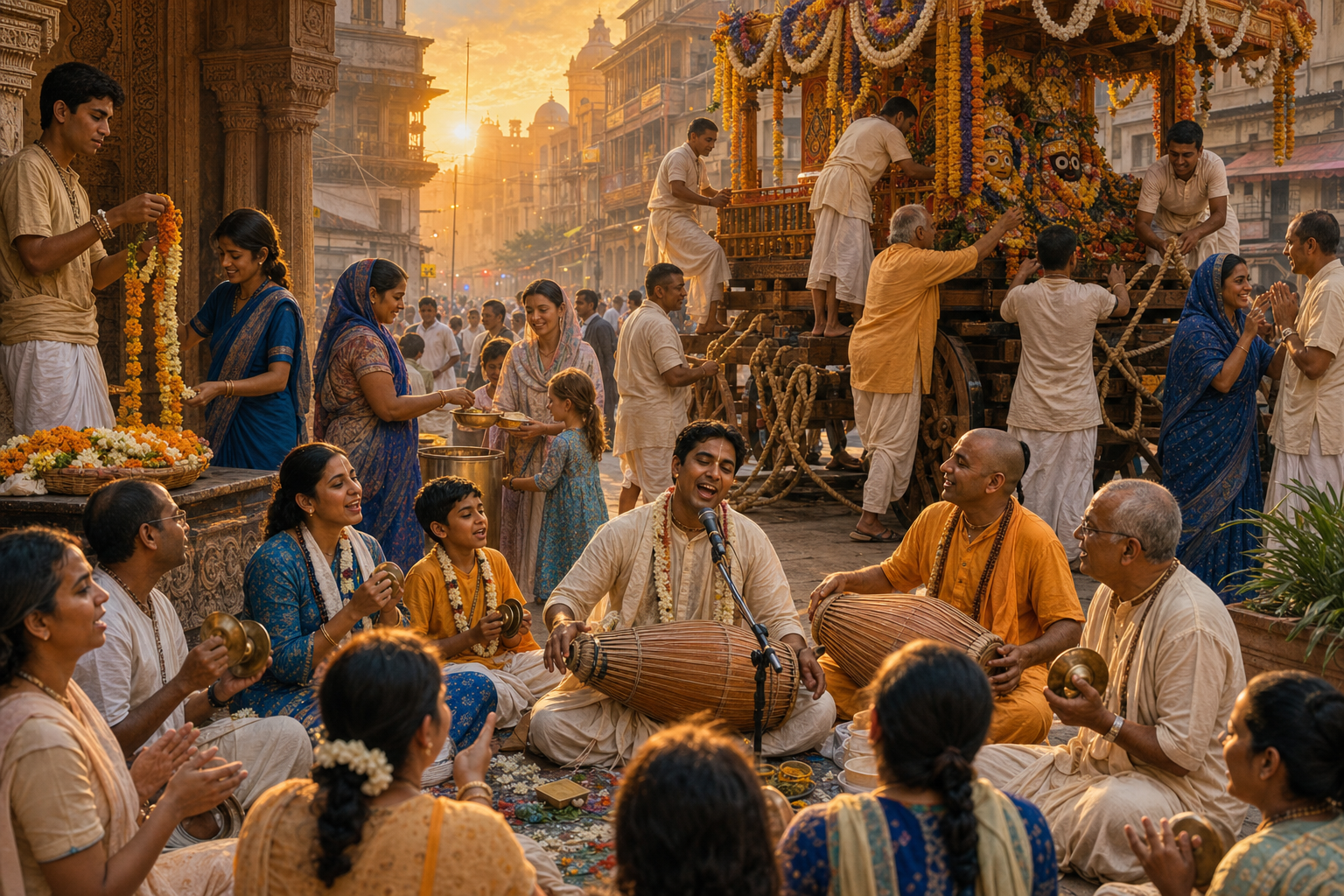
You have been asked to lead kirtan, help with Ratha-yatra, welcome newcomers, or preserve the work of an elder devotee. The immediate tasks look different, but the underlying decision is the same: will your competence draw attention to the servant, or help more people participate in service to Krishna?
Two Gaudiya Vaishnava legacies offer a practical answer. Sri Jayananda Prabhu showed how engineering, permits, fundraising, hospitality, construction, and street-level reliability could become seva. Agnideva Prabhu showed how melody, rhythm, pronunciation, breath, and attentive leadership could become congregational devotion. Their examples give you a working standard for public bhakti: keep the holy name at the center, make participation possible, and prepare the next person to serve without depending on your presence.
One discipline unites visible kirtan and hidden service
It is easy to separate a devotional program into spiritual and practical sides. The kirtan leader appears to handle the spiritual part, while the person obtaining permission, repairing equipment, cleaning the site, or organizing prasadam handles logistics. Gaudiya seva does not support that division. The practical work protects the conditions in which remembrance, hearing, chanting, darshan, and hospitality can occur.
Jayananda Prabhu made this unity visible in San Francisco. He supported temple life through practical work, participated in sankirtana, treated guests with dignity, and helped establish Ratha-yatra there from 1967 onward. Chariot construction was not incidental to the worship. Neither were permits, civic relationships, transport, volunteer schedules, crowd management, prasadam distribution, or sanitation. Each protected the public offering.
His achievement was therefore larger than one successful procession. A liturgical tradition rooted in Jagannath Puri could enter a modern Western city without surrendering its identity. The devotional center remained Jagannath, Baladeva, Subhadra, nama-sankirtana, and prasadam. The surrounding form became legible to municipal officials, neighbors, families, and first-time visitors. Communities in cities including New York, London, Toronto, Sydney, and Durban later developed public Ratha-yatra celebrations on this durable pattern.
Agnideva Prabhu served the same purpose through sacred sound. His musical skill did not make the assembly an audience. It helped the assembly chant. His leadership could move from quiet reflection to joyful intensity, but the call-and-response remained central. Approachable melodic shapes, steady rhythmic frameworks, clear pronunciation, controlled breath, and sensitivity to the room turned technique into pastoral care. The test was not whether the leader produced an impressive climax. It was whether people could hear, answer, remain attentive, and remember Krishna together.
This gives you a useful definition of legacy. A legacy is not the preservation of a famous personality’s surface style. It is the transmission of devotional intention through practices another servant can learn. If a specialist’s excellence makes everyone dependent on that specialist, the inheritance is fragile. If the excellence helps newcomers enter, volunteers take responsibility, and apprentices grow, the inheritance is alive.
Lead kirtan so the congregation can actually participate
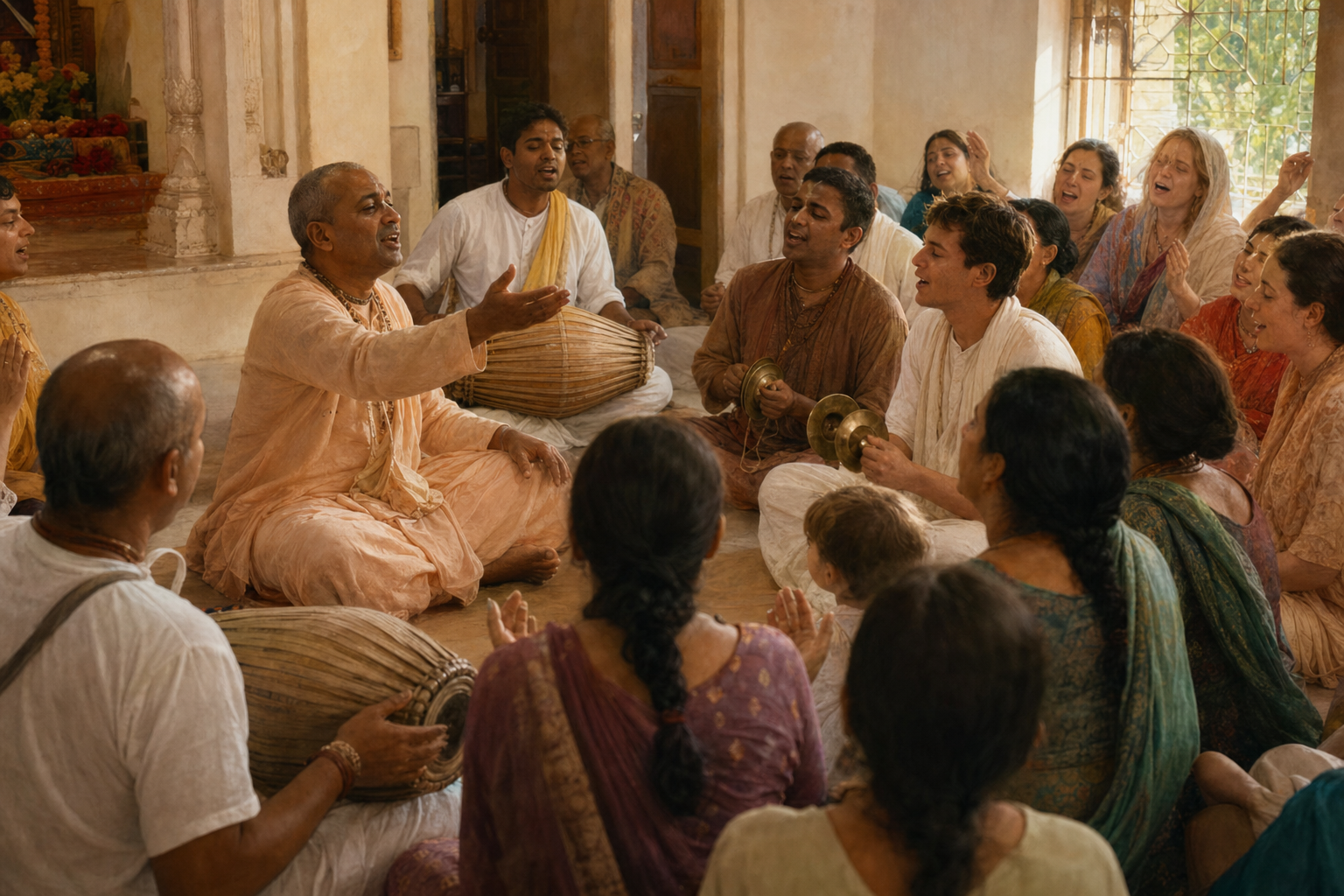
Gaudiya kirtan is not ordinary music with religious words added to it. It is congregational remembrance through the holy name, often described as sankirtana-yajna. Musical craft matters because careless craft can obstruct participation. It cannot replace devotion, and it should never turn the maha-mantra into background material for the leader’s display.
Choose a frame people can enter
Begin with the human beings in front of you. Select a pitch that a mixed congregation can answer without straining for the highest or lowest notes. Start at a tempo slow enough for the syllables and pulse to be clear, but not so slow that people lose the shape of the response. Introduce one short melodic cue before adding variations. A newcomer should be able to recognize what to sing after hearing it once or twice.
Familiar rhythmic cycles can support this accessibility. Kaherva provides an eight-beat frame, dadra a six-beat frame, and teentaal a sixteen-beat frame that can accommodate longer festival development. These counts are not badges of sophistication. Use the simplest cycle that the available players can hold steadily while listening to the singers. An elaborate tala that fragments the response is serving the musicians, not the kirtan.
Harmonium can provide melodic support, mridanga can articulate the rhythmic movement, and kartals can keep a bright shared pulse. Their proper relationship is supportive. If the congregation cannot hear the mantra, reduce the instrumental density or volume. Clear gain staging is especially important when microphones, amplification, livestreams, or remote participants are involved. Loudness is not devotional intensity, and preventable hearing discomfort is not an offering.
Build intensity without manufacturing emotion
A strong kirtan has movement, but movement is not the same as continuous acceleration. Agnideva Prabhu’s leadership could develop from a contemplative vilambit pace toward a faster drut passage while retaining clear melodic cues and congregational response. The essential skill was pacing: intensity alternated with space, allowing breath, attention, and collective singing to recover.
Raise the tempo only while the response remains together. If pronunciation blurs, participants stop answering, or percussion begins competing with the mantra, simplify. Return to a known motif, reduce the volume, or settle the pulse. Rasa cannot be forced by speed. The leader creates musical conditions for attention and then allows devotion to remain the purpose.
Use this sequence for your next kirtan
- Give a brief devotional frame. Tell newcomers that the leader sings first and everyone is invited to respond. Provide transliteration and a concise explanation of the maha-mantra where needed.
- Set a comfortable pitch and establish the pulse before introducing melodic ornament.
- Sing a short, complete phrase with crisp Sanskrit pronunciation. Rounded vowels and breath supported from the diaphragm help sustain tone without shouting.
- Listen to the response before choosing the next phrase. Repeat what the room has learned; do not change the melody merely because the leader is ready for novelty.
- Let mridanga, kartals, and harmonium reinforce the voices. Adjust the instruments when the words disappear beneath them.
- Develop the pace in stages, alternate exertion with rest, and leave enough space for a stable resolution.
- Alternate qualified leaders during longer programs. This protects vocal health, develops successors, and keeps the gathering from becoming identified with one performer.
Afterward, evaluate participation rather than applause. Could a first-time visitor follow the response? Did the leader listen as carefully as the congregation? Did each tempo change preserve the mantra’s clarity? Could another trained devotee have taken over without disrupting the devotional center? Those questions reveal more about the quality of the kirtan than the complexity of its melody.
Build public seva with a professional safety standard
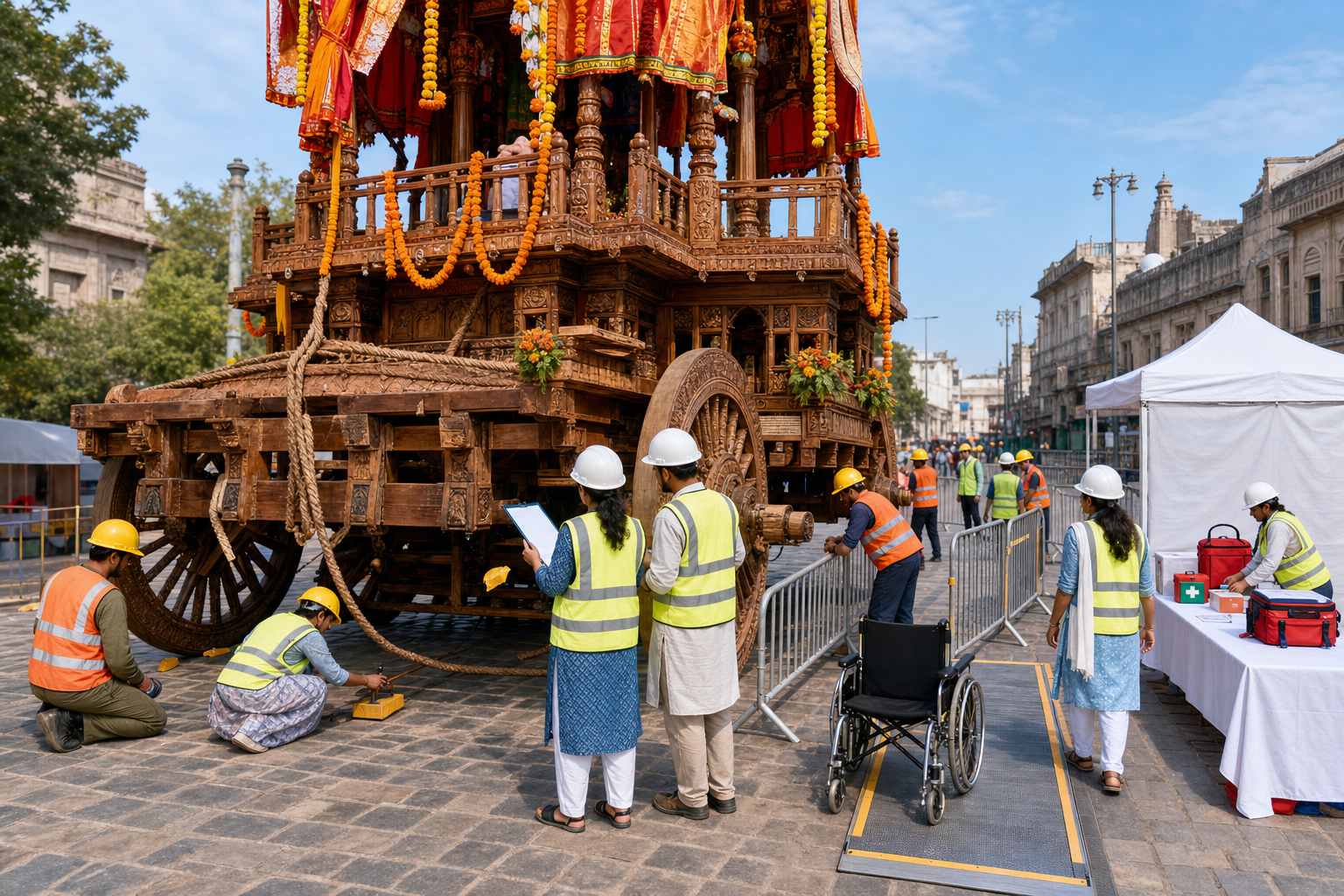
A street festival becomes a devotional environment only when people can enter it without avoidable confusion, exclusion, or danger. Sincerity does not compensate for an unsafe chariot, an unauthorized route, unclear volunteer authority, inaccessible facilities, or unmanaged crowds. Public trust is part of the offering because neighbors and civic officials encounter the tradition through the conduct of its servants.
Jayananda Prabhu’s strength lay in joining humility to operational competence. He cultivated relationships with city departments, helped obtain permits, organized carpentry and transport, and coordinated volunteers while keeping guests and participants in view. Even during leukemia, he continued contributing to Ratha-yatra and temple needs as his health allowed before departing in San Francisco on May 1, 1977. His authority grew from taking responsibility, not reserving prestigious work for himself.
Organize six connected workstreams
- Define the devotional center. Write a short brief naming the Deities, the role of nama-sankirtana, the place of prasadam, and the standard of conduct expected from volunteers. This keeps practical decisions connected to the purpose of the festival.
- Resolve civic requirements early. Confirm the route, permits, municipal conditions, transport arrangements, neighborhood communication, and any restrictions before publicly promising details that may have to change.
- Treat chariot construction as a safety-critical responsibility. Give design, structural work, movement, and inspection to competent people. Name the person authorized to halt the procession if the structure, route, weather, crowd, or coordination becomes unsafe.
- Divide volunteer responsibility clearly. Construction, transport, kirtan, crowd guidance, prasadam, sanitation, guest welcome, and communications each need a named coordinator and a backup. A general appeal for everyone to help does not establish accountability.
- Design hospitality deliberately. Use visible and, where useful, multilingual signs. Explain what visitors are seeing without pressuring them. Provide an orderly prasadam workflow, accessible facilities, and volunteers who know how to receive questions respectfully.
- Rehearse the handoffs. Walk through the start, procession, pauses, arrival, prasadam service, cleanup, and response to a stop call. The vulnerable points are usually where one team assumes another team has taken responsibility.
If the required permission, competent construction review, or safe movement plan is not ready, do not move the chariot. A stationary darshan and kirtan program is a safer devotional alternative than improvising a procession around an unresolved hazard. No schedule, reputation, or fear of disappointment should overrule a legitimate safety stop.
The kirtan and operations teams also need one shared plan. The lead kirtaniya should know the route, expected pauses, and signals from the procession coordinator. Sound equipment should suit a moving congregation rather than only the musicians nearest the microphones. Prasadam and welcome teams should know when crowd flow is likely to change. This coordination prevents devotional activity from becoming detached from the people it is meant to serve.
Municipal compliance does not weaken Gaudiya identity. Done carefully, adaptation protects it. The tradition remains clear about Jagannath and bhakti while demonstrating that Hindu public worship can be reliable, generous, and considerate of the city that hosts it. That was the organizational grammar that allowed Ratha-yatra to become repeatable across very different urban settings.
Transmit the method, not merely the memory
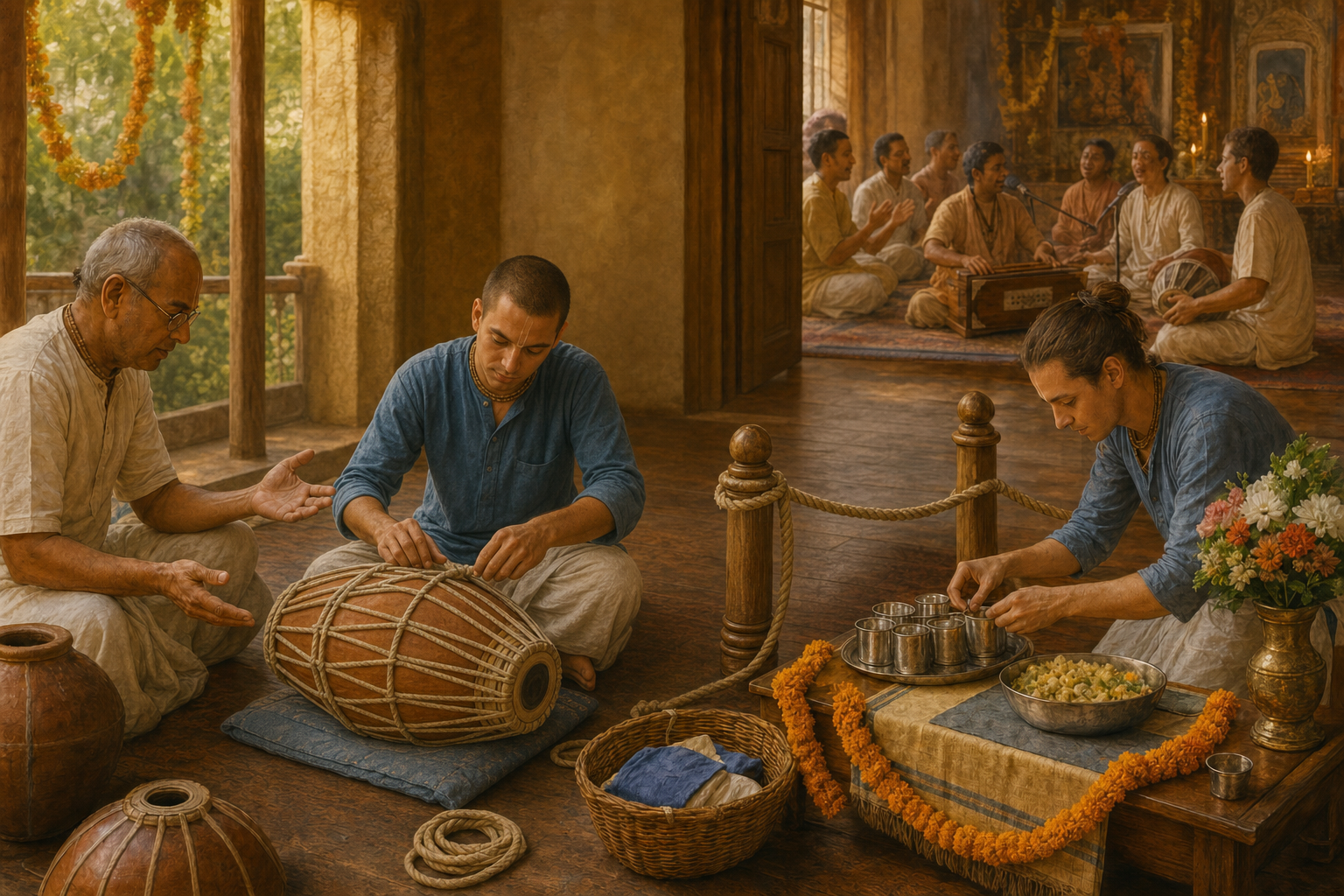
A disappearance day, or tirobhava-tithi, is not complete when a community remembers a devotee warmly but leaves the devotee’s work unpracticed. Gaudiya remembrance asks you to receive both the servant’s devotional disposition and the conduct through which it became visible. In Jayananda Prabhu’s case, humility took the form of repairing, fundraising, building, welcoming, and accepting responsibility. In Agnideva Prabhu’s case, humility took the form of listening, pacing, pronouncing carefully, and placing congregational chanting above display.
Many Ratha-yatra committees place Jayananda Prabhu’s photograph on a chariot. The gesture becomes pedagogically stronger when it is paired with a concrete act: inspect neglected equipment, train a new volunteer, improve accessibility, reconcile an unclear handoff, or serve a guest whom others have overlooked. Likewise, honoring a kirtaniya requires more than replaying a beloved recording. Teach someone how the response was cued, why a tempo changed, how the instruments were balanced, and when the leader chose restraint.
Archive enough context for another person to learn
An audio file preserves sound, but it does not automatically preserve lineage. For every recording worth keeping, document the modal or raga center, tala, beats per minute, pitch reference, date, festival or temple context, and participating musicians. Add a brief note describing the melodic cue, the sequence of tempo changes, and how the leader responded to the congregation. These details turn an admired recording into usable teaching material.
- Keep the highest-quality original file unchanged and create a separate copy for ordinary listening or online distribution.
- Use consistent names and metadata so recordings can be found by leader, date, occasion, tune, or tala.
- Preserve transliteration, meaning, and any available melodic transcription beside the audio rather than in an unrelated folder.
- Record who supplied the description and obtain appropriate consent before publishing identifiable participants.
- Assign an archive custodian and a successor. A repository that only one person understands is another fragile dependency.
Digital gatherings require the same discipline. Agnideva Prabhu’s passing brought approximately one hundred devotees together through Zoom for sankirtana, showing how dispersed communities can share the holy name across continents. Clear audio leadership, controlled gain, thoughtful pacing, and respect for different time zones make such access workable. Technology can extend the congregation, but it should not turn remote devotees into spectators of an overproduced stream.
Welcome the wider dharmic family without erasing distinctions
Public kirtan often draws Hindus from other sampradayas as well as Sikhs, Buddhists, Jains, and people with little knowledge of any dharmic tradition. There are genuine points of recognition: Sikh communities honor kirtan, sangat, seva, and shared food; Buddhist communities sustain sacred recitation and sangha; Jain communities use mantra and stavan to cultivate ethical and contemplative attention; Hindu bhakti traditions place sacred sound at the heart of devotion.
These resonances do not make the traditions interchangeable. Hospitality works best when the common ethical ground is stated alongside theological clarity. You can say plainly that this is Gaudiya Vaishnava kirtan centered on the Hare Krishna maha-mantra, that participation is invitational, and that prasadam is food offered in devotion and shared as grace. A visitor does not need ambiguity in order to feel welcome.
This balance also gives interfaith partners something trustworthy to engage. Shared commitments to service, non-violence, disciplined conduct, sacred sound, and dignified hospitality can support cooperation. The event remains recognizably Gaudiya because cooperation is expressed through honest difference rather than a claim that every dharmic practice means the same thing.
Key takeaways
- Judge devotional excellence by whether it helps people remember, participate, and serve, not by how prominently it displays the expert.
- Lead kirtan with a singable pitch, clear pronunciation, repeatable melodic cues, supportive instruments, and tempo changes the congregation can follow.
- Treat permits, structural safety, volunteer authority, accessibility, prasadam, and sanitation as integral parts of public seva.
- Cancel or replace an unsafe procession rather than allowing devotional urgency to override a legitimate stop decision.
- Preserve context as well as recordings: tala, tempo, pitch, occasion, musicians, cues, and the leader’s response to the room.
- Honor departed devotees by training successors and completing neglected service, not only by reproducing their outward style.
At your next gathering, choose one act that will outlive the program. Give a newcomer a response they can sing, appoint a safety coordinator who can stop the procession, train an apprentice in a real responsibility, or save one recording with enough context to teach from it. A living Gaudiya legacy begins when another person can serve Krishna more steadily because you prepared the way.
References
- Dandavats – The Saint in the Streets: Sri Jayananda Prabhu’s Legacy and the Rise of Ratha-yatra in the West
- Dandavats – Honoring HG Agnideva Prabhu’s Timeless Kirtan Legacy and Devotional Service to Srila Prabhupada