
If an animal dies while protecting people, you may feel gratitude and unease at the same time. Was it a noble sacrifice, an instinctive act, or a tragedy that human beings should have prevented?
A Dharmic response can hold those questions together. You can honor extraordinary courage without glorifying death, assigning an animal a human theory of martyrdom, or treating another creature as evil. The real test comes afterward: does your gratitude lead to more compassionate and more competent care for every life sharing that place?
Honor the protection, not the death
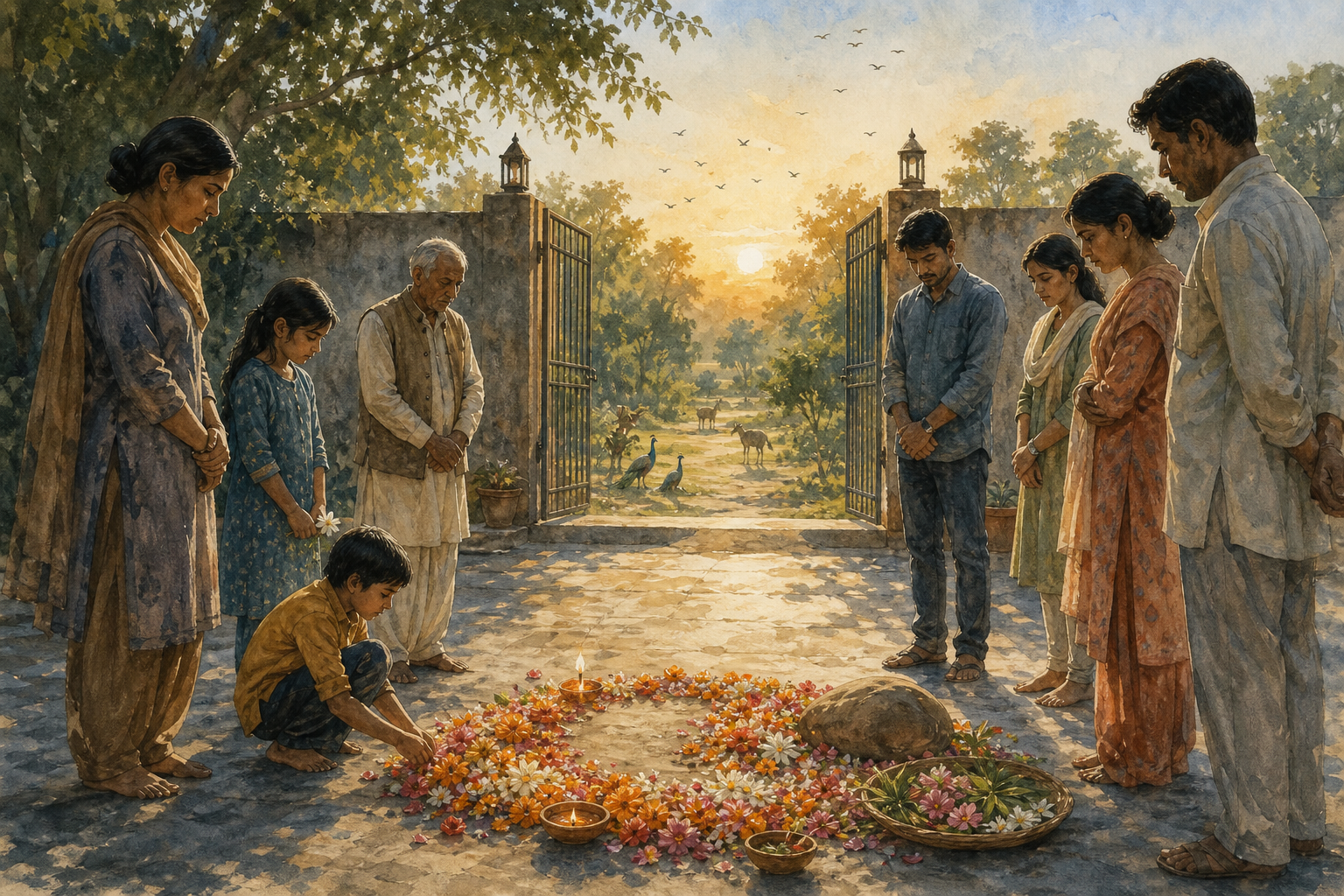
On 20 April 2026, a community dog named Kali confronted a venomous snake near Sri Jagannath Sishu Vidya Mandir Elementary School in Dhirakula village, Odisha. The snake was believed to be an Indian cobra, Naja naja. Kali placed herself between the snake and around 30 children, continued fighting until the threat was stopped, and suffered a bite to the mouth. The children survived unharmed. The snake was killed, and Kali later died from envenomation.
Calling that self-sacrifice is understandable, but the term needs care. Kali’s protective behavior is observable. Her bond with the children and the danger she accepted are intelligible from what she did. We cannot establish that she contemplated death in the abstract or made the kind of philosophical choice a human martyr might make.
That limit does not empty her action of moral meaning. Calling an act instinctive does not make it insignificant, just as calling it sacrifice does not prove human-like deliberation. Well-socialized community dogs can form protective bonds with the people around them and act as sentinels. Kali’s conduct was remarkable because the direction of her action was clear: she moved toward danger while vulnerable children stood behind her.
If you are deciding how to speak about such an event, use four questions:
- Who was being protected? Name the vulnerable lives rather than praising danger in the abstract.
- Was the danger immediate? Protective action during an active threat is different from aggression undertaken later.
- What can honestly be known? Describe the animal’s behavior without inventing thoughts, vows, or supernatural instructions.
- What should gratitude produce? A worthy tribute should improve care, prevention, and emergency readiness.
The animal’s death is not what makes the deed Dharmic. Compassionate protection is. Death was the cost of the encounter, not an outcome that anyone should seek to reproduce.
Ahimsa is a discipline of response, not a denial of danger

Ahimsa is sometimes treated as if it requires pretending that no conflict exists. A cobra beside a group of children presents a real danger. Yet the presence of danger does not turn the snake into a moral villain. It is an animal moving through an environment where fields, prey, vegetation, buildings, people, and other animals meet.
Dharmic traditions do not supply one mechanical answer for every conflict between lives. Jain ascetic discipline applies ahimsa with an exactness different from the obligations commonly assumed by Hindu, Buddhist, Jain, or Sikh householders. Within each tradition, circumstances and interpretations also differ. Kali’s action should therefore be received as protective courage, not converted into a universal rule authorizing humans to kill animals whenever they feel afraid.
A practical way to apply ahimsa is to examine the encounter across three periods:
- Before danger: reduce the conditions that bring snakes, rodents, dogs, and crowds into avoidable conflict. Prevention usually preserves more lives than bravery during an emergency.
- During immediate danger: move people away, keep others from crowding the animal, and use the least harmful effective response available. When there is time and distance, trained forest personnel or registered snake rescuers are preferable to an improvised confrontation.
- After danger: obtain urgent treatment for anyone bitten, record what made the encounter possible, and correct that condition before the next gathering.
This approach accounts for harm caused by action and harm allowed through neglect. It also keeps courage in its proper place. Abhaya is not thrill-seeking or domination. It is fearlessness ordered toward protecting life. Human beings, unlike an animal reacting in a few dangerous seconds, can inspect a school boundary, arrange professional contacts, and remove hazards in advance.
The snake’s death must remain part of the moral accounting. It may have occurred during an unavoidable struggle, but it is not a reason to celebrate the destruction of snakes as a class. No rite of gratitude to Kali should become an excuse for retaliatory killing.
Dharmic traditions converge ethically, not metaphysically
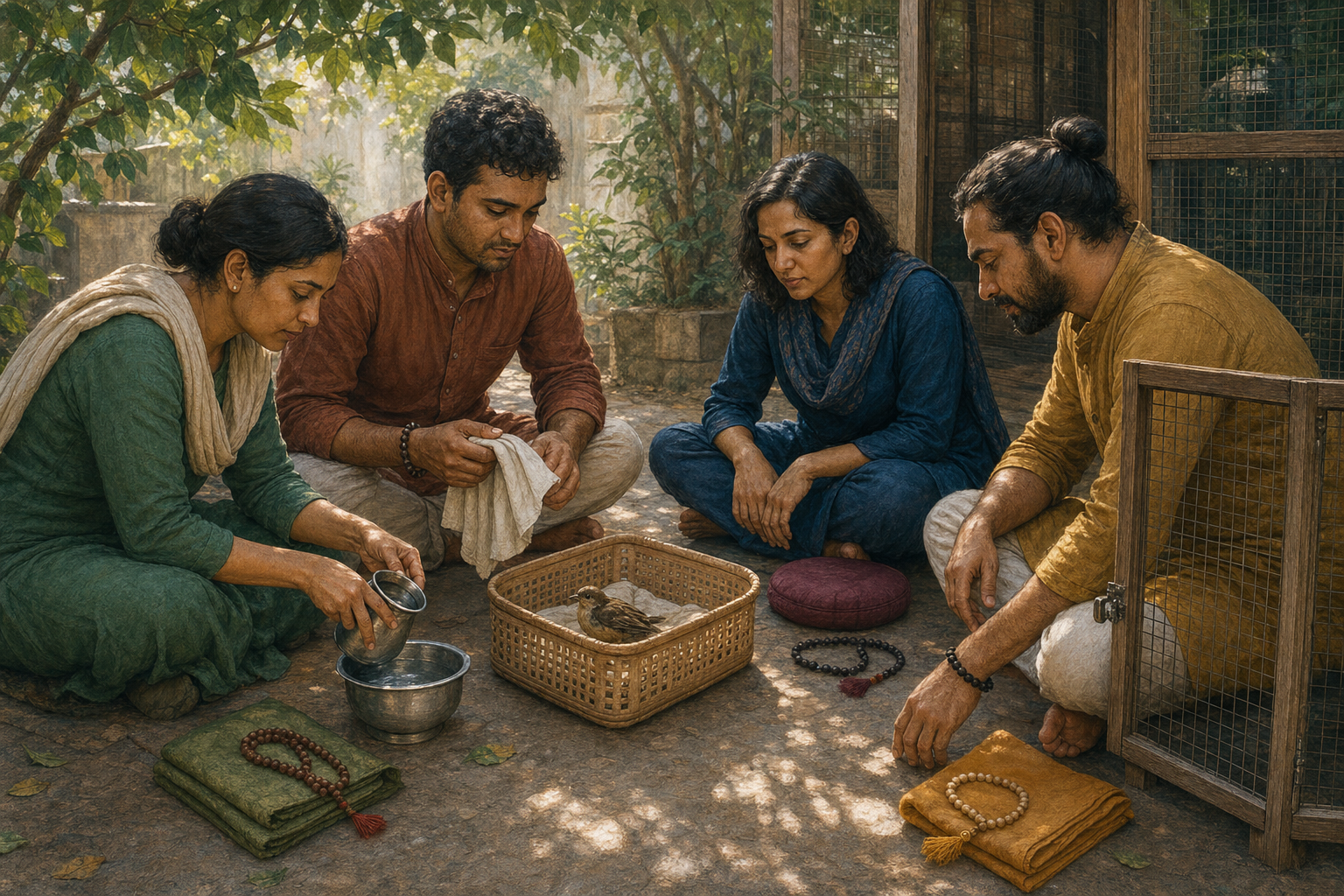
Hinduism, Buddhism, Jainism, and Sikhism do not teach identical accounts of the self, soul, karma, or liberation. Saying that they are simply the same would erase distinctions that their practitioners take seriously. Their meeting point here is ethical: human moral concern does not stop at the boundary of the human species.
- Hindu perspectives: daya places compassion at the center of right conduct, while many Hindu traditions recognize spiritual significance throughout living existence. Sacred memory repeatedly refuses to treat animals as spiritually empty. Bhairava is accompanied by a dog, Yudhishthira refuses to abandon the dog who reaches the gate of heaven with him, and Kukur Tihar publicly honors canine loyalty and service. Kali’s worth did not begin when she saved children; her deed made an existing relationship visible.
- Buddhist perspectives: metta and karuna train goodwill and compassion toward sentient beings. The useful question is not whether an animal can explain its virtue in human language, but whether our response reduces fear, suffering, and future harm.
- Jain perspectives: every jiva demands moral consideration, and ahimsa exposes how casually human convenience can injure other lives. Anekantavada also helps resist a false single-label account: instinct, courage, tragedy, ecological conflict, and human responsibility can each disclose a side of the event without exhausting it.
- Sikh perspectives: seva directs ability toward selfless service, while sarbat da bhala widens concern toward the good of all. A community honors protective service most convincingly when it answers with service of its own.
This shared vocabulary prevents two opposite mistakes. One mistake treats an animal as a disposable tool whose value appears only when it serves humans. The other turns the animal into a sentimental replica of a human saint. Dharmic compassion requires neither reduction. You can recognize Kali as a dog, respect the bonds and capacities proper to her life, and still receive her conduct as morally instructive.
The same discipline applies to the cobra. Compassion does not require denying its danger. It requires seeing a dangerous living being accurately, without converting fear into hatred. That distinction is where ahimsa becomes a practical ethic rather than an attractive slogan.
Make remembrance change how the community behaves
Kali’s community wrapped her in white cloth, placed her on a flower-adorned trolley, and conducted dignified public rites recognizing her protection of the children. Such a rite need not claim that animals and humans have identical social roles. It gives a community a language for gratitude, grief, and responsibility across species.
Give grief a truthful Dharmic form
When children have witnessed the event, adults should not make death sound desirable or tell them that Kali was destined to die for them. A clear account is enough: she protected them, she was bitten, and the venom killed her. The snake was dangerous, but it was not wicked.
A family, school, temple, or village can then choose forms of remembrance consistent with its own sampradaya and local practice. The form may include flowers, prayer, silence, a lamp, or a public expression of thanks. No invented universal ritual is necessary. What matters is that the rite tells the truth and directs gratitude toward care.
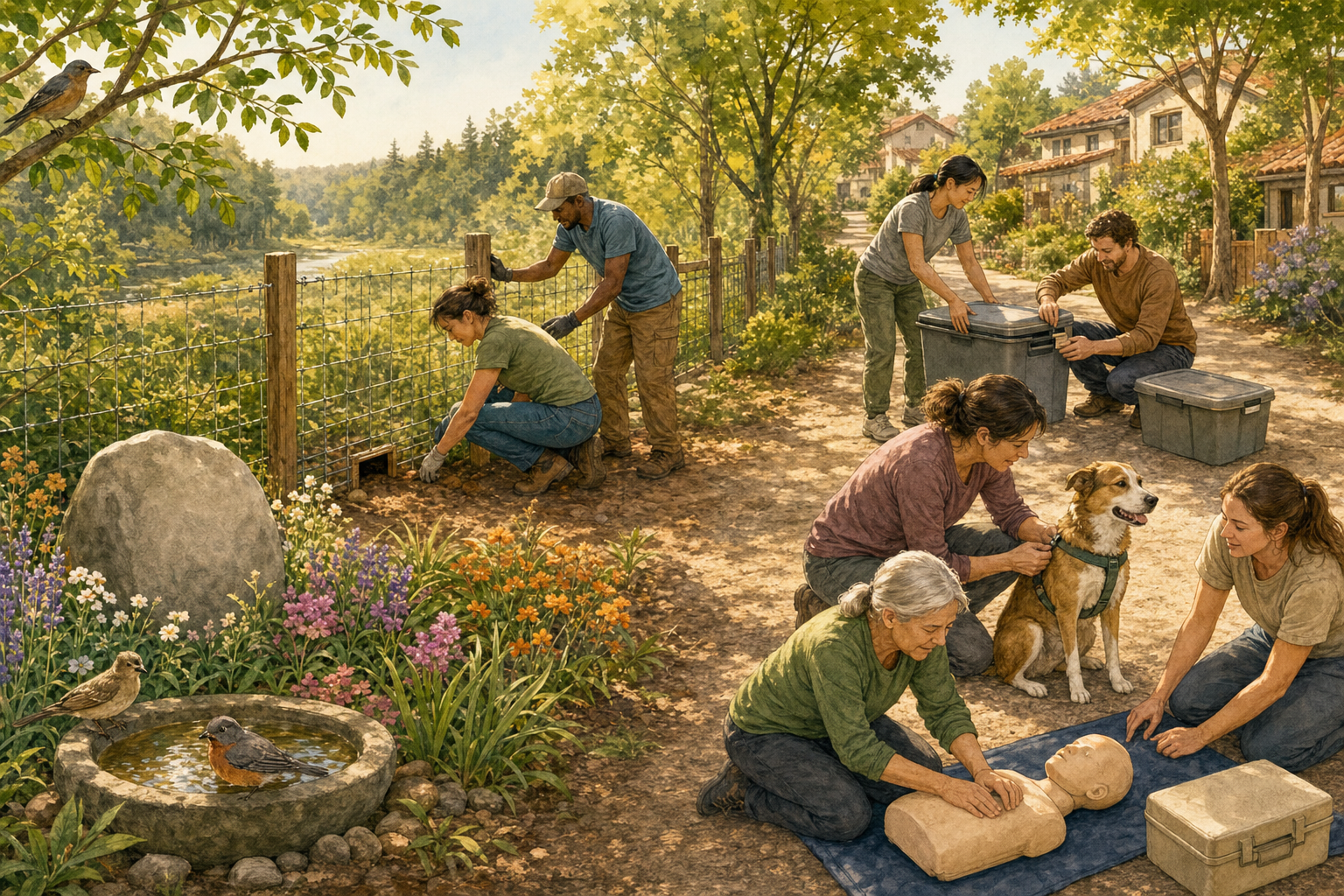
Give the remembrance a concrete beneficiary. Sponsor vaccination or sterilization for community dogs. Support veterinary access. Improve a school boundary. Teach children how to withdraw safely from a snake. A memorial that prevents another death is not less spiritual than a ceremony; it is the ceremony carried into conduct.
Build protection before courage is needed
Snake encounters become more likely where prey, cover, buildings, and human activity overlap. In eastern India, rising heat and prey movement around April can increase activity near cultivated land and settlement edges. Schools and community spaces should inspect those edges before the hotter period and again whenever vegetation, rubbish, or structural gaps return.
- Walk the whole perimeter. Mark brush, stacked debris, low shrubbery, holes beneath doors, gaps around utility conduits, and signs of rodents. Do not limit the inspection to the main entrance.
- Remove cover and prey attractants. Clear unnecessary brush and debris, manage waste and stored food, and address rodent activity. The mechanism matters: fewer hiding places and less prey make the site less attractive.
- Close entry routes. Seal gaps beneath doors and around conduits. Where locally appropriate, install and maintain low boundary mesh intended to deter entry.
- Create a clear student zone. Keep the place where children wait, eat, or assemble free of dense vegetation and stored material. Visibility gives teachers and children more time to withdraw.
- Post an emergency contact card. Include medical transport, the nearest appropriate medical facility, veterinary help, the forest department, and a registered snake-rescue contact. Confirm the numbers rather than copying an old list.
- Teach observable actions. Children should move away, alert an adult, and never touch, corner, tease, or throw objects at a snake. Awareness teaching should not use a live animal as a prop.
- Manage community dogs humanely. Coordinate Animal Birth Control sterilization and anti-rabies vaccination instead of driving familiar dogs away or leaving their health unmanaged. Record which animals have received care and when follow-up is due.
Community dogs may warn people about wildlife, but they must not be recruited as living security equipment. Do not encourage a dog to attack a snake or allow children to approach because a familiar dog is present. Kali’s courage reveals a relationship worth honoring; it does not create a method that anyone should deliberately repeat.
Treat every suspected bite as urgent
A suspected venomous snakebite is an emergency even before severe symptoms appear. For a human victim, keep the person calm, limit movement, immobilize the affected area, and arrange immediate medical transport for assessment and antivenom treatment. Do not apply a tourniquet, cut the wound, or delay transport while attempting a home procedure.
A bitten dog or other animal needs urgent veterinary care. A mouth or facial bite can be especially dangerous because those tissues have a rich blood supply, allowing venom to enter the system rapidly. Rural access to timely veterinary antivenom may be limited, so the emergency plan should identify veterinary help before an encounter occurs. Do not wait for collapse before seeking care.
When a snake is present but no attack is underway, clear people from the area and contact trained wildlife personnel. Trying to capture or kill it can turn a manageable sighting into a bite emergency. This is where preparation joins daya: competent restraint protects the children, the dog, the rescuer, and the snake.
Key takeaways
- Animal self-sacrifice is a careful moral description of protective behavior, not proof that an animal formed a human concept of martyrdom.
- Honor the compassion and courage in the act. Do not treat death itself as sacred, desirable, or worthy of imitation.
- Ahimsa begins before confrontation: remove hazards, create distance, prepare contacts, and choose the least harmful effective response.
- Hindu, Buddhist, Jain, and Sikh teachings remain doctrinally distinct while converging on compassion beyond the human species.
- A truthful tribute includes the threatened snake in the moral accounting and refuses retaliatory hatred.
- The most durable memorial combines appropriate rites with snake-safety measures, urgent-care planning, vaccination, sterilization, and humane stewardship.
If you help care for a school, temple, housing society, or village space, make two changes before the next gathering: walk the perimeter for specific hazards and place verified emergency contacts where adults can reach them quickly. If community dogs share the space, confirm their vaccination and sterilization status as well. That is how gratitude stops being a story about one brave animal and becomes a living duty toward all.