
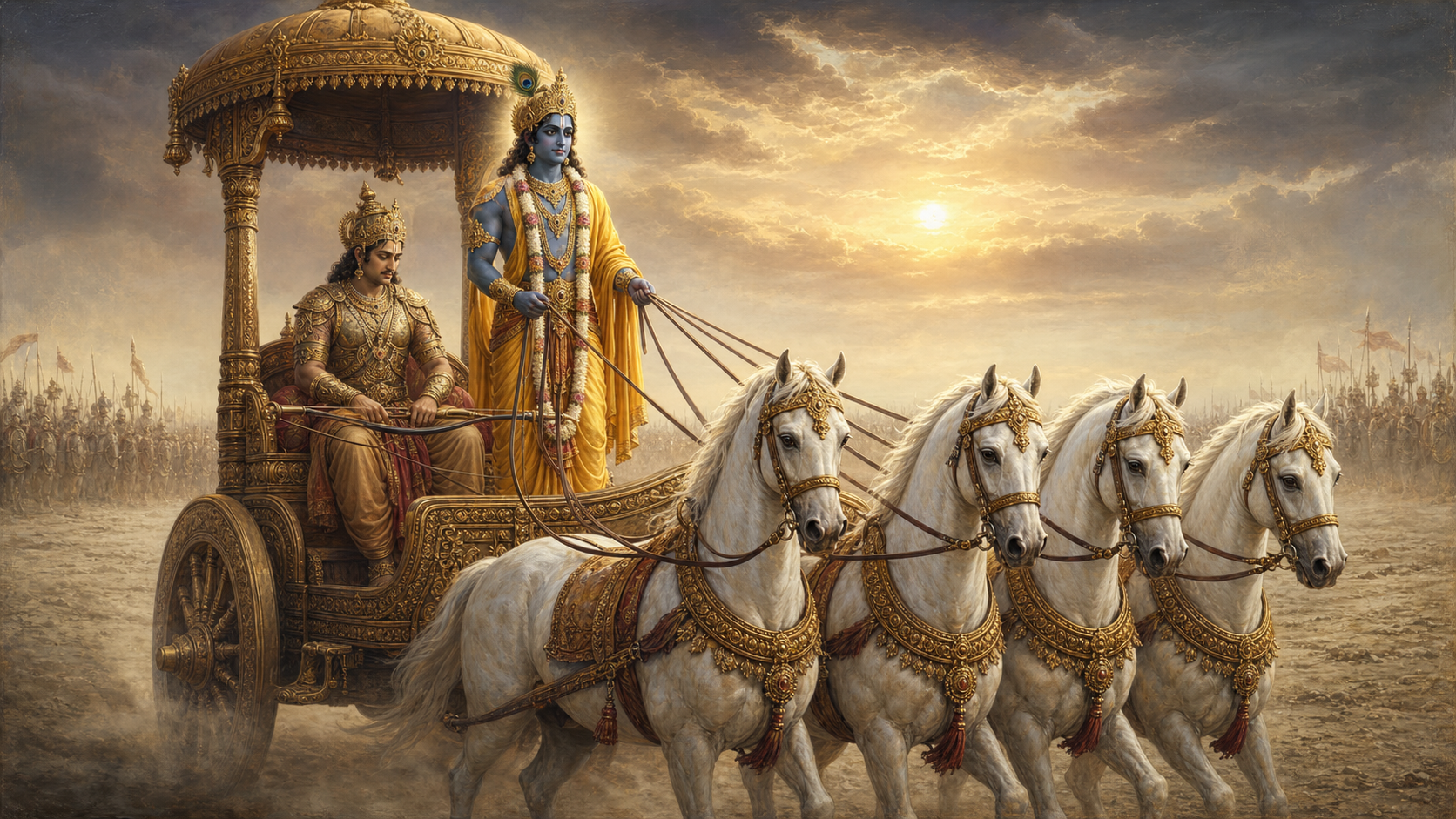
If the Krishna on your altar is the butter thief, the enchanting flute-player, or the beloved child, you already possess a powerful devotional relationship. But when you must confront injustice, set a painful boundary, fulfil an unwelcome duty, or act without knowing the outcome, that familiar imagery may not tell you how Krishna accompanies you there.
You do not need to replace Bala-Krishna with a harsher deity. You need to recover Parthasarathi: the Krishna who first seeks peace, then stands amid unavoidable conflict without hatred, guides a bewildered human being, and joins devotion to disciplined action.
Parthasarathi is not a licence for aggression
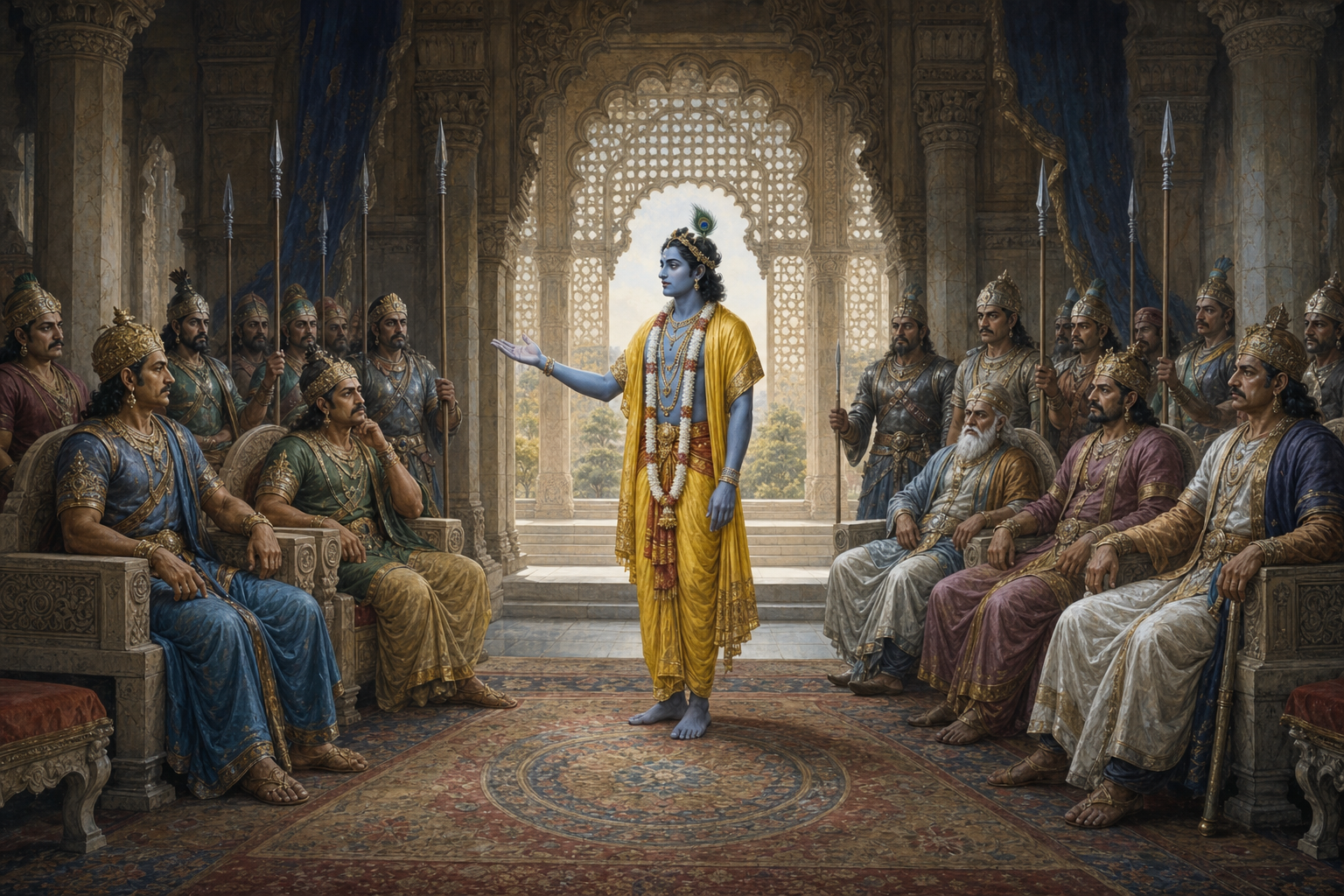
The phrase “warrior Krishna” can mislead before it illuminates. At Kurukshetra, Krishna is not depicted as a conqueror searching for battle. He serves as Arjuna’s charioteer, keeps his vow not to wield a weapon, and teaches while armies wait. His distinctive power is not the capacity to inflict greater violence. It is the capacity to see the moral field clearly when affection, fear, obligation, and consequence have become entangled.
The sequence matters. In the Udyoga Parva, Krishna pursues diplomacy before war. In the Bhishma Parva, the Bhagavad Gita addresses Arjuna only after that effort has failed and the crisis can no longer be escaped by wishing it away. The Shanti and Anushasana Parvas then place questions of rule, responsibility, and restraint inside a wider ethics of governance. Krishna’s battlefield presence therefore joins peacemaking, discernment, and bounded action; it cannot honestly be reduced to a divine endorsement of combat.
This gives you a safeguard against one of the easiest misuses of the Gita: treating every disagreement as Kurukshetra and every opponent as adharma. An insult, a family argument, a political rivalry, and the defence of vulnerable people are not morally interchangeable. Before invoking Dharma-Yuddha, test your situation against its demanding order of thought:
- Duty before wounded pride: Are you protecting something entrusted to you, or merely answering a personal slight?
- Peace before coercion: Have truthful dialogue, persuasion, correction, restitution, and reconciliation genuinely been attempted?
- Proportion before retaliation: Does the response stop the wrong with the least excess, or is punishment becoming an appetite?
- Truth before advantage: Would your chosen method still seem dharmic if your adversary used it?
- Non-attachment before triumph: Can you do what is required without making victory, applause, or humiliation of the other side your spiritual reward?
These tests distinguish courage from aggression. They also distinguish non-attachment from passivity. Krishna does not tell Arjuna that consequences are unreal or that conduct does not matter. He teaches action without possessiveness toward its fruits. You remain responsible for the truthfulness, discipline, and limits of your action even when you cannot control its result.
Other Dharmic traditions sharpen rather than erase this distinction. Sikh thought connects dharam-yudh with the defence of righteousness and the vulnerable, while binding it to seva and inner discipline. Jain ahimsa and aparigraha place an exceptionally high burden on any acceptance of harm. Buddhist reflections on rule through dhamma keep authority answerable to compassion, metta, and restraint. Their doctrines are not identical, but all make self-mastery a condition of legitimate power. Anger alone never becomes sacred because it has adopted religious vocabulary.
Why the flute and butter pot became the devotional default
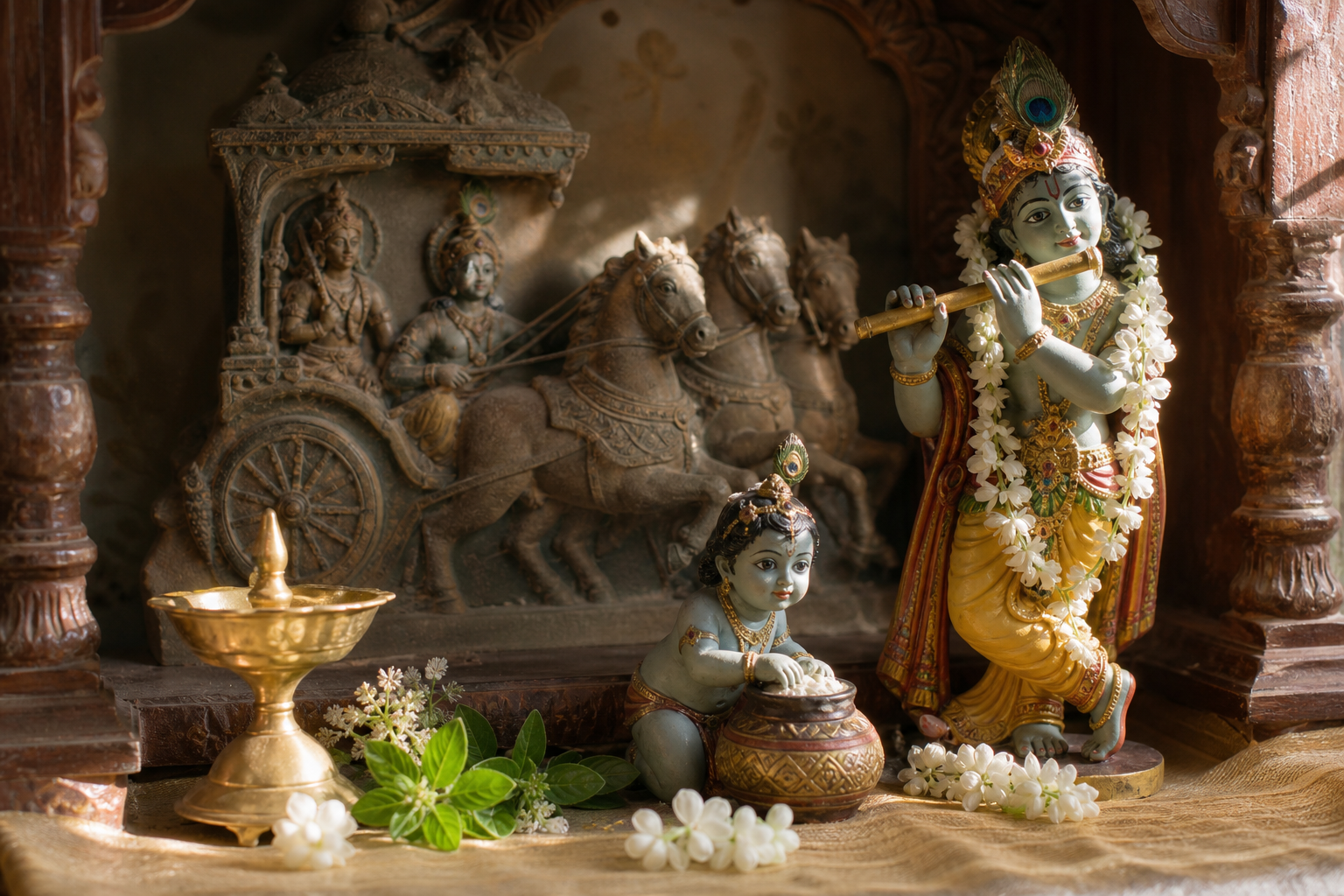
Parthasarathi’s relative absence from popular devotion does not require a conspiracy or a failure of faith. Tender forms of Krishna travel more easily through the ordinary structures of devotional life.
- Domestic seva favours intimacy. Bala-Krishna can be bathed, dressed, fed, awakened, and put to rest. The devotee cares for Bhagavan as a beloved child, turning familiar household acts into worship.
- Sweetness is immediately performable. Venugopala belongs naturally to music, dance, longing, friendship, and festival. In rasa language, vatsalya and madhurya can be felt before they are philosophically analysed. Vira-rasa asks you to contemplate fear, discipline, obligation, and irreversible consequence.
- Pilgrimage and temple networks reproduce familiar forms. Vrindavan, Nathdwara, and Udupi helped make Krishna’s childhood and pastoral lila central to widely circulating songs, images, and practices. Parthasarathi remains explicitly enshrined at places such as the Triplicane Parthasarathy Temple, but that form does not dominate the broader visual field.
- Childhood teaching establishes the first image. Butter theft, playful mischief, and protection of devotees are easy to narrate to children. Kurukshetra requires a later conversation about conflicting duties, political failure, kinship, justice, and death.
- Festivals and media reward visible action. Janmashtami, Holi, and Govardhan Puja readily become joyful family events. Gita Jayanti is more textual and reflective. Television, animation, children’s books, and cinema inherit the same difference between an instantly charming scene and a demanding moral dialogue.
This history explains the imbalance, but it does not establish a hierarchy. Bala-Krishna is not an immature form that advanced devotees must outgrow. Parthasarathi is not a superior replacement reserved for stern temperaments. The principle of Ishta, emphasized by Swami Vivekananda, allows a chosen form to become a genuine doorway to the whole of divine reality. The practical problem begins only when our selection of stories permits Krishna to console us but never to correct us.
You can notice that gap by examining what your present devotion trains you to do. When a decision is costly, do you ask only for the discomfort to disappear, or also for clarity about your obligation? Do you remember Krishna’s peace mission as readily as the war that followed it? Can you explain why the charioteer guides without seizing Arjuna’s agency? Do children in your family meet the Krishna who teaches courage as well as the Krishna who inspires affection?
A “no” does not invalidate your bhakti. It identifies the missing part of its curriculum.
Krishna’s words can restore the missing presence
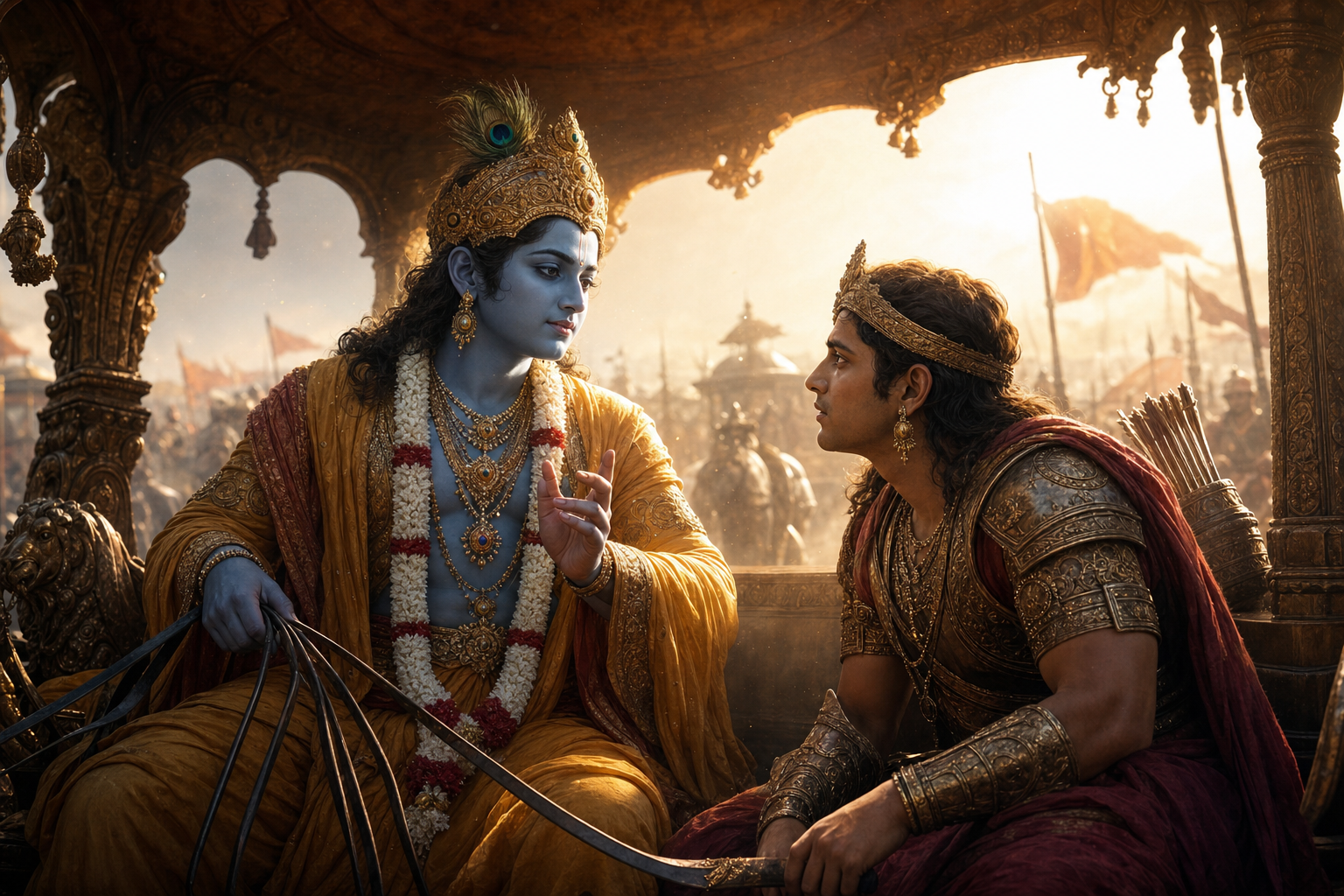
You do not have to wait for a new murti, temple programme, or cultural revival to welcome Parthasarathi into daily worship. Devotional Vedanta holds that Krishna’s name, words, form, qualities, and lila participate in his divine potency. Through nama-nami abheda, the Divine Name is not treated as an ordinary label pointing toward an absent object. Attentive hearing, recitation, and remembrance become forms of association.
The distinction is subtle but important. In the Gaudiya Vaishnava language of acintya-bhedabheda, sacred word and Bhagavan need not be understood as numerically identical objects. Their unity concerns divine potency and effect. That is why reading or hearing Krishna’s teaching can be received as direct devotional companionship, not merely as collecting information about a distant teacher.
This changes the place of the Bhagavad Gita in your practice. It need not sit outside bhakti as a philosophical manual consulted only during a crisis. Reading it aloud can be seva. Remembering a verse can be smarana. Discussing its meaning can be shravana and kirtana. Acting on its instruction can become karma-yoga. Parthasarathi is present not only in an image of the chariot but in the teaching spoken from it.
Several passages give that companionship a practical rhythm. Bhagavad Gita 9.34 joins remembrance, devotion, worship, and reverence. Bhagavad Gita 15.15 locates the Lord in the heart and presents the Vedas as disclosing him. Bhagavad Gita 10.10-11 describes buddhi-yoga, the discerning guidance given to those who remain devoted. Read together, they prevent a split between loving Krishna and asking Krishna for moral intelligence.
Context still matters. A sentence copied from the Gita is not a blank cheque for a decision already made. Sacred speech is traditionally received within sadhu, guru, and shastra, not detached from the discipline that makes understanding possible. When a verse seems to confirm your anger too quickly, slow down and ask:
- What problem is Arjuna actually facing in this passage?
- What attachment, fear, or confusion is Krishna correcting?
- What outward duty and inward disposition are being joined?
- What limits would disappear if the verse were isolated from Krishna’s prior diplomacy and the Gita’s larger teaching?
That reading discipline keeps Parthasarathi from becoming a projection of your preferred politics or temperament. You approach him to have your motives examined, not merely blessed.
Build Parthasarathi into worship and moral choice

At the altar
Keep the devotional practices that already make Krishna near. Add a short discipline that lets the charioteer speak inside that relationship:
- Begin with your familiar form of Krishna. Offer the food, lamp, flower, mantra, song, or quiet attention that belongs to your existing practice. The aim is integration, not displacement.
- Read a coherent Gita passage aloud. Do not collect an isolated slogan. Read enough to hear Arjuna’s difficulty, Krishna’s answer, and the quality of action being required.
- Name an actual duty. Put one unresolved obligation into a plain sentence: “I need to tell the truth about this,” “I need to protect someone affected by this decision,” or “I need to stop postponing what belongs to my role.” Avoid dramatic language.
- Examine the motive. Write under the headings Duty, Attachment, Peaceful Means, Protection, and Limit. If you cannot fill one of them honestly, you are probably not ready to call the proposed action dharmic.
- Carry the teaching into the day. During japa or remembrance, return to the instruction rather than rehearsing an imagined victory. At day’s end, review whether you acted truthfully and proportionately, not merely whether you got what you wanted.
This practice makes devotion less dependent on mood. Bala-Krishna keeps the heart tender; Parthasarathi keeps tenderness from becoming avoidance. The same Krishna teaches you to care deeply without surrendering judgement.
When conflict becomes public or collective
The battlefield setting makes the Gita relevant to civic and collective responsibility, but it also makes careful scaling essential. Do not promote an ordinary grievance into Dharma-Yuddha simply because epic language makes your side feel righteous. Follow Krishna’s sequence instead:
- Establish what is actually at stake. Identify the truth, person, institution, or vulnerable group requiring protection. Separate that stake from your reputation and factional loyalty.
- Identify your svadharma. Ask what belongs to your role, competence, and responsibility. Moral concern does not automatically authorize every method or place you in command.
- Use peaceful means seriously. Dialogue is not a ceremonial box to tick before retaliation. Listen, state the wrong precisely, offer correction where possible, and preserve a path by which the other party can change course.
- Define limits before acting. Decide what you will not do even for a desired outcome: deceive, dehumanize, punish uninvolved people, or turn necessary resistance into revenge.
- Accept uncertainty without abandoning review. Release possessiveness toward the result, but examine the conduct afterward. Non-attachment removes vanity; it does not remove accountability.
A useful internal correction is to stop asking, “Is Krishna on my side?” Ask whether your side, your language, and your method are still answerable to dharma. Parthasarathi does not make the devotee infallible. He makes self-deception harder.
In family teaching
Children do not need the joy removed from Krishna’s story. They need the story allowed to continue. After a Bala-Krishna lila, tell how Krishna later became a peace envoy, how he offered guidance without taking over Arjuna’s choice, and why courage is different from anger. Ask what Krishna tried before battle, whom a leader must protect, and why having strength does not permit its careless use.
This pairing prevents two distortions at once. Krishna does not become merely an adorable figure from childhood, and the Mahabharata does not become a spectacle of divinely approved violence. A young devotee instead encounters one continuous personality: playful without frivolity, loving without weakness, powerful without cruelty, and resolute without hatred.
Key takeaways
- Parthasarathi’s heroic form is the unarmed charioteer, diplomat, teacher, and strategist; it represents disciplined responsibility rather than an appetite for war.
- Bala-Krishna and Venugopala became devotional defaults because intimacy is easier to embody in domestic seva, song, festival, childhood teaching, and visual media.
- The imbalance should be repaired through integration, not rivalry. Tenderness and heroic duty are complementary relationships with the same Krishna.
- Within devotional Vedanta, hearing, reciting, and remembering Krishna’s words are modes of divine association. The Bhagavad Gita can therefore function as daily bhakti, not only as abstract philosophy.
- Apply Parthasarathi’s sequence to conflict: establish duty, attempt peace, protect the vulnerable, impose truthful and proportionate limits, and act without hatred or possessiveness toward the result.
- The strongest safeguard against misusing the Gita is to let Krishna question your motives before you use his words to justify your position.
At your next puja, leave the flute, butter pot, and beloved child exactly where they are. Place the Bhagavad Gita beside them, read a passage aloud, and name one duty you have been avoiding. That small act restores the charioteer without losing the sweetness that first drew you to Krishna.
References
- DharmaRenaissance Blog — Beyond the Flute: Why Bala-Krishna Thrives as Parthasarathi’s Warrior Ethos Lies Dormant
- DharmaRenaissance Blog — Krishna’s Omnipotence Explained: Why Name, Mantra, and Scripture Offer Direct, Daily Companionship