
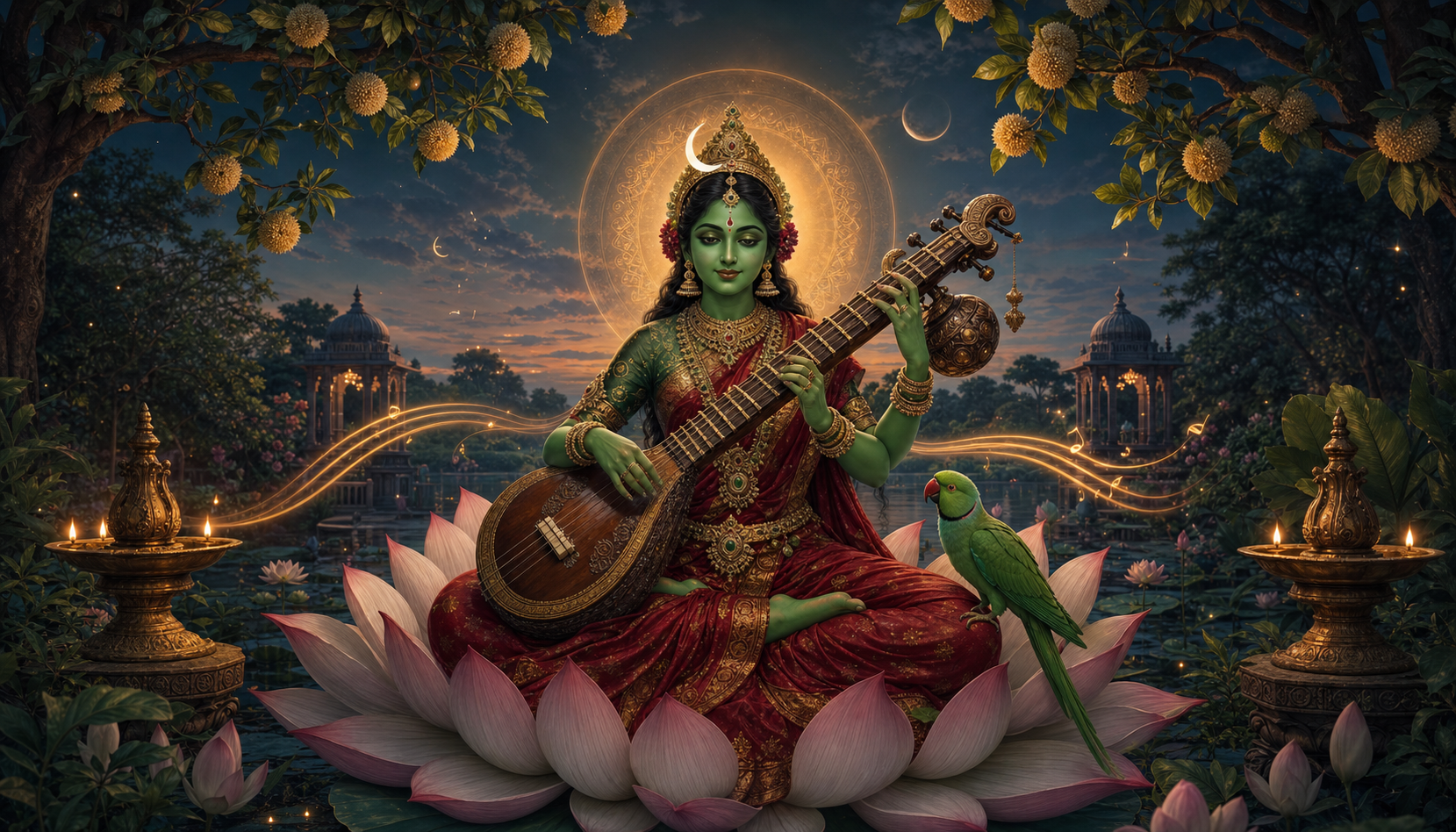
You may have encountered a dark-green goddess holding a vina, accompanied by a parrot, or invoked through a short Shyamala mantra. The immediate question is often whether she is Saraswati, Matangi, an attendant of Lalita Tripura Sundari, or an independent form of the Divine Mother. A rigid either-or answer will usually obscure more than it clarifies.
Laghu Shyamala becomes intelligible when you read her name, theology, image, and mode of worship together. That approach helps you recognise what her emblems mean, respect differences among lineages, and distinguish simple household devotion from practices that require instruction.
Laghu describes the approach, not a lesser goddess
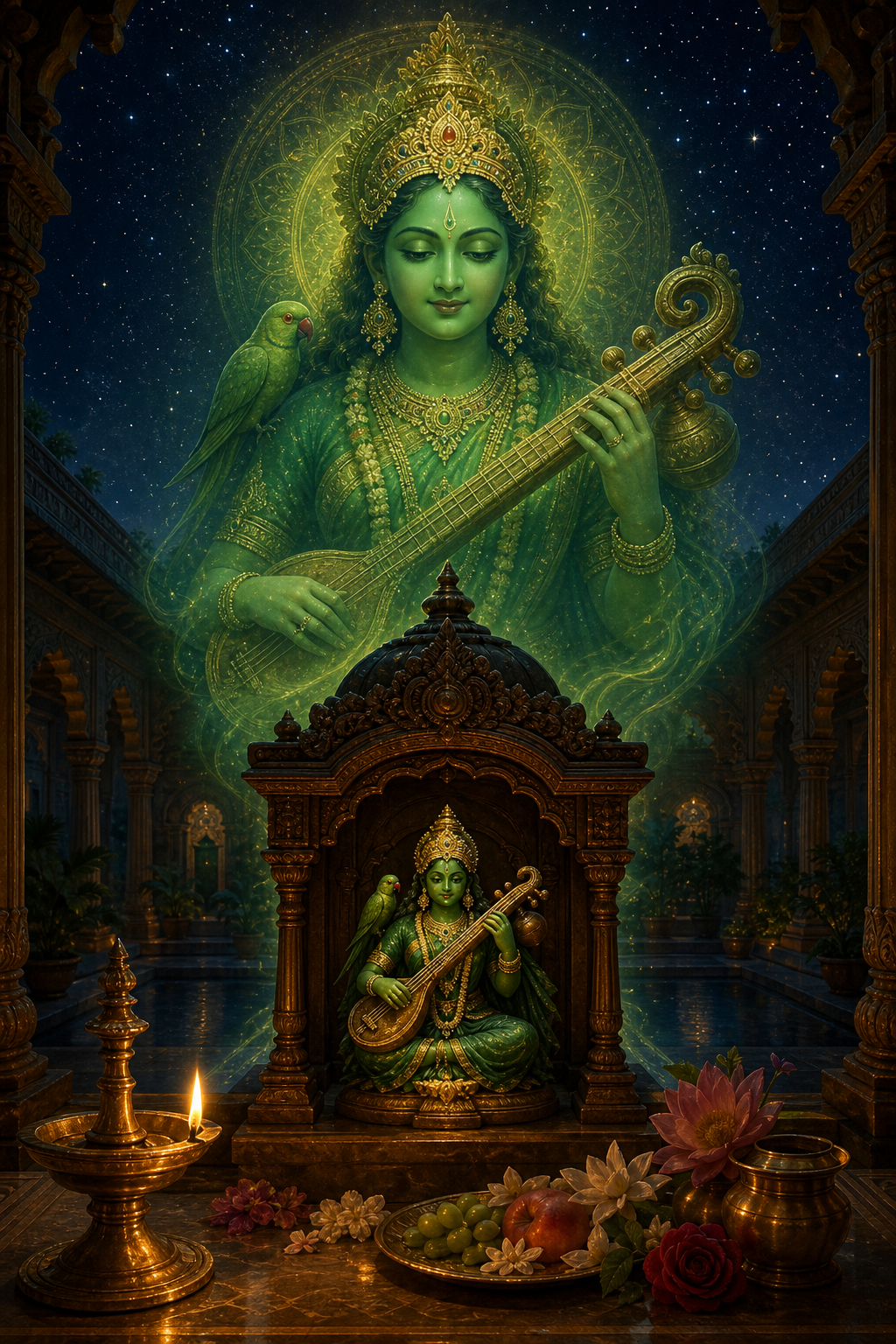
The word laghu can mean light, concise, compact, or readily approached. In ritual and devotional titles, it often identifies a shortened hymn, a concise sequence, or a relatively accessible form of practice. It does not reduce the deity’s spiritual stature. Laghu Shyamala is therefore not a junior or diluted Shyamala; the name points to a compact way of approaching a profound form of Shakti.
This distinction matters in practice. An accessible stotra may be suitable for ordinary devotional recitation, while a nyasa, a compound of seed syllables, or a lineage-specific visualisation may still require guidance. Do not assume that laghu means every procedure bearing the name can be reconstructed casually from fragments.
Shyamala refers to a dark, dusky, deep-green, or blue-black hue. That colour is not a sign of moral darkness. Its natural correspondences are rain-heavy clouds, fertile soil, dense vegetation, the night sky, and the concealed place in which a seed germinates. The name directs your attention toward ripeness, depth, and creative potential held before it becomes visible.
You can therefore read the full name at three levels:
- Theologically: she is concentrated Shakti as knowledge, meaningful sound, creativity, and fertile manifestation.
- Liturgically: laghu indicates a concise or approachable current of invocation, not an inferior divinity.
- Contemplatively: shyamala presents darkness as the fertile depth from which insight, language, music, and life emerge.
This reading corrects two common mistakes at once. You need not make the goddess ominous because she is dark, and you need not make her spiritually minor because her worship is called concise.
Her theology begins where insight becomes responsible speech

Laghu Shyamala belongs to the theology of Vac-Shakti: divine power manifesting as speech, music, understanding, and the capacity to give an inner perception an intelligible form. Speech here means more than vocal fluency. It includes the quiet formation of thought, the discernment that tests it, the form that makes it communicable, and the ethical purpose for which it is expressed.
This is why her field includes students, poets, musicians, teachers, orators, scholars, healers, and community leaders. Each must do more than accumulate information. Each must turn perception into language or action without severing it from truthfulness and care.
A useful theological key is the intersection of iccha-shakti, jnana-shakti, and kriya-shakti – the powers of will, knowledge, and action. Laghu Shyamala joins them through clear intention, intelligent expression, and a sense of right timing.
| Power | What it asks of you | What happens when it is isolated |
|---|---|---|
| Iccha-shakti, the power of will | Examine why you want to speak, create, teach, or persuade. | Desire without discernment becomes vanity, appetite, or manipulation. |
| Jnana-shakti, the power of knowledge | Understand the matter before giving it verbal or artistic form. | Learning without humility becomes sterile display or intellectual pride. |
| Kriya-shakti, the power of action | Speak or act in a form suited to the person, place, and moment. | Activity without knowledge produces noise, injury, or wasted effort. |
This triad gives you a practical test. Before an important conversation, ask three questions: Is my intention clean? Do I understand what I am saying? Is this the right form and time in which to say it? That small discipline expresses Laghu Shyamala’s theology more faithfully than eloquent speech used merely to win.
Her relationships with other goddess forms should be handled with equal precision:
- Saraswati: Shyamala shares the domains of learning, music, cultivated expression, and speech. The overlap is real, but calling her only a dark-coloured Saraswati erases her specifically Tantric, fertile, and transformative dimensions.
- Matangi: several lineages closely identify Shyamala with Matangi, the Mahavidya associated with inner speech, artistic refinement, and wisdom that is not confined to elite enclosures. This association should not be turned into a claim that every lineage uses the two names identically.
- Lalita Tripura Sundari: in some Srividya settings, Shyamala appears in relation to Lalita. Lalita embodies the sovereignty of blissful awareness, while Shyamala directs knowledge, music, and expression. Their functions are complementary rays of Shakti, not competing jurisdictions.
If your family, temple, or guru-parampara gives a particular identity to an image, preserve that context. An internet checklist cannot overrule a living lineage’s name, mantra, or ritual grammar. Where no lineage information is available, describe the form modestly as Shyamala or Shyamala-Matangi rather than claiming an exact esoteric identity.
Read the icon as a grammar of creative intelligence
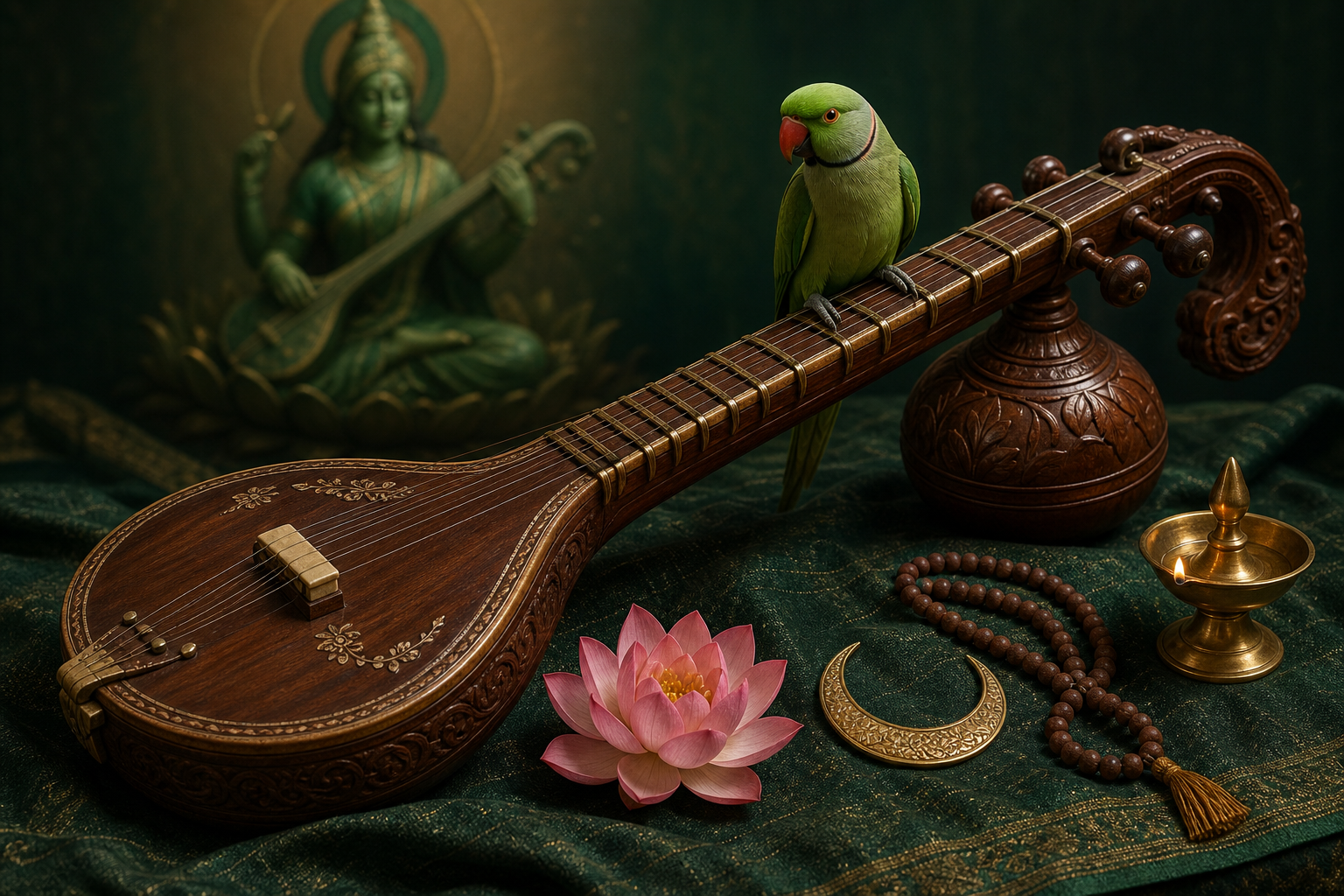
Shyamala’s attributes vary by region and lineage, so no single emblem is an infallible identification test. The image works more like a sentence: complexion, posture, implements, ornaments, and attendants qualify one another. Begin with the complete arrangement rather than isolating one familiar object.
- Dark-green or blue-black complexion: this is the visual centre of the theology. It evokes rain, soil, vegetation, nocturnal depth, and the unmanifest condition from which form arises. Read it as fertile hiddenness, not negation.
- Vina: the instrument signifies more than musical talent. A string yields beauty only through tension, proportion, rhythm, and attentive adjustment. The vina therefore teaches disciplined harmony – an apt model for speech, poetry, education, and social life.
- Book or palm-leaf manuscript: the text represents learning received through memory and transmission. It reminds you that inspiration does not cancel study. Creative speech must remain answerable to knowledge.
- Japa-mala: the rosary places repetition beside creativity. Skill ripens through sustained attention; spontaneous grace is not an excuse to avoid discipline.
- Parrot: the bird suggests living, responsive language, melodic sound, and the fertility of spring. It can repeat words, but as a living presence it also distinguishes animated speech from lifeless recital.
- Crescent moon, garlands, and ornaments: these associate cultivated beauty with changing rhythm and ordered time. Adornment is not decorative excess here; it is form made harmonious.
- Lotus, gem throne, creepers, or floral surroundings: these place sovereignty within a world of growth. The lotus joins emergence and purity, while vegetation makes the goddess’s fertility visibly ecological.
The vina, manuscript, mala, and parrot together present knowledge as both inheritance and improvisation. You receive language from a tradition, refine it through study and repetition, and then make it alive in a new circumstance. Removing any part of that sequence creates a distortion: inheritance without responsiveness becomes rigid, while improvisation without memory becomes shallow.
Fertility must also be read at its proper scale. Shyamala’s imagery certainly permits bodily and agricultural associations, but it is not limited to reproduction. Fertility includes a mind capable of insight, an artistic tradition capable of renewal, a field nourished by rain, a family in which children learn to listen, and a community able to generate truthful public speech. The icon does not make a medical promise; it reveals creation as a many-layered sacred process.
This is also why the dark hue deserves special care. A habit of equating dark with evil makes the image unintelligible. In this Indic symbolic field, darkness can be the womb before birth, silence before a word, stillness before understanding, and soil before harvest. When you encounter the colour, ask what it holds and nourishes before asking what it hides.
A careful household practice for speech, study, and art
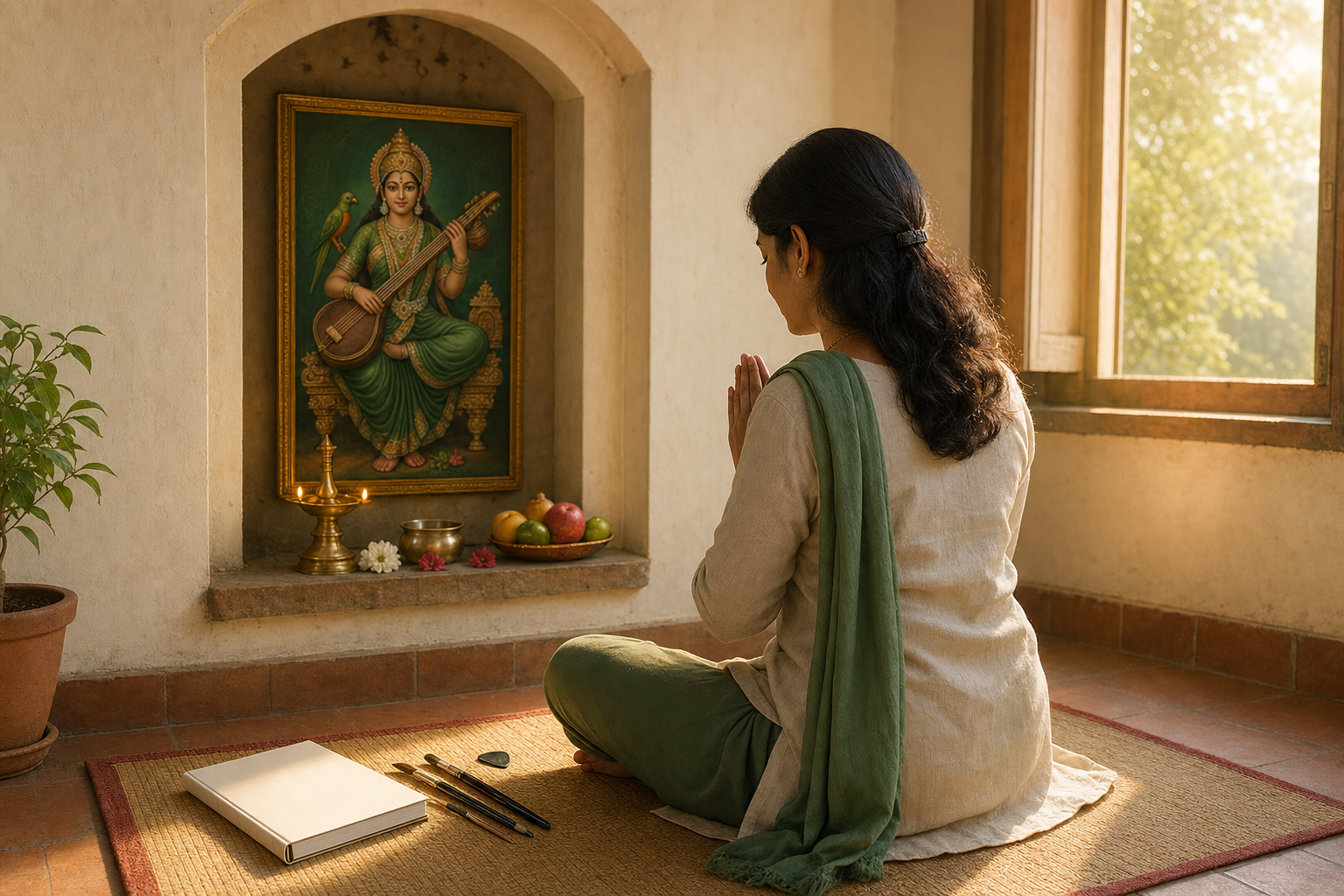
You do not need an elaborate ritual to begin honouring Laghu Shyamala. A clean place, a steady intention, and ethically disciplined speech are more coherent than a complicated procedure assembled without context. Keep ordinary devotion simple, and leave specialised nyasa, initiated mantra sequences, and lineage-specific ritual details to qualified guidance.
- Name the purpose. Choose one concrete field: truthful speech, attentive study, musical practice, compassionate communication, or clarity before teaching. A suitable intention is: May what I learn and express serve truth, non-injury, and the good of those who hear it.
- Prepare a modest altar. Use a clean image or yantra, a safely placed lamp, and whatever simple offering is locally and practically available. White or green flowers, unbroken rice, sesame, fruit, and a ghee lamp belong to established patterns of Shyamala devotion, but they are not a shopping requirement.
- Become quiet before making sound. Let the breath settle without forcing it. If visualisation helps, contemplate a dark-green radiance at the throat when working with speech, or at the heart when the need is to unite expression with empathy. Treat this as devotional contemplation, not as a claim about anatomy.
- Use a simple invocation consistently. One accessible formulation is Om Aim Hrim Shyamala Devyai Namah. Pronounce it steadily and repeat it for a period you can maintain without hurry. The seed syllables aim and hrim are sacred sound-units, not words to recombine experimentally. If your tradition sets requirements for their use, follow those requirements.
- Add one recognised hymn if appropriate. The Shyamala Dandakam is associated with eloquence and classical learning; a shorter Laghu Shyamala hymn may be more sustainable for daily recitation. Choose one text and learn it carefully instead of continually collecting new ones.
- Complete the ritual in conduct. Sit briefly in silence, then connect the worship to one act: listen without interrupting, correct an untruth, study before offering an opinion, encourage a learner, practise an art attentively, or use your voice in service.
Fridays, spring observances, and Navaratri may be favoured occasions in some communities. Vasant Panchami and regional celebrations of Saraswati, Bhagavati, or local goddess forms can also provide a natural setting. These are opportunities, not reasons to postpone practice. A brief daily observance usually forms character more reliably than an elaborate annual event disconnected from ordinary speech.
The ethical boundary is clear. Shyamala’s power is not permission to dominate a room, win every dispute, or dress aggression in polished language. Satya, ahimsa, and seva – truthfulness, non-injury, and service – test whether eloquence is actually aligned with the goddess. If worship is making your speech more contemptuous, manipulative, or performative, correct the conduct before adding ritual complexity.
This standard also applies to digital speech. Before sharing a charged claim, verify it. Before answering in anger, allow silence to do its work. Before using a sacred quotation as a weapon, ask whether you understand its context. Laghu Shyamala’s discipline is not merely the production of words; it is the transformation of the person who produces them.
Key takeaways for recognising and approaching Laghu Shyamala
- Laghu identifies a concise or approachable form of worship; it does not make Shyamala a lesser goddess.
- Her dark-green or blue-black hue signifies fertile depth, rain, soil, ripeness, and creation held before manifestation – not evil or spiritual deficiency.
- Her central theological field is Vac-Shakti, the power that joins insight, speech, music, knowledge, and ethically directed action.
- The vina, manuscript, mala, parrot, lotus, and floral imagery should be interpreted as a connected symbolic system rather than a rigid identification checklist.
- Relationships with Saraswati, Matangi, and Lalita vary by lineage. Functional overlap does not justify erasing the distinct name or context of the form before you.
- Simple household devotion can centre on a clean altar, a lamp, a short invocation, a recognised hymn, and disciplined conduct. Specialised Tantric procedures should remain within competent guidance.
The next time you stand before a Shyamala image, pause before assigning a label. Notice the colour, hands, instrument, text, bird, seat, and surrounding vegetation. Then ask what movement the whole image depicts: depth becoming insight, insight becoming form, and form becoming life-giving action.
Carry one part of that movement into your next conversation or period of study. Form the intention, understand the matter, choose the right words, and leave enough silence to hear their effect. That is a direct way to let Laghu Shyamala’s iconography become lived sadhana.