

You hear Krishna called Bhagavan, Shiva called Ishvara, the Buddha called Bhagavan, and a revered teacher called Guru. Then someone treats avatar, prophet, bodhisattva, and Tirthankara as different words for the same kind of mediator. The vocabulary sounds comparable, but the underlying claims are not.
You do not need to rank these figures or force them into one theological mold. You need to ask what kind of word you are hearing, what relationship it establishes, and how that tradition believes sacred truth becomes accessible. Those distinctions let you honor another path without misrepresenting your own.
First separate a title from a sacred role

The fastest way to become confused is to treat every sacred term as a job description. Bhagavan and Ishvara are principally divine titles. Avatar and prophet identify very different modes of divine action or revelation. Guru, bodhisattva, and Tirthankara belong to still other accounts of guidance and liberation.
Sacred mediation is the larger question behind all these words: how does truth beyond ordinary perception become present, intelligible, and transformative in human life? A tradition may answer through divine embodiment, revealed speech, enlightened teaching, lineage, scripture, ritual presence, or a combination of these. Similar ethical results do not make the mediators metaphysically identical.
| Term | What it primarily identifies | What you should ask next |
|---|---|---|
| Bhagavan | The revered Divine in personal fullness, or a sacred honorific in a wider Indic setting | Who is being addressed, and what does Bhagavan mean in this tradition? |
| Ishvara | The Lord as sovereign, capable, governing, and cosmically authoritative | Is this general devotional language or a technical term within a philosophical school? |
| Avatar | A descent or manifestation of the Divine | Does the tradition regard this figure as divine presence rather than a recipient of revelation? |
| Prophet | A chosen human messenger of divine revelation | What message, covenant, law, or warning is being transmitted? |
| Guru | Sacred teaching and transmission through an authoritative guide or lineage | How does this lineage understand the guru’s status and authority? |
| Bodhisattva or Tirthankara | Distinct Buddhist or Jaina models of compassionate guidance and the recovery of a liberating path | What does this tradition teach about liberation, divinity, and the guide’s attainment? |
One figure can be described by more than one term because the words may answer different questions. Calling Krishna Bhagavan emphasizes divine fullness and relationship; discussing avatara emphasizes divine descent. Calling Shiva Ishvara emphasizes sovereignty; calling Shiva Bhagavan emphasizes plenitude and reverence. There is no contradiction unless you first assume that every title is an exclusive rank.
When you encounter unfamiliar sacred language, mark each word mentally as a title, a role, a relationship, or a technical philosophical category. Do that before translating it into English. A translation such as Lord, Blessed One, incarnation, messenger, or teacher can help, but it cannot carry the entire theology by itself.
Bhagavan and Ishvara emphasize different facets of the Divine

Bhagavan is related to bhaga, a fullness of excellence. A classical enumeration identifies six complete excellences: knowledge, sovereignty, potency, strength, valor or inexhaustibility, and splendor. The title therefore directs attention toward a Divine Person whose fullness can be known, loved, remembered, and approached through bhakti.
Ishvara arises from the Sanskrit root ish, associated with ruling, mastering, and being capable. It directs attention toward divine lordship: the intelligence and sovereignty by which cosmos, karma, and dharma are upheld. The Isha Upanishad speaks of all this as pervaded by the Lord, while Yoga Sutra I.24 describes Ishvara as a special purusha untouched by affliction, action, and karmic residue.
This is a difference of accent, not a rule that confines Vishnu and Shiva to separate theological offices. Vishnu is called Ishvara, and Shiva is called Bhagavan. Krishna’s speech in the Bhagavad Gita is introduced with Sri Bhagavan uvaca, while Shaiva usage naturally favors names such as Isha, Ishana, Maheshvara, and Parameshvara. The familiar preference for Bhagavan in Vaishnava settings and Ishvara in Shaiva settings tells you what each devotional culture often foregrounds; it does not establish a universal hierarchy.
This matters whenever someone argues that one deity must be subordinate because a text uses one title rather than another. The title alone cannot support that conclusion. Check the whole passage, the lineage interpreting it, and the quality being praised. Bhagavan may be highlighting intimacy, grace, and plenitude. Ishvara may be highlighting rule, freedom, and cosmic authority. Both can apply to the same supreme reality within the same broad Sanskritic world.
Philosophical schools sharpen the terms differently
A dictionary meaning is only your starting point because several schools give these titles technical precision:
- Advaita Vedanta: Ishvara is saguna Brahman, Brahman apprehended as the Lord with attributes who sustains cosmic order and dispenses the fruits of karma. Devotion to Bhagavan can mature into the knowledge through which nirguna Brahman is realized.
- Vishishtadvaita: Narayana is Bhagavan, the inner ruler and supreme object of devotion. The cosmos is understood as His body, while surrender, or prapatti, makes the relationship direct and personal. Ishvara remains applicable, but Bhagavan carries the tradition’s strong relational accent.
- Dvaita Vedanta: Vishnu is the supreme Ishvara, eternally distinct from individual souls and matter. Bhagavan expresses His perfection and grace; Ishvara expresses His absolute sovereignty.
- Shaiva traditions: Shiva as Ishvara or Parameshvara is Pati, the Lord who releases the bound soul from its fetters. In Kashmir Shaivism, Ishvara can also name a particular tattva within the sequence of Shiva, Shakti, Sadashiva, Ishvara, and Shuddhavidya.
The Kashmir Shaiva example is a useful warning. If Ishvara appears on a metaphysical chart, translating it merely as God may hide its precise place in that system. If it appears in a stotra of surrender, the devotional sense of supreme Lord may be central. Let genre and school guide the meaning.
Ishta, the chosen form through which a devotee aligns with the Divine, gives this plurality a practical home. A Vaishnava does not need to weaken devotion to Vishnu in order to recognize that Shiva can be called Bhagavan. A Shaiva does not need to abandon Shiva’s supremacy within Shaiva theology in order to understand why Vishnu is called Ishvara elsewhere. Respectful plurality asks you to represent each claim accurately, not to pretend that all schools formulate every claim identically.
Avatar and prophet mediate through presence and message
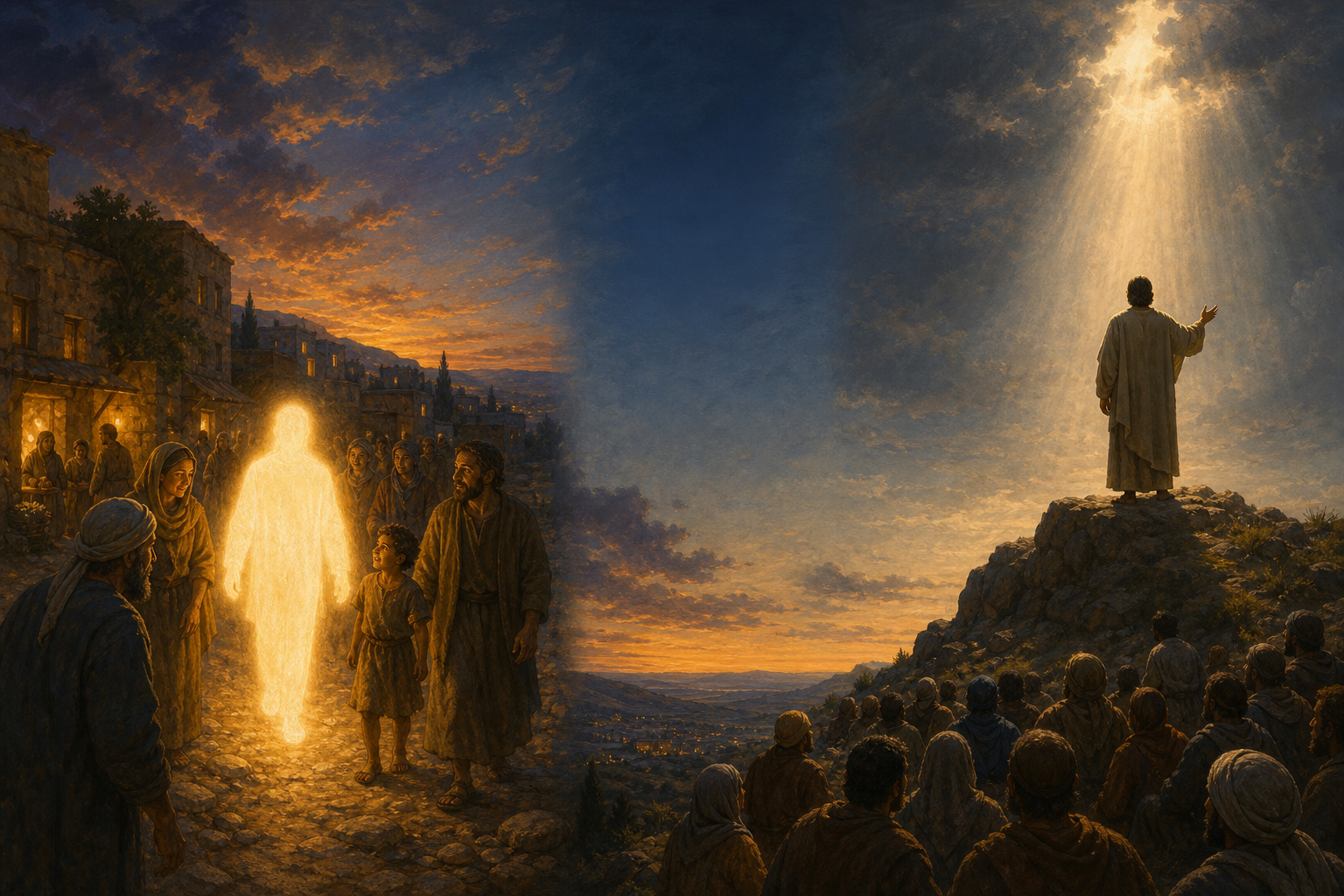
Avatar and prophet should not be treated as interchangeable translations. The central difference is ontological. An avatara is a descent of the Divine into the world. A prophet is a chosen human being who receives and communicates divine revelation. Both may teach, correct wrongdoing, and renew a community, but they do so from different positions in relation to the Divine.
In the Hindu avatara framework, the Divine becomes present to restore dharma, protect devotees, and realign cosmic order. Bhagavad Gita 4.7-8 gives the familiar pattern: when dharma declines and adharma rises, the Divine manifests. The avatara is therefore not merely carrying a message from Ishvara. The avatara is understood as divine presence and as the source of both instruction and grace.
That claim explains why darshana, lila, prasada, murti-seva, and loving remembrance matter so much in avatara-centered devotion. The devotee is not relating only to a teacher’s preserved statements. The Divine has become personally accessible. Bhakti can consequently function as a direct path to moksha alongside knowledge, righteous action, and contemplation.
Prophecy follows a different grammar in Judaism and Islam. The prophet is an exalted servant and messenger, but the distinction between Creator and creature remains. Prophetic authority comes from faithfully conveying divine will, calling a community back to covenant, law, justice, and right conduct. The message is divine; the messenger is not therefore an incarnation of its divine source.
Christianity prevents an overly simple Hindu-versus-Abrahamic contrast. It preserves the prophetic tradition while also affirming Jesus Christ as the Word made flesh, fully divine and fully human. That is a distinctive, once-for-all doctrine of Incarnation, not merely another instance of prophecy and not the same as the recurring Hindu pattern of avataras across cosmic ages.
When comparing an avatara with a prophet, use four tests:
- Identity: Is the figure the Divine made present, or a human chosen by the Divine?
- Authority: Does revelation originate in the figure’s divine being, or is a received revelation being transmitted?
- Mission: Is the central work restoration of dharma through divine descent, or proclamation of divine command, covenant, and guidance?
- Time: Does the tradition expect repeated manifestations across cosmic cycles, a historical succession of messengers, or one unique Incarnation?
These tests are more reliable than matching surface actions. Two sacred figures may both preach compassion or confront injustice without occupying the same metaphysical category. Begin with what each tradition says the figure is; only then compare what the figure does.
The surrounding structure of authority matters as well. Hindu traditions weave together shruti, smriti, agama, temple practice, and guru-parampara. The avatara confirms and enlivens dharma within that ecology rather than making every other channel unnecessary. Jewish, Christian, and Islamic traditions organize revelation around their respective scriptures and interpretive communities, although they differ significantly about canon, incarnation, prophetic succession, and finality. Comparing only the central figure while ignoring scripture, lineage, ritual, and community gives you an incomplete picture of sacred mediation.
The wider Dharmic family uses shared words without shared ontology
Bhagavan travels across Indic religious boundaries. Buddhist Sanskrit and Pali usage addresses the Buddha as Bhagavan or Bhagava, and Jaina devotion honors Bhagavan Mahavira. This shared honorific expresses reverence, spiritual eminence, and sacred fullness in context. It does not prove that Buddhists or Jainas have adopted a Hindu doctrine of a creator Ishvara.
That is why translating Bhagavan automatically as the creator God can mislead. In a Vaishnava text, Bhagavan may name the supreme personal Godhead. In a Buddhist discourse, the same Indic honorific does not turn the Buddha into a creator deity. In Jaina usage, it does not make Mahavira a divine messenger sent by a cosmic ruler. Preserve the title if a one-word English equivalent would import a doctrine that the setting rejects.
Bodhisattva: compassionate presence without creatorhood
In Mahayana Buddhism, a bodhisattva voluntarily remains engaged with the suffering world and employs upaya, skillful means, for the liberation of beings. This can resemble the avatara principle at the level of compassionate availability. The resemblance is functional, however. A bodhisattva is not thereby the descent of a creator Ishvara.
If you are comparing a bodhisattva with an avatara, say exactly where the parallel lies: both can express saving compassion and a willingness to meet beings in forms they can approach. Then state where it stops: their traditions give different accounts of ultimate reality, divinity, selfhood, and the being who appears.
Tirthankara: a ford-maker who reopens the path
Jainism speaks of twenty-four Tirthankaras in each cosmic cycle. A Tirthankara is a perfected ford-maker who rediscovers, embodies, and teaches the path to liberation while establishing a community able to cross from bondage toward freedom. The recurring pattern can look structurally similar to repeated divine descents, but a Tirthankara is neither a creator nor the recipient of a creator’s command.
The right comparison therefore concerns recurring world-guidance, not incarnation. If you call a Tirthankara a prophet, you introduce a sender-and-messenger relationship that Jain metaphysics does not require. If you call a Tirthankara an avatar, you introduce divine descent. Ford-maker retains the distinctive Jaina logic.
Sikh Guru: one light, transmitted guidance, living authority
Sikh tradition understands the ten Gurus through one Jot, one light, expressed through ten forms. Guruship culminates in the Guru Granth Sahib as living Guru and also finds communal embodiment in the Guru Panth. This is neither the standard prophet model nor a simple restatement of Hindu avatara theology. Revelation, sacred presence, disciplined practice, and community are joined in a distinctly Sikh account of guidance toward Akal Purakh.
Sikh bani also uses names such as Hari, Govind, and Ram, drawing from the shared vocabulary of the Indic sacred world. Shared names make conversation possible, but context decides their doctrinal force. You should not assume that every appearance of Ram imports a complete Vaishnava theology, just as you should not assume that different vocabulary means there is no civilizational relationship.
The bare word guru requires the same care. It tells you that teaching, transmission, and spiritual authority are central. It does not, by itself, settle whether a particular tradition regards the guru as a human teacher, a realized master, the bearer of a sacred lineage, a manifestation of divine grace, or something more specific. Ask the lineage before imposing a category from outside it.
Use a six-question method when a sacred title is disputed

You can resolve most disputes about divine titles without beginning a contest over which religion or deity is superior. Work through the language in this order:
- Name the tradition and school. Hindu, Buddhist, Jaina, Sikh, Jewish, Christian, and Islamic vocabularies cannot be decoded by sound alone. Within Hinduism, Advaita, Vishishtadvaita, Dvaita, Shaiva, Shakta, Smarta, and Vaishnava settings may sharpen a term differently.
- Identify the kind of word. Decide whether you are looking at an honorific, an ontological identity, a sacred office, a devotional relationship, or a technical category in a metaphysical system.
- Ask who or what the figure is. Is this the Divine, a divine manifestation, an enlightened being, a perfected teacher, a bearer of sacred light, or a human messenger?
- Ask what mediates truth. Is access given through presence, speech, scripture, lineage, ritual, community, disciplined practice, or several of these together?
- Check what the claim does not mean. Bhagavan Buddha does not establish a Buddhist creator-God. Vishnu as Ishvara does not make Ishvara exclusive to Vishnu. A bodhisattva’s compassion does not turn the bodhisattva into an avatara. A prophet’s authority does not make the prophet divine.
- Translate only after interpretation. If Lord, Blessed One, incarnation, prophet, or teacher would erase a decisive distinction, retain the original word and explain it briefly.
Consider three common claims. If someone says that Shiva must be lower because Vishnu is Bhagavan, the overlap of the titles defeats the premise. If someone says that Bhagavan Mahavira means Jainism worships a creator-God, pan-Indic honorific usage exposes the mistranslation. If someone says avatar is simply the Sanskrit word for prophet, the difference between divine descent and commissioned human messenger identifies the category error.
Key takeaways
- Bhagavan commonly emphasizes personal divine fullness, excellence, accessibility, and the relationship invited by bhakti.
- Ishvara commonly emphasizes sovereignty, mastery, cosmic governance, and lordship.
- Bhagavan and Ishvara overlap; neither word establishes an exclusive rank for Vishnu or Shiva.
- An avatara is divine descent, while a prophet is ordinarily a human recipient and messenger of revelation. Christianity’s doctrine of Incarnation requires separate treatment.
- Buddhas, bodhisattvas, Tirthankaras, Sikh Gurus, and Hindu avataras must be understood through their own traditions before functional parallels are drawn.
- Shared sacred vocabulary can reveal Indic kinship without making Hindu, Buddhist, Jaina, and Sikh doctrines identical.
The next time a sacred title causes disagreement, write three notes beside it: the tradition speaking, the kind of word being used, and the mode of mediation being claimed. If those three points are clear, you can defend a Dharmic understanding firmly without turning semantic confusion into needless sectarian rivalry.
References
- DharmaRenaissance Blog – Bhagavan and Ishvara, One Truth: Why Vishnu and Shiva Bear These Timeless Honorifics
- DharmaRenaissance Blog – Avatar vs Prophet: Decoding Sacred Roles, Divine Presence, and Dharma Across Faiths