

You have volunteers, a legitimate grievance and a strong sense of dharmic duty. Then comes the question that decides whether the mobilisation will matter: what, precisely, should a public authority do differently on Monday morning?
A slogan can gather people, but it cannot appoint a nodal officer, repair a reporting system or protect a citizen’s rights. To produce those results, Hindu civic mobilisation must convert moral conviction into a lawful demand, give that demand to the correct institution and make the response measurable. That is not a retreat from Hindu interests. It is how those interests acquire durable civic power.
The constitutional test: move from identity to public duty
A Hindu organisation does not have to hide its identity to participate in public life. Reverence for Gaumata, concern for women’s safety, protection of temples, preservation of heritage and resistance to coercion can all arise from an explicitly dharmic consciousness. The constitutional discipline begins when that consciousness becomes a demand upon the state.
At that point, the demand must identify a public duty that can be administered without arbitrary treatment. A useful formula is: dharmic principle, defined public problem, competent authority, lawful remedy, protective safeguards and published result. If one of those elements is missing, energy that could have improved an institution is likely to dissipate into symbolism or confrontation.
Consider cow protection. Article 48 places preservation of cows, calves and other milch and draught cattle within the Directive Principles. The Prevention of Cruelty to Animals Act, 1960 supplies an animal-welfare framework, while Maharashtra and Goa have distinct state-level animal-preservation laws. These provisions support serious public action, but they do not give a private group a licence to stop, punish or publicly condemn people on suspicion. Investigation and enforcement remain functions of lawful authorities.
The distinction between symbolism and legal effect also matters. Calling Gaumata Rashtramata can express civilizational gratitude and invite public stewardship. Unless a competent authority creates a defined legal status, however, the phrase remains a moral and cultural declaration. A disciplined memorandum will explain the symbolism briefly and then ask for actions already within administrative competence: veterinary response, shelter coordination, lawful transport oversight, vaccination, traceability, fodder planning and transparent case handling.
The same test applies to mobilisation for women’s safety. Protection from fraud, stalking, coercion, trafficking, workplace harassment and digital abuse is a legitimate civic objective. Adults also retain constitutional liberty under Article 21 in choosing their relationships. A campaign protects women when it increases their agency and access to lawful remedies. It weakens its own case when it treats an interfaith relationship, without evidence of an offence, as proof of deception.
Before endorsing a demand, ask three questions:
- What exact power or duty authorises the public body to act?
- Could the requested action burden an innocent person, a compliant farmer, a consenting adult, a survivor or an accused person before facts are established?
- What observable result will show that the institution acted fairly and effectively?
If the law or jurisdiction is uncertain, obtain advice from a lawyer familiar with the current state framework before filing or publicising allegations. A legal provision copied from another state, or from an outdated criminal-law reference, can send volunteers to the wrong authority and expose citizens to avoidable harm.
Build a memorandum an officer can actually implement

The most useful civic document is not the one with the strongest adjectives. It is the one that reduces the distance between a grievance and an administrative decision. An officer should be able to identify the jurisdiction, the responsible department, the requested order and the method of review without interpreting your ideology for you.
Build the memorandum in this order:
- Name one administratively defined problem. Replace a broad complaint such as poor cow protection with a bounded problem such as the absence of a coordinated response for injured or abandoned cattle within the tehsil.
- Send it to the authority that controls the process. A Tehsildar can be relevant where revenue administration must coordinate with police, animal husbandry officials and local bodies. A workplace harassment complaint belongs within the statutory workplace process, not in a general community delegation. A campus safety failure should reach the institution that controls the campus and its reporting system.
- State the governing duty carefully. Distinguish a constitutional principle, a statute, a state rule, a municipal responsibility and a voluntary community commitment. Do not present them as interchangeable.
- Attach verifiable local material. Use dated incident records, locations, existing correspondence, institutional gaps and responsibly obtained photographs or records. Remove personal data that does not need to be disclosed. Do not turn an unverified social-media message into an allegation.
- Request named administrative actions. Ask for an order designating responsibility, a standard operating procedure, a coordination meeting, a referral arrangement or a reporting schedule. Request action rather than ideological agreement.
- Include rights and fairness safeguards. State that implementation must follow due process, protect survivor confidentiality, avoid religious profiling, respect the presumption of innocence and reject vigilantism.
- Define the review. Identify the indicators to be reported, the office responsible for maintaining them and the forum for a quarterly public review.
For a tehsil-level bovine-welfare effort, the operative requests could include a nodal officer, periodic coordination among veterinary, police and municipal personnel, a documented rescue-and-referral procedure, arrangements with suitable gaushalas, mapping of accident and abandonment hotspots, and reporting to the District Collector. That package creates an administrative chain. A bare demand for stricter enforcement does not.
If you request a round-the-clock helpline, specify who receives the call, who dispatches assistance, where an animal can be taken, how an incident is logged and what happens when shelter capacity is full. Otherwise, the helpline may become a telephone number attached to no service. The same principle applies to an anonymous safety portal: it needs a confidential case owner, an escalation route, a response standard and safeguards against retaliatory or malicious disclosure.
Ask for written acknowledgement when the memorandum is submitted. Preserve the final text, annexures and correspondence as one case file. At follow-up meetings, record which request was accepted, rejected, transferred or left pending. This turns a public gathering into an auditable civic process and lets you escalate administrative inaction without escalating social tension.
Protect people and animals from the campaign’s side effects

A constitutional campaign must examine the burdens created by its own preferred policy. This is especially important when a demand affects livelihoods, personal liberty, reputation or physical safety.
Strict cattle controls without rehabilitation capacity can leave farmers responsible for animals they cannot maintain and can contribute to abandonment or unmanaged stray populations. Enforcement should therefore be paired with veterinary access, fodder and water planning, shelter capacity, humane transport procedures and support during drought or market shocks. Castration, where appropriate and lawfully provided, can be part of population management. Officials and volunteers also need clear boundaries so compliant farmers and transporters are not harassed.
Economic design is not separate from gau seva. Dung-based biogas, compost, bio-slurry and responsibly regulated panchgavya enterprises can make care more viable, particularly when connected to self-help groups, agricultural extension, finance or insurance. These activities should be treated as livelihood systems with training, quality control and real demand, not as slogans attached to an overcrowded shelter.
Urban cattle management needs another layer. Plastic in waste, unsafe traffic corridors, heat stress and monsoon disruption are municipal problems as much as cultural ones. Owner registration, accredited shelters, designated response arrangements, better waste control and coordination with traffic police can prevent injury without substituting street confrontation for governance.
Women’s-safety mobilisation carries equally serious risks when protection becomes surveillance. Adults and minors cannot be collapsed into one legal or ethical category. Families can discuss identity deception, financial pressure, digital footprints, consent and warning signs of coercion, but an adult woman’s lawful decision is not transferred to a family or campaign committee merely because relatives disagree with it.
Concentrate volunteer education on conduct that can be identified without profiling a community: impersonation, threats, isolation from support, financial exploitation, stalking, non-consensual image sharing, workplace retaliation and violence. Teach practical safeguards such as unique passwords, two-factor authentication, careful location sharing, documentation of threatening messages and prompt use of official reporting channels.
At workplaces, the POSH Act, 2013 requires functioning Internal Committees and credible redressal processes. Mobilisation should help women find and use that institutional route, while pressing employers to train staff and disclose anonymised performance information. It should not publish a complainant’s identity or conduct a parallel public trial.
Bystanders also need a proportionate method. The Direct-Distract-Delegate-Document framework gives volunteers four options: intervene directly when safe, interrupt the situation indirectly, call a responsible authority, or preserve relevant information without circulating it publicly. Documentation serves the affected person and the lawful process; it is not material for a viral message.
Put these limits in a written volunteer code before the first public event:
- No physical interception, detention, threats or punishment.
- No naming an alleged offender or survivor on an unverified claim.
- No inference of guilt from religion, caste, dress, language or relationship type.
- No circulation of intimate images, private addresses or unnecessary personal records.
- No obstruction of police, medical, workplace or judicial procedures.
- No claim that volunteers possess powers reserved to public authorities.
These rules are not cosmetic. One reckless volunteer can endanger a survivor, compromise an investigation, injure an innocent person and destroy the trust required for future cooperation.
Make service delivery, fairness and follow-through visible
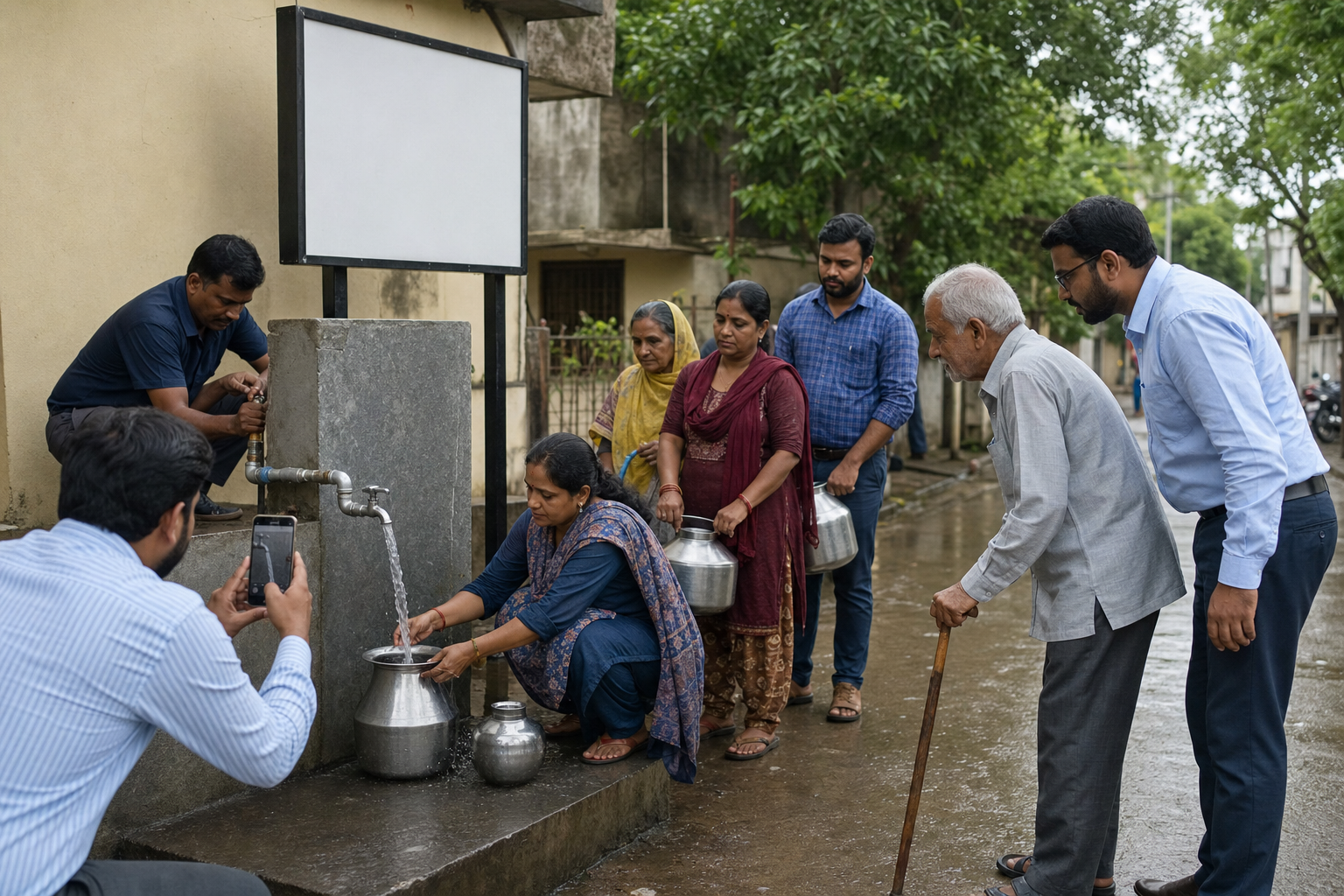
Attendance, speeches and social-media reach tell you whether mobilisation occurred. They do not tell you whether governance improved. Measure the administrative service created by the mobilisation, the experience of people who use it and the safeguards that restrain misuse.
For bovine welfare
A district or tehsil dashboard can track vaccination coverage, Foot-and-Mouth Disease prevention, brucellosis testing, emergency response time, animals rehabilitated, gaushala occupancy, adoption or placement, and the status of reported cases. Ear-tagging and registration can improve traceability when they are implemented through established systems and accompanied by accessible veterinary support.
Read the measures together. A rise in rescues alongside permanently full shelters may reveal that intake has improved while rehabilitation has stalled. Strict transport enforcement alongside rising abandonment may show that the economic burden has merely moved. High vaccination totals without clarity about the eligible local population cannot establish adequate coverage. A dashboard should reveal these tensions rather than reward the most flattering number.
For women’s and youth safety
Useful measures include training coverage by institution and age group, knowledge before and after training, POSH compliance, response times for cyber incidents, time taken to dispose of cases through the relevant process, and periodic perception surveys. An initial increase in reporting does not necessarily prove that underlying harm increased; it may mean people finally trust the channel enough to use it. Interpret volume beside response quality, confidentiality and case outcomes.
Do not use arrest counts, public accusations or the number of relationships investigated as campaign success measures. Those indicators reward suspicion and coercion rather than safety. Better measures ask whether a person could report without retaliation, whether the institution responded, whether due process was followed and whether preventive knowledge improved.
A quarterly review should include the responsible officials, relevant service providers and credible community representatives. Publish aggregate information, not identities or case details. Record unresolved capacity constraints openly: shortage of veterinarians, lack of shelter places, an inactive Internal Committee, weak cyber-response capacity or an unclear referral route. Naming the institutional bottleneck makes the next civic demand sharper.
Use the review to make one of four decisions for every request: continue it, redesign it, fund the missing capacity or close it because it is ineffective or unfair. Constitutional governance includes the willingness to correct one’s own campaign, not only the determination to correct the state.
Keep dharmic purpose while widening civic cooperation

Public reason does not require a Hindu organisation to discard Hindu vocabulary. It requires that the proposed remedy protect a common good and remain intelligible to citizens who do not share every premise.
Ahimsa directs attention to preventable harm. Daya and karuna demand compassionate treatment. Satya rules out rumour and strategic exaggeration. Seva converts concern into patient institutional work. Aparigraha warns against treating another person as property. These values have resonances across Hindu, Jain, Buddhist and Sikh traditions, even where their philosophical accounts differ. They can support cooperation without pretending that all dharmic traditions are identical.
The practical translation is straightforward. A gau seva coalition can include farmers, veterinarians, gaushala managers, municipal officials, self-help groups and traffic personnel because each controls part of the welfare system. A women’s-safety coalition can include students, parents, counsellors, employers, campus administrators, cyber personnel and lawful support services because no single group controls prevention, reporting and recovery.
Coalition partners do not need to endorse every cultural formulation. They do need to agree on the operational commitment: no cruelty, no coercion, no profiling, no vigilantism, accurate reporting and transparent review. This limited agreement is often stronger than a rhetorical claim of total unity because each participant knows what must be done and what conduct is out of bounds.
Before launching, conduct a final challenge session. Give a small group permission to ask who could be harmed, which authority might reject the request, what resource is missing, how the data could mislead and what a hostile or reckless volunteer could do with the campaign’s language. Revise the memorandum and code of conduct in response. A movement confident in its dharma should be able to test its own methods.
Key takeaways
- Begin with an explicitly dharmic concern if that is the movement’s conviction, but convert it into a defined public problem and a remedy within lawful authority.
- Ask an institution for an order, process, service, referral arrangement or report. Do not ask volunteers to perform enforcement functions.
- Pair restrictions with capacity. Cow-protection enforcement needs veterinary care, rehabilitation and farmer support; safety reporting needs confidential, competent redressal.
- Protect liberty and dignity at the design stage through due process, survivor confidentiality, the presumption of innocence and a ban on religious profiling.
- Measure response times, service coverage, case handling and capacity constraints rather than crowds, accusations or arrests.
- Review results quarterly and change a demand when evidence shows that it is ineffective, underfunded or unfair.
Your next step need not be a national convention. Choose one local problem, identify the office that owns it and draft one memorandum whose operative requests fit on a single page. Add the safeguards and measures before collecting signatures. When the first quarterly review arrives, you will have something more valuable than a moment of visibility: a public record of whether dharmic conviction improved constitutional government.
References
- Hindu Janajagruti Samiti – From Tehsils to Nation: Gau Samman Avahan Abhiyan’s Roadmap to Honor Gaumata as Rashtramata
- Hindu Janajagruti Samiti – Beti Surakshit, Rashtra Surakshit: Mobilising Pune for Women’s Safety and National Unity